

Joel Simon
Artist
Scenes observed slowly and held with care, where light, posture, and silence allow the ordinary street to become a quiet stage for feeling
Joel Simon’s paintings sit quietly with you. They don’t announce themselves loudly or ask to be decoded immediately. Instead, they invite a slower kind of looking – one shaped by light, atmosphere, and a deep belief in the emotional power of everyday moments. Based in Belfast, Simon works in oil, creating cinematic urban scenes that feel suspended between memory and imagination.
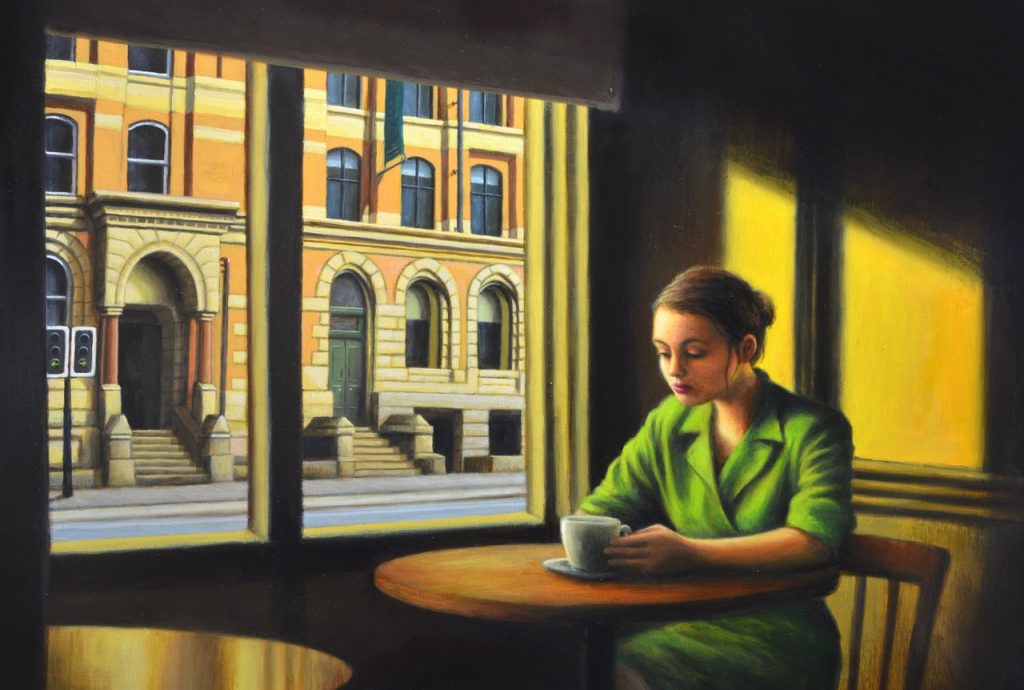
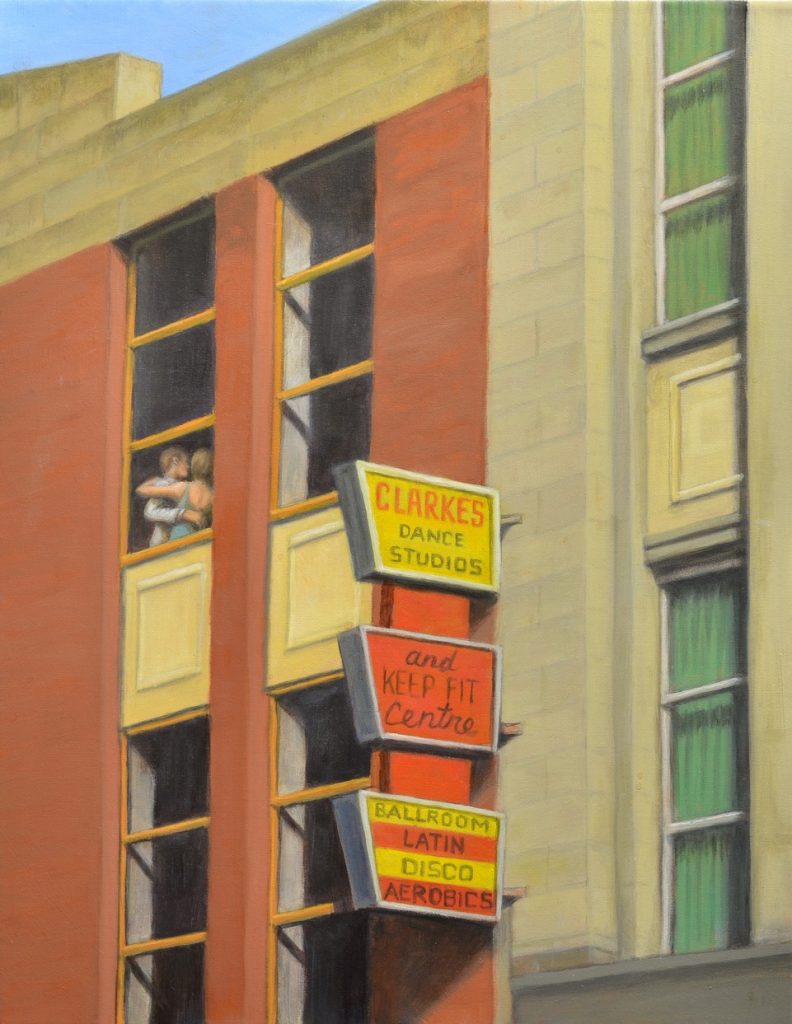
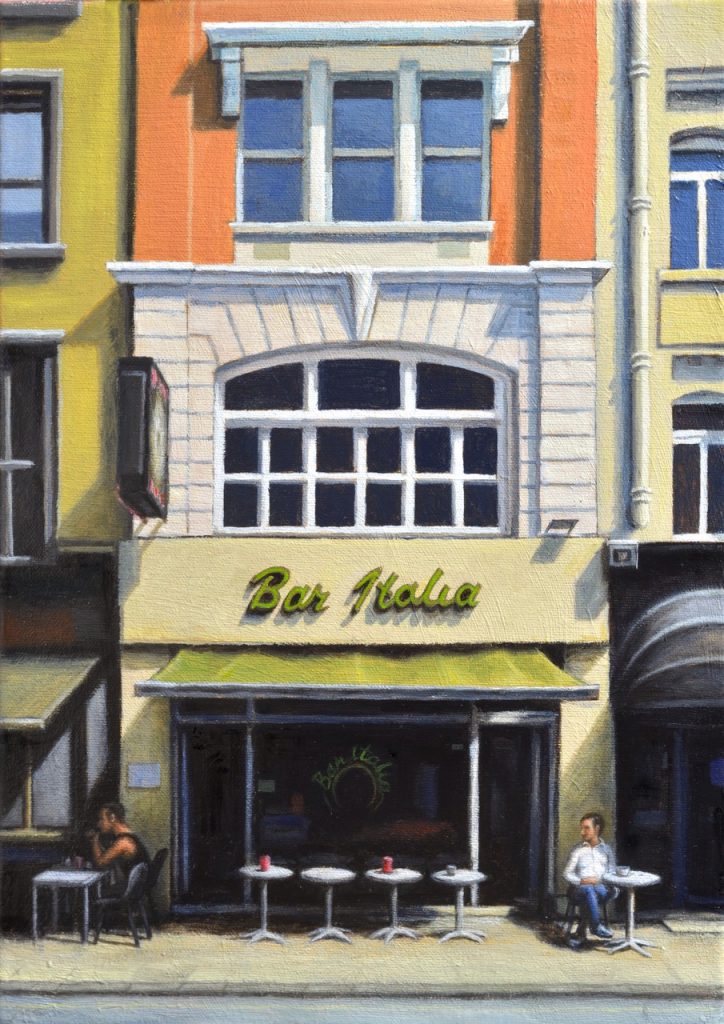
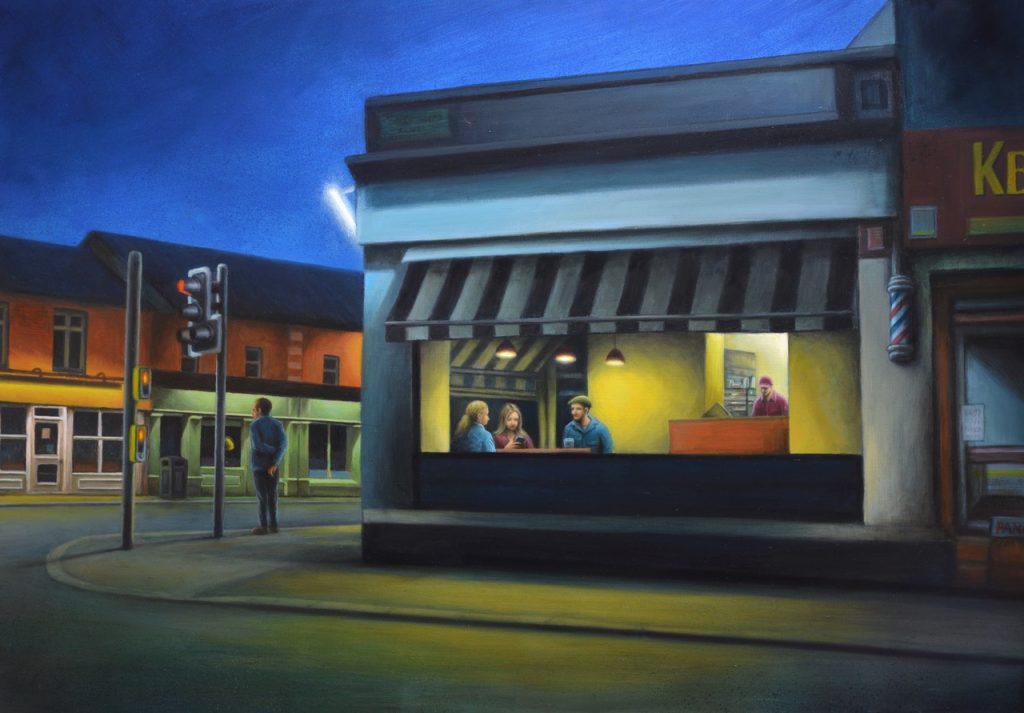
Often rooted in real places and fleeting encounters, his paintings feel less like documents of specific moments and more like distillations of mood. A figure waiting for a train, a man in a window on Lombard Street, warm sunlight streaming into a cafe – these are scenes that hover between the ordinary and the heightened, imbued with a sense that something has just happened, or is about to.
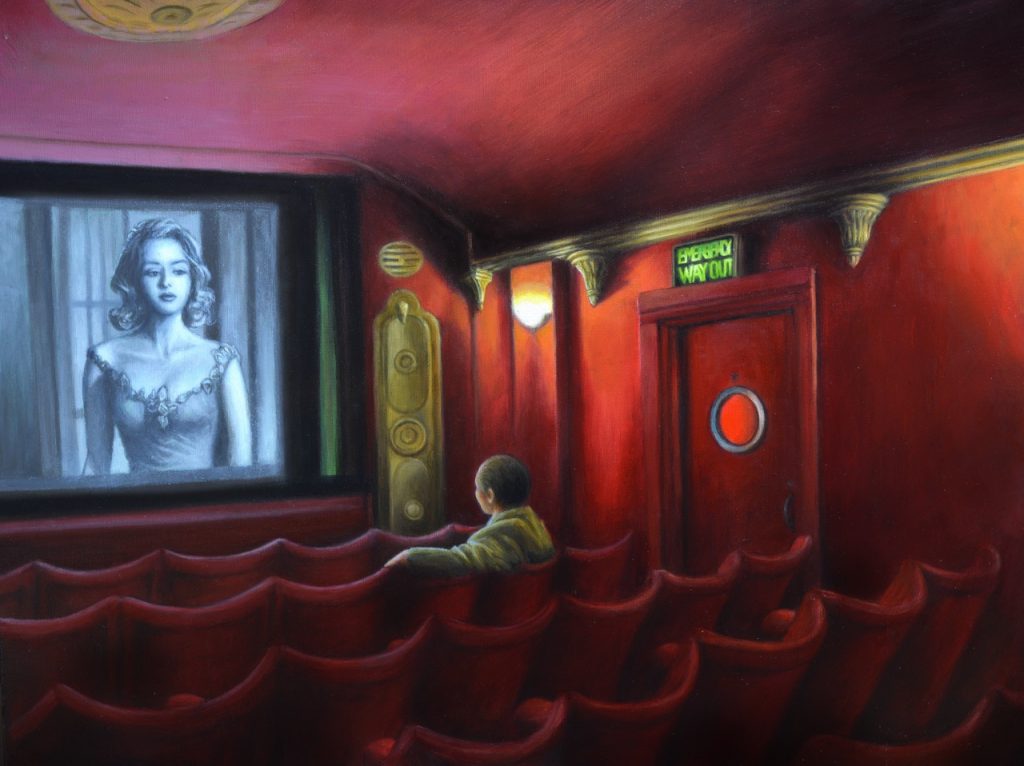
His work draws from a European tradition of figurative painting, but it is filtered through the sensibility of someone who spent years thinking in frames, sequences, and light. The result is a body of work that feels intimate without being insular, nostalgic without being sentimental, and romantic without denying the world’s current complexities.
Working Slowly, Thinking in Stories
Simon rarely approaches a single painting in isolation. Instead, his studio practice unfolds across several canvases at once, ideas overlapping and feeding into one another. At any given time, there may be four or five works in progress – a streetscape in one corner, a solitary figure in another, a fleeting gesture captured mid‑routine elsewhere.
“I generally have a few canvases on the go at the same time,” he says. “I’ve got so many ideas – plenty of projects, and plenty more that I haven’t even got the composition for yet.”
This multiplicity is less about productivity than it is about allowing ideas to breathe. Moving between works keeps any single painting from becoming overly fixed too early, allowing intuition to guide decisions around tone, balance, and narrative. Scenes are allowed to shift until they settle into something that feels emotionally true.
For Simon, painting is not about racing toward completion. It is about staying open long enough for a story to emerge – sometimes subtly, sometimes unexpectedly.
From Street to Canvas
Cities are Simon’s primary source material. Belfast, London, Paris – places walked slowly, observed carefully, and photographed not for accuracy, but for possibility. His process often begins while moving through a city: noticing how light falls across a street, how people occupy space, how architecture frames human presence.
“I work around my holidays,” he explains. “I’ll walk through a place, see a location that really inspires me, and take lots of reference images.”
Back in the studio, those references are treated as raw material rather than instructions. Using digital tools, Simon reshapes scenes entirely.
“I completely change the composition,” he says. “I’ll remove people, add people, simplify it, make it more spare, add in new elements. There’s a lot of compositional work that happens before I ever start painting.”
Only once the image feels resolved – emotionally and visually – does it make the transition to canvas. Oil paint allows him to work slowly, building surfaces gradually and letting light emerge layer by layer.
Linen, Oil, and a Romantic Logic
In recent years, Simon has committed exclusively to working on linen rather than cotton or wood – a decision rooted as much in feeling as in material logic.
“There’s something about linen I really love,” he says. “The irregularity of the weave, the romance of it. Cotton feels more industrial to me.”
That romance extends beyond texture. Linen’s connection to Belfast’s history – as a nineteenth‑century epicentre of the linen trade – carries a quiet resonance for Simon, grounding his work materially in place. There is also a poetic symmetry in his choice of medium. “I work exclusively in oils,” he notes. “And linseed oil comes from the flax plant as well. There’s a harmony there.”
These are details that most viewers will never consciously register, but for Simon they matter. They slow the act of painting, deepen his connection to the surface, and reinforce painting as a tactile, almost meditative practice.
Light as a Central Character
If people occupy Simon’s paintings, light often leads them. Winter sun slipping between buildings, a warm glow across sandstone façades, illumination pooling softly through windows – these moments are treated with as much care as any figure.
“Portraying light for me is almost as important as portraying people,” he says. “The way it seeps through a window or glows inside a space can be incredibly inspiring.”
His appreciation of light is inseparable from his understanding of architecture. Years of studying art history and architectural styles – from baroque to neoclassical – inform how he frames buildings and understands their presence.
Yet it is light that ultimately animates these structures, giving environments a personality of their own. In many of his paintings, place is not a backdrop but an active participant in the narrative.
Dressing the Figure, Holding the Mood
Simon’s figures are grounded in real people – observed on the street, photographed in passing, or invited to pose – but they are rarely depicted exactly as found. Clothing is altered, gestures refined, silhouettes clarified.
“I tend to depict real people in real positions,” he says, “but I’ll often change their outfits.” Practical considerations aside, this allows him to focus on line, shape, and mood rather than contemporary fashion that might distract from the painting’s atmosphere.
His visual instincts are informed by a lifetime of absorbing classic cinema, vintage photography, and fashion imagery from the 1930s and 40s. Rather than being directly referenced, these influences sit quietly beneath the surface.
“I’ve digested so much of that imagery that it’s just there,” he explains. “I kind of know what pose feels natural, what looks right.”
Solace, Romanticism, and Refusal
Simon is clear about what his work is not trying to do. He has little interest in didactic commentary or in mirroring the world’s harshest realities back at the viewer.
“I’m not interested in reflecting the world as it is,” he says. “There’s already so much of that. I’m trying to reinterpret the world in a more beautiful way.”
He loosely situates his work within a romantic tradition – figurative and realistic, but guided by sentiment, idealism, and emotional resonance rather than critique. This approach is not escapism so much as refusal: a decision to create images that offer pause rather than pressure.
“I find real solace in the work,” he reflects. “The act of painting makes me very happy. And I’d like to think that some of my paintings bring a bit of that to other people too.”
In an age saturated with bad news and visual noise, this commitment to quiet beauty feels increasingly radical.”
Looking Forward
For Simon, ambition is less about scale or spectacle and more about refinement. Improvement is measured in small increments: cleaner drawing, more confident handling of paint, sharper emotional clarity.
“Improving technically is very important,” he says. “But ultimately it’s about telling narrative stories about people – and doing it better.”
That pursuit keeps him returning to the same cities, the same streets, the same light, seeing them anew each time. Paris and London continue to call him back, not for novelty, but for their inexhaustible potential.
In a world that often moves too fast and asks art to shout, Joel Simon’s paintings remain committed to something quieter: patience, observation, and the enduring power of light to hold a story.
Keep up with Joel via social media: @joel_simon_art
And for more information, prints, original works and commissions visit Simon’s website: joelsimon.art
Support Go Leor. Get the Print. Join the Story.
Go Leor is an independent Irish arts magazine built by hand, heart, and community. Your support keeps meaningful storytelling alive – in print, in culture, and in conversation. Through Patreon, you can join as a monthly supporter and receive exclusive benefits across our tiered memberships:
Fir Bolg: Your name printed inside every issue.
Muintir Neimhidh: Your name + monthly issue delivered (UK & Ireland) and PDF issues.
Muintir Partholóin: All previous benefits + monthly editor’s dispatch.
Bradán Feasa: All benefits + help shape future articles and themes.
Your backing helps us print, publish, and grow a space for creative voices across Ireland and beyond.
The Latest Articles

Desima-Jayne Connolly on Building Arts Centres Around People and Place
From Christmas markets to the return of light, how collaborative programming at Flowerfield and Roe Valley places people, place and wellbeing at the centre of cultural life.

Fight Like a Girl: Ana Fish on Safer Spaces & Murals
Tracing a life shaped by movement, myth, and community – using street art to reclaim space, tell shared stories, and make the everyday world feel safer, softer, and more alive.

Inni-K on Still A Day: Genuine Irish Songwriting
In the aftermath of touring Still A Day, the singer, composer, and multi-instrumentalist considers music, nature, and what remains once the movement stops.

Bob Speers and the Quiet Magic of Ireland’s Bogs
In a room filled with timber, peat, and light, artworks hung on walls are more like fragments of the land itself – weathered, breathing, and alive with memory.

Hernan Farias on Light, Connection and Creative Growth
From the Classroom to the Camera – charting his shift from teaching English in Chile to full-time photography in Northern Ireland.

The Colour & Spirit of Time: Tricia Kelly’s Journey with Ócar
Exploring how sixty million years of volcanic fire, weather, and transformation created the red ochre that now colours Tricia’s life and work.