
Anthony Murphy

Mythical Ireland

An astronomer’s path into Ireland’s ancient past – tracing how skywatching, myth and archaeology converge across the island’s landscapes.

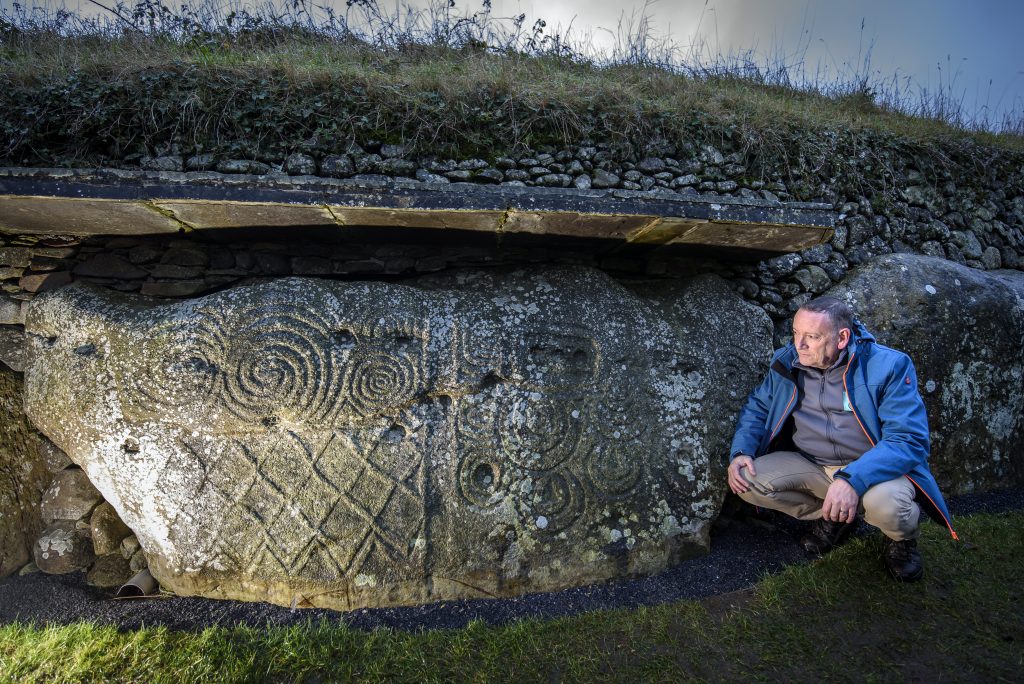
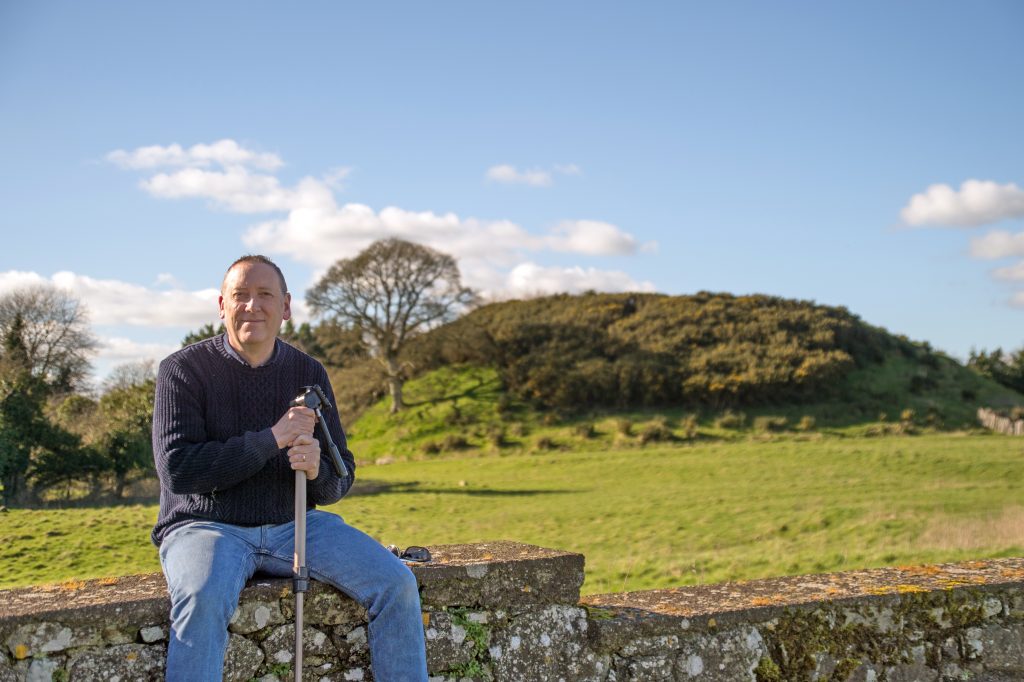
Anthony beside Kerbstone 52 at Newgrange

“I’m full-time self-employed now. As of two weeks ago.”

Anthony Murphy says it plainly, without ceremony. After thirty-three years of nine-to-five employment, income generation is now entirely in his own hands. “Patreon would account for about 50% of it,” he explains. “And I’m trying to grow that because that just gives me that comfort of everything else being a bonus on top of that. It’s a different world.”

That shift is not a reinvention. It is the natural continuation of decades of writing, photographing and interpreting Ireland’s ancient landscape through Mythical Ireland. The work has always been there – in the books, in the tours, in the sky-watching, in the steady presence at monuments in winter frost and summer dusk. What has changed is simply the structure around it – “It’s all trending upwards”

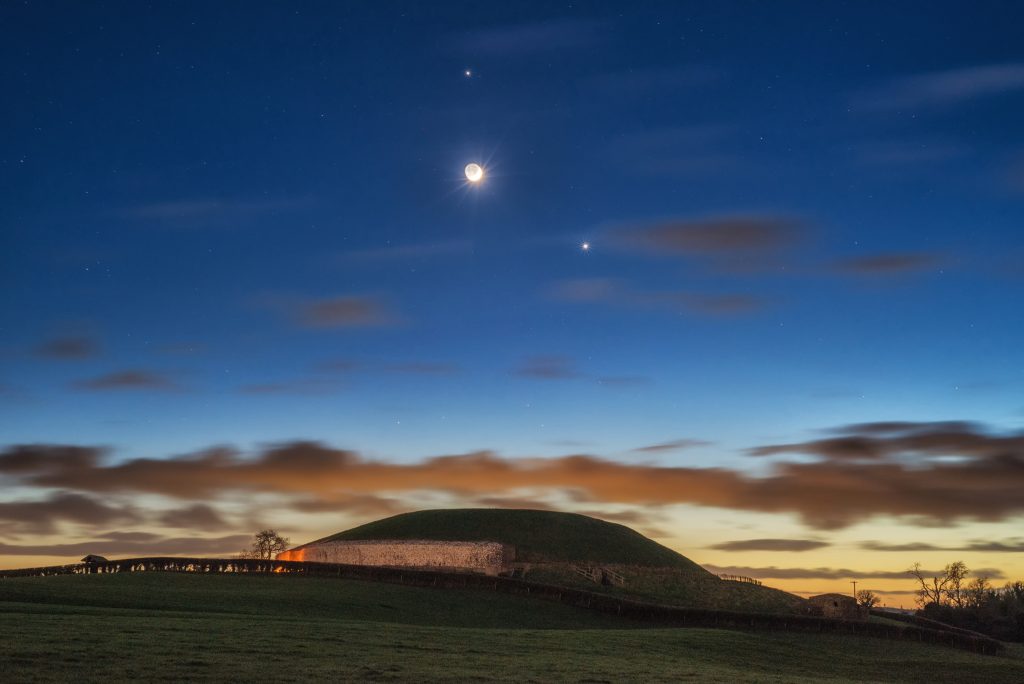
Venus-Jupiter Conjunction Above Newgrange

A Book and Orion

Murphy can trace his immersion in astronomy to a single evening.

The library, before the internet, was an exciting place. He remembers bringing home a book about the night sky and looking out through the kitchen door on a midwinter night.

“There was Orion glinting and sparkling brilliantly on a cold January night. And I’m looking at the book going, ‘There’s Orion’ – and there it is. And I was just completely captivated.”

There was fascination with the science – distances between Earth and the sun, the nearest star, the enormity of the universe.

He wrote to NASA, requesting material for what he told them was a school project, and received booklets and glossy Voyager photographs in return. But alongside that scientific curiosity was something else.

“I was unusual because I was a visual astronomer,” he says. “Most people are armchair astronomers… they like reading about it, but they don’t like spending time out in the cold with binoculars and telescopes. But I was the opposite.”

He would go outside alone, often the only one in the household willing to leave the warmth of the fire or television. Over time, that solitary attention took on a contemplative quality.

“I find the night sky is a little bit like my church,” he says. “If you want to revel in your own place in things, there’s no better way than to stand alone under the night sky and contemplate the vastness of the universe.”

Not religion, he clarifies – but awe. Magnitude. Perspective.

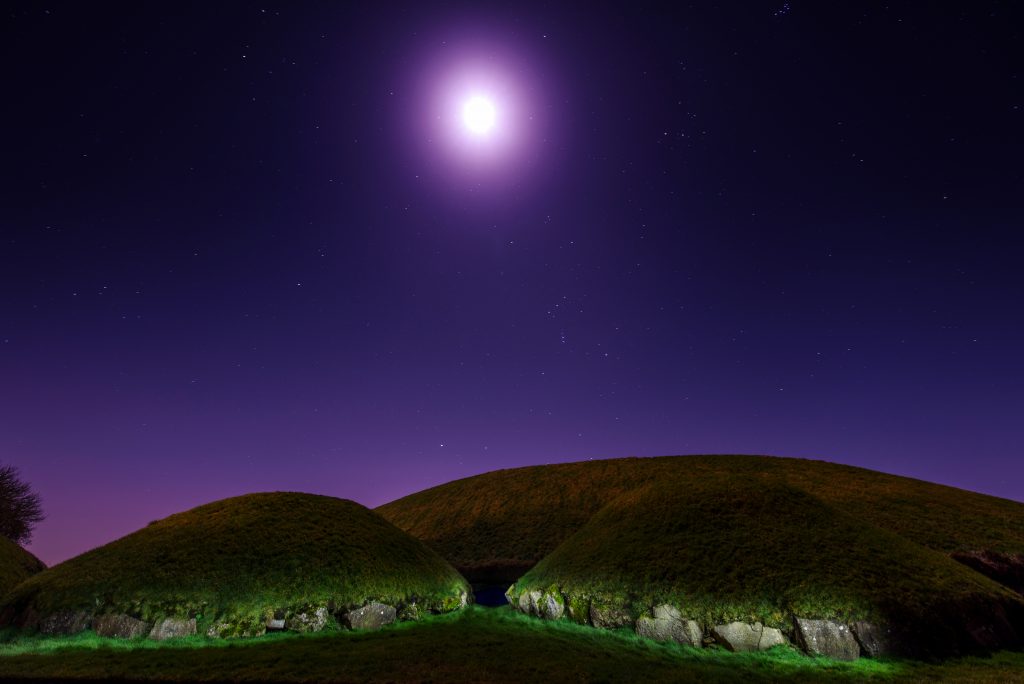
Orion Carries the Moon Over Knowth

The Pathway Into the Monuments

“Astronomy was the pathway into it,” he says, when asked how that childhood fascination led to Ireland’s ancient sites.

The deeper immersion began in January 1999 while he was working at the Drogheda Independent. An artist, Richard Moore, approached him with a suggestion: that there was far more astronomy connected with the monuments of the Boyne Valley than archaeological literature acknowledged.

They knew Newgrange was aligned to the winter solstice sunrise. That was accepted. But Moore began pointing to carvings – crescent shapes, star-like motifs.

“Tell me that’s not a star,” Murphy recalls him saying. “Tell me when you look at that you don’t think of the night sky.”

Murphy agreed.

What followed was the writing of Island of the Setting Sun: In Search of Ireland’s Ancient Astronomers, his first book. Its central argument was that Neolithic astronomy in Ireland was far more complex than the simple tracking of the sun’s annual movement along the horizon.

“You can’t watch the annual movement of the sun and not notice the moon and the planets and the stars as well,” he says. The oversimplification, he argues, came partly from archaeologists having “little or no knowledge of astronomy.”

The book marked the convergence of three strands that have remained constant ever since: astronomy, mythology and archaeology. Moore supplied a phrase that Murphy continues to quote:

“It is only where stars, stones and stories come together that a deeper truth about the past can be known.”

Living within five kilometres of Brú na Bóinne – with Knowth and Dowth part of the same ritual landscape – he had grown up reading about excavations in the newspapers each summer. The revelations about age, complexity and megalithic art unfolded alongside his own growing astronomical knowledge.

“It was a nice combination of two things,” he says. “And then it became something else.”

That “something else” was myth.

Myth and Migration

Through Moore, Murphy developed not just curiosity but affection for the stories of the Boyne Valley – the narratives surrounding Bóinn, the Tuatha Dé Danann, the Milesians.

He speaks in detail about the Lebor Gabála Érenn – the Book of Invasions – describing it as a work of syncretism by medieval monks, blending indigenous lore with Christian and classical influences. The text chronicles six arrivals into Ireland, long treated as entirely mythological.

Murphy suggests those arrivals may echo real migrations.

“Until around about 2012 or 2013, we believed that the modern Irish population was descended from the first arrivals into Ireland after the Ice Age – the Mesolithic hunter-gatherers,” he explains. “Now we know that’s complete codswallop.”

Genetic research has demonstrated that Neolithic farmers – with origins in Anatolia – were later largely replaced by Bell Beaker populations at the beginning of the Bronze Age. The lineage of modern Irish people lies primarily with those Beaker communities.

The structure of the myth, however, remains intriguing.

“It’s like here’s a blueprint for what’s going to happen later,” he says. “History repeats itself. In Ireland, sometimes it seems that history repeats what’s in myth.”

He references the storm raised by the Tuatha Dé Danann to scatter the Milesian fleet – a mythic episode that curiously foreshadows the historical Spanish Armada. He does not claim literal continuity, but he points to resonance.

“Myth acting as a template,” he calls it.

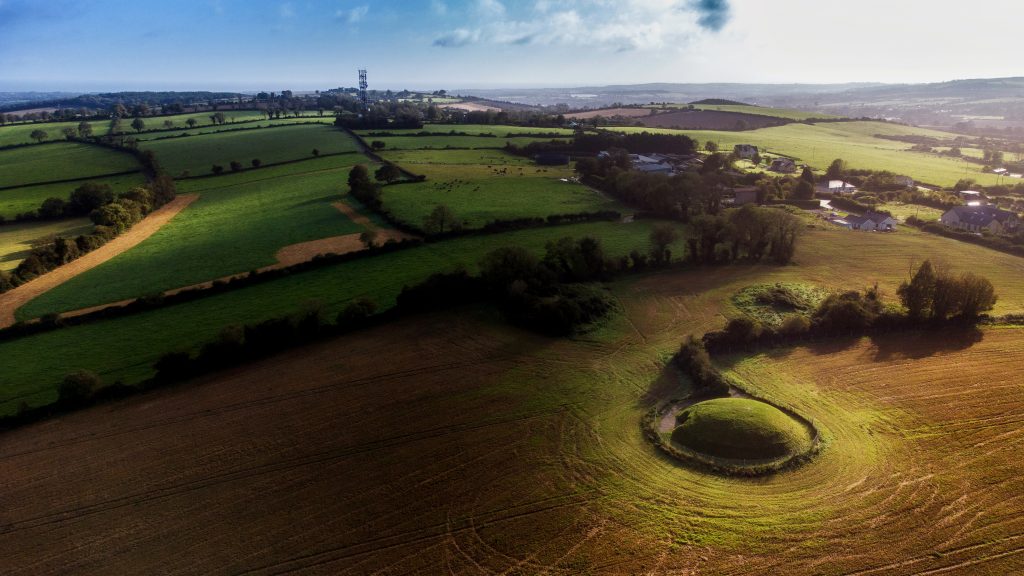
Fourknocks Catches the Winter Sun

Marking the Year

Murphy does not frame himself as ritualistic, but he is acutely aware of seasonal thresholds. Speaking about Imbolc, he clarifies:

“I’m not the sort of person who generally gets into ritual… I mark them in my own way by just being conscious of them and sometimes writing about them.”

As someone who has “loved the sky since I was in single-digit age,” he tracks the six-week rhythm between festivals – the cross-quarter days bracketing solstices and equinoxes.

“Imbolc is fabulous,” he says, “because it really does mark a very noticeable threshold between the slow increase of the light in January and suddenly through February and March you have this much more dramatic extension of the day.”

The Gregorian calendar, he argues, is “kind of nonsensical.” The older divisions, by contrast, reflect measurable celestial movement.

“You can see the longer day… by the end of March it’s not getting dark till nearly eight in the evening, and you kind of feel we’re coasting now.”

Even the moon reveals how disconnected many have become from basic cycles.

“People go mad when they see a photograph of the full moon,” he says. “And they don’t realise in 29 days there’ll be another one.”
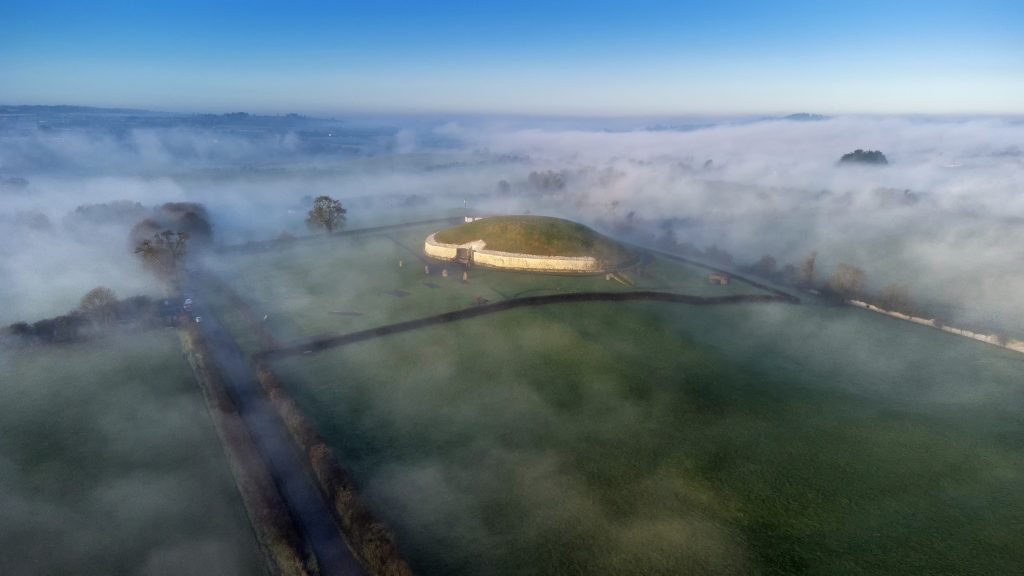
Misty Winter Solstice Sunrise at Newgrange

The Eye in the Sky

Murphy’s engagement with technology is practical rather than performative. He began flying drones in March 2017. Sixteen months later, he identified what became known as Dronehenge – a previously unrecognised Late Neolithic enclosure near Newgrange.

“I photograph monuments and archaeological landscapes,” he says. “What better place to use a drone?”

Aerial imagery expanded perspective. Video footage was licensed to television companies. Drone photographs sit alongside twilight landscapes in his annual calendar.

Photography, he insists, is less about equipment than timing.

“Ninety percent of it is just being there at the right time. The other ten percent is having the equipment and a little bit of knowledge.”

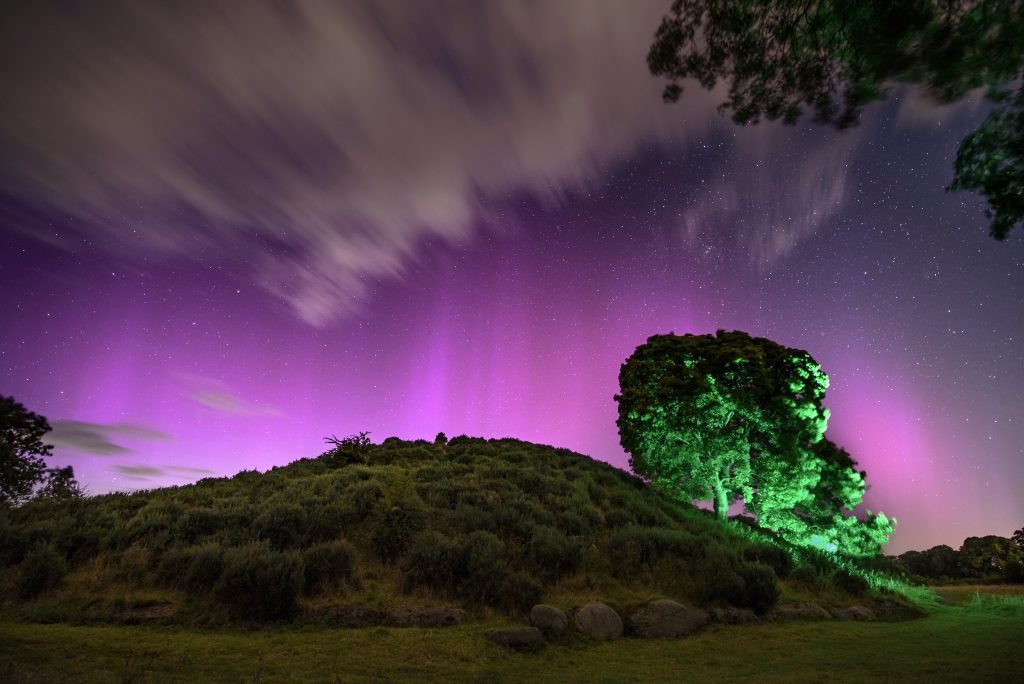
He recounts photographing the Mound of the Hostages on the Hill of Tara during an aurora display. Without professional lighting, he and his son placed phone torches in the entrance to illuminate the structure.

“That’s the trick,” he says. “Just a little bit of lighting at the entrance made all the difference.”

What surprised him most was that no one else had thought to do it.

“There were lots of people on the Hill of Tara taking photographs of the aurora – but not one of them over at the mound.”

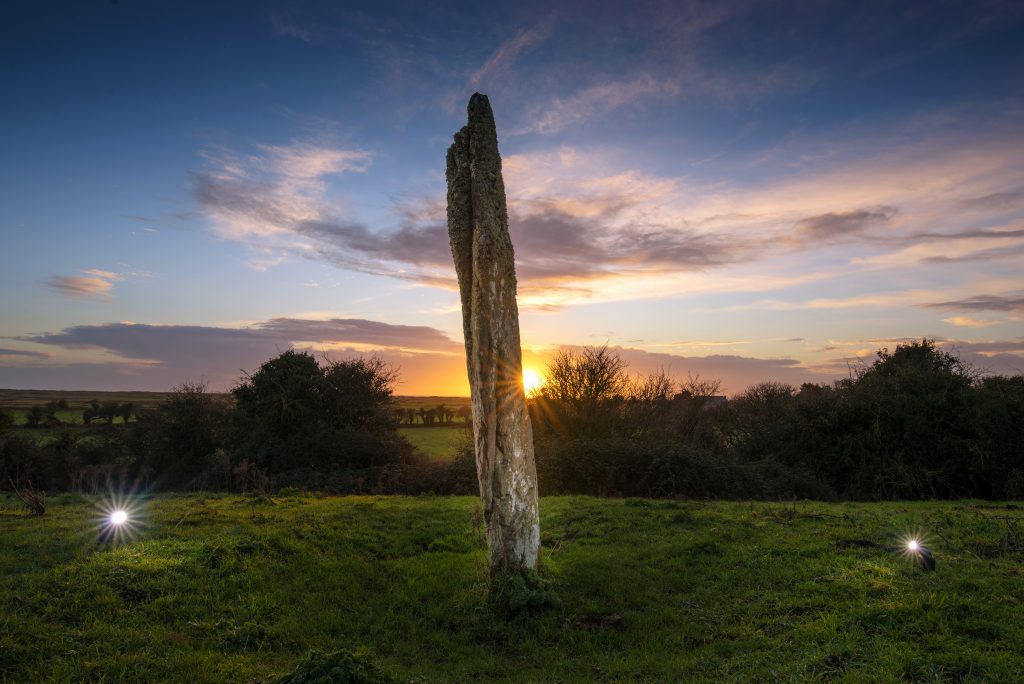
Baltray Standing Stones - Blog

Writing at the Centre

Despite the photography, the tours and the digital platforms, Murphy returns repeatedly to writing.

“That’s the thing that got the whole thing started,” he says.

He records his own audiobooks – prompted by years of readers telling him, “You should read your books aloud.” With broadcast experience in radio and television alongside his print journalism background, the process feels natural.

“It makes complete sense,” he says.

He speaks of substantial manuscripts underway – large-scale works building on earlier books such as Mythical Ireland and Newgrange: Monument to Immortality. His ambition is straightforward:

“I can give you a book every year if you want.”

The discipline is evident. The research base is deep. The archive – textual and photographic – is extensive. Distribution, he notes, is always the challenge. “It’s very well having the website… but if your books aren’t on the bookshelves…”

Aurora Above Dowth

Above and Below

Throughout the conversation, Murphy moves easily between sky and soil. From Orion to Newgrange. From Anatolian farmers to Bell Beaker replacements. From aurora over Tara to the mechanics of shutter speed and ISO.

Astronomy, mythology and archaeology remain, in his words, “the three central planks of everything I’ve done since.”

The sky above.

The monuments beneath.

And the long continuity of stories in between.

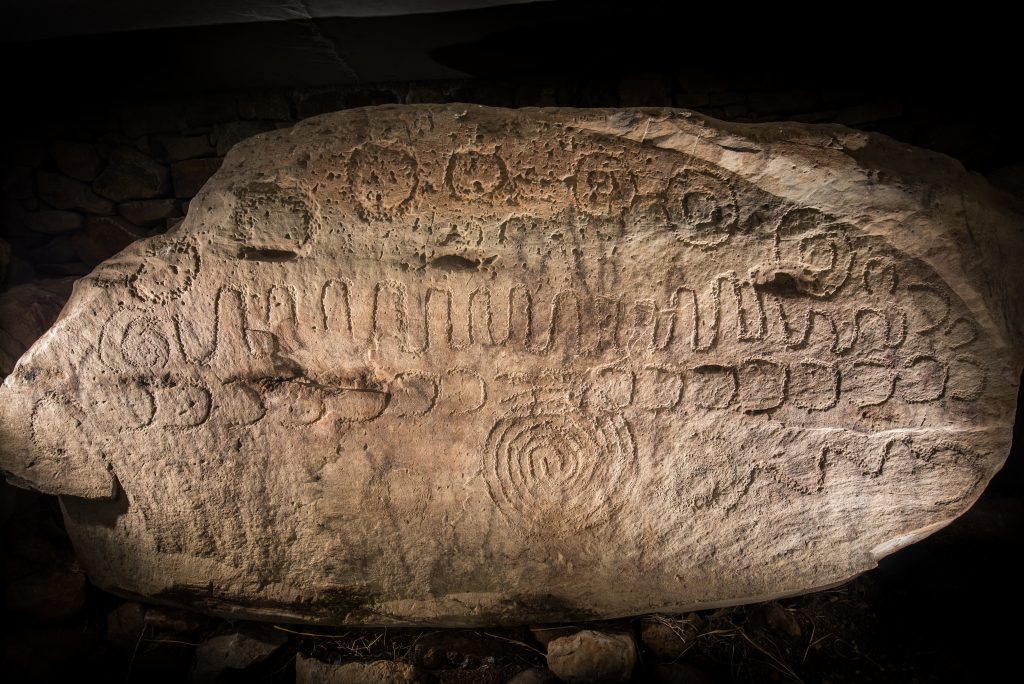
Knowth Calendar Stone - Blog
To explore more of Anthony Murphy’s work – including his books, signed editions, annual calendars, fine art photography prints, audiobooks, guided tours, lectures, podcast episodes and regular myth-and-astronomy livestreams – visit: mythicalireland.com
Support him directly via Patreon: patreon.com/mythicalireland
And keep up with Mythical Ireland via social media: @mythicalireland

Support Go Leor. Get the Print. Join the Story.

Go Leor is an independent Irish arts magazine built by hand, heart, and community. Your support keeps meaningful storytelling alive – in print, in culture, and in conversation. Through Patreon, you can join as a monthly supporter and receive exclusive benefits across our tiered memberships:

  • Fir Bolg: Your name printed inside every issue.

  • Muintir Neimhidh: Your name + monthly issue delivered (UK & Ireland) and PDF issues.

  • Muintir Partholóin: All previous benefits + monthly editor’s dispatch.

  • Bradán Feasa: All benefits + help shape future articles and themes.

Your backing helps us print, publish, and grow a space for creative voices across Ireland and beyond.

The Latest Articles