Joshua Burnside
Musician
From the layered textures of Teeth of Time to a more exposed and intimate sound in It’s Not Going to be Okay, Burnside enters a new phase of his work
At this year’s Folk on Foot Awards – where Teeth of Time was nominated for Folk Album of the Year – Joshua Burnside found himself looking back at a record that no longer felt like his own.
“It’s sort of weird… it feels like I released that album decades ago,” he says. “I guess just a lot has changed from then to now in my life.”
There’s no attempt to smooth over that change.
“I always sort of feel like the person who wrote my own songs in my previous albums is not the person I am now… it feels like I’m just doing covers of those songs.”
That distance is where It’s Not Going to Be Okay begins – not as a concept, but as a condition. Written in the aftermath of the death of his best friend, Dean Jendoubi, the album stays close to what it is, rather than trying to reshape it.
Collaboration, Friendship, Influence
Burnside and Jendoubi’s relationship ran deeper than friendship. They made music together, shaping each other’s instincts early on, with that collaboration captured on Dean’s 2017 record Skin Hunger, which features Burnside.
“We were both big fans of a band called The Books… Dean’s taste in music influenced me and still influences me.”
That shared listening – and making – never really left.
“When I’m writing music, I often think about certain people and if they would like it… and Dean was always one of those people.”
For Burnside, music has always been relational.
“When you’re making music… you’re also kind of making it for your friends.”
Letting the Songs Stand
“I didn’t want to rely on weird sounds or quirky production – I wanted the songs to stand on their own two feet.”
For an artist whose work has often leaned into texture and experimentation, that shift is immediate. On It’s Not Going to Be Okay, the arrangements are stripped back, the space is left open, and the weight falls on what’s being said.
“The lyrics are quite straightforward… sometimes the best way to say it is the simplest way.”
Writing the Everyday
“It seems so obvious to me now to write very real-world sort of lyrics… references to Ikea or Super Monkey Ball… grounding it in the humdrum reality of day-to-day life.”
The influence of Richard Dawson sits behind that shift – a way of writing that allows the everyday to carry meaning without being elevated into something else.
“But that’s what life’s sort of made of… all these little things and all these places and all these references.”
The Weight Carried in Everyday Objects
“It was tennis rackets that Dean and I would play tennis together…”
When asked what objects carried weight, his answer settles on something simple, but deeply held.
“We had this sort of funny system… he would bring the balls and I would bring the rackets… I had his racket and my racket in the same case.”
There’s no explanation for it.
“I don’t know why we did this. It’s just kind of a weird thing.”
He still keeps them and they’ve become something else entirely.
“That brings me a lot of sadness… but also something that I treasure.”
The Artwork: Stripping Back to Essentials
The album artwork follows the same instinct as the music – reduction.
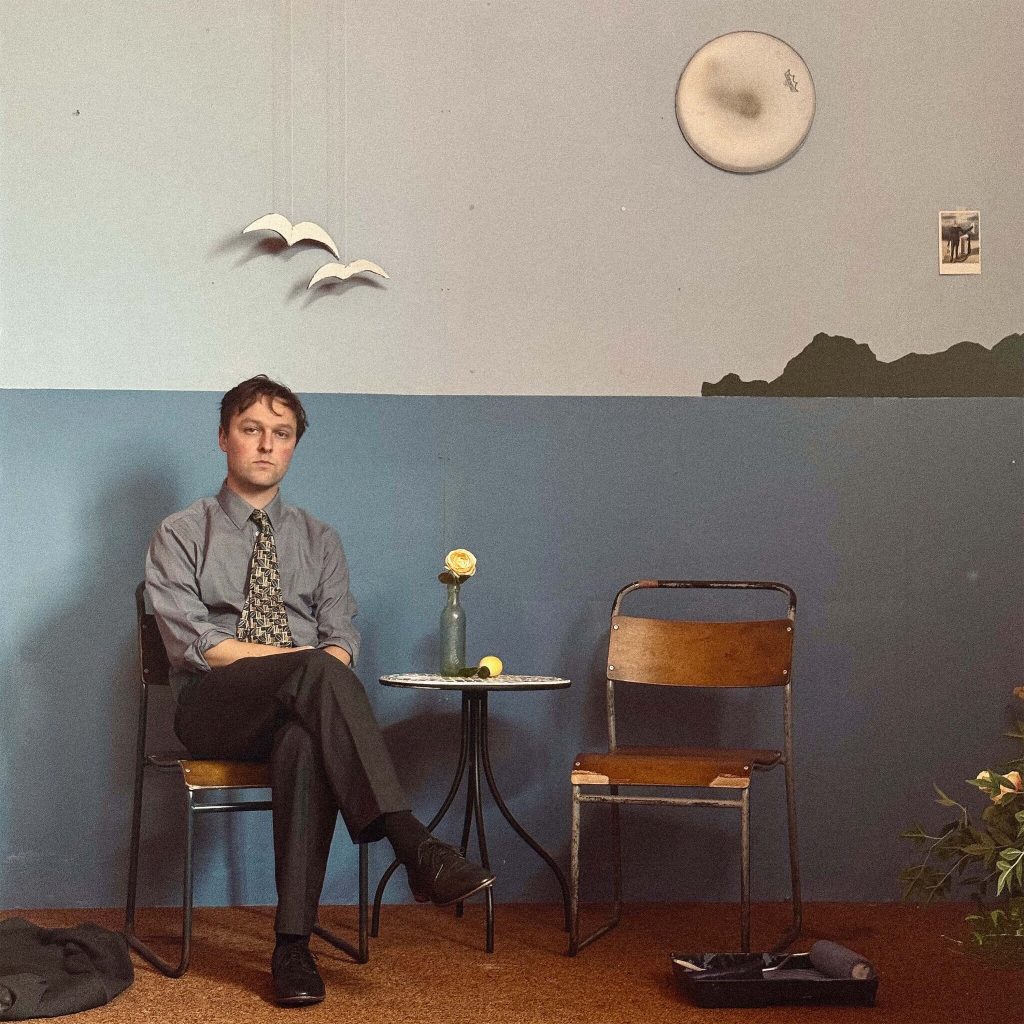
Working within the network of Vault Artist Studios, Burnside developed the visuals in collaboration with Robin Price. What began as a layered composition was gradually stripped back.
“I had loads of stuff all over it even a fireman’s hat”
It didn’t hold.
“It just looked… a bit too busy.”
The process became about removing anything that wasn’t essential.
“Robin said he didn’t like the moon I painted… he said I should just use the snare drum skin.”
The drumhead becomes the moon – a direct link to the music rather than an added symbol. It’s a real object, tied to the life of the record.
That connection carries into the songs. In With You, Burnside references Dean in the line, “the snare you used to play.” It’s understated, but specific – the same object, the same presence, carried across both the sound and the image.
What remains is minimal:
“The water and the sky and the moon… and the two chairs.”
Vault Artist Studios: Spaces in Motion
Vault Artist Studios isn’t a single building – it’s a network of artists working across unused and often derelict spaces in Belfast, adapting each one as needed.
“The way it kind of works… you might only get a couple of years in a space… or the building itself might just become unusable.”
Each move reshapes the work.
“It means that every album is in a new space and has a new sound.”
Teeth of Time was recorded in Marlborough House, near the Albert Clock – a small office space with difficult acoustics that shaped the record’s character.
For It’s Not Going to Be Okay, Burnside worked from a rebuilt space on the Shankill Road, alongside Muckno (Jamie Bishop).
“We had to get rid of the whole ceiling… then stapled loads of wool… and put wood panels over that.”
The result was something different.
“It’s probably the first recording space that I’ve ever been in that I wasn’t constantly battling against.”
Next, that work will move again – to a former Freemasons building on the Newtownards Road in East Belfast.
The People in the Record
While much of the album is Burnside alone, it remains collaborative at its edges.
His brother appears on drums across several tracks, alongside contributions from Muckno (Jamie Bishop), Ben Flavelle-Cobain, Zara Byrne-McCullough and Dany Byrne-McCullough.
Aine Gordon features both on the record and visually – her voice appearing on tracks, and her presence extending into the album’s video work.
Building Visual Worlds
The album’s visual language carries into its music videos, but more importantly, so does a thread that has always run through Joshua Burnside’s work – a focus on relationships that feel grounded, human, and increasingly absent from wider media.
Shot partly in former Vault Artist Studios spaces – including Marlborough House – and on location at Bracken Hill, one video leans into The X-Files, with Burnside and Aine Gordon stepping into the roles of Mulder and Scully.
“She’s sort of playing the role of Scully… to my Mulder.”
It’s playful on the surface, but it reflects something more consistent in his writing. Where a lot of contemporary narratives lean toward conflict, breakdown, or heightened stakes – political, economic, or otherwise – Burnside’s work often sits in a different space. One where relationships are allowed to be steady, respectful, even when they’re not aligned.
“They’re just great friends who respect each other… but have completely opposing worldviews.”
That dynamic – friendship without fracture, difference without hostility – is central. It speaks to a quieter kind of connection, one that doesn’t rely on drama to be meaningful, and one that feels increasingly overlooked in how modern life is portrayed.
Keeping Music Close to the Ground
Outside of recording and touring, Burnside remains embedded in Belfast’s music community.
He continues to help run the Sailortown Folk Club at The American Bar, alongside a trad session at The Black Box, and regular sessions in places like the Sunflower Public House.
“It’s just a really, really fun way to make music… it’s kind of low stakes… purely for the fun of it.”
He also remains a supporter of spaces like The Duncairn, including their Super Sunday Sessions, where music is shared across generations and communities.
“It’s not all about… doing big gigs and releasing records… a lot of it is just about connecting.”
Unearthing What’s Already There
“I often feel like… you stumble upon songs… like a buried dinosaur… and you’re just dusting off the sand.”
The work, for Burnside, isn’t in building something new. It’s in recognising what’s already there.
With It’s Not Going to Be Okay, what’s been uncovered is something unguarded – a record that doesn’t attempt to resolve what it holds.
It’s Not Going to Be Okay
You and Me is the only track recorded before Dean’s death. There’s a softness to it – subtle strings, recorded at home – something he couldn’t quite recreate in the studio. That version holds. It feels untouched in a way the rest of the record can’t be, and that’s exactly why it works.
With You carries a different weight. A steady, understated bass runs through it, grounding a starkly honest retelling of Dean’s funeral – the kind of detail anyone who has lost a friend will recognise immediately. It’s elevated further by the voice of Aine Gordon, which cuts through with a clarity that never overreaches.
The title track, It’s Not Going to Be Okay, opens things outward – pulling grief into a wider frame of politics and climate, without losing that same personal core.
The Last Armchair turns inward again. It sits with the weight we attach to objects, and the quiet realisation that we don’t really grow out of the things that shape us early on.
Good Times Are Coming moves between memory and the present – small, everyday objects seen through rose-tinted recollection. Super Monkey Ball, a party, fragments of a life that feel ordinary until they’re not. It ends on a note that doesn’t resolve cleanly – slightly discordant, in keeping with the vulnerability that runs through the album.
Burnside has said, “I don’t think I feel any different inside as when I was 10 years old, or younger even.”
There’s something in that which the album keeps returning to – how grief can unmoor you, pulling you back through childhood memories, through versions of yourself you thought you’d left behind.
It’s an incredible record. Not just in its writing, but in the way it’s held together – by Burnside’s commitment to the relationships around him, to the community that shapes Belfast, and to a kind of emotional honesty that’s difficult to access anywhere outside of live music – or an album like this.
It’s Not Going to be Okay is available to stream now via Spotify and Apple Music
Joshua Burnside will be performing across Ireland, the UK and beyond throughout 2026.
Upcoming dates include shows in Cork (Cyprus Avenue), Dublin (The Button Factory), Glasgow (Òran Mór), Leeds (Brudenell Social Club), London (EartH) and Bristol (Beacon)
For full links, tickets and more visit his linktree: @Joshua_Burnside
And keep up with Joshua via social media: @joshuaburnside
Support Go Leor. Get the Print. Join the Story.
Go Leor is an independent Irish arts magazine built by hand, heart, and community. Your support keeps meaningful storytelling alive – in print, in culture, and in conversation. Through Patreon, you can join as a monthly supporter and receive exclusive benefits across our tiered memberships:
Fir Bolg: Your name printed inside every issue.
Muintir Neimhidh: Your name + monthly issue delivered (UK & Ireland) and PDF issues.
Muintir Partholóin: All previous benefits + monthly editor’s dispatch.
Bradán Feasa: All benefits + help shape future articles and themes.
Your backing helps us print, publish, and grow a space for creative voices across Ireland and beyond.
The Latest Articles

Clann Miotlantach / Mythlantics, Alice Rekab and the Future It Opens
Tracing identity through objects, inheritance, and the quiet movement of the Atlantic Ocean as a space of connection and shared histories

Kerrie Hanna – Carrying the Land Through Authentic Material and Light
Ancient pigment and endangered craft meet feminist reclamation and community authorship in a practice rooted in land and light

Anne Harper – The Magic Stories That Still Live in the Land
From ancient hills in County Down to evolving musical practice, uncovering the quiet connections that link mythology, place, and lived experience

Why Online Movements Have Such a Powerful Grip on People
Mark Malone explores how people are drawn into online spaces – and how understanding, not judgement, might be the way out

Frances Magee – Preserving Ireland’s Natural World in Cyanotype Magic
In her North Belfast garden, Frances Magee transforms carefully tended plants into luminous cyanotypes – where texture, imperfection and light combine in work that feels timeless.

Mark Bonello – Capturing the Spirit of Ireland’s North Coast
From London galleries to the North Coast studio, Mark Bonello paints light, labour, and lived experience with unwavering focus