Katriona Sweeney
Katriona Designs
Where Irish memory, bold typography, and hand-painted craft converge – from Donegal buses and rush crosses to Belfast walls and wearable design.
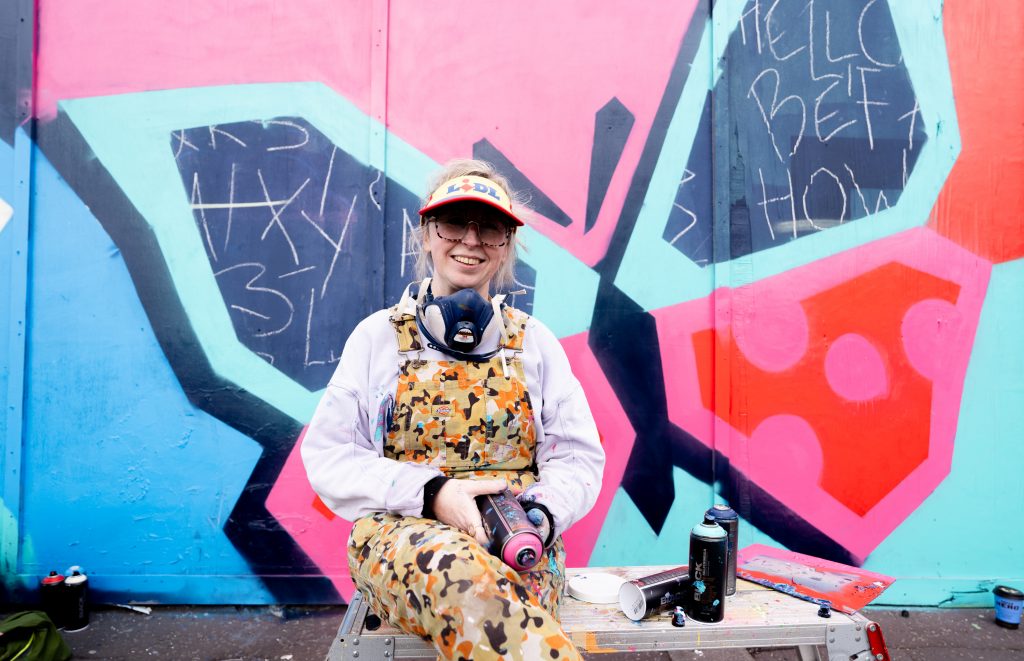
In Belfast, in a studio that shifts between experimentation and commercial deadlines, Katriona Sweeney has started painting again.
“There’s a lot of ideas float about in my head,” she says, half laughing. “And you’re just like – no, you need the time to do them.”
After years immersed in digital design, branding work and mural commissions, she’s returned to canvas – working in acrylics and collage, stepping deliberately away from the screen.
“I normally work with spray paint and enamel paint – for mural & sign painting. Acrylic feels different as its new to me.I don’t know how it’s going to look once I begin painting. It’s more of a process… you kind of go, ‘I don’t like it yet.’”
For someone whose background is rooted in graphic precision, typography and colour theory, canvas introduces a different rhythm – slower, more tactile, more instinctive.
“It’s nice to step away from the computer. There’s no tactile element to digital. I get a bit bored of it. It’s not the same.”
That hunger for texture and hand-made process runs through everything she creates – whether it’s a mural wall in Belfast, a risograph print layered in fluorescent ink, or a pair of statement earrings drawn from childhood memory.
Bringing Donegal to Belfast
If there is a thread binding Katriona’s practice together, it is memory – particularly memory shaped by Donegal, where she grew up.
Her now-annual St Brigid’s Day workshops, teaching people how to make traditional rush crosses, began almost accidentally.
“I had a bag of rushes in the car and the art shop were like, ‘Oh, we’d love some.’ Then the next year it was, ‘Will you do a workshop?’ And now it’s still happening.”
What might have been a one-off craft session has become something more communal. People gather after work, sitting around tables weaving rushes into crosses, swapping stories as they work.
“You don’t have to talk – you’re crafting. And then people join in. It was very casual but lovely.”
The tradition is deeply personal. Her mother, Brigid, was known locally for teaching anyone who asked how to make the crosses.
“My mum was called Brigid. I think she felt it was her duty in life. People would come to the house and she’d just show them. My dad always brought home a big bag of rushes. It was just something to do in winter.”
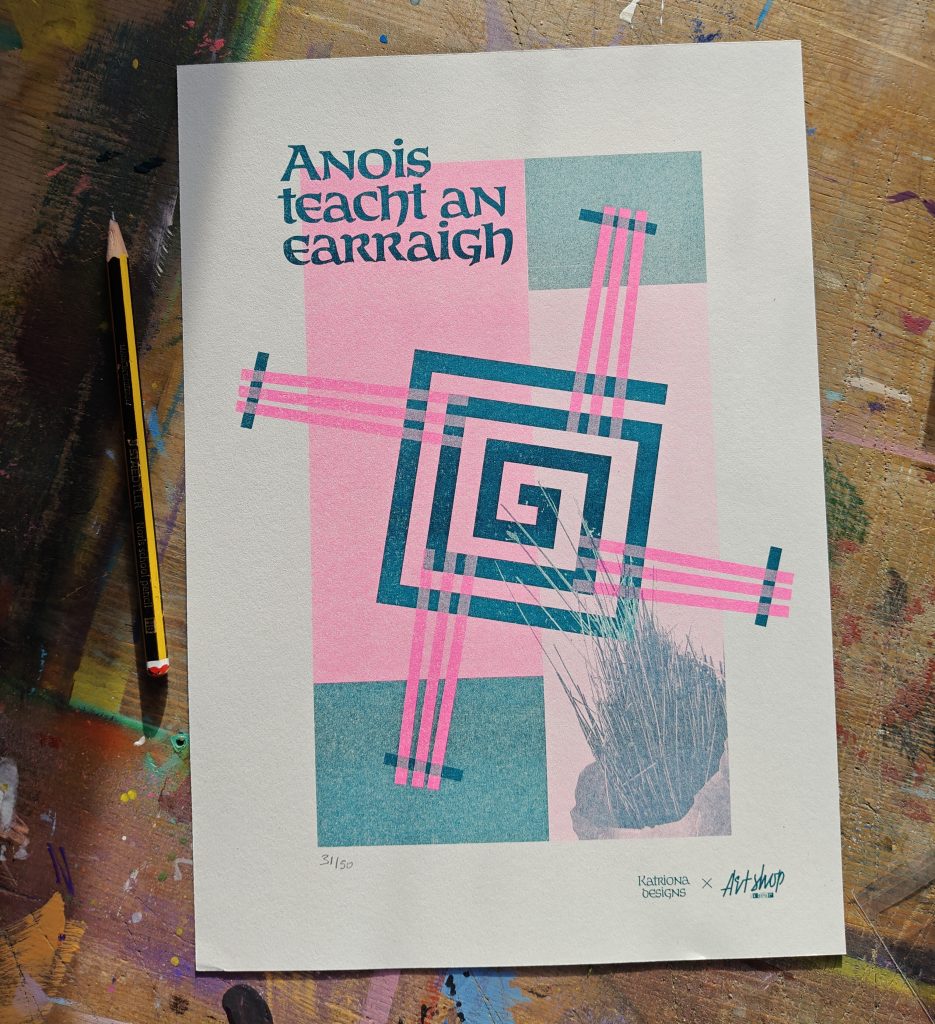
That lineage filtered into a collaborative risograph print created with Belfast School of Art – a two-colour piece designed around the overlapping plates that create a third hue where they meet. In Anois Teacht An Earriagh rush patterns, collage, spring colour and instinctive composition sit side by side.
“It really is a bit of me – all the elements that make up me.”
The print reflects what she does so well: holding tradition in one hand and bold contemporary colour in the other.
The Swilly Bus: Nostalgia in Motion
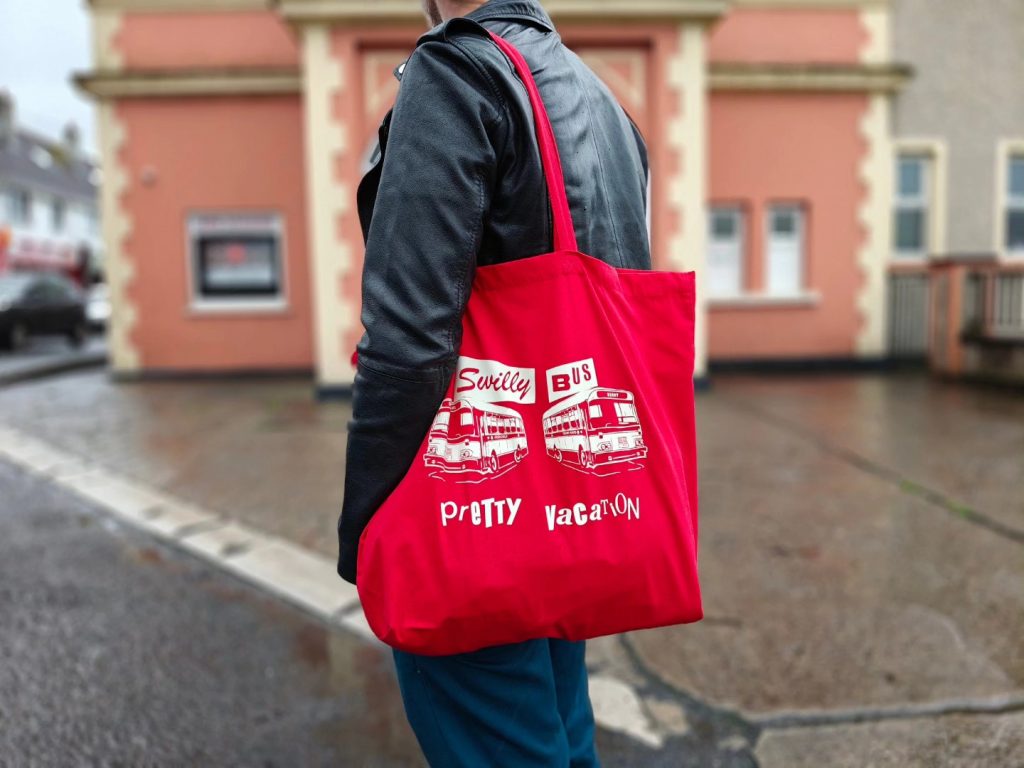
Few works capture her connection to place quite like the Swilly Bus design – a vibrant, graphic tribute to the iconic Donegal bus service.
Originally created as an illustration six years ago, it has since taken on a life of its own – appearing on tote bags and T-shirts that circulate at markets and in everyday life.
What she didn’t expect was how deeply it would resonate.
“People come up and tell me their stories. They met their now partners on that bus… memories of smoking on the bus… it’s quite heartwarming.”
In Belfast markets, Donegal emigrants light up at the sight of it. At home, older neighbours in their eighties carry the tote bags to bingo. Younger customers gravitate toward the screen-printed tees.
“There’s bad memories of the bus breaking down – but they’re actually really good memories because we laugh at them now.”
The Swilly Bus was more than transport; it was connection – to Derry for shopping trips, to neighbours, to adolescence, to independence.
“It’s a big part of the community.”
Through her design, shared memory becomes something physical – something you can carry.
Architecture & Character
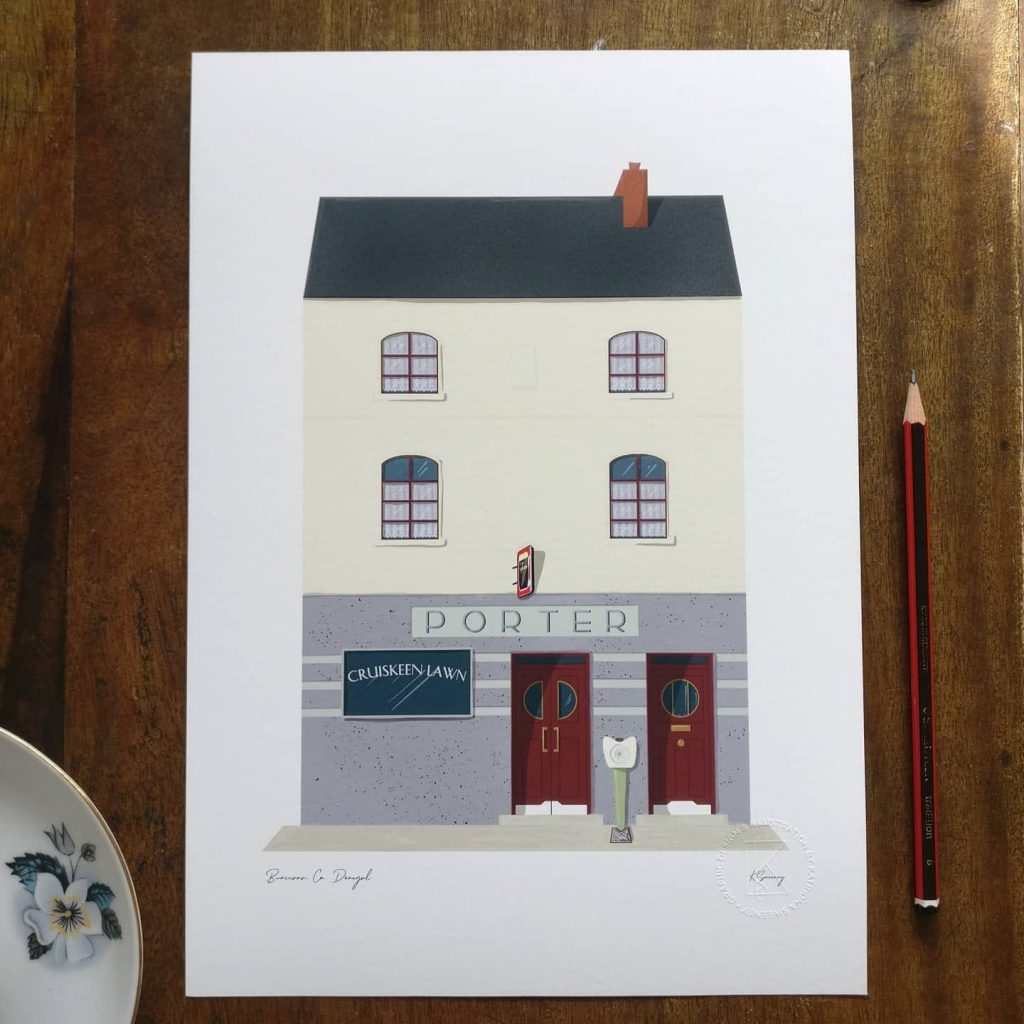
Architecture often “finds her,” she says, rather than the other way around.
“Normally I stumble across places when I’m out and about. It’s the architecture, or the story behind it.”
She isn’t interested in drawing buildings simply because they are picturesque. There has to be a reason – a narrative, a pull.
“There’s loads of nice buildings – but not all of them I connect with. I find it hard to draw ones just for the sake of it.”
Many of her Donegal pieces were born from preservation instinct.
“I didn’t want them forgotten about. I wanted people to share more stories.”
Her architectural illustrations carry the clarity of her graphic design background – bold shapes, careful shadow, studied colour harmony – but they also carry atmosphere.
“There’s things you really have to study to create the feeling of a building… I do a lot of staring at things.”
It is that quiet study that allows a building’s character to emerge.
From the Sidelines to the Wall
Katriona’s entry into mural work was gradual.
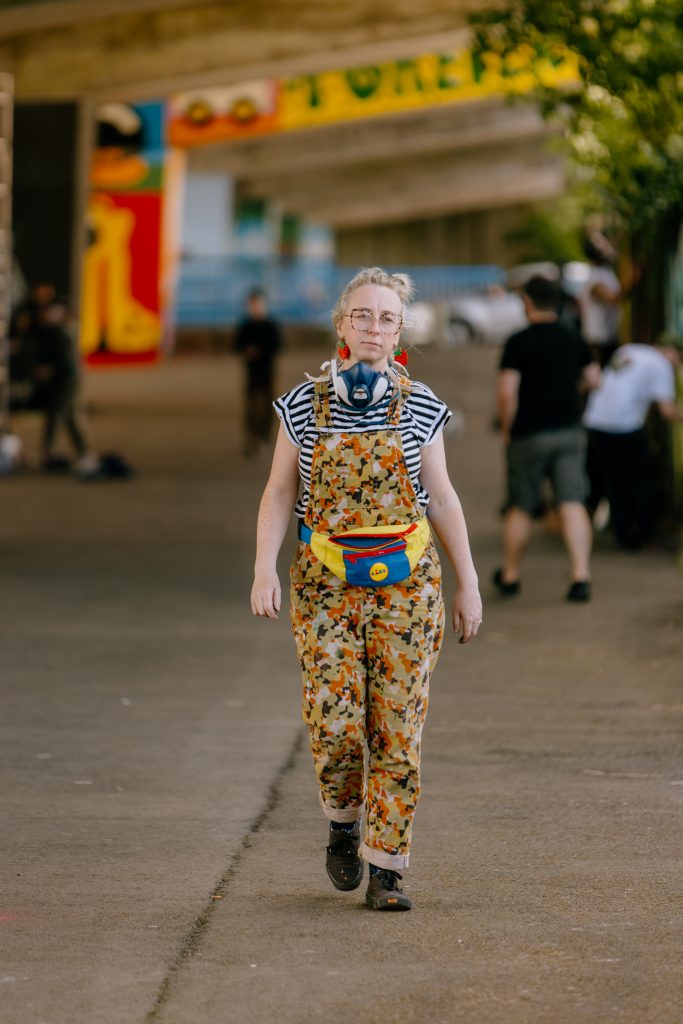
Her husband works as a street artist, and for years she assisted on larger projects – filling colour, observing, absorbing the process.
“I was always in the background of street art.”
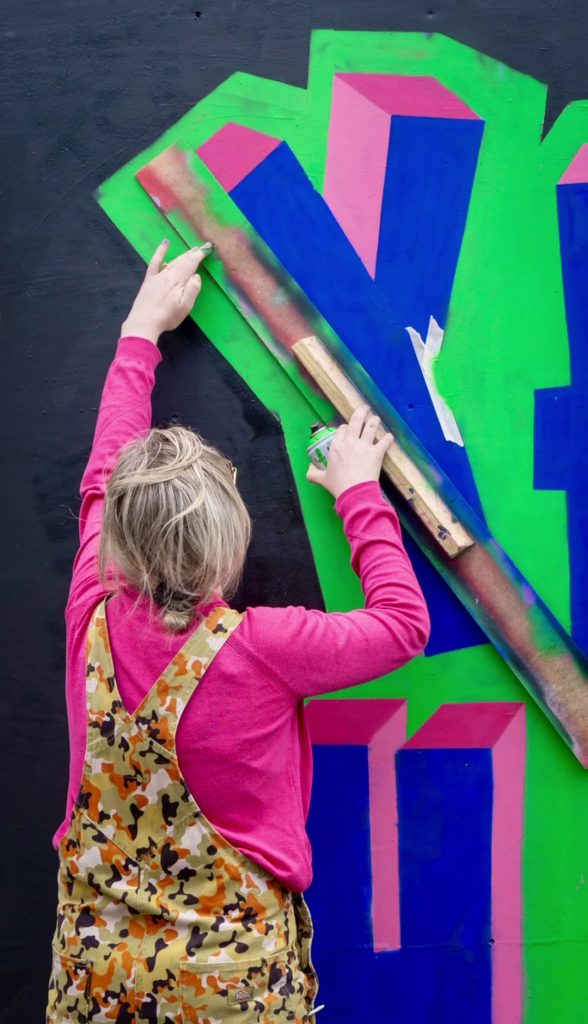
Three years ago, she was invited to take part in an International Women’s Day mural event in Belfast. It was her first wall.
“I got all the nerves… but I gave it a go and I was like – that was amazing.”
The scale altered her relationship to design.
“You just get lost in the wall.”
Her love of lettering – so central to her graphic practice – found a natural home in mural work.
“I’ve always loved letters. That’s what draws me to graffiti – the lettering side of things.”
Colour, form, typography – all expanded to architectural scale.
Child of Prague: Icon to Ornament
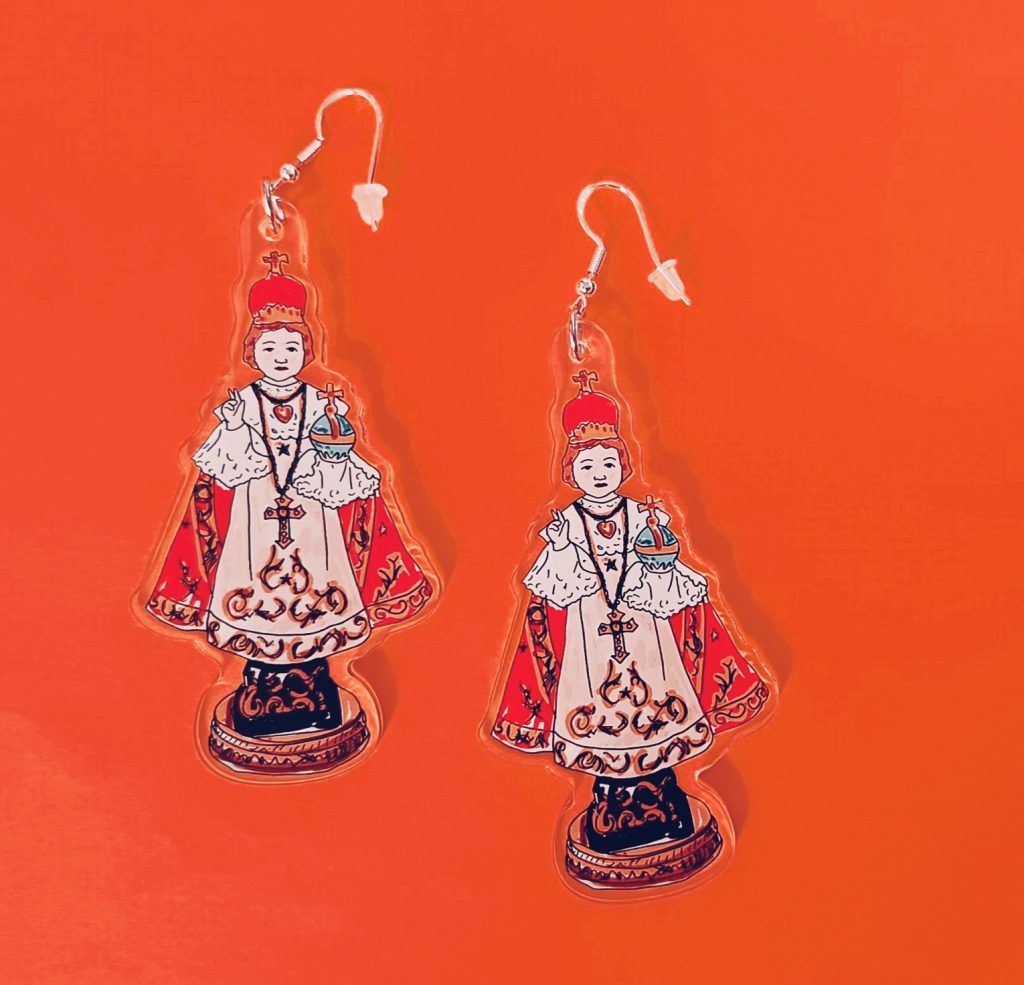
Another example of cultural memory made contemporary is her Child of Prague design – originally an illustration inspired by the statue that lived in her childhood home, once repaired with a makeshift bottle lid after being knocked over.
“It was just something that was always in our house.”
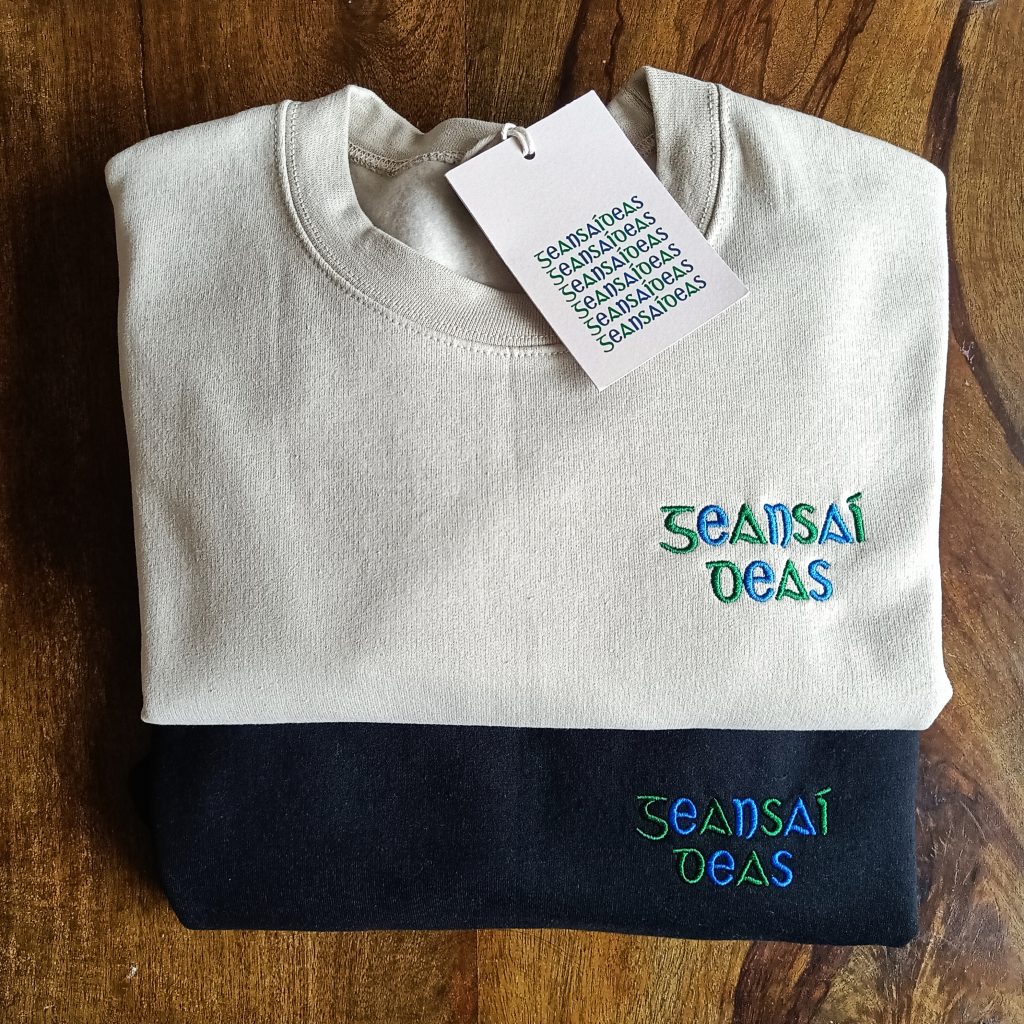
What began as a print evolved into statement acrylic earrings – bold, graphic and unmistakably Irish.
“I create things I’d wear myself. And then I put it out there.”
She tested scale physically, cutting paper, hanging shapes from her ears, adjusting proportion until it felt right.
The finished pieces are playful yet reverent – heritage reimagined as wearable design.
They’ve since become associated with an old superstition: using the Child of Prague in the days around their wedding, hoping to secure sunshine.
Katriona jokes that for new brides “I have to get them to sign a disclaimer – If it rains, it’s not my fault.”
Sign Painting & Slower Craft
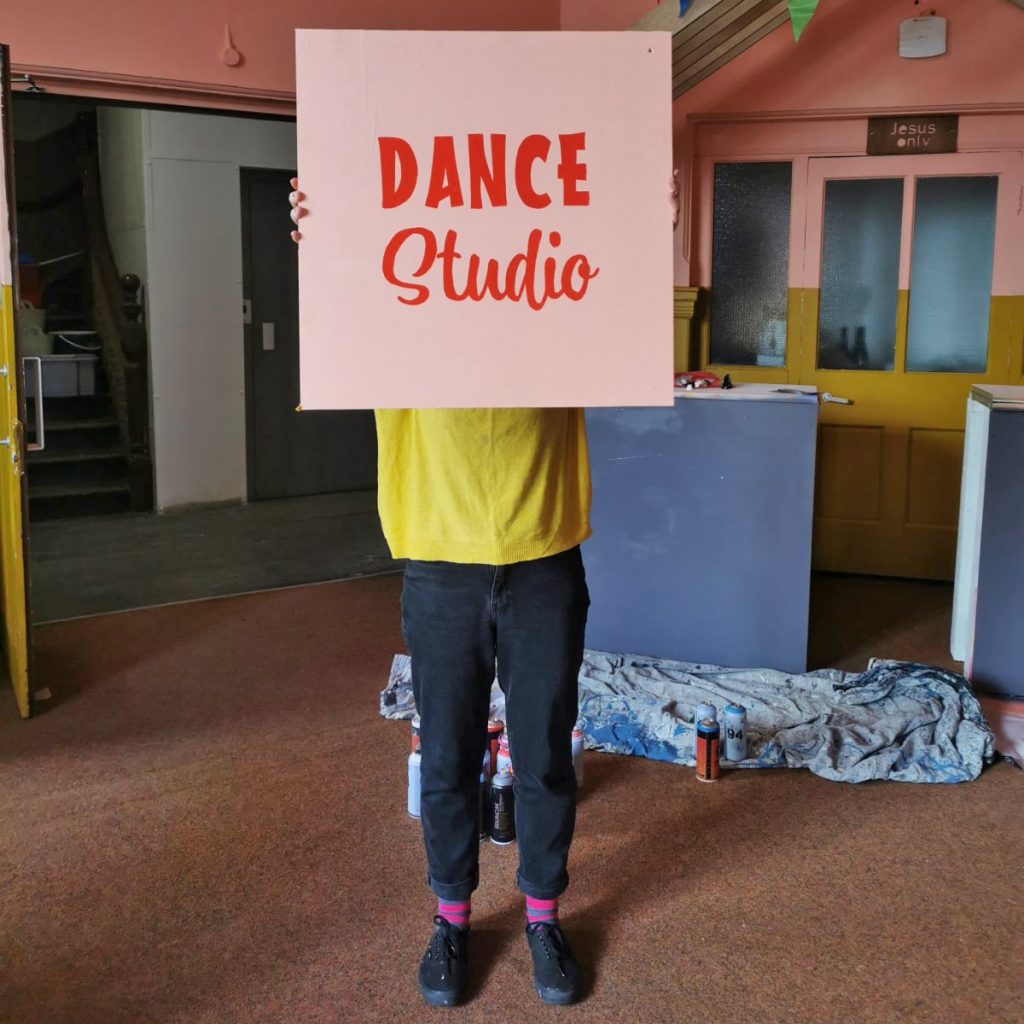
Sign painting has become one of her most energising pursuits.
“Why haven’t I done this sooner? It fits in with my love of old shop fronts and typography.”
Working with enamel paint and brush control demands patience – single strokes, steady hand, flow and rhythm.
“Hand-painted signs hit different, and are made to hang around for years.”
In Bristol, at a gathering called Burds of the Brush, she found herself surrounded by others equally obsessed with lettering.
“It was amazing to be around people just talking about lettering, sharing tips & tricks, and inspiring each other.”
Like rush cross-making, like hand-painted signs, this is about revival.
“It’s an old craft that needs to be kept alive.”
Across her practice, that theme recurs: preservation not through nostalgia alone, but through use.
The Balance
Behind the murals, prints and product designs is the steady hum of freelance commercial work – branding projects, design contracts, necessary commissions.
“There’s the artist in me, and the commercial artist,” she says. “It’s about finding that balance.”
Many of her most beloved pieces – the Swilly Bus, the Child of Prague earrings, the architectural prints – began simply as ideas she needed to make real.
“I create things I’d wear myself… and then I put them out there.”
When asked if she’ll keep going, she doesn’t hesitate.
“I can’t see my self stopping anytime soon, it just fits in with how I think & see things, my way of storytelling.”
Through bold colour, studied typography and deeply rooted memory, Katriona Sweeney is doing something colourfully powerful: taking fragments of Irish life – buses, statues, buildings, rushes – and ensuring they remain not only remembered, but carried, worn, and lived with.
Old craft. New colour. And stories that refuse to fade.
Explore Katriona’s selected work and discover available pieces through her website: katrionadesigns.com
Find prints, earrings sweaters and much more via her shop: katrionadesigns.bigcartel.com
And keep up with her via social media: @katrionadesigns
Support Go Leor. Get the Print. Join the Story.
Go Leor is an independent Irish arts magazine built by hand, heart, and community. Your support keeps meaningful storytelling alive – in print, in culture, and in conversation. Through Patreon, you can join as a monthly supporter and receive exclusive benefits across our tiered memberships:
Fir Bolg: Your name printed inside every issue.
Muintir Neimhidh: Your name + monthly issue delivered (UK & Ireland) and PDF issues.
Muintir Partholóin: All previous benefits + monthly editor’s dispatch.
Bradán Feasa: All benefits + help shape future articles and themes.
Your backing helps us print, publish, and grow a space for creative voices across Ireland and beyond.
The Latest Articles

Frances Magee – Preserving Ireland’s Natural World in Cyanotype Magic
In her North Belfast garden, Frances Magee transforms carefully tended plants into luminous cyanotypes – where texture, imperfection and light combine in work that feels timeless.
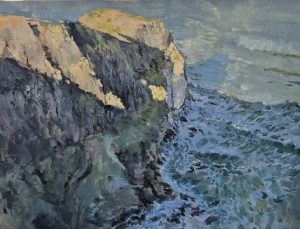
Mark Bonello – Capturing the Spirit of Ireland’s North Coast
From London galleries to the North Coast studio, Mark Bonello paints light, labour, and lived experience with unwavering focus
Anthony Murphy and the Secrets of Ancient Ireland
An astronomer’s path into Ireland’s ancient past – tracing how skywatching, myth and archaeology converge across the island’s landscapes.
Desima-Jayne Connolly on Building Arts Centres Around People and Place
From Christmas markets to the return of light, how collaborative programming at Flowerfield and Roe Valley places people, place and wellbeing at the centre of cultural life.
Fight Like a Girl: Ana Fish on Safer Spaces & Murals
Tracing a life shaped by movement, myth, and community – using street art to reclaim space, tell shared stories, and make the everyday world feel safer, softer, and more alive.
Finding Magic Stillness in the City: Joel Simon’s Paintings
Scenes observed slowly and held with care, where light, posture, and silence allow the ordinary street to become a quiet stage for feeling