
Barry Keegan
Visual Communicator
From Aardman influences to ancient memory systems, a practice that shapes clay, doodles, and character into bold forms of visual communication
There is a particular kind of artist who resists the neatness of a single title. Barry Keegan is one of them.
Across his online presence, he appears as a 2D artist, designer, game artist, character designer, animator, doodler, clay modeller and maker of strange, expressive little figures. In conversation, however, the title he seems most comfortable returning to is simpler and broader: visual communicator.
It is a phrase that reaches back to his time in college. His course was called Visual Communication and, although he first understood it through the more familiar shape of graphic design, the term has grown more useful with time. It leaves room for drawing, animation, games, clay, digital tools, surface pattern and physical objects. It does not force the work to sit still.
“That basically kind of sums up what we do,” Barry says. “Visual communication. Using whatever medium is most appropriate or effective at the time.”
Barry began in graphic design, working in the field for years before reaching a point where he needed a change of pace. The decision he faced then was unusually stark: invest his savings in property, or go back and study something different.
He chose animation.
“I did graphic design for years until I felt I needed a change of pace,” he says. “That’s when I decided I’d give animation a shot.”
It was, he reflects, probably the right move. Animation opened a door into studios, and from there into mobile games. It allowed him to move closer to work that felt more exciting than graphic design had become. But it also introduced him to a working rhythm shaped by contracts, short-term opportunities and waiting for the next thing to come around.
“You’re kind of just waiting for the next thing to come around,” he says. “It can just be the nature of the work.”
A person who begins as a graphic designer, moves into animation, works as a 2D artist in game studios, develops character work, experiments with clay and doodles, and thinks in terms of visual storytelling can end up with a job title that grows longer every time it is explained. Visual Communicator, in the end, gives him enough space.
Aardman, Plasticine and the Need to Make by Hand
If Barry’s professional life has moved through digital fields, clay has remained a constant physical thread. It did not arrive recently. It was not a deliberate pivot into handmade work after years of digital practice. It was there from childhood.
“Since I was a kid, I’ve always used plasticine,” he says.
That early fascination was shaped, at least in part, by Aardman Productions. The studio behind Wallace and Gromit has an unusually powerful place in the imagination of artists who grew up watching clay become character, comedy and movement. For Barry, Aardman’s influence is obvious. There are not many stop-motion studios quite like it.
“I definitely think there was a strong Aardman influence back in the day,” he says.
What is interesting in Barry’s relationship to clay is that he does not describe it romantically. He likes the immediacy of it: opening the packet, handling the material, making the character on the spot.
He is aware of Aardman’s technical world – the formulas, the material consistency, the stories around clay supplies, and even the studio fire that destroyed original Wallace and Gromit figures – but he does not try to recreate that level of material engineering in his own work.
When asked whether he has experimented with clay in the same way, he jokes that he could not be trusted as an amateur chemist.
“Things would definitely explode around me.”
Instead, he takes the material more directly. He uses it as it comes. That rawness seems important. Clay offers a speed and physicality that sits apart from the layered processes of digital art. There is no need to open software, organise files, rig a model or plan a production pipeline. You can simply begin.
For Barry, polymer clay also brought another possibility: permanence. Plasticine can be squashed, reworked and lost. Polymer clay allows the thing to harden, survive and remain.
“You could make these things and they become a bit more permanent,” he says. “Something that wouldn’t get squished as easily.”
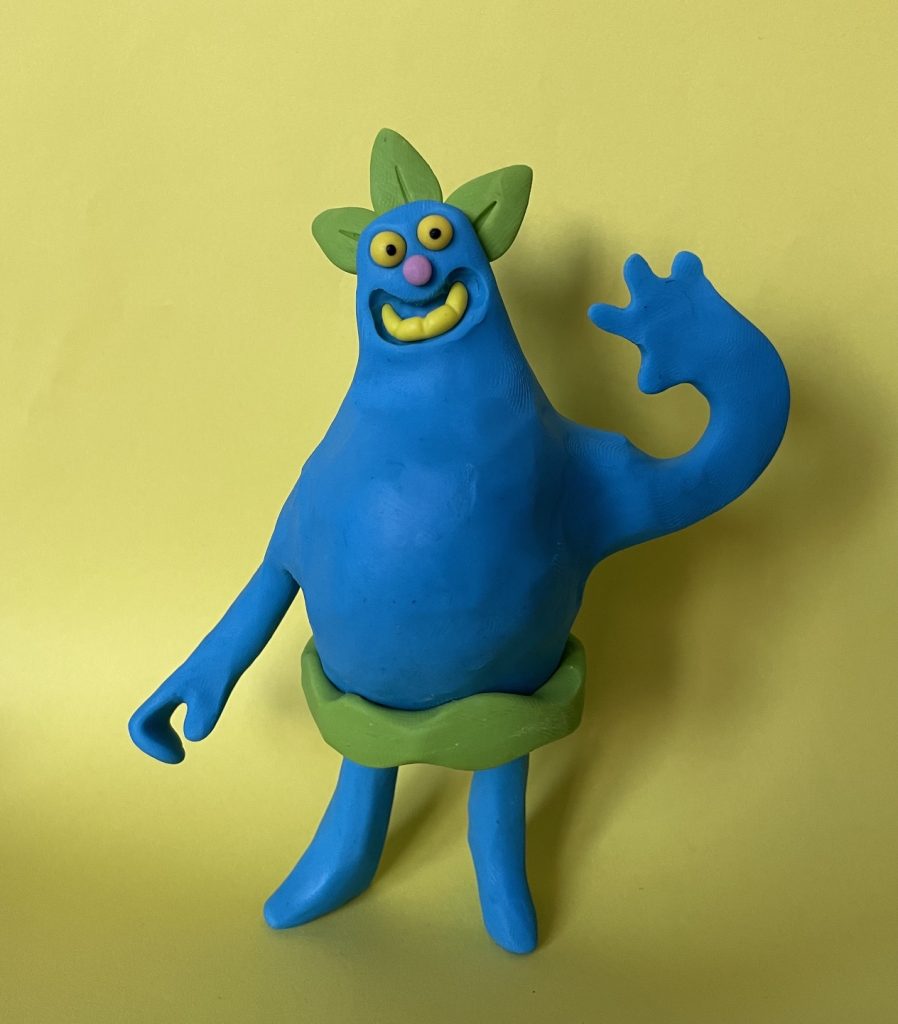
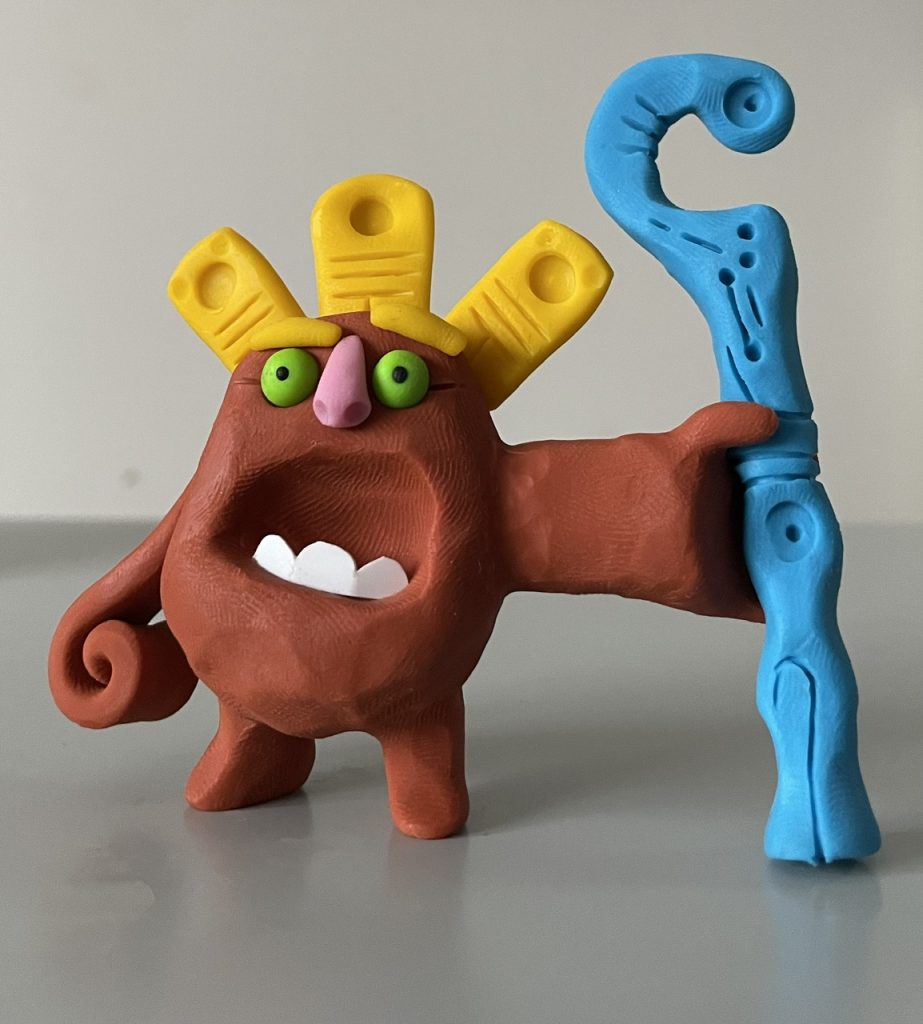
His clay figures are often simple in their construction but direct in their expression. He usually begins with character rather than colour. The figures tend to have large eyes, expressive hands and a clear emotional state. Shock, surprise, movement, humour and feeling are made visible through body language and facial expression.
“All my characters usually have big eyes and very expressive hands,” he says. “It’s very clear what emotion they’re portraying.”
Barry tends to choose one bold, almost primary colour, then adds one or two additional colours for contrast or emphasis. There is a graphic directness to that approach: a kind of flat, bold visual language brought into three dimensions.
Doodles, Memory Palaces and Keith Haring
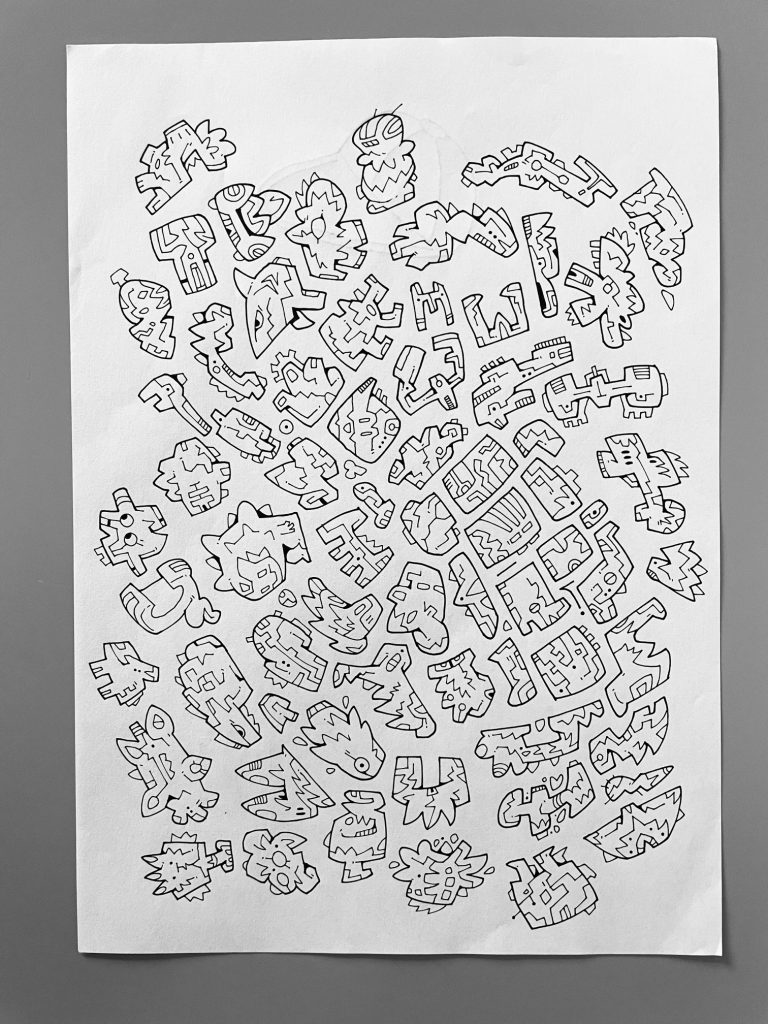
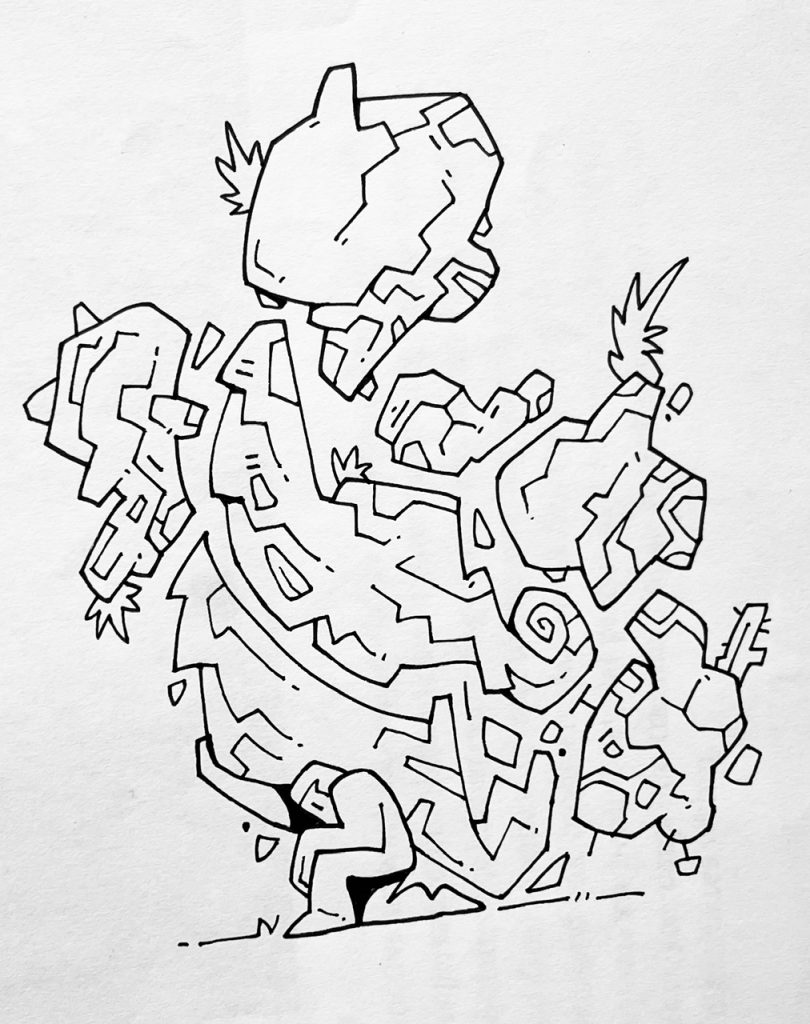
Barry’s doodles are a significant part of his visual language. They appear across his work as lines, symbols, marks, characters, patterns and surface decoration. Some are abstract and instinctive; others feel more character-led. They are not always planned and they do not always carry a fixed meaning.
“It’s usually just freestyling,” he says. “It’s a way of breaking art block for me.”
When Barry doodles, he describes moving into a kind of flow state. Lines and shapes begin to fit together. He is not necessarily trying to communicate a specific idea at the beginning. Instead, the act of making becomes a way of working through blockage, rhythm and visual balance.
But there is another side to the doodles. Barry has become interested in the idea that marks, patterns and objects can hold knowledge. That interest began through Derren Brown, whose writing on memory led Barry toward memory palaces and eventually to Lynne Kelly, the Australian writer and researcher whose work explores how ancient cultures used objects, places, songs, images and symbols to preserve knowledge before writing became dominant.
Barry became interested in how civilisations used art and physical forms to remember. Hieroglyphs, totem poles, symbolic systems and memory objects all suggested a different relationship between image and knowledge.
“I guess I was influenced by the idea of storing knowledge in physical form using symbols and patterns,” he says.
It is a wonderfully strange path: from Derren Brown to Lynne Kelly, from memory techniques to ancient knowledge systems, from there into clay figures and doodles. Barry jokes about the possibility of his own doodles being dug up in the future and mistaken for some mystical formula that might save humanity. In reality, he is careful not to overstate the meaning already present in them. Most of the time, the doodles are intuitive. But he is interested in whether more meaning could eventually be embedded into them.
Looking at Barry’s doodles, it is easy to think of Keith Haring. The comparison comes up naturally: the boldness, the direct line, the sense of figures and marks in motion, the graphic energy that can travel across surfaces.
Barry does not reject the comparison, though he frames it as a likely subconscious influence rather than a deliberate act of homage. Haring’s work had such a strong presence in the 1980s, and endured across so many kinds of media.
“It would be difficult not to absorb some of that,” he says.
Barry is wary, however, of presenting himself as someone trying to continue the work of any one artist. His influences are broader and more mixed. Some come from comics. Some from animation. Some from graphic design. Some from street art, designer toys and the visual culture around him.
“I mean, everything has probably influenced the doodles in a way,” he says.
The influence of urban vinyl and designer toys is especially interesting. Barry remembers being drawn to that scene growing up – the world of Kidrobot and toy-like objects treated as art surfaces. Urban vinyl often overlaps with street art and graffiti, and for Barry this connects again to the desire to draw across surfaces, to bring pattern and character onto physical forms.
That attraction continues in his interest in 3D modelling. He has experimented with digital sculpting tools such as Nomad Sculpt on the iPad, as well as drawing over 3D models in Procreate. What appeals to him is not only modelling in itself, but the idea of a three-dimensional canvas: a surface onto which doodles, marks and patterns can be applied.
“The idea of combining those patterns and those doodles with the 3D surfaces is pretty appealing to me,” he says.
Nickelodeon, Cartoon Network and Genndy Tartakovsky
When Barry talks about animation, he is not only talking about stop-motion. Aardman is part of the story, but so too are the sharp, graphic, television animations of
Nickelodeon and Cartoon Network.
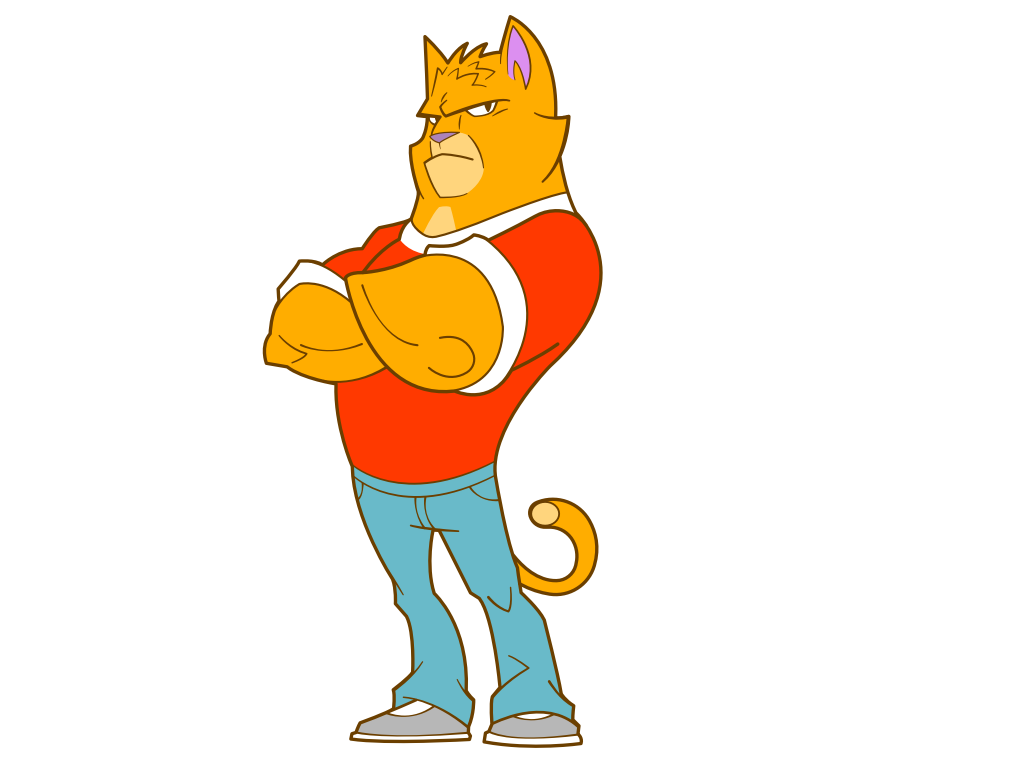
He is drawn to pose-to-pose animation: snappy movement, clear silhouettes, strong graphic timing and the kind of visual storytelling that can communicate instantly.
One name stands out in this part of the conversation: Genndy Tartakovsky.
Tartakovsky, the creator of Samurai Jack and a major figure behind Dexter’s Laboratory, The Powerpuff Girls and Primal, was important enough to Barry that he wrote a dissertation on him in the past.
“I really like his animation, his style and his direction,” Barry says. “It has a real graphic appeal behind it.”
Samurai Jack becomes a particularly rich point of discussion. The show was made for a young audience, yet carried a sense of violence, stillness and maturity that set it apart from many animated series of its time. What interests Barry most is the direction. He connects Tartakovsky’s work to futurism, especially the obsession with speed, motion and the layering of movement. In Samurai Jack, however, motion is often made more powerful through restraint. Scenes can feel almost like still frames. The screen may hold a few visual panels at once. Composition does the storytelling. Silence carries weight.
“A lot of the scenes and shots in Samurai Jack are almost still frames,” Barry says. “You’re seeing a few panels on the screen at a time.”
There are echoes here of Akira Kurosawa, whose influence on Samurai Jack is often felt in standoffs, pacing, framing and the use of silence. The show stood out because it relied on composition to carry meaning. You could understand what was happening because the image had been carefully directed.
This returns us, again, to visual communication.
For Barry, animation is not just movement. It is decision-making. Where the character stands, how the frame is composed, when the action pauses, what the silhouette says, how much information is held back, how much is made clear. These choices affect his own thinking, especially in relation to game art.
Although he has not worked in mobile games for a while, Barry recognises how those animation influences carried into that world. The bold silhouettes, snappy movement and graphic clarity he admired in television animation were not limited to children’s cartoons; they became practical tools for making characters feel readable, expressive and immediate on screen.
“You can get a really punchy, snappy, graphic, energetic animation,” he says.
AI, Animation and the Illusion of Understanding
If Barry’s practice is grounded in visual communication, physical making, character, composition, intention and the survival of meaning, then generative AI sits directly against those concerns.
His position is not one of panic. In fact, he thinks the threat is overblown.
“I think its capabilities are definitely overblown,” he says.
From his point of view, generative AI resembles a “convoluted stock asset library”. It can assemble, approximate and produce superficially impressive results, but it does not understand what it is doing.
Barry pushes back against one of the common arguments made in defence of AI: that artists also learn by absorbing the world, borrowing influences and putting things back together. To him, this comparison misses something essential. Artists do not require the scraping of global visual culture to make work.
“Artists have been making artwork for years well before mass communication and travel,” he says. “They haven’t had or needed access to all that visual information to be able to create.”
That, for Barry, is the difference. Human making can emerge from direct experience, limitation, imagination, memory and material engagement. Generative systems depend on vast quantities of existing material. They do not begin from nothing. They consume.
He does not see the main danger as artistic replacement. The danger, he says, is trust.
“The only danger I see is the absolute trust in something that doesn’t know what it’s doing.”
He compares the spectacle around AI to The Emperor’s New Clothes and The Wizard of Oz. In both stories, power depends on illusion. People believe because they are told to believe, or because the staging is convincing enough to hide the small figure behind the curtain.
“The great and powerful Oz is just a guy behind a curtain,” he says. “This is all just an illusion.”
Barry understands why animators are worried. He sees the online claims that AI can recreate Pixar-level animation or produce finished moving images from a few prompts. But to him, those outputs are only impressive on the surface.
“People are forgetting what an animator and director does,” he says.
In traditional 2D animation, every frame is considered. Every line has been placed. Every second of movement carries decisions about rhythm, gesture, character, camera, composition, lighting, colour and direction. The same is true, in different forms, across digital animation and game production. Artists are not merely producing images. They are making choices.
“You don’t have the control,” Barry says of generative AI. “You don’t have the camera angles. You can’t control a character design down to their eyelashes.”
Barry describes AI output as approximation: a vast averaging process built from material that already exists. He compares it almost to a grid, or to Battleship coordinates. If a generator produces an image of a cat, it does not know what a cat is. It has learned, from billions of images, where whiskers tend to appear.
“That’s all it’s really doing in a way,” he says. “Just at a crazy scale.”
The scale makes it look impressive. But scale is not understanding. It may resemble the surface of creative work, but it lacks the intention beneath it.
Print, Zines and the Return of Physical Culture
From AI, the conversation moves naturally into print.
Barry sees physical media becoming more important, not less. In a world where information is increasingly stored online, controlled by platforms, vulnerable to companies collapsing, political pressure, broken links, paywalls, censorship or technological failure, there is meaning in things that can be held.
“I don’t think people should be relying too heavily on digital information,” he says.
He is not rejecting digital tools entirely. His own background runs through graphic design, animation, games and digital modelling. But he believes information should be backed up in other ways. Print, for him, has renewed importance because it gives culture another form of survival.
He has noticed a resurgence in zines, and that resurgence makes sense to him. Zines, comics, magazines and independent print allow people to preserve and share ideas outside the dominant systems of online distribution.
“Printed production, zines and magazines, and the ability to spread messages independently is pretty strong, pretty powerful,” he says.
That vulnerability is not abstract. It becomes visible whenever companies fold, platforms change, access is restricted, or powerful individuals gain control over infrastructure. The conversation touches briefly on Starlink, Elon Musk and the danger of depending on technologies that can be switched off by a single owner or company.
Print does not solve everything. But it offers another route. A magazine, zine, comic, book or physical artwork can move differently through the world. It can be passed on, stored, rediscovered, archived, kept on a shelf, found in a box, read without logging in.
Games, Board Games and Third Spaces
The conversation ends by returning to play.
Barry has worked in mobile games, but he is also interested in how games can become physical and social. He remembers working in mobile game companies where, at the end of the day, people would take out board games. Not Monopoly, he clarifies – not the games that end in arguments – but more modern, socially based games.
These were games that brought people together.
That distinction matters. In a time when people often talk about the loss of third spaces – the places outside work and home where people can gather, talk, play and belong – Barry sees value in cultural forms that encourage presence.
“I believe things like zines, board games, comics, art – something that lasts and draws on a more social world – can bring people back together,” he says.
That line feels like a key to Barry’s work.
His clay figures are physical. His doodles search for rhythm, surface and possible meaning. His animation influences are built around clarity, timing and composition.
His interest in Aardman comes from a childhood encounter with handmade movement. His admiration for Genndy Tartakovsky comes from the power of visual direction.
Barry Keegan’s work points back to the importance of intention. Not as a grand statement, but as a practical one. A character needs a gesture. A frame needs composition. A doodle needs rhythm. A magazine needs paper. A game needs people around a table.
The work lasts because someone made it.
And in Barry’s case, that making remains open-ended: graphic, playful, physical, digital, expressive, and always looking for the medium that can communicate most clearly in the moment.
Explore more of Barry’s clay figures, doodles and character designs visit his website: barkeegan.weebly.com
Keep up with Barry via social media: @barkeegan
Find his latest clay creations via: @barkeegan_klay
And check out his doodles and sketching: @barkeegan_doodles
Support Go Leor. Get the Print. Join the Story.
Go Leor is an independent Irish arts magazine built by hand, heart, and community. Your support keeps meaningful storytelling alive – in print, in culture, and in conversation.
Through Patreon, you can support the magazine in two simple ways:
- Supporter Listing
Have your name printed inside every issue as part of the community helping Go Leor grow. - Print Copy – UK & Ireland
Receive the latest print issue delivered each month across the UK and Ireland, with your name included inside the magazine.
The Latest Articles

Maria Noonan-McDermott: Where Memory Becomes Art
Transforming intimate family memories into paintings and poetry, her work invites others to recognise stories of their own.
Rosina Law-Braney: Reclaiming the Seven Deadly Sins
Through zines, illustration and humour, Rosina Law-Braney creates vibrant feminist stories that make room for identity, desire, grief and collective creative freedom.

Alexander Edward: Weaving from the Land
Growing his own willow beside Strangford Lough, Alexander Edward brings coppicing, landwork and an ancient craft into bold contemporary forms.
John Britton: Finding Calm Through Ink
After three decades of visceral performance and constant travel, John Britton has found a quieter connection through ink, mentorship and calm.
Yvonne Moore: Following Curiosity into Colour
Refusing to settle into a single style, Yvonne Moore follows curiosity across colour, poetry and community, creating art that brings her – and those around her – fully to life.
Lucy Fleming: Carrying the North Coast Light
Through fluorescent colour, oil pastel and an instinct for collaboration, Lucy Fleming turns the light of the North Coast into images that connect art, music and community.