
Ray Bonner

Francois Got Buffed

Street art becomes a way of reading the city differently, where bold colour, sharp humour and careful placement turn ordinary walls into public acts of attention.

Photograph: Neal Campbell

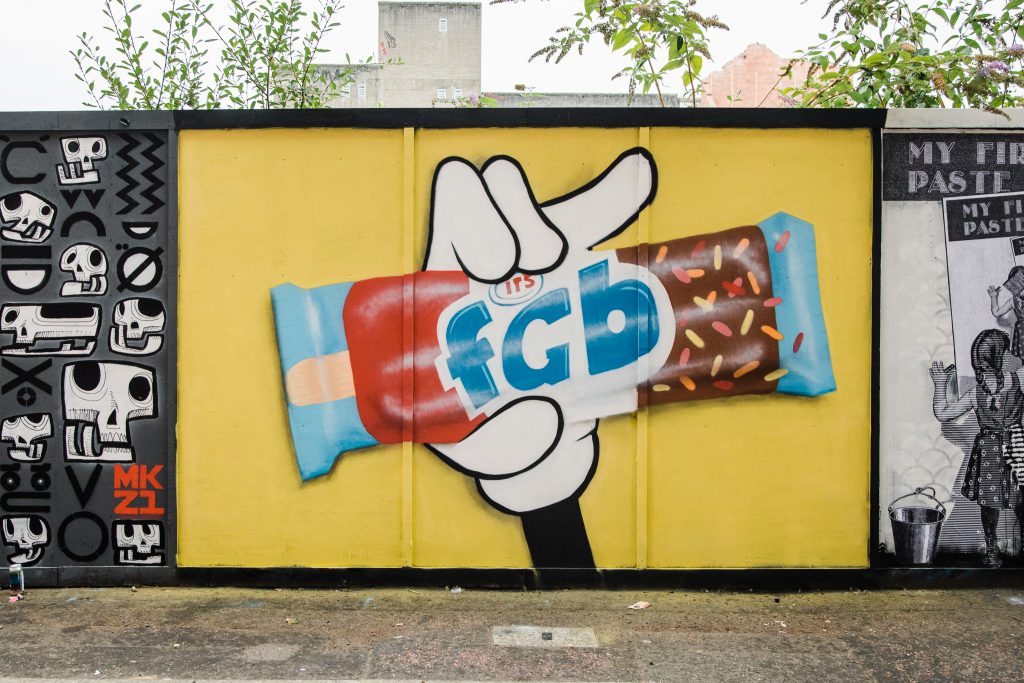
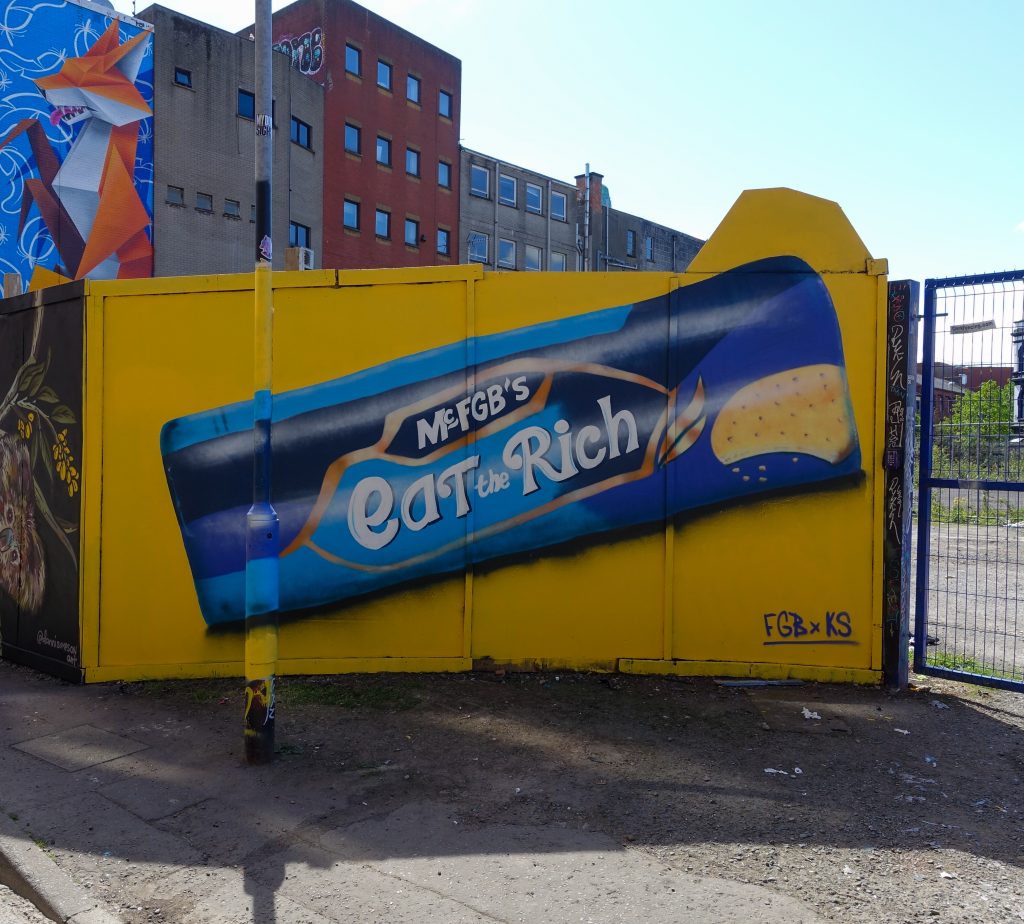
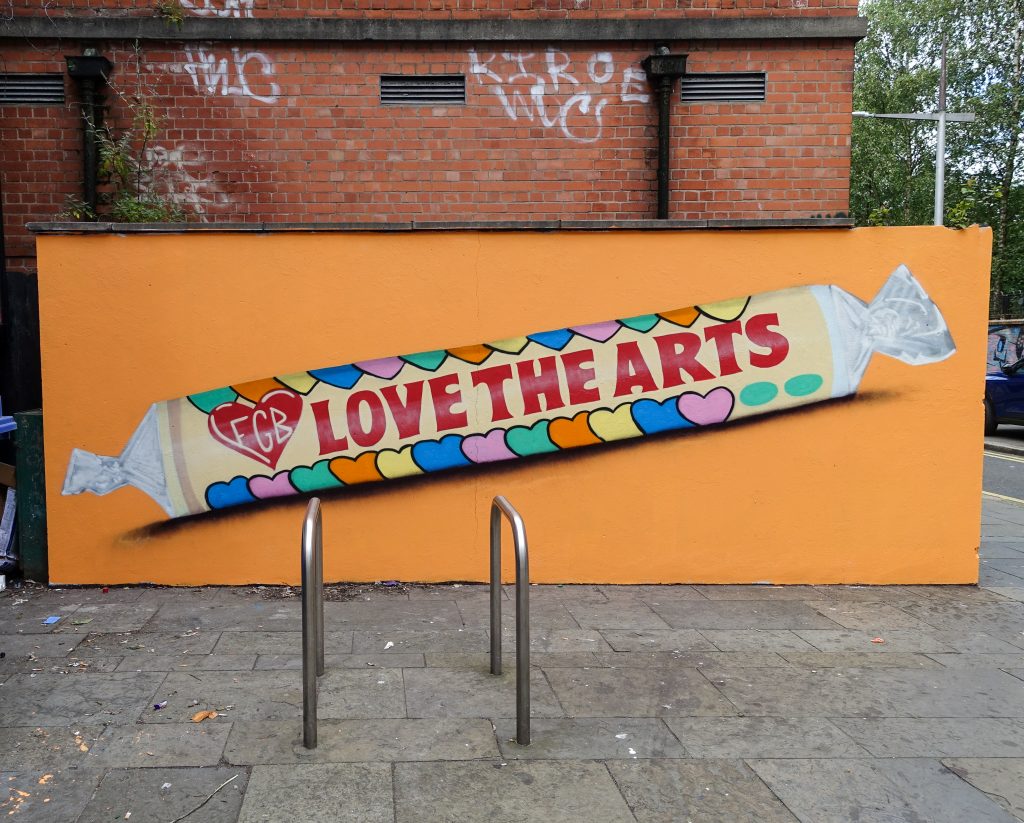
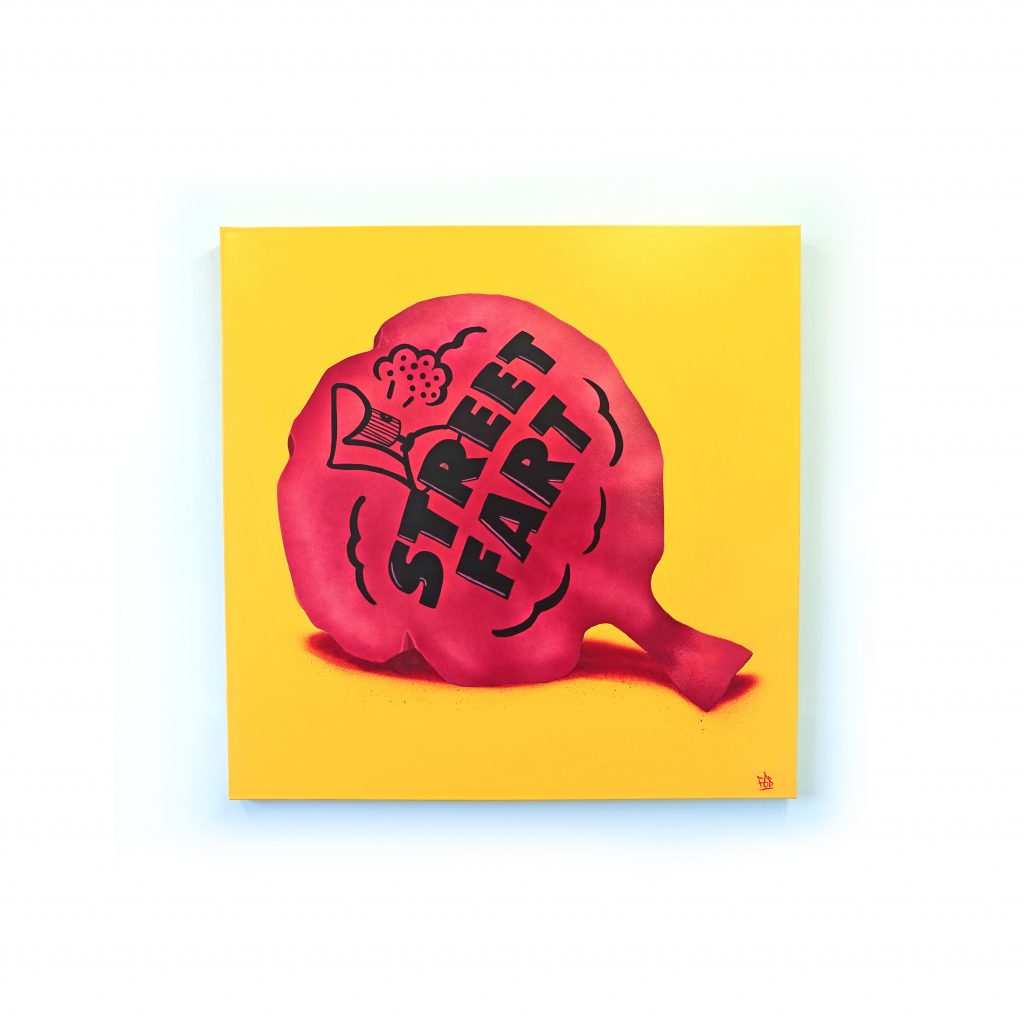
For Ray Bonner, better known through his artist name Francois Got Buffed, or FGB, a wall is never simply a blank surface waiting to be filled. It has a shape, a setting, a speed of encounter. There may be a lamppost in front of it, a tree nearby, a strange architectural break, traffic moving past too quickly for small details, or a light that changes how the work behaves after dark.

Those interruptions are not always problems. For FGB, they can become the beginning of the work.

“I like to try to add elements from around the wall you’re painting on,” he says, “to add to that sense of place.”

That sense of place runs through the conversation. At the time of speaking, FGB was planning a commercial mural with a floral brief – “not exactly my usual kind of thing” – on a large hoarding beside a road. The location immediately shaped the approach. Most people would see it from a moving car, so the image needed to hold at speed.

“I think it’s going to have to be big, bold, graphic,” he says, “but I’ll try to have a really soft colour palette on it.”

That balance is important. FGB’s work is often bright, pop-influenced and playful, but it is not simply loud. It responds to where it is. A mural on a roadside needs a different kind of clarity from a painting someone can stand in front of. A lamppost, rather than being ignored, can become part of the composition. A tree can be used to make the image feel as though it belongs to the place already.

“It’s playing about with perception,” he says. “That can also be fun.”

Working With the Street

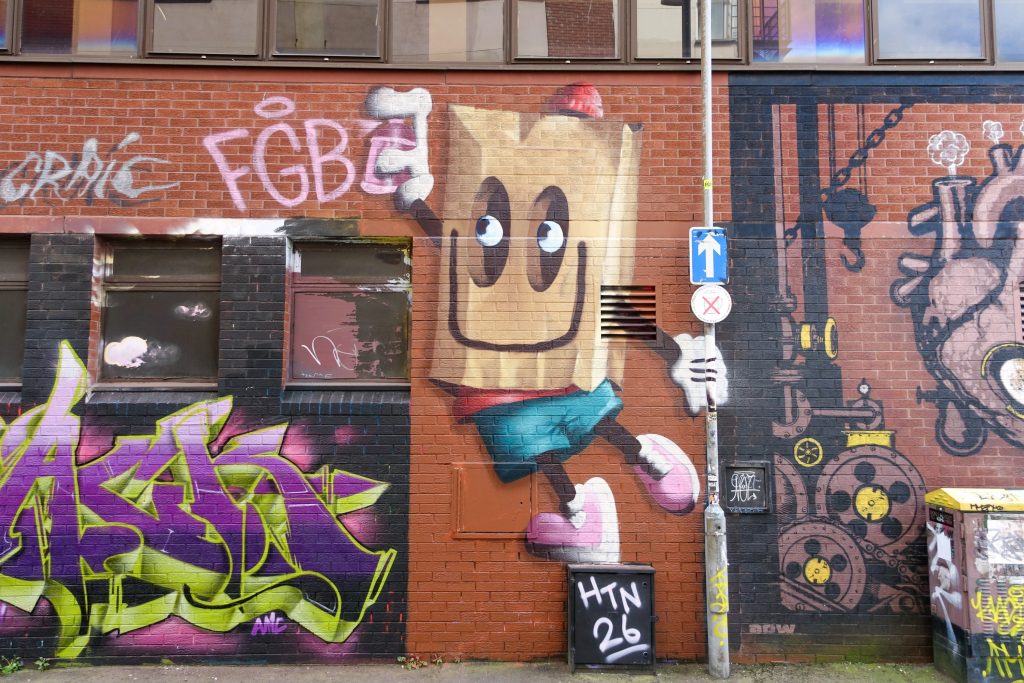
FGB is interested in the way murals can work with the objects already present in the street. Lampposts, lights and other pieces of street furniture can interrupt a wall, but they can also offer something to play with. He likes the thought of using real light, imagining how colours on the wall might appear when the lamps come on at night.

“I love the idea of playing about with the actual light,” he says.

In that part of the conversation, Ana Fish comes up through her own mural work, where a lamp became a central point rather than something to be disguised. FGB also mentions Keyto at Hit the North, whose frog appeared to hold onto a lamppost, with cardboard fingers physically attached to the pole.

“It’s fantastic,” he says.

These examples matter because they reveal what FGB values: a mural that notices where it is. The strongest street art, in his view, is not just an image pasted onto a wall. It is an image that understands the wall, the street and the way people move through the space.

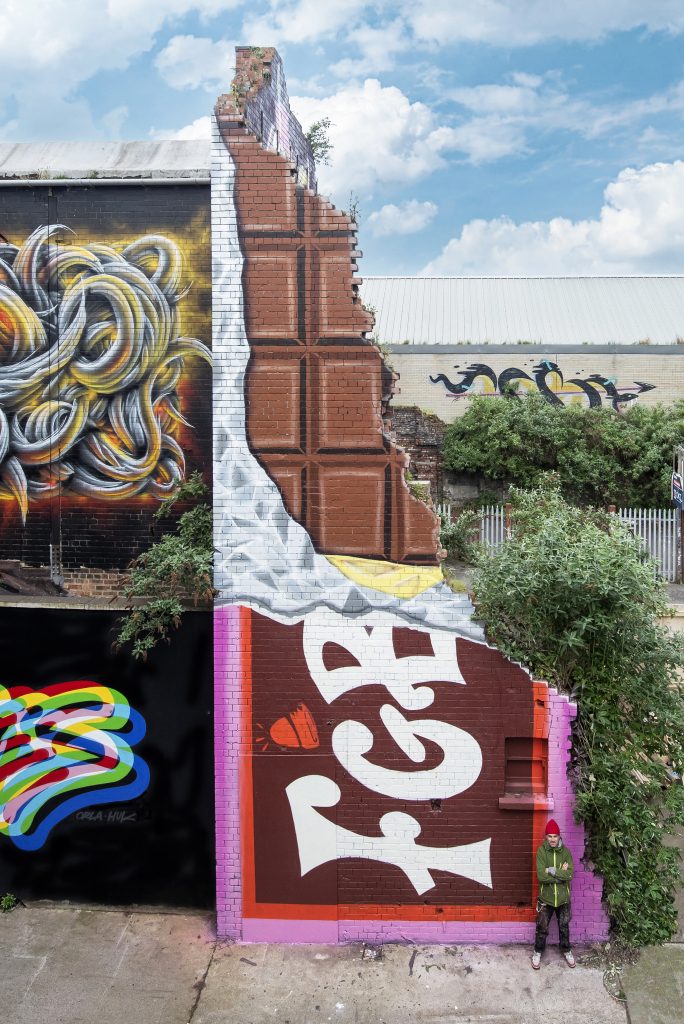
One of his own clearest examples came at Hit the North in 2024. At first, he was frustrated by the awkward shape of the wall he had been given. Then, looking again, he saw something else.

“It just looks like a chocolate bar with a bite out of it,” he remembers thinking.

From that awkward shape came a collapsed structure reimagined as a bitten chocolate bar, with the lower section becoming the wrapper. The wall’s problem became the work’s personality.

Photograph: @streetartatlas

The Chocolate Factory and the Peace Process

FGB initially tried to draw a more explicit political reading from the chocolate bar. In 2024, he realised he had spent half his life before the Good Friday Agreement and half his life after it. He began thinking about Charlie and the Chocolate Factory.

“We had been given the keys to the chocolate factory,” he says.

The image started to carry a question: had the years since the peace process been used well, or had there been a missed opportunity?

The Old Days of Street Art

When FGB talks about street art, he speaks with affection for its earlier atmosphere. When he first started, anonymity was not a branding device. It was part of the conditions of making the work.

“I remember when I first started,” he says, “anonymity was permanent.”

Street art, he explains, was still viewed in much the same way as graffiti. It had not yet been widely monetised, accepted or folded into commercial design culture. People encountered the work by being physically present with it. They saw its scale, the wall, the street, the weather, the surrounding sounds and smells.

Now, much of that encounter happens through social media.

“Everybody’s looking at these things on tiny screens,” he says, “and you just don’t get that same impact.”

FGB is not dismissing social media entirely. He uses it himself, including to show how his work is made. But he is aware of how it can flatten the experience of street art. It can encourage work that fits neatly into a square or rectangle rather than work that belongs fully to the place it occupies.

Back then, he says, there was more emphasis on placement. Artists would see a space, photograph it, sketch for it and make something that worked there specifically.

“People put a lot more thought into, ‘I can see such and such going in this space,’” he says.

That way of thinking still guides him.

Collaboration on the Wall

FGB is also drawn to walls that behave as shared conversations. At festivals, artists are often given their own rectangles, but he remembers the older feeling of walls where artists let their pieces connect: one colour moving into another, a background extending across a boundary, small gestures making separate works feel cohesive.

“It was that element of collaboration,” he says.

He points to Irony and Vents at the end of Union Street as an example. Irony’s painted woman and Vance’s traditional graffiti piece below it used related colours, and a small drop shadow made the letter appear to sit over the figure’s arm.

“It’s just touches like that,” he says, “they link the pieces together.”

KVLR also comes up as an artist particularly good at this. FGB describes him as someone who will suggest bringing one background into another artist’s space, or sharing a colour so the wall becomes one larger artwork.

For FGB, this comes from graffiti. Writers working together would link their pieces so individual names still formed part of a whole. That old grammar still has value. It makes the wall feel alive with exchange rather than divided into competing panels.

Skateboards, Cartoons and Graffiti

FGB’s visual influences begin outside the gallery. Skateboard graphics were crucial.

“Skate graphics were definitely a massive influence,” he says. “I would sit and stare at the images in skate magazines or catalogues looking over the graphics.”

He was drawn to bold colours, solid outlines and the way artists used the limited space of a deck. That still resonates with him and his own use of space.

T-shirt design had a similar impact. He mentions Bathing Ape designs from the late 1990s and early 2000s, where a simple but well-executed logo showed how powerful a repeated graphic identity could be.

Cartoons also shaped him deeply. They offered colour, bold line and surreal freedom. Bodies did not have to behave like real bodies. Arms could be too long, heads could be too large, forms could be distorted and still feel alive.

“You don’t have to make things look human,” he says. “They don’t have to be realistic.”

Graffiti was another major influence, though his early experience of it was shaped by the North. Growing up, he mostly saw political graffiti made with brushes, rollers and household paint. When he saw more colourful graffiti through skate magazines, and later in Dublin, it hit differently.

“When I saw proper graffiti it was like a colourful punch in the face,” he says.

Dublin became important because it showed him placement in action: work appearing in perfect spots, or in obscure places that made the city feel charged with possibility.

Showing the Labour

FGB often shares the process behind his murals, not just the finished image. In an age of instant AI images and frictionless online content, that feels increasingly important. It shows that a mural is not simply an image arriving from nowhere. It is planning, drawing, measuring, prep, mistakes, adjustments and physical labour.

“I think that showing how the work is created helps break down the barriers of ‘how does it get there,’” he says.

One of the questions mural artists are asked most often is how they paint at that scale. FGB sees process-sharing as a way to demystify that, especially for newer artists.

“Showing the creation process helps demystify that,” he says.

It can also make the work more generous. He has learned from watching other artists, picking up small tips and tricks or refining his own process through conversation. For him, newer artists can sometimes focus too much on the spray painting itself without seeing the amount of preparation that happens before anyone touches the wall.

“Seeing the work that other artists put into the prep should help them see it’s not just about the artwork on the wall,” he says.

That belief connects to his own practice. A finished wall may look playful, but behind it sits drawing, value, colour planning and repeated problem-solving.

Learning Colour Differently

Colour is central to FGB’s work, which makes it striking when he explains that he is colourblind.

“When I first kind of started doing street art,” he says, “I just done everything in black and white, because I didn’t like using colour.”

Over time, he developed workarounds. If someone points to a blue, he might know it as a particular Montana 94 colour rather than simply blue.

“I’ve learned colour through various paint companies’ range of paint,” he says.

A mentorship with Irony in London helped refine this even further. Irony had scanned colours from spray paint ranges and organised them by value, from light to dark, allowing FGB to work more analytically in Photoshop or Procreate.

“It’s just been unbelievable,” he says.

Rather than treating colourblindness only as a limitation, FGB has built a process around it.

“What way can I create a process so I can work with this?” he asks.

That question seems to run through much of his practice.

Oul Paintings and Bright Intrusions

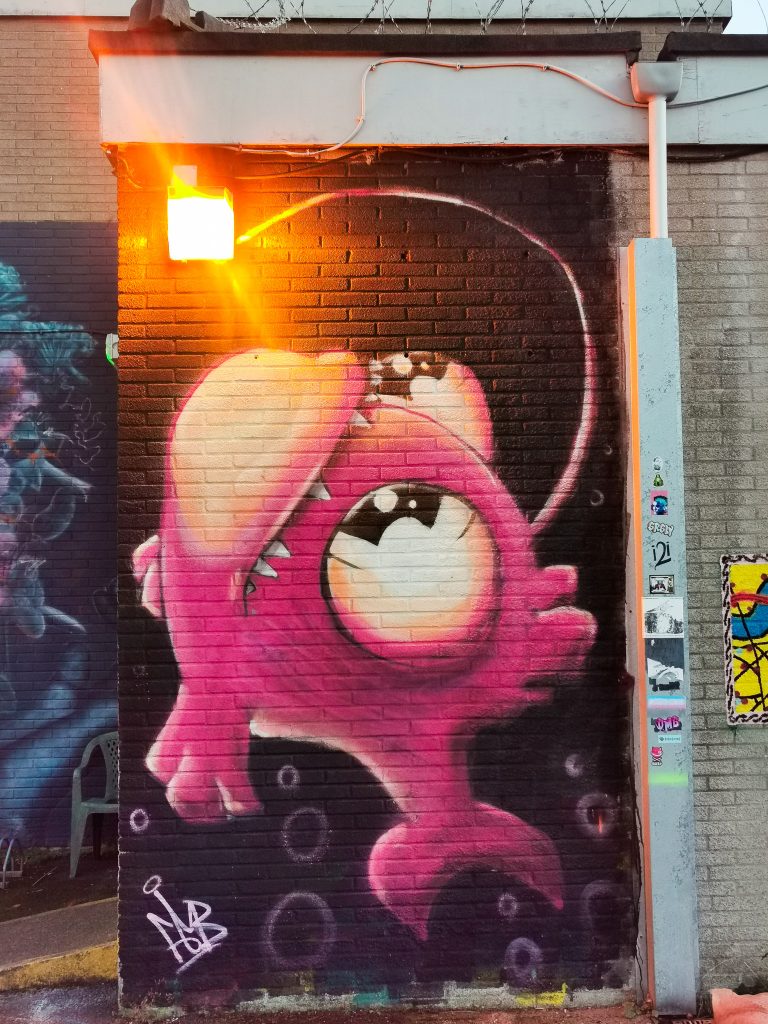
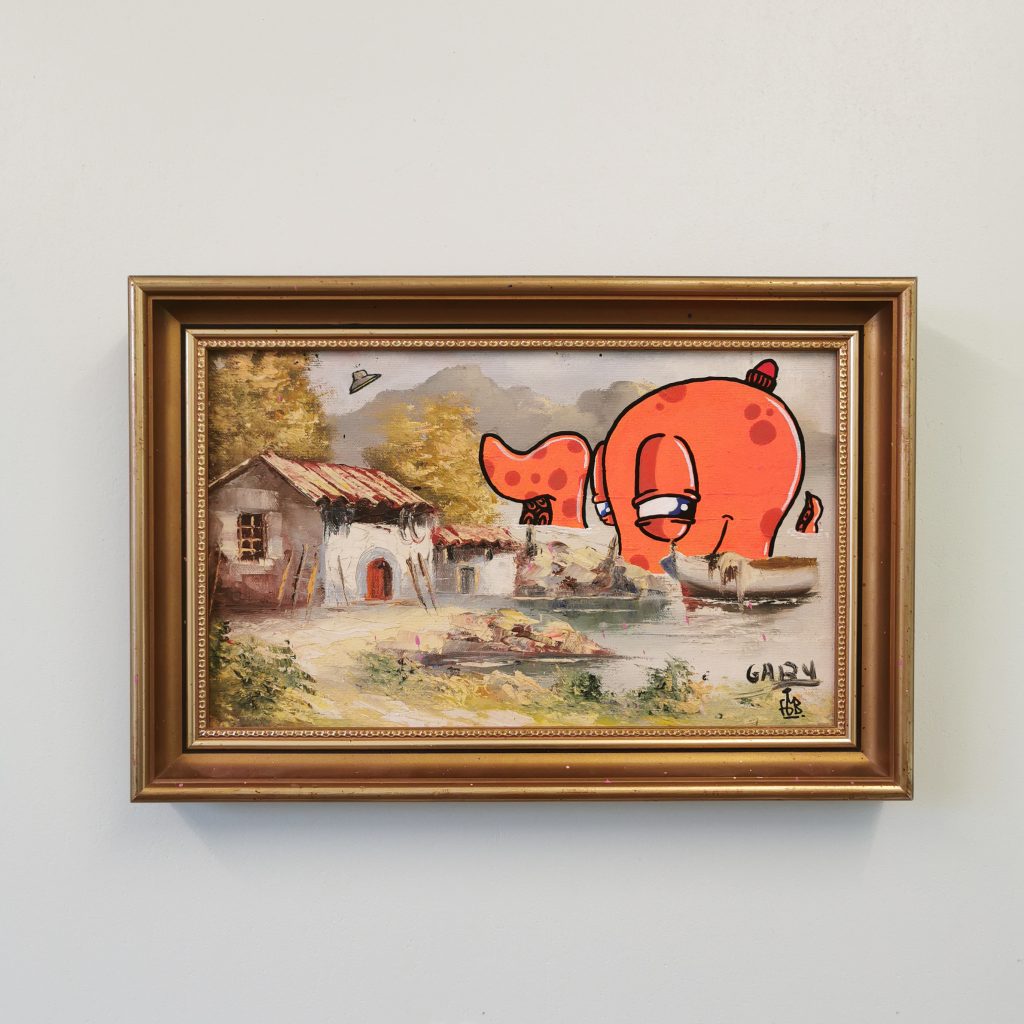
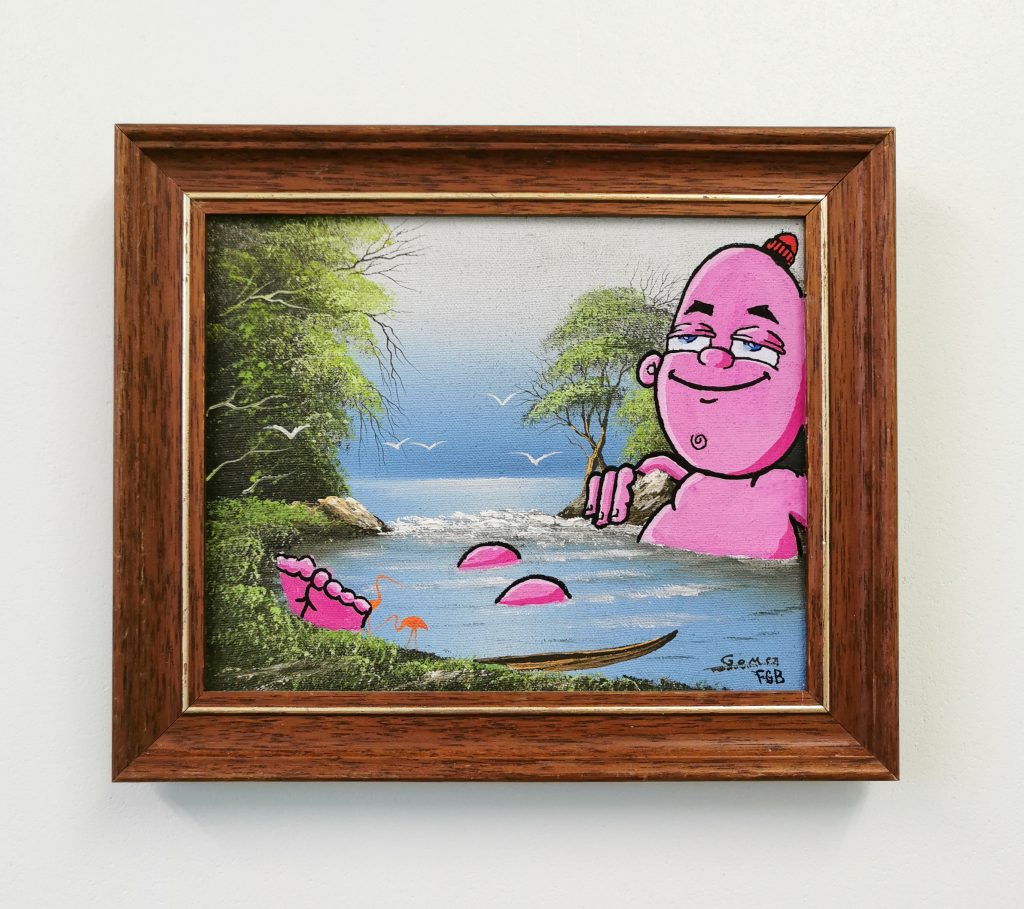
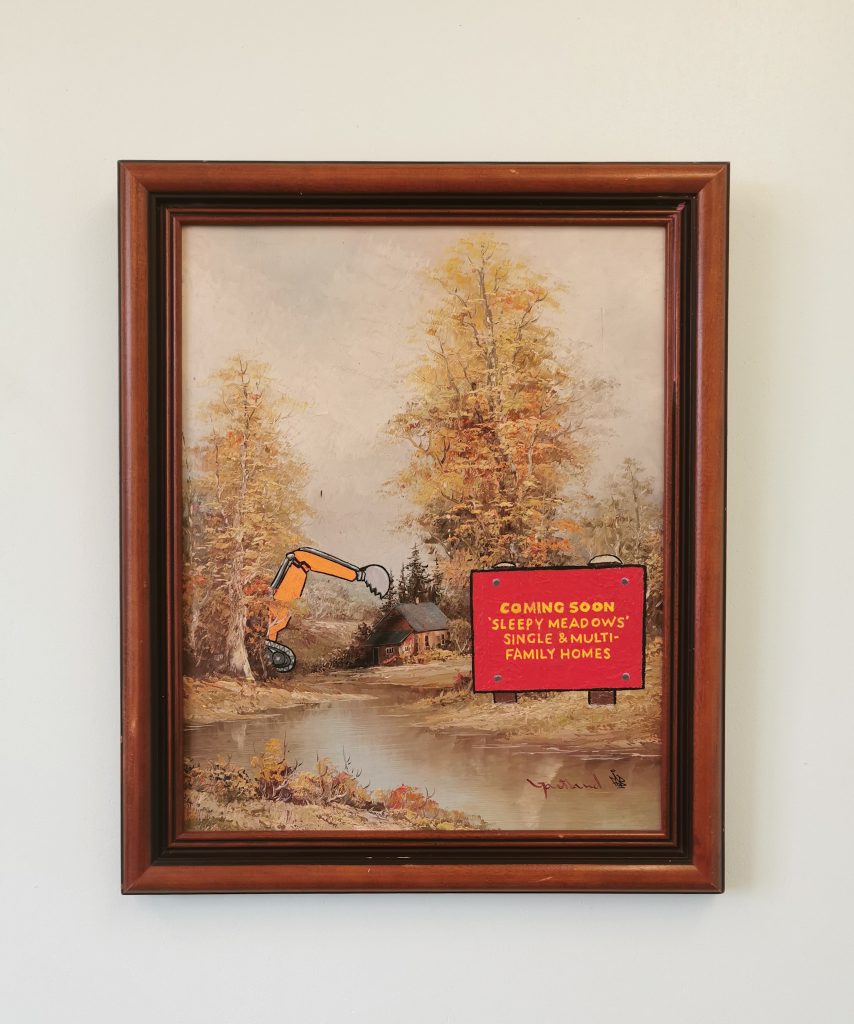
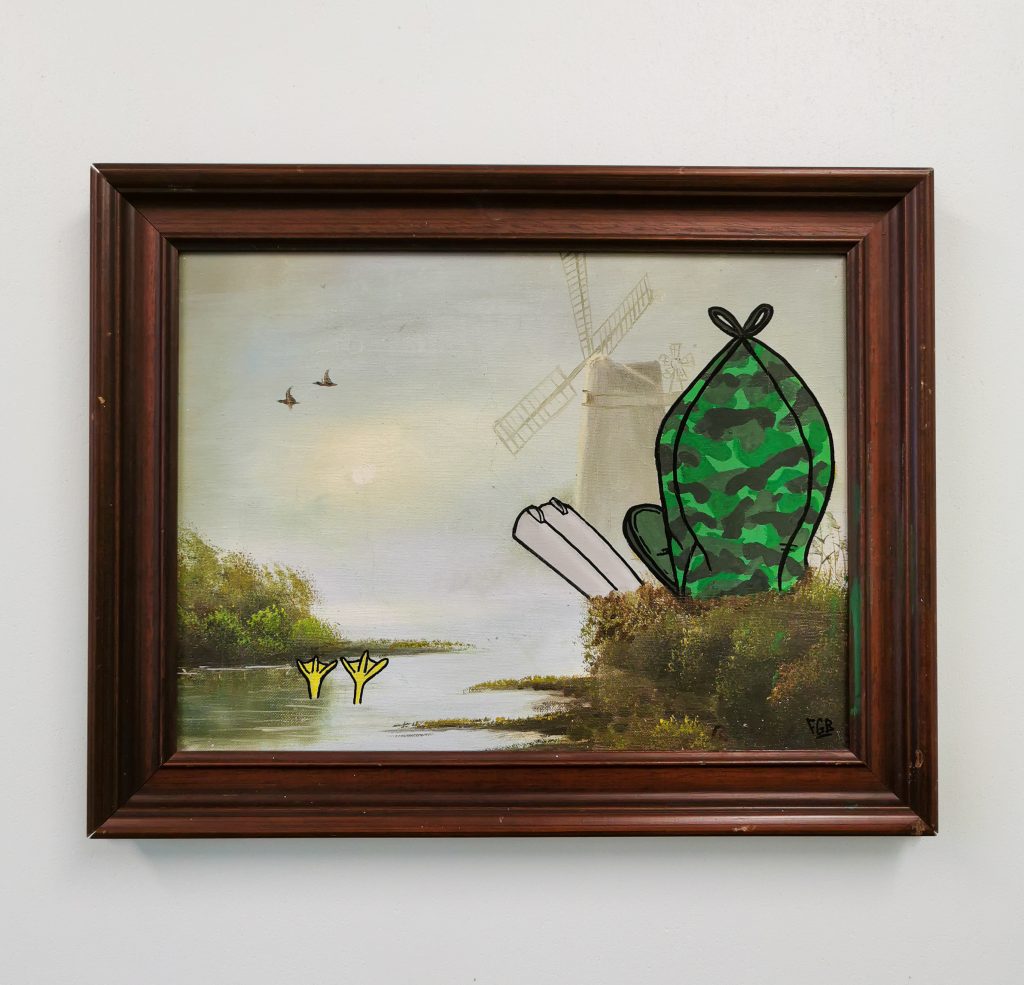
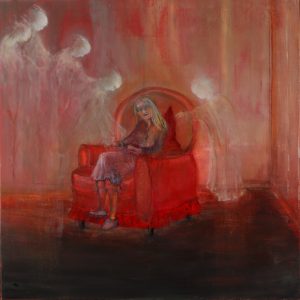
FGB’s work with found paintings also reflects his interest in contrast. He speaks about finding old paintings with subdued or neutral palettes, to which he introduces the arrival of his own brighter forms – pinks, oranges, octopuses or strange characters – cutting into those quieter scenes to create Oul Paintings.

“I think it is that idea of these beautiful old paintings that are quite soft,” he says, “and then I use a lot of pinks and oranges.”

The result is a collision of visual languages. The inherited painting meets the cartoon, the street mark, the strange interruption.

The Temporary Gallery

The word “buffed” points directly to the temporary nature of street art: work can be painted over, tagged, weathered or removed. For FGB, that impermanence is both frustrating and energising.

“I think it’s a bit of a mixed bag,” he says.

He enjoys seeing fresh pieces change over time as tags are added and walls begin to deteriorate. It gives the work what he calls a “colourful lifespan.”

“You’re not really going to get a chance to come back and fix bits you don’t like,” he says.

That makes him want the work to be as close as possible to what he intended while he works. At the same time, he values the idea of the city as a constantly changing gallery.

“You want to see new things happening,” he says.

Some losses are harder. He mentions ACHES and VOYDER on the bingo hall, two major artists whose works disappeared when the building was knocked down. It is a reminder that even large public artworks can vanish with redevelopment.

“Really appreciate it while it’s there,” he says.

Subculture, Development and Vault

FGB is alert to what happens when corporations move into street art. As murals become popular, they can be used to make brands look cool, decorate developments or sell a version of subculture back to the people it came from.

“It happens to all subcultures,” he says. “The corporate world start to see value in it and how they can benefit from it.”

He contrasts that with artists who want to respond to place, community and meaning. Companies, he says, often want the cheapest and quickest way to put something on a wall.

“They just don’t give a shit about that,” he says.

This is where spaces like Vault Artist Studios matter. FGB sees Belfast as full of empty buildings with potential, many in overlooked areas. Used well, those spaces can bring creative life into communities without simply gentrifying them.

“They can reinvigorate these places,” he says.

Vault has also shaped his own practice. Having a dedicated space mattered, but so did the daily presence of other artists, performers and makers.

“Communities are massively important,” he says. “I know my practice benefited massively when I joined Vault.”

The support, exchange and shared knowledge of that community have had a lasting impact. It also makes creative careers visible. FGB mentions the circus performers at Vault as an example: young people may see circus or art as entertainment, then realise through open studios that these are possible lives.

“All of a sudden,” he says, “it’s something that’s just a normal job.”

The Work Behind the Wall

For all the immediacy of FGB’s finished work, he is still actively studying. He has been teaching himself drawing, buying packs of small A5 sketchbooks and doing at least one drawing every day.

“Even if you think you’re good at something, you can always improve on it,” he says.

He has also been reading Drawing on the Right Side of the Brain, captivated by exercises that ask the artist to draw upside down so the object becomes line, shape and angle rather than a named thing.

“You’re not thinking of it as a person sitting in a chair,” he says. “It’s all abstract.”

The same attention now goes into colour mixing, studio work and the foundations beneath each piece. Spray paint gives him individual colours ready-made, but painting in the studio asks for another level of mixing and control.

“If your sketch is brilliant and then your colours are brilliant and your tonality’s brilliant,” he says, “it’s just all these things that add up to make each artwork as good as it can be.”

That may be the clearest way to understand Francois Got Buffed. The work is playful, public and bright, but it is not casual. It is built from looking carefully: at walls, decks, cartoons, graffiti, lampposts, oul paintings, other artists, colour systems, empty buildings and the changing city itself.

The finished mural may be temporary, but the thought behind it stays with you. It asks you to look again at the street, and to notice that even the awkward wall may already be waiting to become something stranger and more alive.

To find out more about Francois Got Buffed, visit his website: francoisgotbuffed.wixsite.com
To explore more of Francois Got Buffed’s work beyond the wall, visit his online shop: fgb.bigcartel.com
And keep up with him via social media: @francoisgotbuffed

Support Go Leor. Get the Print. Join the Story.

Go Leor is an independent Irish arts magazine built by hand, heart, and community. Your support keeps meaningful storytelling alive – in print, in culture, and in conversation.

Through Patreon, you can support the magazine in two simple ways:

  • Supporter Listing
    Have your name printed inside every issue as part of the community helping Go Leor grow.
  • Print Copy – UK & Ireland
    Receive the latest print issue delivered each month across the UK and Ireland, with your name included inside the magazine.

The Latest Articles