
Mark Malone
Sound Migration
An exploration of how people are drawn into online spaces – and how understanding, not judgement, might be the way out
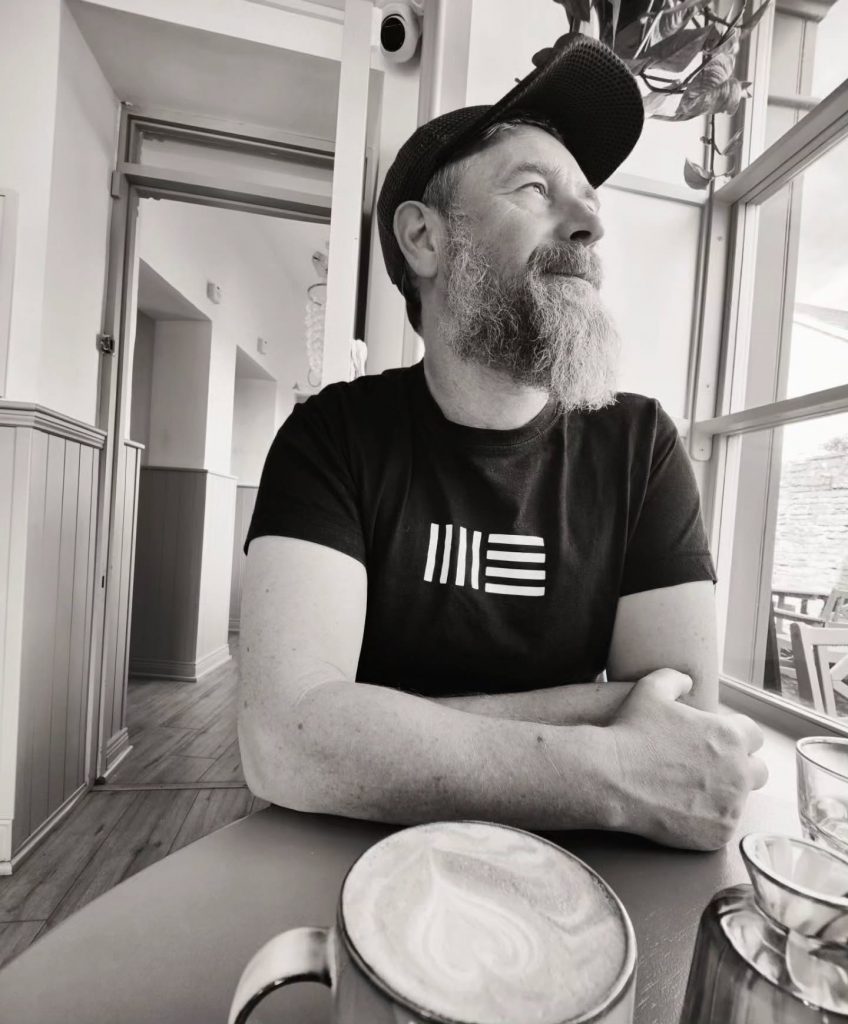
“I grew up in a fairly militarised part of the country… there’s a certain level of political literacy that goes with just the nature of where you’re born.”
For some people, questions around identity, belonging, and fairness arrive gradually. For others, they are simply part of the environment from the beginning. They are not abstract ideas but lived realities, shaping how the world is understood long before there is any need to define them.
“Politics was kind of a normal thing… it wasn’t a foreign kind of way of thinking about the world.”
That familiarity did not produce certainty. Instead, it created a habit of noticing – of recognising that people move through systems, and that those systems influence how people relate to one another.
Learning Through Doing
In Belfast in the late 1990s, that awareness began to take a more practical form. It was shaped not through formal structures, but through shared spaces where people organised, created, and responded together.
“I was in and around… DIY scenes where people were organising and creating spaces and resources for themselves.”
There was something compelling about that approach. It suggested that change was not something distant or abstract, but something that could be built – often imperfectly – by the people closest to it.
“It was quite attractive… seeing people create their own spaces and resources… that opened up questions around power and how systems are structured.”
Those early experiences were not about fixed positions or rigid ideas. They were about participation, experimentation, and a sense that understanding comes through involvement rather than observation.
A Grounded Life
Alongside this, there was always something more immediate – work rooted in the physical world.
“Construction… that’s what I’ve always done.”
It was not separate from everything else, but part of the same life. A family trade, something practical and tangible, offering a different kind of perspective – one grounded in making, building, and working alongside others.
After time in Belfast, a move south came not through planning a new direction, but simply through work.
“It was primarily construction… I’d been in Belfast for almost ten years and wanted to try something different.”
That duality remained – the physical and the social running alongside each other, each informing the other in quiet ways.
A Change in the Landscape
Around the early 2010s, something began to shift in how people connected and organised.
“I started seeing… organised anti-migrant and anti-Muslim activity… particularly online.”
At that time, there was a widespread belief that social media platforms might act as tools for liberation. Events like the Arab Spring were often framed through that lens, described as movements enabled by platforms like Twitter – spaces where people could organise, communicate, and challenge power structures.
“There was an argument… that things like the Egyptian revolution were ‘Twitter revolutions’… tools for democracy or liberation.”
But that understanding didn’t hold for long.
“In reality, they’re just tools… they get used by whoever is using them.”
What followed was a clearer recognition that these platforms didn’t simply reflect the world – they shaped it. They influenced how people encountered information, how they responded to it, and how ideas moved between individuals and communities.
The Blurring of Worlds
Over time, the distinction between online and offline began to fade.
“People don’t live separate online and offline lives anymore… they just have the internet in their pocket.”
This shift changed more than convenience. It altered the pace and intensity of everyday life. Where once there was distance – a newspaper, a broadcast, a moment to step back – there is now a constant stream of information.
“Thirty years ago you had a news cycle… now it’s 24/7, always there.”
That constant exposure does not just inform. It creates pressure, shaping how people feel as much as what they think.
How People Get Pulled In
There is often a tendency to imagine that people adopt harmful ideas through deliberate, clear decisions. The reality is usually much less defined.
“Very few people… wake up one day and decide. People tend to drift into these movements.”
That drift begins with something familiar. A sense that something isn’t working, or that something important is being overlooked.
“There are very real anxieties out there… around housing, around how people are being looked after.”
These concerns are not imagined. They are grounded in everyday experience, and they carry weight.
Within that, there is often something that resonates.
“There is always an element… a grain of truth in how things are framed.”
The difficulty lies in how that truth is used. Instead of leading to deeper understanding, it can be redirected.
“That energy gets directed elsewhere… blame gets placed on others.”
What begins as a question becomes a narrative, and over time that narrative can become difficult to step outside of.
Belonging and Identity
Part of what makes these spaces powerful is not simply the ideas they promote, but the sense of connection they provide.
“It creates identity… it creates bonding.”
For many people, that sense of belonging is immediate and meaningful. It offers clarity in uncertain moments, and connection in places where that may feel absent.
“People can end up living their entire social lives in these spaces.”
Leaving, then, is not just about changing a viewpoint. It can mean losing a network, a shared language, a place to exist.
The Limits of Labelling
In response, it is common to simplify – to apply labels, to categorise, to draw clear boundaries between positions.
But this can make understanding more difficult rather than easier.
“Terms get used as slurs rather than as descriptive… and that’s not useful.”
Reducing people to categories removes the possibility of nuance. It creates a fixed picture where, in reality, people are constantly shifting.
“We all hold contradictory ideas… people are persuadable.”
If there is no space for that movement, then there is no space for change.
“If people feel written off… you lose the ability to understand why they’re there.”
The Design of Attention
The environments people move through are not neutral.
“They’re designed… to maximise engagement.”
In practice, this often means prioritising content that provokes strong emotional responses. Fear, anger, and urgency travel quickly, and are reinforced by the systems that surface them.
“High intensity emotions tend to be negative… and that aligns with how certain narratives spread.”
This creates a cycle where particular types of content become more visible, shaping not only discussion but perception itself.
What Gets Amplified
Certain themes appear again and again, regardless of place or context. They surface in different conversations, different communities, but they follow a familiar pattern.
“It’s the same narratives… fear around attacks on women, on children.”
These are not abstract fears. They are rooted in real experiences, in real harm, and in long-standing issues that exist across society. Violence against women, abuse, and harm to children are not new problems, nor are they confined to any one group. They are deeply embedded issues that cut across communities, often happening in private spaces, often unspoken, and often unresolved.
“Sexual violence is real. Harm to children is real.”
Because these fears are real, they carry weight. They are felt instinctively, and they demand attention. People want to feel safe. They want to know that those around them are protected. They want answers to problems that have, in many cases, persisted for generations.
Within that, there is something powerful – but also something that can be redirected.
“There are feelings and anxieties that can be mobilised.”
What often happens is not the creation of fear, but the reshaping of it. Complex, systemic issues – rooted in culture, inequality, silence, and long-term patterns – are reframed into something more immediate and more easily targeted. The focus shifts away from the broader reality of these problems and toward simplified explanations that place responsibility elsewhere.
In doing so, the original issue can become obscured. Instead of asking why these harms exist, or how they might be meaningfully addressed, attention is drawn toward who can be blamed in the moment.
What is left behind is the original problem – unchanged, still present, and often still unspoken.
Understanding this does not diminish the seriousness of those fears. If anything, it highlights their importance. It suggests that these are issues that deserve deeper attention, not quicker conclusions.
Because when something is both real and unresolved, it becomes easy to reshape.
A Wider Shift
Beyond individual groups, there is a broader movement in how ideas enter public conversation.
“What we’re seeing is… the terms of debate shifting.”
Ideas that once existed at the edges begin to appear in more familiar spaces, often through repetition rather than scrutiny.
“People start using the same language… and that gives those ideas more legitimacy.”
In trying to respond, there can be a tendency to mirror those narratives, but this can reinforce them instead of challenging them.
What Exists Alongside It
Despite all of this, there is another reality that receives far less attention.
“There are far more people doing positive work than people realise.”
Across towns and cities, but just as often in smaller places, people continue to come together in quiet, practical ways. These are not large, coordinated movements with clear structures or visibility. More often, they are local responses – neighbours meeting neighbours, small groups forming around a shared need, people deciding to act because something in front of them requires it.
“There’s been a very significant number of localized responses… people turning up, helping, supporting, integrating within communities.”
That support can take simple forms. Meeting someone new and helping them find their feet. Showing up when tensions rise. Creating a space where people can talk without fear of being judged or pushed into a corner. It is often less about grand gestures and more about consistency – about being present, about building trust slowly over time.
“Most of it is organic… not centrally organised.”
In many cases, people are relying on those closest to them. Friends, neighbours, local groups – the kinds of connections that exist beneath the surface of everyday life. These are the relationships that hold when things become uncertain, and they often become the first point of response when something feels like it is beginning to fracture.
What emerges from this is not a single movement, but a pattern. Small communities finding ways to support one another. People recognising that they are not as isolated as they might feel. A shared understanding that change does not always arrive from above, but can begin with the people already around you.
And within that, there is a quiet reassurance.
“There are far more of us… we’re just catching up.”
It may not always be visible in the same way as conflict or division, but it is there – in the everyday decisions people make to stand alongside one another, to listen, and to respond with something other than fear.
Stepping Back Into Perspective
Engaging with this constantly can take a toll.
“It’s not a particularly joyful thing… dealing with this material all the time.”
Maintaining perspective becomes essential.
“Simple things… spending time with people, getting outside, taking care of yourself.”
These are not small acts. They are ways of rebalancing, of remembering that life exists beyond what is presented on a screen.
“There’s a relationship between how this impacts you and what else is going on in your life.”
Making Room to Think
There is no single conclusion offered here. No demand to take a position or to arrive at certainty.
Instead, there is something quieter – a recognition that understanding takes time, and that people are not fixed.
“We all hold contradictory ideas, and people can change.”
In a world that often rewards quick judgement and immediate reaction, the ability to pause – to question, to reconsider, to look again – becomes something else entirely.
Not a weakness, but a way forward.
And perhaps, in that space, there is room to step outside the cycle.
Keep up with Mark via social media: @soundmigration


Support Go Leor. Get the Print. Join the Story.
Go Leor is an independent Irish arts magazine built by hand, heart, and community. Your support keeps meaningful storytelling alive – in print, in culture, and in conversation. Through Patreon, you can join as a monthly supporter and receive exclusive benefits across our tiered memberships:
Fir Bolg: Your name printed inside every issue.
Muintir Neimhidh: Your name + monthly issue delivered (UK & Ireland) and PDF issues.
Muintir Partholóin: All previous benefits + monthly editor’s dispatch.
Bradán Feasa: All benefits + help shape future articles and themes.
Your backing helps us print, publish, and grow a space for creative voices across Ireland and beyond.
The Latest Articles

Maria Noonan-McDermott: Where Memory Becomes Art
Transforming intimate family memories into paintings and poetry, her work invites others to recognise stories of their own.
Rosina Law-Braney: Reclaiming the Seven Deadly Sins
Through zines, illustration and humour, Rosina Law-Braney creates vibrant feminist stories that make room for identity, desire, grief and collective creative freedom.
Alexander Edward: Weaving from the Land
Growing his own willow beside Strangford Lough, Alexander Edward brings coppicing, landwork and an ancient craft into bold contemporary forms.
John Britton: Finding Calm Through Ink
After three decades of visceral performance and constant travel, John Britton has found a quieter connection through ink, mentorship and calm.
Yvonne Moore: Following Curiosity into Colour
Refusing to settle into a single style, Yvonne Moore follows curiosity across colour, poetry and community, creating art that brings her – and those around her – fully to life.

Lucy Fleming: Carrying the North Coast Light
Through fluorescent colour, oil pastel and an instinct for collaboration, Lucy Fleming turns the light of the North Coast into images that connect art, music and community.