Shirani Bolle
Artist
Colour, craft, and confrontation converge in a feminist practice that reclaims the body, the home, and the right to be seen
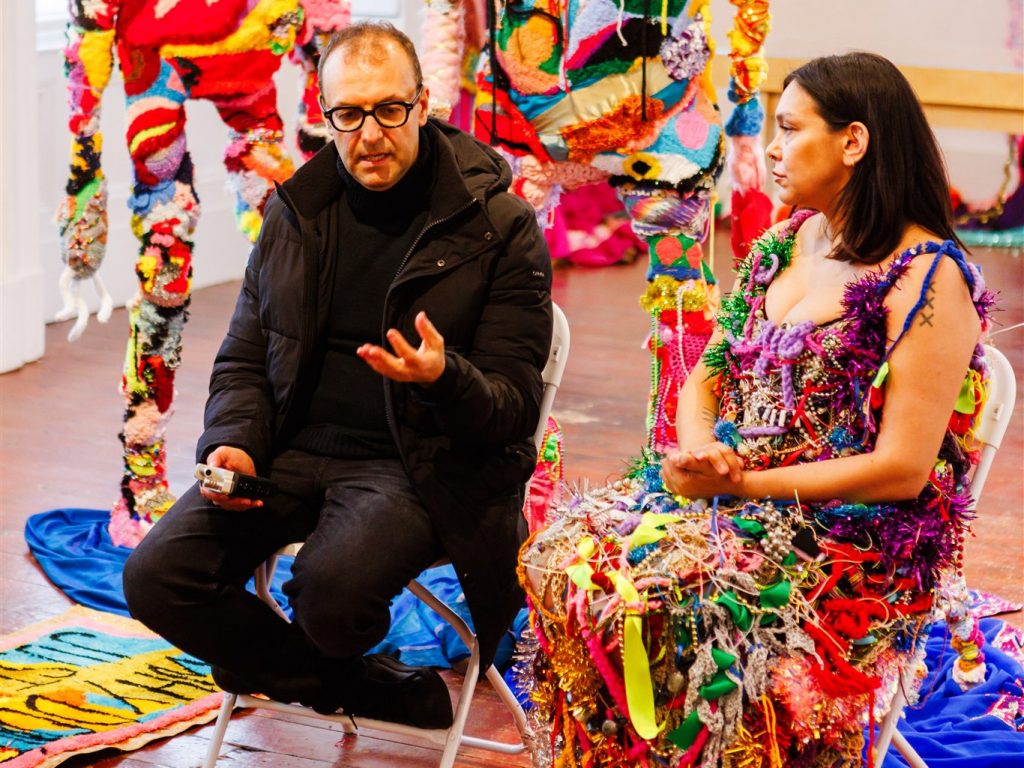
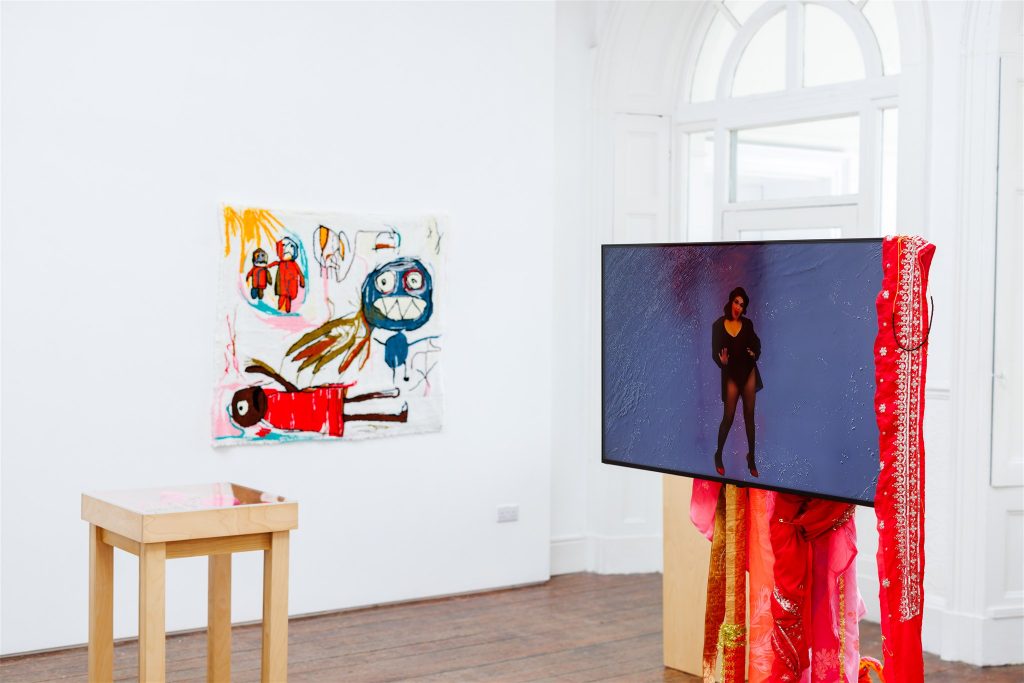
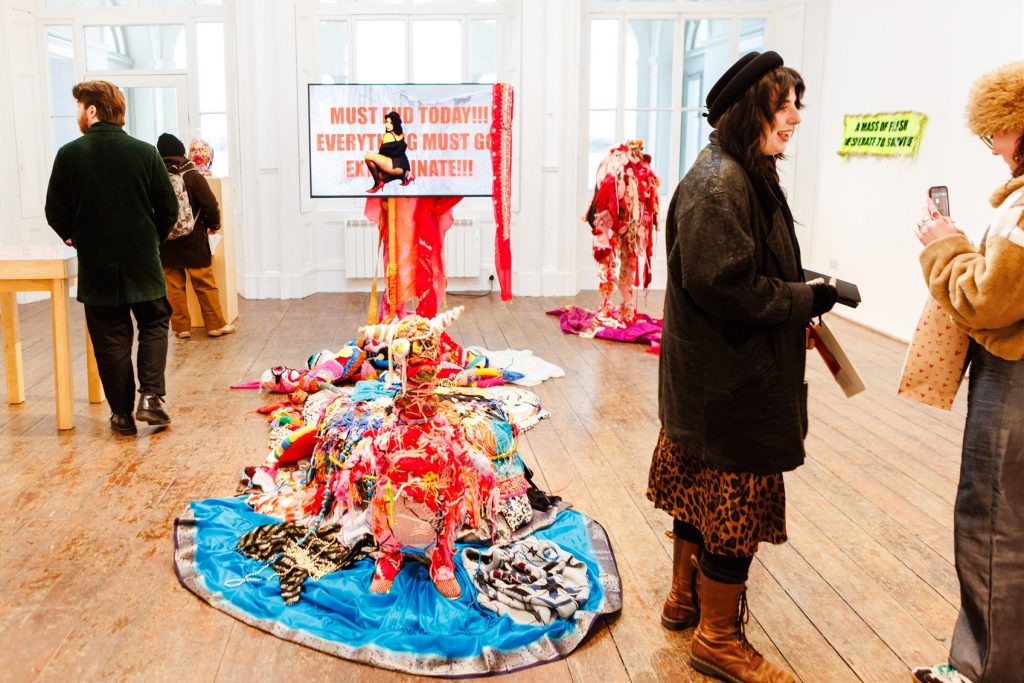
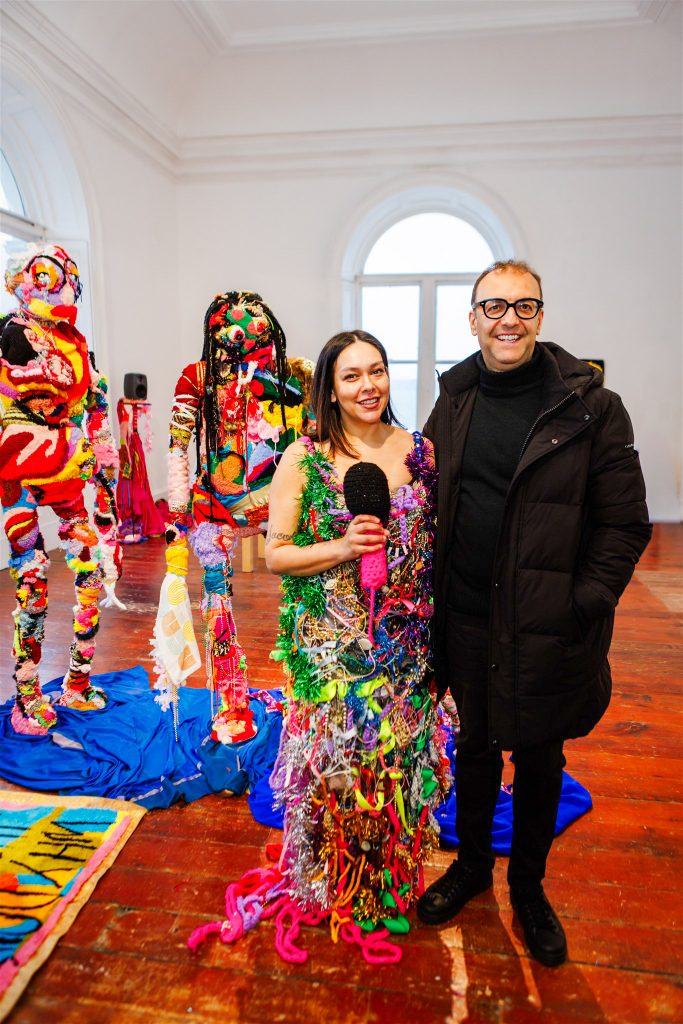
At Sirius Arts Centre, Shirani Bolle encountered her work differently in an exhibition curated by Miguel Amado, her first solo show and the largest presentation of her work to date.
The exhibition marked a turning point – not just in visibility for her work, but in understanding. As a self-taught artist, she describes her practice as something built in motion, each piece part of an ongoing process rather than a fixed outcome.
“I learned loads, to be honest. I’m self-taught, so everything I do is a learning experience… you’re just getting more and more steps as you go along.”
But it wasn’t simply the act of exhibiting that shifted things. It was the process of installation, working alongside the curator, that reframed how she understood her own output. The context of the space itself also carried weight, having previously admired exhibitions by artists like Alice Rekab and Thaís Muniz, who also explore themes of identity and diaspora through their own and intergenerational lived experience.
She describes that proximity as affirming, feeling not only inspired by their work, but genuinely part of a wider conversation she had already felt connected to before her work entered the space.
Within the exhibition, pieces she had previously dismissed – work left sitting in the studio, half-forgotten – were suddenly recontextualised.
“I get very bored… even with things I’m proud of. My mind moves on really quickly, so I can dismiss work very easily.”
That impulse – to judge, discard, move on – was challenged when it was proposed to her to bring everything into the gallery and take things from there.
What emerged was not a collection of stand-alone, separate works, but a system of relationships.
“I realised how a curator puts things together to tell a story… how every piece interacts with every other piece. And how important it is to see that journey.”
The shift is subtle, yet fundamental. The question moves from “is this good?” to “what does this do in relation to everything else?”
“It doesn’t matter whether I really like it or not… it just has to have value within the wider conversation.”
From Fragment to Whole
Bolle’s practice resists containment within a single medium. Sculpture, sound, moving image, textiles – each element emerges independently, often without a clear endpoint.
In isolation, this can feel disjointed.
“When you’re in your studio… you feel a bit crazy. You’re like, why am I doing this? None of it makes sense together.”
It is only in the gallery that the logic becomes visible.
“I realised ‘this is why’. Because I had the sculptures, and the performances, and the sound, and the film… and suddenly it’s a world.”
This idea of world-building becomes central. The work is not a series of objects, but an environment – something immersive, cumulative, and interconnected.
“That’s what I’m trying to do as an artist. It’s not about individual pieces – it’s about the whole.”
Even elements that feel unresolved in isolation – an experimental video, an unfinished form – find their place within that structure.
“Put it with everything else and it makes complete sense.”
Making Through Necessity
Bolle’s move into textiles began not as a conceptual shift, but as a practical one – a way of continuing to make work within the constraints of daily life.
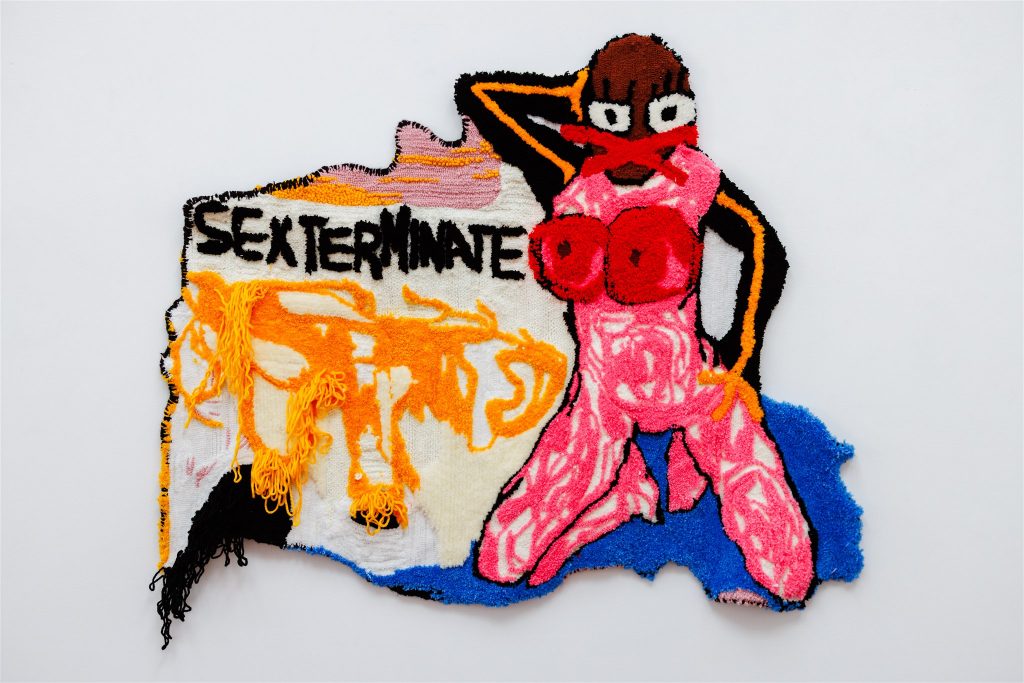
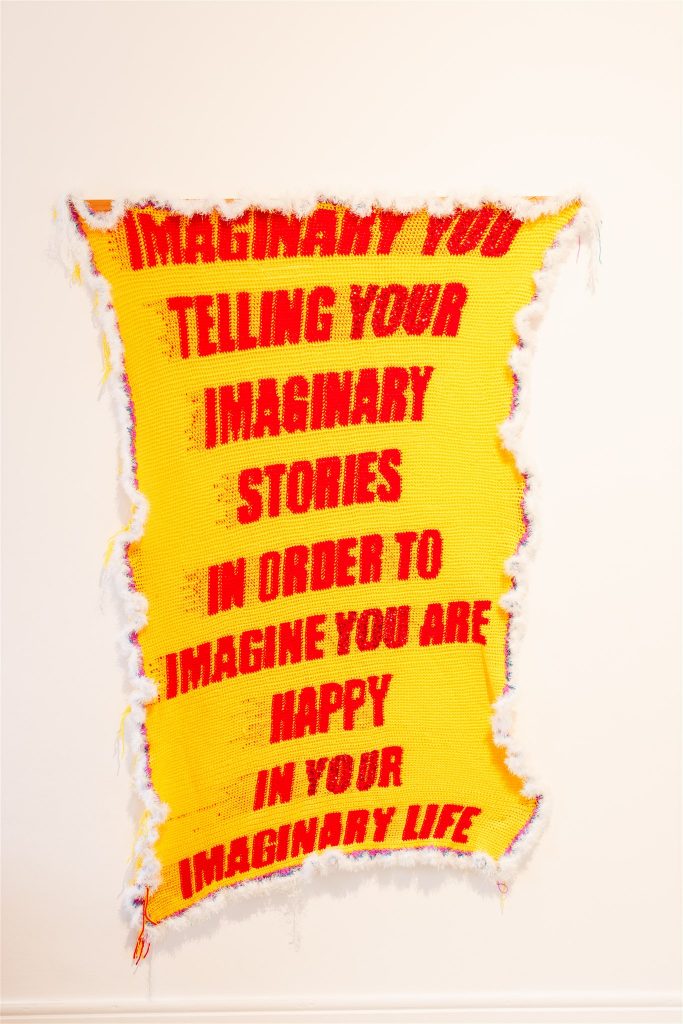
Working primarily with paint, she found the demands of the medium increasingly difficult to sustain while raising two young children. Crochet offered something different: a form that could move with her rather than requiring stillness – a quiet but pointed reclaiming of time, labour, and authorship within a space so often structured around care.
“My connection to textiles was born out of necessity really… I taught myself how to crochet and quickly realised it was something I could pick up and put down when I needed.”
The work began to unfold in fragments – in cars, at football practice, in the small intervals between responsibilities – reshaping not only how Bolle worked, but how the work itself could exist. In this, the act of making becomes inseparable from the conditions it emerges within, foregrounding a feminist understanding of labour that refuses to separate art from the realities of lived experience.
Inheritance, Material, and Collaboration
What began as a practical solution reveals deeper connections. Textiles, for Bolle, carry an inherited weight, shaped by both personal memory and wider histories of labour – particularly those historically carried by women.
“There’s an element of ancestral connection to it as my Sri Lankan grandma taught girls in the local village in Colombo how to crochet and that’s how she paid for her family to survive.”
Alongside this are early memories of making and material – her mother crocheting and sewing, and her Dutch grandmother’s cupboard filled with wool, which she recalls as “like a treasure trove.” Within that item, one discovery stands out: a small gun hidden inside a book. It’s an image that lingers, one that feels uncannily aligned with her own work – where softness and tension, care and threat, are held together within the same form.
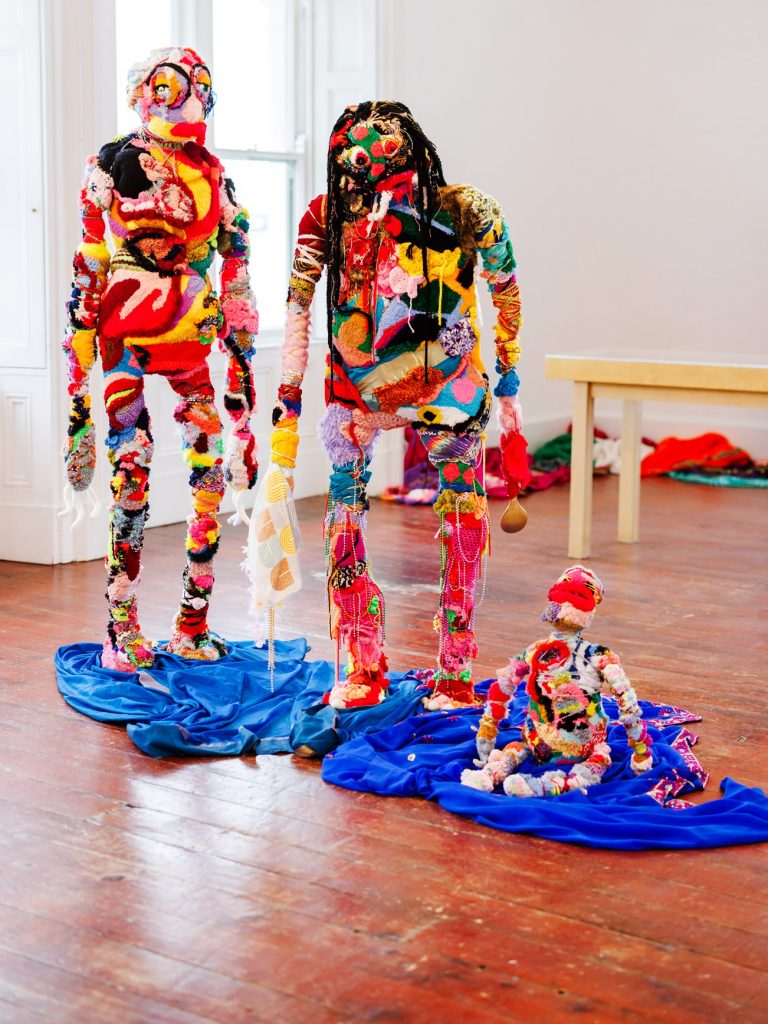
This duality runs through her sculptures. The pieces come together gradually, forming something cohesive through accumulation rather than design – a process she relates to the transformation of fabric itself.
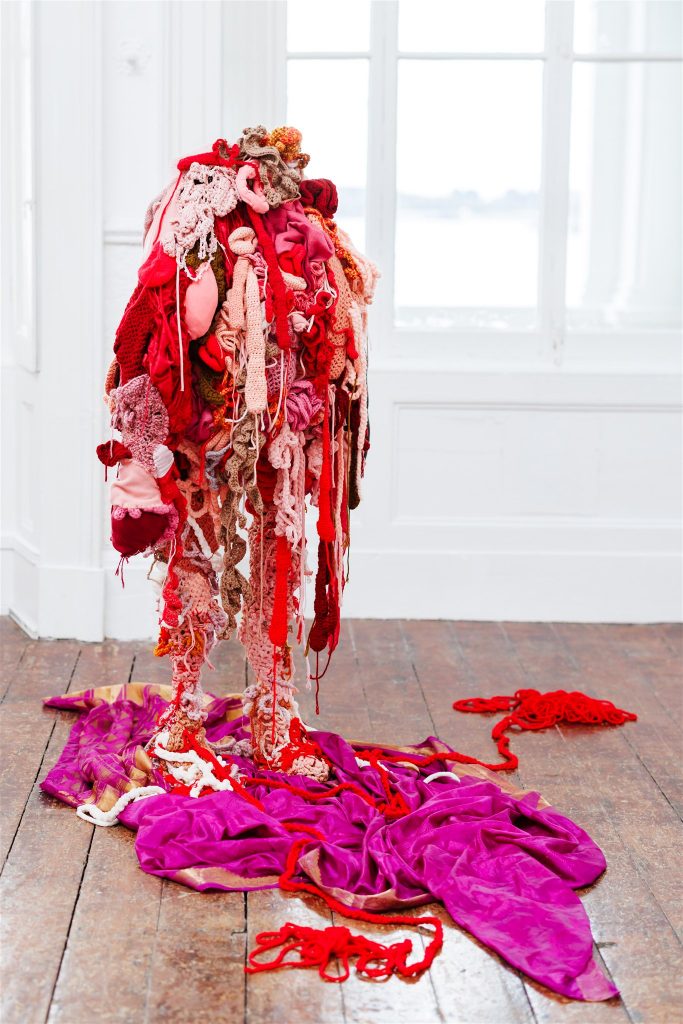
“The way that a saree is just a huge sheet of cloth with no real structure until it is wrapped around the person… that feels very much how I construct my textile sculptures.”
Her use of second-hand fabrics extends this further, bringing the labour of unseen makers into the work. These materials carry the imprint of global production systems – often shaped by gendered and racialised labour – and, in repurposing them, Bolle reframes the act of making as collective rather than singular.
“I view these works as a kind of a collaboration between me and the person working in the sweatshop… this question is often on my mind ‘who gets to be an artist’?”
The Monstrous and the Human
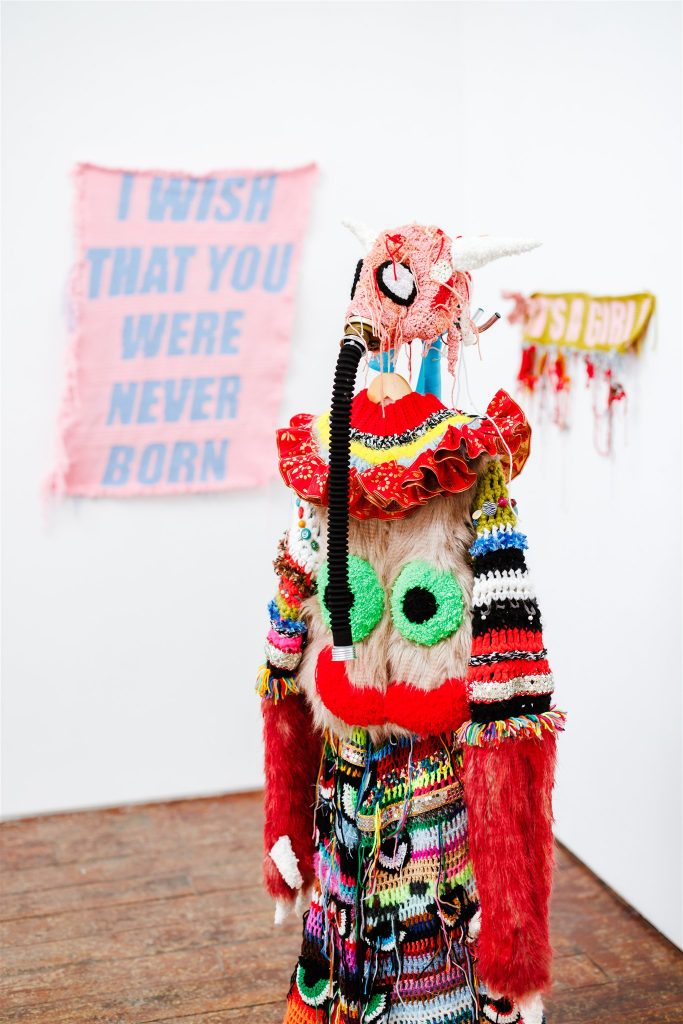
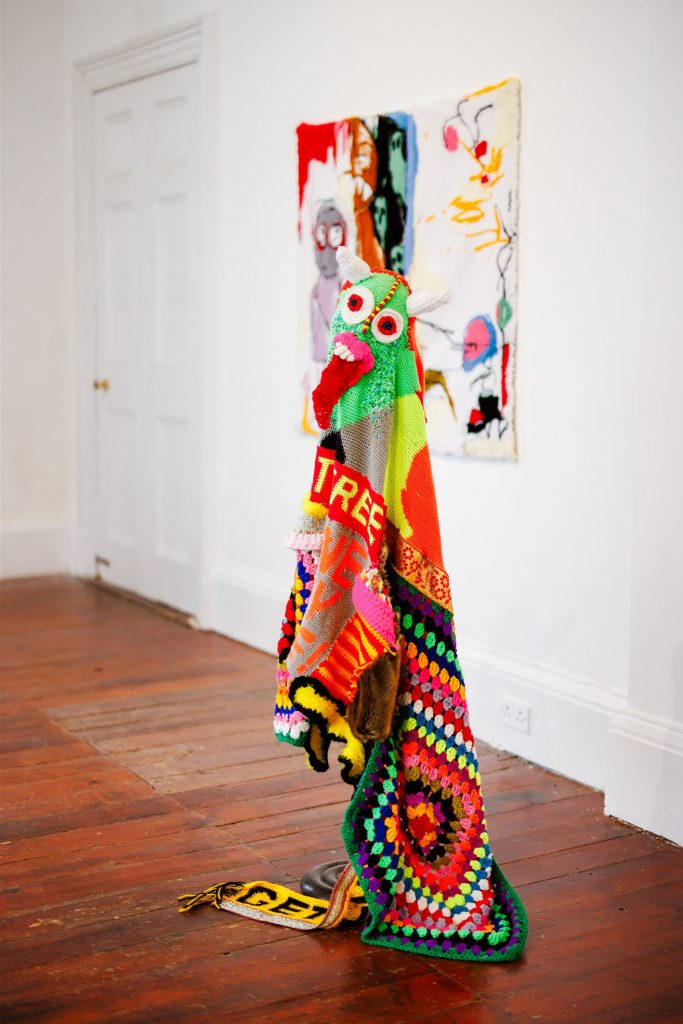
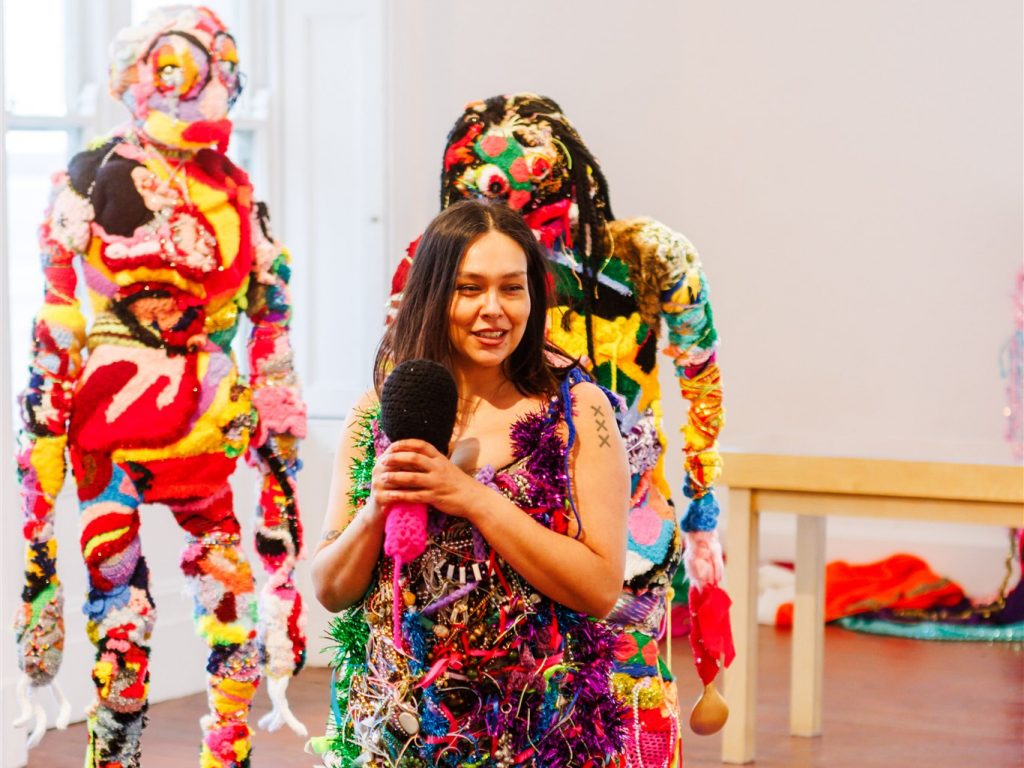
Across Bolle’s work, figures recur – soft, ambiguous forms she refers to as “monsters.” The term is provisional, but revealing.
“I haven’t settled on the name… but I keep calling them monsters.”
The word is less about appearance than it is about recognition.
“I kind of see everybody as having this potentially monstrous nature.”
Rather than depicting something external or fantastical, the figures operate as a way of surfacing what is already present – something internal, often concealed beneath social acting.
“They’re revealing the reality of who we are… the parts we try to cover up with niceties.”
In this sense, the “monster” becomes less an accusation and more a mirror – an unflinching, whole figure that holds the full breadth of human nature without reducing or softening it.
Masks, Perception, and Power
This idea extends into her engagement with Sri Lankan masking traditions, where masks are not symbolic but functional – used in ritual to ward off illness or embody specific conditions.
“There’s a belief that if you portray something – if you embody it – it has power within your reality.”
For Bolle, this intersects directly with her experience of neurodivergence, particularly the shifting nature of perception.
“So many things can feel like an attack… but that doesn’t necessarily mean that they are.”
The mask, then, becomes more than concealment. It becomes a tool – something that can alter consciousness, redirect lived experience, and create space for agency.
“Masking is seen as negative… but once you understand it, there’s a power there. You can choose how you perceive things.”
This reframing moves the mask from defence to expression.
“I believe a mask can really reveal who we are.”
Understanding Instead of Winning
Running through Bolle’s practice is a persistent question: how do we live alongside difference?
Not in abstraction, but in lived experience – family, relationships, political divides.
“I disagreed incredibly with my dad… but the only way I could move forward in my life was by trying to understand him.”
That relationship carries a deeper weight. Her father’s experience as a Holocaust survivor shaped not only his life, but the atmosphere of the home – where anxiety, vigilance, and learned fear were not abstract notions, but realities. For Bolle, this becomes a way of understanding how trauma moves across generations: how fear is absorbed, how it lingers in the body, and how it informs the way we apprehend and respond to the world around us.
It is not something she renders directly, but it underpins the emotional logic of the work – an awareness that what we carry is often inherited as much as it is understood.
This extends outward into broader social tensions, where division often hardens into certainty.
“Everyone thinks they’re right. No one thinks they’re the monster.”
Instead of positioning her work as corrective, Bolle sees it as exploratory – an attempt to create space for complexity rather than resolution.
“There is no truth… we’re all moving around in our own versions of it.”
Art, in this context, becomes a slower form of communication. Less direct, but more enduring.
“You might not remember someone saying something… but you remember how something made you feel.”
Comfort, Protest, and the Limits of Expression
This tension is brought into focus in her performance Comfort Fruit, where she interrogates the nature of protest in a mediated, comfortable world.
“I explore the paradox of protest in the digital age, where empathy often remains confined within the boundaries of comfort and where solidarity is performed at a safe distance.”
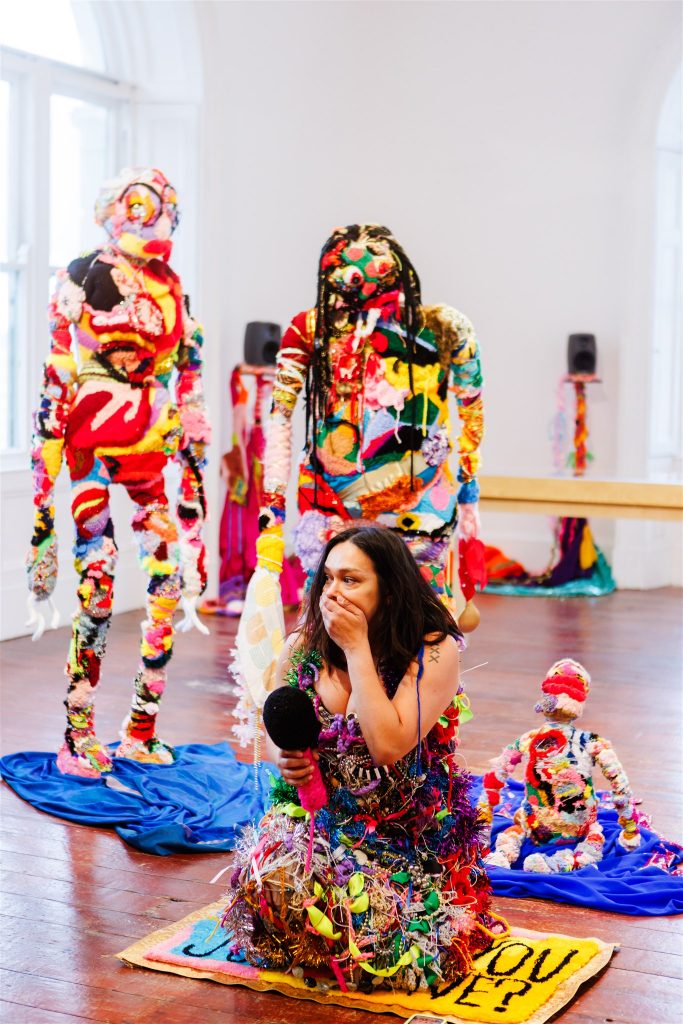
During the performance, Bolle ‘doom scrolls’ on her phone while singing Strange Fruit by Billie Holiday, positioned within a context of comfort: seated, wrapped, contained.
The contradiction is deliberate.
“It’s almost more about wanting to be right… you get a dopamine hit when people agree with you.”
The work asks a difficult question: what does it mean to care, if that care never leaves the realm of safety?
Colour as Disruption
Colour operates as both entry point and provocation within Bolle’s practice.
Audiences often respond instinctively – describing the work as playful, childlike, even “fun.” But this reading is deliberately unstable.
“I use colour as a cultural reference to Sri Lanka and beyond… where it can be used in everything.”
Placed within a Western framework, that same use of colour creates friction. It unsettles expectation.
“There’s this feedback loop… people reveal something about themselves in how they react.”
For some, the response is immediate connection. For others, distance.
“I love that. Even if people are turned off – I enjoy that reaction.”
Colour becomes a mechanism of disruption, exposing assumptions about seriousness, value, and cultural hierarchy.
Becoming the Work
It is difficult to separate Bolle from the environment she creates.
The materials, the props, the techniques, the garments – they operate as extensions rather than outputs.
“That’s the biggest compliment… when someone says you look like your work.”
This integration is not accidental. It is the result of a gradual turn toward a clearer personal alignment with the mediums, allowing the work to reflect something personal and unfiltered.
“In recent years, I’ve just gone… and made the work that’s truest to myself.”
What emerges is not a practice defined by medium, but by continuity.
Each element – visual, sonic, performative – feeds into the same evolving structure.
“It all has to come together. It has to be the whole.”
A Place to Make
Now based in Limerick City, Bolle speaks about the move away from London, where she lived before, not as a compromise, but as a necessary recalibration.
“In London, it’s very easy to feel like you’re doing something when you’re not really doing anything at all… you’re just being swept up in noise.”
In Limerick City, the pace – and the community – offers something different.
“I’ve never made more work than I have here. The community is incredible.”
What might initially appear as a quieter setting reveals itself as fertile ground.
“There’s always someone… whatever you need, there’s someone to do it.”
The result is not isolation, but focus – a terrain where the work can expand without distraction.
Learning Through Children
Running parallel to her practice is the influence of her children, whose questions – direct, disarming, and often existential – cut through the learned caution of adulthood.
Bolle discusses how revealing these exchanges can be, not just as a parent, but as an artist. Children approach the world without the same fear of asking the “wrong” question, often articulating ideas that adults have learned to suppress or avoid.
These moments become a form of clarity – reminding her of the importance of curiosity, as well as of staying close to the kinds of questions that first drove her to make art.
At its core, Bolle’s practice is driven not by answers, but by questions – often the same ones carried from childhood into adulthood.
At the same time, her children become a counterpoint within this. Their questions cut through the caution that adulthood builds, offering moments of clarity and openness that resist the tendency to close down or retreat.
Bolle speaks about how revealing these exchanges can be. In those moments, there is a reminder of something essential – of curiosity without constraint, and of the importance of continuing to ask difficult questions.
This Has Nothing To Do With Me
In her exhibition, this has nothing to do with me, Bolle expands this approach into a fully realised realm – one that resists linear reading and instead asks the viewer to move through it intuitively, encountering fragments that build into something larger.
Bolle is the definition of an artist, with an incredible ability to draw audiences into her world in every medium she turns her hand to – all disciplines are interwoven strands of the same language.
There is a generosity to the work, echoed in her presence online – her social media an outpouring of support to those struggling to communicate their own ideas and concerns. That openness carries into the exhibition, where vulnerability is not presented as spectacle, but as something lived and shared.
The cultural references embedded throughout the work reveal the depth of her life, while the playful – and at times deliberately lurid – use of textiles and colour complicates that reading. Rather than softening difficult themes, these elements becomes a way of holding them in view, allowing trauma and hurt to exist alongside humour, absurdity, and warmth.
Like the rest of her practice, the exhibition does not resolve into a single statement. Instead, it creates a space in which meaning is built through proximity – between works, between motifs, and between artist and audience.
To learn more about Bolle, visit her website: shiranibolle.com
And keep up with her journey via social media: @shiranibolle_
Support Go Leor. Get the Print. Join the Story.
Go Leor is an independent Irish arts magazine built by hand, heart, and community. Your support keeps meaningful storytelling alive – in print, in culture, and in conversation.
Through Patreon, you can support the magazine in two simple ways:
- Supporter Listing
Have your name printed inside every issue as part of the community helping Go Leor grow. - Print Copy – UK & Ireland
Receive the latest print issue delivered each month across the UK and Ireland, with your name included inside the magazine.
The Latest Articles

Stuart Quigley: The Wonderful Spirit Behind This Beyond
A practice shaped by return – where coastlines, family memory, and material come together to explore what it means to carry home with you

Seanna O’Boyle: The Authentic Depth of Light, Layers and Ancient Wood
Drawing from the Old Masters and Irish prehistory, a practice that builds meaning through material, memory, and the discipline of making

Alison Pascoe: The Powerful Art of Knots, Craft & Connection
A practice rooted in heritage craft, where knotting, material and teaching become a language of connection across place and people

Bernadette Doolan: The Revealing Force Behind Her Figures
A practice shaped by resilience, where the figures she paints hold a quiet strength that continues to rise through each work, carried across a practice that moves between mediums

Sam Allen: The Special Pull of Home, Sea and Memory
A practice shaped by return – where coastlines, family memory, and material come together to explore what it means to carry home with you

Becca Calmont: The Magic Art of Wax, Silver and Instinct
From reclaimed materials to instinct-led making, a jewellery practice built on process, variation, and the refusal to repeat