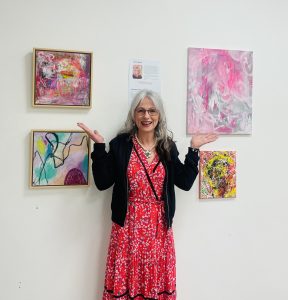
Bernadette Doolan
Artist
A practice shaped by resilience, where the figures she paints hold a quiet strength that continues to rise through each work, carried across a practice that moves between mediums
Bernadette Doolan doesn’t describe painting as something she chooses to do. It’s something that runs beneath everything else.
“I don’t think I make the decision to go and paint… I just find myself there.”
Even when life intervenes – as it inevitably does – it never replaces the work. It feeds it.
“It never takes over. It’s always going on… percolating. Life gets in the way sometimes, but I think it’s all part of it… it feeds the excitement when you get in.”
Living and working in Wexford, her practice sits in constant dialogue with her surroundings – nature, memory, and the quiet rhythms of daily life. Even the small, almost incidental relationships – like the robin she’s patiently befriended, “Mr. Bo Jangles” – become part of that ecosystem, grounding the work in something lived rather than constructed.
Showing Up, Letting It Happen
For Doolan, the act of painting begins long before the first mark. It starts with showing up.
“I’m constantly in the studio… sometimes it’s just showing up. I think that’s half the battle.”
There is no rigid plan, no fixed outcome. The process is responsive, almost conversational – guided by the materials as much as by the artist herself.
“I always find that if I go in, I’ll end up starting something, even if I don’t have an intention.”
That first mark is the threshold. From there, the work unfolds on its own terms.
Portraits That Are About People
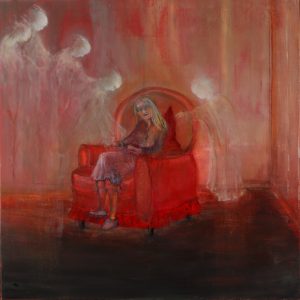
At first glance, Doolan’s figures might read as portraits. But they resist identification.
“They’re portraits and they’re figurative, but I want them to be more about portraits of emotions… lived emotions that we’ve all experienced.”
This ambiguity is intentional. A named subject would close the work down – fix it in place. Instead, she creates space for the viewer to enter. “If I painted from a picture of somebody, then it’s like, ‘oh, that’s Mary’… and then it loses that ambiguity.”
What replaces that certainty is something more expansive. The work becomes a shared emotional field – one where the viewer’s experiences sit alongside her own.
The Moment the Painting Looks Back
There’s a recurring reaction to Doolan’s work – one she values deeply.
“It’s the first time I’ve actually stood in front of an artwork where I feel I’m the one being looked at.”
This observation, shared with her by a writer named Daniel after an exhibition at GOMA, captures something central to her practice. The figures don’t simply present themselves – they confront.
What begins as unease often turns into recognition.
“Sometimes people are a bit unnerved… but then they sit with it… and they end up telling me what’s going on in the painting.”
In that exchange, the work expands. It becomes layered with interpretations she never consciously placed there.
Memory, Childhood, and the Emotional Trigger
Much of Doolan’s imagery is rooted in memory – not as a literal recollection, but as a feeling.
“It could be through whatever they’re wearing… you kind of go, ‘oh my God, I had a pair of those’… and suddenly you’re transported back.”
Her paintings act as portals – small, precise triggers that unlock entire sensory worlds. A gesture, a posture, a fragment of clothing can collapse time, bringing the viewer back into their own past.
Even when she references her own childhood, the intention is not documentation – it’s resonance.
The Dog as Witness
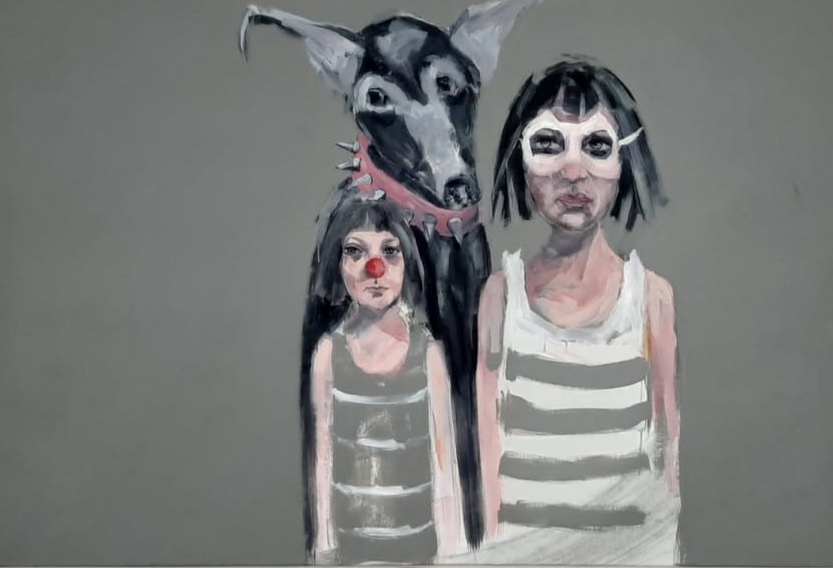
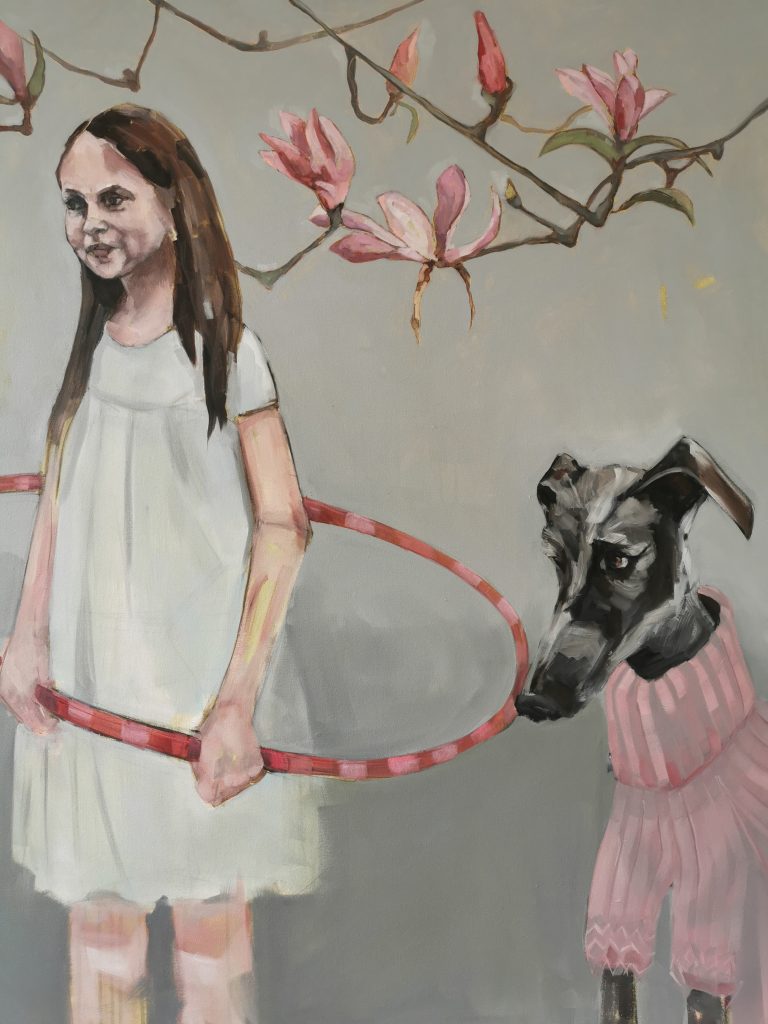
Dogs appear throughout her work, not as decoration, but as emotional anchors.
“They represent that kind of unconditional support… that’s always there.”
Drawing from her own life, including the presence of her two rescue lurchers, these figures embody a kind of quiet companionship. They stand alongside the human subjects – not intruding, not demanding – simply present.
Space, Suggestion, and the Power of Less
One of the most striking aspects of Doolan’s work is what she leaves out.
“I was trying to do as much with as little… to create an impact.”
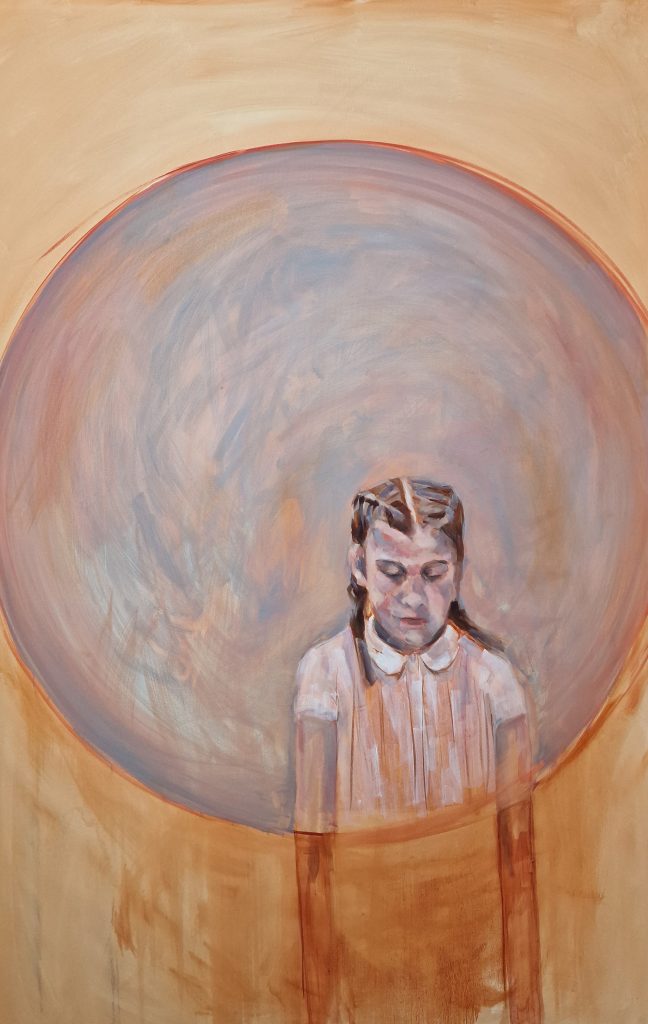
Her figures often sit to one side of the canvas, surrounded by vast areas of empty space. It wasn’t a conscious decision at first – but over time, she began to understand it.
“I realised… I stand over on the right-hand side… it’s like I’m getting out of the way… leaving space.”
That space isn’t absence – it’s invitation. It allows the viewer to enter, to project, to complete the image.
The same restraint carries through into her mark-making. Faces are suggested rather than fully rendered, gestures implied rather than fixed. The result is a kind of visual openness – where meaning isn’t delivered, but discovered.
The Child That Keeps Going
Running parallel to her technical approach is something more instinctive – a conscious effort to hold onto a childlike way of working.
“The kid in me shows up sometimes… just go for it.”
Where the adult voice hesitates – measuring, comparing, doubting – the child moves forward without permission. For Doolan, maintaining that mindset is essential.
“Children… fall down, they get back up again… whereas we’ll go, ‘better not try that again.’”
It’s this resilience that allows her to keep pushing, to keep submitting, to keep making – regardless of outcome.
Self-Sabotage and Self-Belief
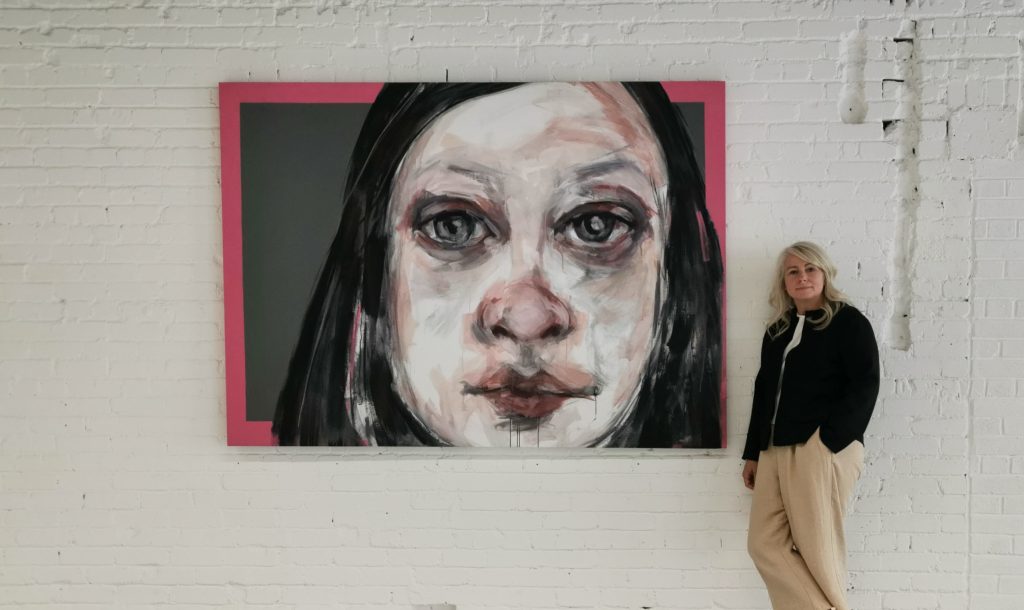
That tension between doubt and instinct surfaces clearly in her discussion of a self-portrait.
“I don’t do self-portraits… but I thought, ‘have a go.’”
What followed was both unsettling and revealing. As the image developed, she recognised herself in it – and with that recognition came resistance.
“I gave myself a black eye… I realised that’s what we tend to do as artists… we sabotage things before we even start.”
The act of finishing the painting became a quiet assertion – not of technical ability, but of belief.
Making Work That Has Weight
Alongside her paintings, Doolan’s other work carries a different kind of gravity.
Her piece 196 – a series of porcelain spoons created in response to the deaths of children in institutional care – emerged slowly, over years of reflection.
“I needed to do something… but it took maybe three years.”
Each spoon represents a life, a presence, a loss. When exhibited in Dublin, the work took on a physical rhythm – moving in the air, casting shadows that resembled musical notation across the walls.
What followed was unexpected.
“I got emails… from sisters and brothers… thankful that it had been acknowledged.”
For Doolan, this is where the work extends beyond the studio – into something shared, something held collectively.
Doolan returns to a piece of advice from her husband: “If you kick the ball enough times, it has to go in.” It’s a simple idea, but one that sits at the core of her practice.
The act of continuing, of showing up again and again, is where the work holds its ground. That same persistence carries into the ideas she continues to develop beyond the studio, where her attention turns to stories that remain unresolved.
There is a sense that some works take years to surface for a reason – that they require time, space, and a willingness to return. In that return is a quiet insistence: that certain lives, particularly those too easily overlooked, deserve to be held, counted, and made visible.
There Is Nothing Else
For all the shifts in medium, scale, and subject, one thing remains constant.
“If I never sold another painting… I wouldn’t stop.”
The work isn’t dependent on validation, or exhibition, or outcome. It exists because it has to.
“It’s part of me… part of my DNA.”
And perhaps that’s what defines Doolan’s practice most clearly – not a style, not a subject, but a refusal to separate life from making. The two are intertwined, feeding each other, shaping each other – until the distinction no longer matters.
To find out more about Bernadette and browse her available paintings, sculptures, and prints, visit her website: bernadettedoolan.com
To hear Bernadette discuss her work and exhibitions in more depth, visit her on YouTube: @bdetted
And keep up with her via social media: @bernadettedoolanart
Support Go Leor. Get the Print. Join the Story.
Go Leor is an independent Irish arts magazine built by hand, heart, and community. Your support keeps meaningful storytelling alive – in print, in culture, and in conversation.
Through Patreon, you can support the magazine in two simple ways:
- Supporter Listing
Have your name printed inside every issue as part of the community helping Go Leor grow. - Print Copy – UK & Ireland
Receive the latest print issue delivered each month across the UK and Ireland, with your name included inside the magazine.
The Latest Articles

Shirani Bolle: Monsters, Survival & the Power of Colour
Colour, craft, and confrontation converge in a feminist practice that reclaims the body, the home, and the right to be seen

Stuart Quigley: The Wonderful Spirit Behind This Beyond
A practice shaped by return – where coastlines, family memory, and material come together to explore what it means to carry home with you

Seanna O’Boyle: The Authentic Depth of Light, Layers and Ancient Wood
Drawing from the Old Masters and Irish prehistory, a practice that builds meaning through material, memory, and the discipline of making

Alison Pascoe: The Powerful Art of Knots, Craft & Connection
A practice rooted in heritage craft, where knotting, material and teaching become a language of connection across place and people

Sam Allen: The Special Pull of Home, Sea and Memory
A practice shaped by return – where coastlines, family memory, and material come together to explore what it means to carry home with you

Becca Calmont: The Magic Art of Wax, Silver and Instinct
From reclaimed materials to instinct-led making, a jewellery practice built on process, variation, and the refusal to repeat