
Ciara Darcy
Beaded By Ciara
In beads, fabric and carefully held detail, Ciara Darcy turns fashion into a record of labour, memory and feminist history, where small objects carry serious weight.
When Ciara Darcy answers the phone, she is sitting in the car.
There is a nervousness there at first, the kind that often appears when someone is asked to explain work they usually makes with their hands rather than their voice. She admits later in the conversation that she is not always comfortable talking about her practice. She does not necessarily think of all the meaning until someone asks her directly, and then suddenly the ideas arrive: slow work, AI, gender-based violence, handbags, feminism, textile waste, price, labour, visibility, fashion history.
That slight hesitation feels important, not because it weakens the work, but because it reveals something about it. Ciara’s pieces are not made from a rehearsed brand statement.
They come from instinct, observation, irritation, care and a deepening understanding of the cultural histories attached to the objects she makes.
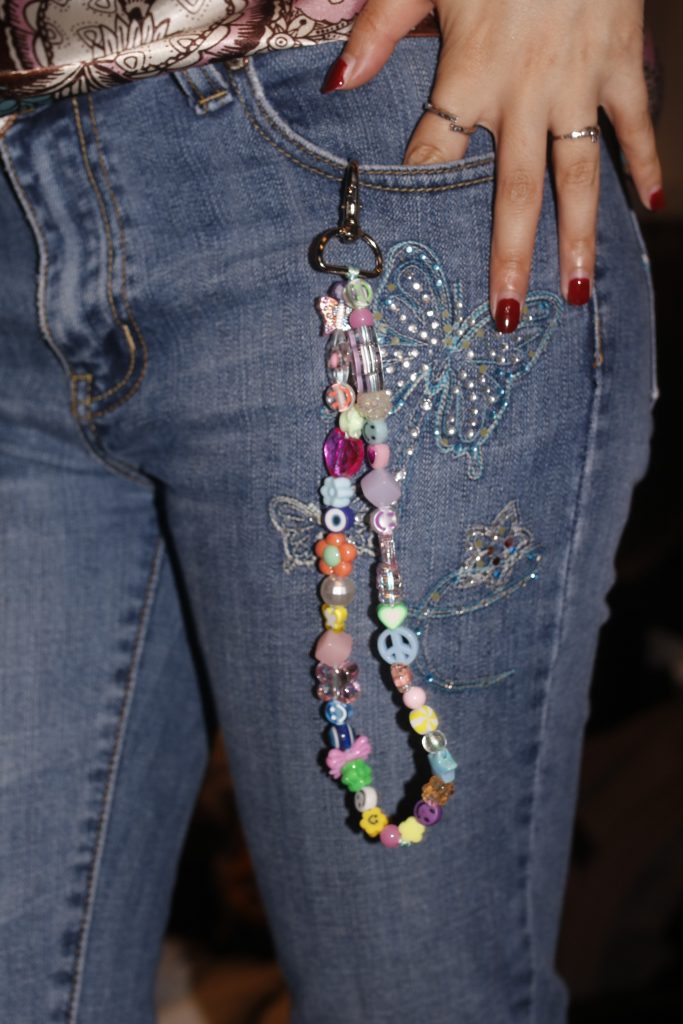
Through Beaded by Ciara, she creates handmade accessories, bags, garments and beaded pieces that carry much more than their bright surfaces first suggest.
They are playful, colourful and often nostalgic, but they are also built around labour, femininity, waste, fashion and the politics of being seen.
From Fine Art to Something You Can Hold
Ciara studied Fine Art, but painting did not hold her for long.
“I feel like when I started it, I thought, oh, painting is my thing,” she says. “And then I started to feel disconnected.”
What drew her instead were materials that were more physical. She wanted something hands-on. Something tactile. Something that could be held.
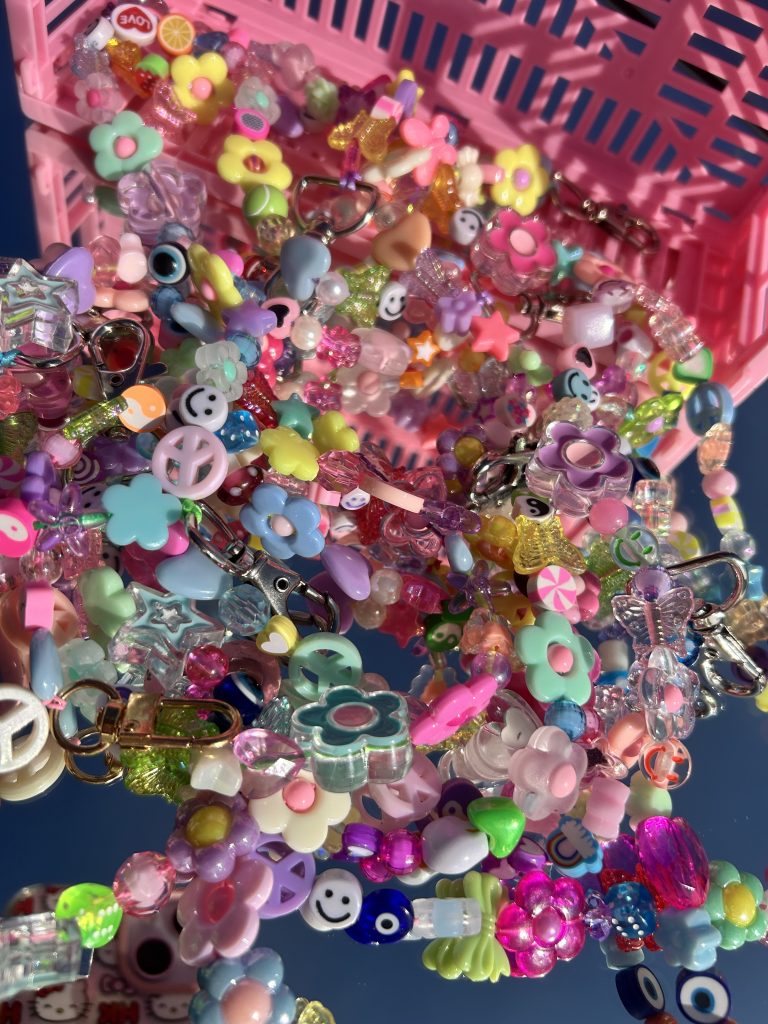
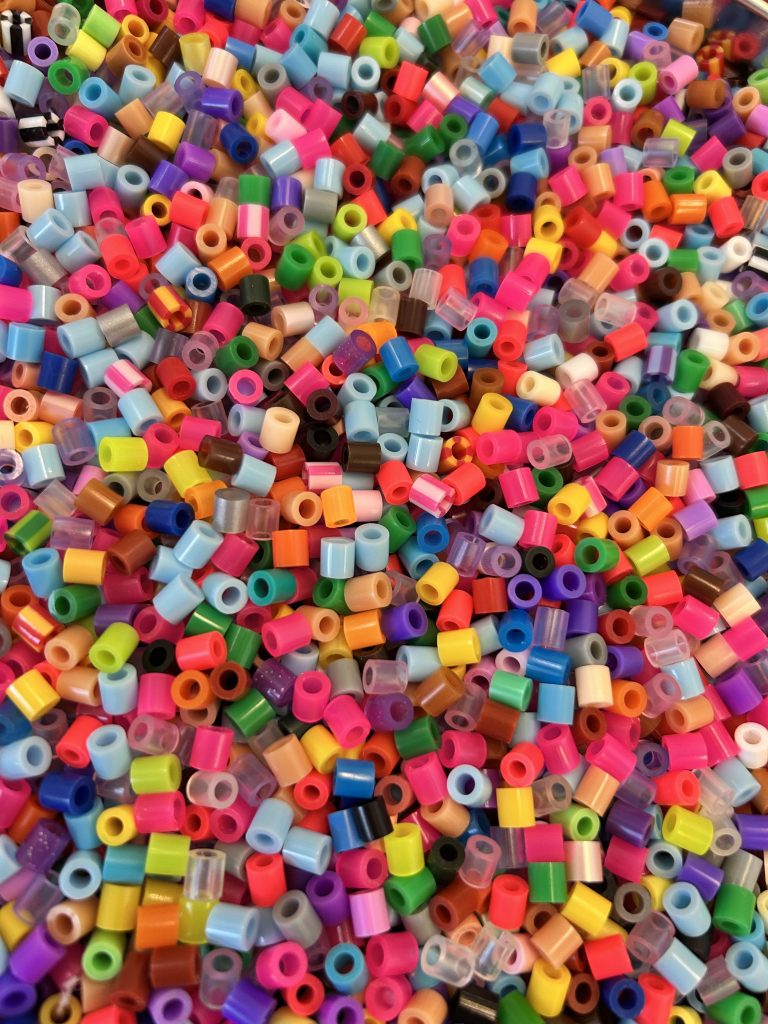
Sewing and beading became the centre of that shift. The beading began almost by accident. While she was at college, an office was throwing out a tub of beads. Ciara saw them and asked for them.
“Give them to me and I’ll do something out of it,” she remembers.
She has not really stopped since.
That origin still matters. Beaded by Ciara did not begin with a clean commercial plan or a bought-in stock of pristine materials. It began with discarded objects and the instinct to rescue them. The beads were unwanted, but Ciara recognised a possibility in them. That impulse runs through much of her work now, where recycled fabrics, offcuts, old garments and found materials become part of the character of each piece.
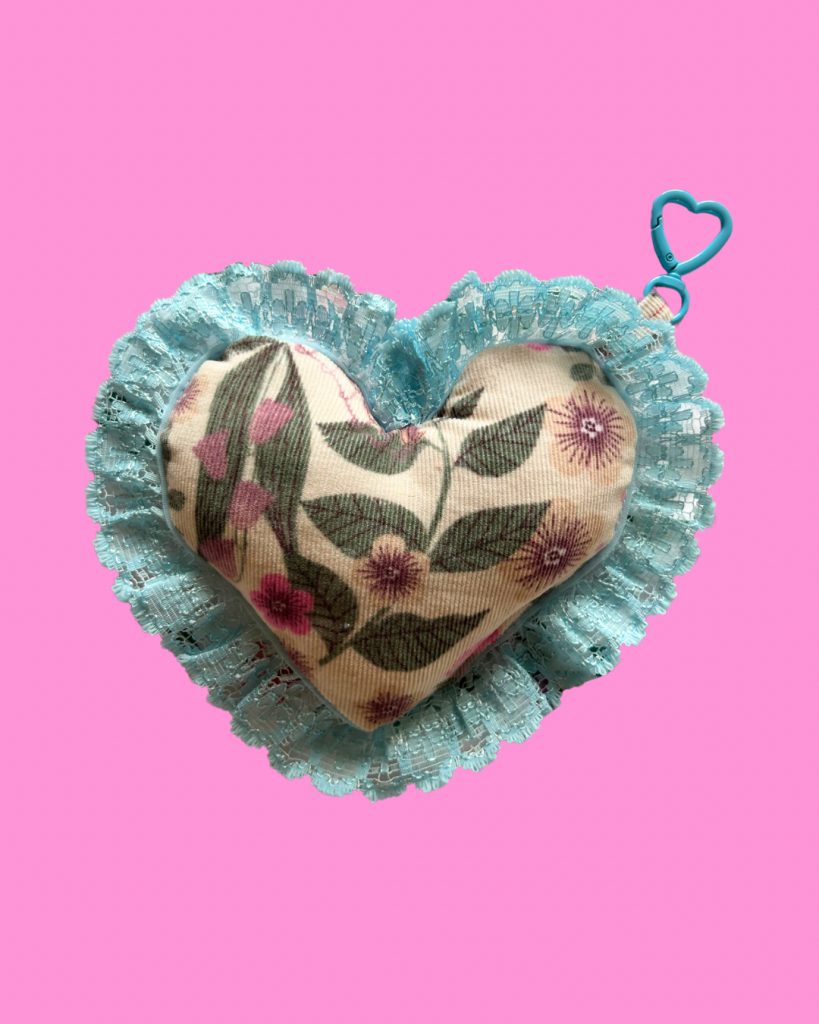
Recently, she has been making bag charms from recycled fabrics, cutting scraps into heart or star shapes before sewing them together. One of those charms was made from an Irish dancing dress. She used the sleeve, cut around the existing embroidery and kept the shape of it intact.
The result is not just reuse as a sustainability gesture. It is reuse as memory. A fragment of one garment becomes the centre of another object.
“I think it’s more interesting to use things that have already been used,” she says. “It feels more special.”
The Value of Slowing Down
Ciara often returns to the idea of slowness.
In fashion, there is pressure to constantly produce something new. Every photoshoot seems to demand a new piece, a new idea, a new visual, a new reason to post. That rhythm does not naturally fit with the way she works.
“Sometimes you could feel really pressured,” she says. “Especially in fashion, you want to have something new every time. Every time there’s a photoshoot, you want to have something new and something exciting, but it’s not really realistic.”
For Ciara, the answer is to keep the process slow and intentional. A few strong pieces matter more than a large number of rushed ones.
That slowness is not only practical. It is philosophical. Ciara describes the world as increasingly instant. Against that, making by hand becomes a way to slow down and remain with the process.
She does not frame her work as a direct opposition to AI from the beginning. It was not a manifesto first. But as generative technology has become more visible in art, fashion and society, it has become harder to ignore.
“Making art is a very human thing,” she writes. “As long as we continue to make things with our hands, and minds, we are opposing AI.”
Four Months in Beads
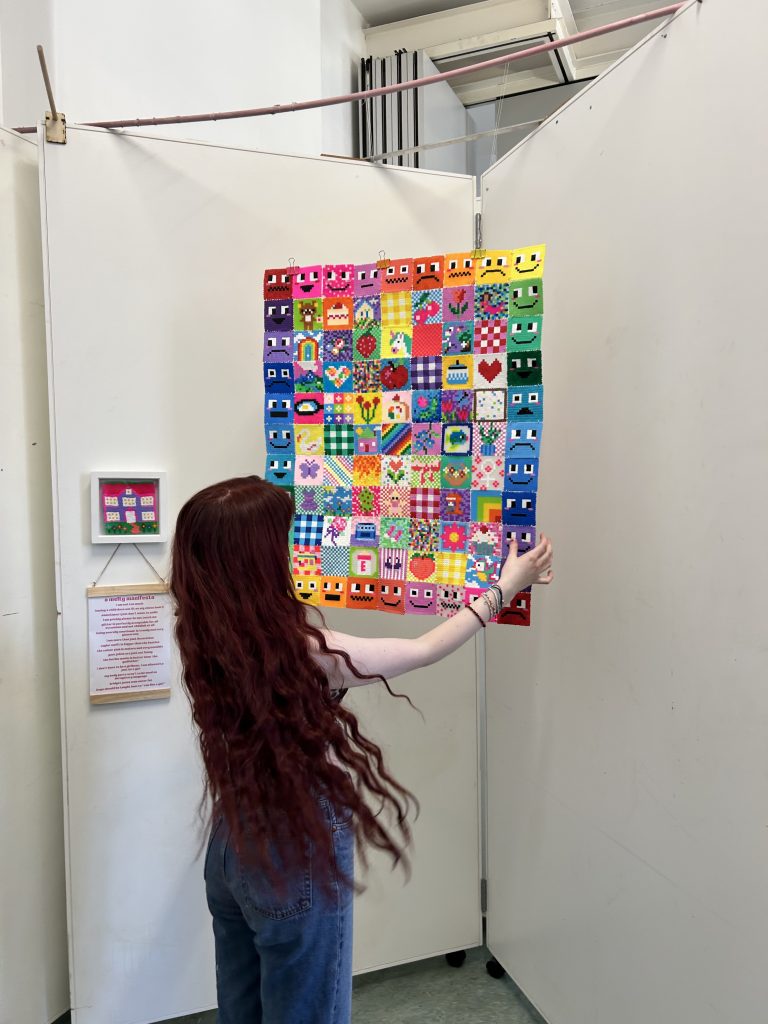
One of Ciara’s most striking pieces was a quilt made entirely from beads.
When she tells people it took four months, she says they do not always believe her. That disbelief reveals something important about how handmade labour is misunderstood. People can see the finished object, but not always the hours inside it.
A photo online flattens time. It makes four months look instant.
That is one of the hardest parts of sustaining a handmade business. Ciara says people often struggle to understand the relationship between price and labour. When something takes hours and hours to make, that effort does not always translate through an image on Instagram.
She has had people message her asking for a piece, then back away once she gives the price. Others tell her they can get something similar online for cheaper.
“But you can’t,” she says.
What they can get online may imitate a look, but it does not carry the same quality, attention or presence. Ciara is clear that mass-produced items are also made by people somewhere, often under difficult conditions. But there is a difference between a piece made slowly by one person, checked by hand, built from rescued material, and an item produced through the machinery of fast fashion.
Her work is handmade, one of a kind and sustainable. Those values are often praised in theory, but harder to defend in a marketplace shaped by Shein, Temu and a constant expectation of cheapness.
Ciara admits that even her own prices are held back by fear.
“My things aren’t even that dear,” she says, “because I’m too scared to put my prices up.”
Craft, Gender and the Question of Seriousness
Beneath the colour and playfulness of Ciara’s work is a sharp awareness of how craft has historically been valued – or undervalued.
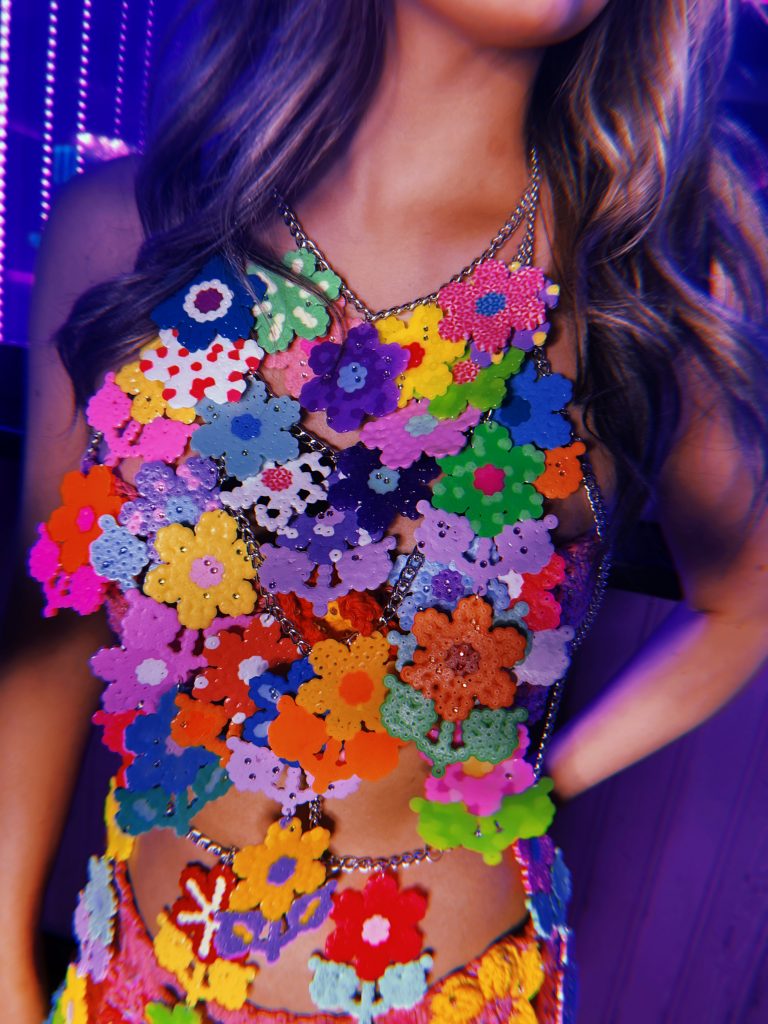
She has been thinking more about techniques traditionally seen as feminine, and how they sit within art and fashion contexts. Beading, quilting, sewing and melty beads are not neutral choices for her. They are tied to ideas of labour, gender and care, and to the long-standing division between what gets treated as “art” and what gets dismissed as “craft.”
In the conversation, Ciara mentions a phrase that has stayed in her mind: if a man makes it, it is art; if a woman makes it, it is craft.
That tension sits at the core of her work.
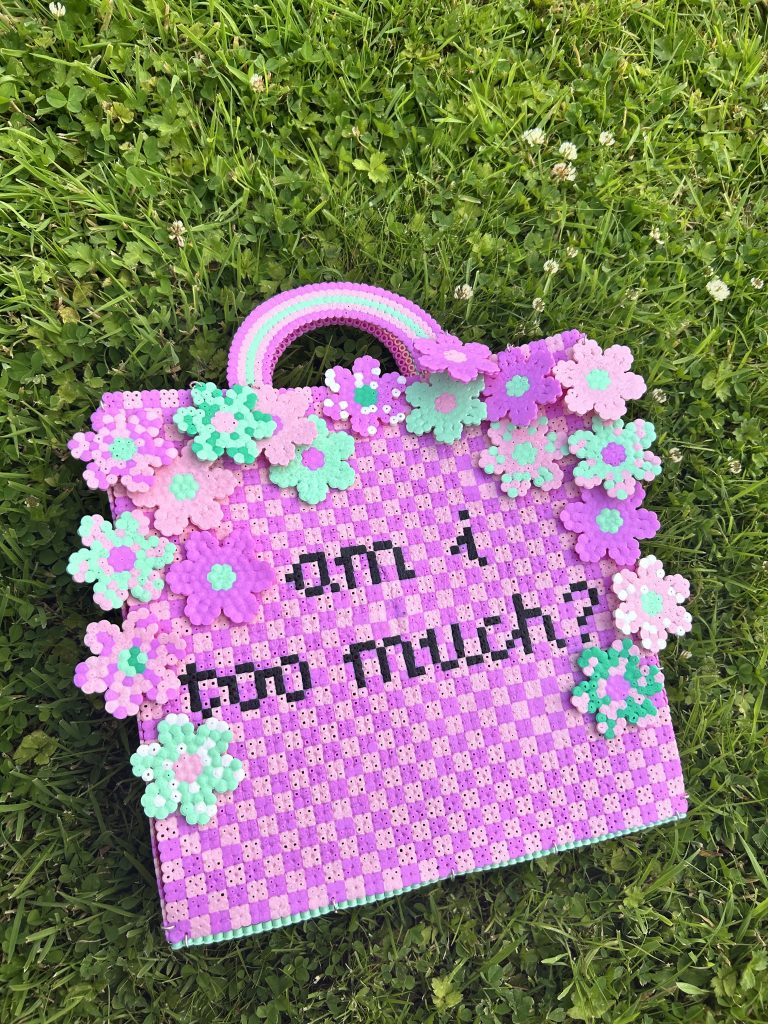
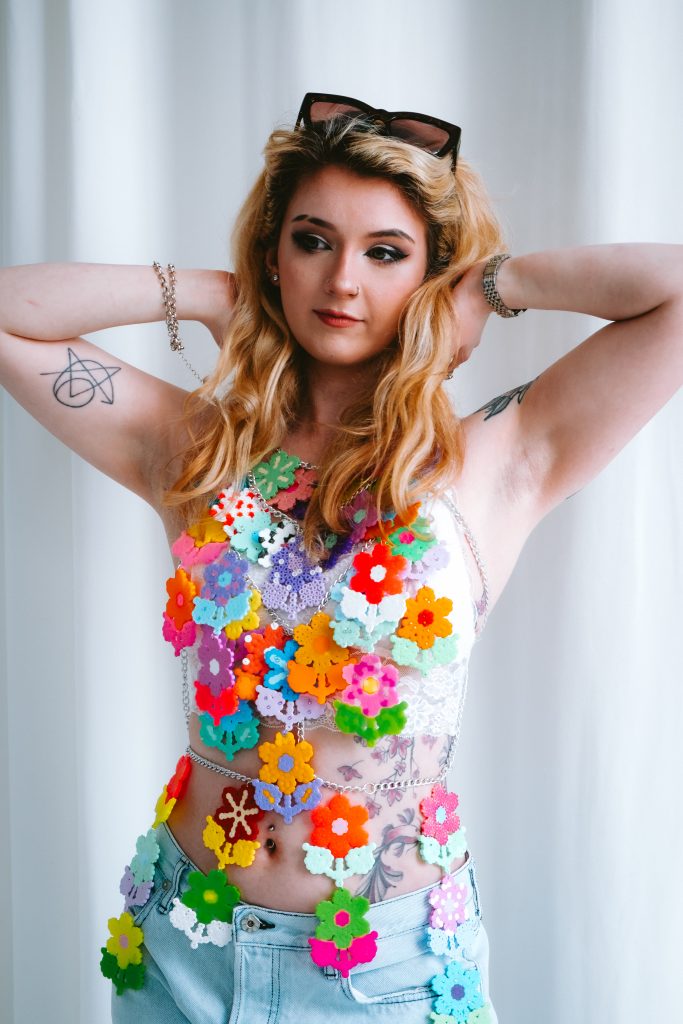
The materials themselves matter. Melty beads carry childhood associations. Many people remember using them when they were young. Because of that, they can be dismissed as unserious or childish. But Ciara is interested in that dismissal. She uses those materials deliberately, placing them into fashion and art contexts where their supposed lack of luxury becomes part of the challenge.
Her quilt, bags and garments use feminine-coded processes not as decoration alone, but as a way to question what culture decides is valuable.
Quilting, in particular, carries a history of women’s labour, domestic skill, patience and communal making. It is often treated as soft, secondary or amateur, despite the time and technical knowledge it demands. Ciara’s beaded quilt brings that overlooked labour into view while also making it strange. It is familiar and unfamiliar at once: a quilt, but not soft; a craft object, but also a conceptual artwork; a feminine form, but one carrying critique.
AI, Violence and Taking Back Control
Ciara’s thinking around AI developed through a college project. The brief was based on AI, and at first she worried that she would be expected to use it. Instead, she moved in the opposite direction, researching how AI and generative technology intersect with gender-based violence.
That research brought her to the misuse of AI-generated imagery, including tools used to remove clothes from images of people without consent. As those technologies became more public, Ciara found herself thinking about how women’s bodies are taken, altered, distributed and consumed through digital systems.
Her response was to make work that was deliberately feminine.
The quilt, the dress, the handbags and the materials all became part of a visual language about reclaiming control. Rather than using AI to generate something frictionless, she turned toward processes associated with patience, domestic history and the physical body.
Everything had to be made by hand.
That is why the handmade quality of the work is not only aesthetic. It is political. The bead, the stitch, the inconsistency, the visible process – all of these become evidence of a person making decisions in real time.
Ciara says it is important that “the hand behind the work stays visible.” The imperfections and inconsistencies are not flaws to be hidden. They are where the value sits.
Especially now, when so much can be automated, the fact that a person made something becomes part of its meaning.
The Hidden History of the Handbag
One of the most compelling parts of Ciara’s practice is her interest in the history of fashion objects that are often taken for granted.
Handbags are central to her work, and she has spent time researching their historical relationship to gender and control. She explains that handbags were originally worn by men, because women were not allowed to carry their own belongings in the same way. Their possessions were carried by men.
After the war, as women began carrying their own things, the handbag became part of a broader shift in independence. What now appears to many as an ordinary women’s accessory carries a deeper history of ownership, movement and social change.
“You see a handbag and you think, yeah, that’s a woman’s thing,” Ciara says. “But nobody knows that it started out as a man’s thing.”
That overlooked history interests her. It shows how fashion can record power, even in small objects. A bag is not only a bag. It can speak to who is allowed to carry money, keys, letters, tools, cosmetics, documents, private things, public things, a life.
Ciara is also interested in Princess Diana’s use of small handbags, often referred to as “cleavage bags.” Diana would use them to shield herself from paparazzi when getting out of cars, protecting her body from invasive photographs.
That detail influences the scale of Ciara’s own bags.
“I don’t make big bags,” she says. “I make tiny ones that are sort of impractical.”
On one level, they are playful fashion objects. On another, they carry this memory of women using style as a form of control, protection and refusal. The smallness is not only decorative. It points back to the body, the camera, the gaze and the need to guard oneself.
Fashion as a Record of Feminism
Ciara is keen to highlight the historical significance of fashion and feminism, and her work becomes strongest when those two things meet.
Fashion is often dismissed as surface. Ciara’s practice suggests the opposite. Clothing and accessories can carry histories of labour, ownership, gender, protection, waste, class and creativity. They can show how women’s lives have been restricted and how women have found ways to move within, against and around those restrictions.
The handbag is one example. Quilting is another. Beading, sewing and embellished garments all carry histories of labour that have too often been made invisible because they were associated with women.
Ciara’s work does not shout these histories. It holds them inside objects that are bright, strange and wearable.
That combination is what gives the work its charge. A tiny beaded bag may look playful at first, but it also asks why small feminine objects are so easily underestimated. A melty bead garment may seem nostalgic, but it also challenges what gets to be treated as high fashion. A quilt made from beads may look decorative, but it contains months of work and a direct response to the speed of digital production.
The work asks viewers to look again.
Textile Waste and the Life of Materials
Sustainability is part of Ciara’s practice, though she describes it as something that came naturally rather than as a formal mission statement.
She is aware of the amount of textile waste around her. Charity shops are full of clothing. There are not enough volunteers, rails or systems to deal with everything. Fast fashion produces a constant churn of cheap garments, many of which quickly become waste.
Ciara sees that excess and works against it by using what already exists.
Her use of recycled fabrics and found materials gives each piece a different starting point. Instead of imposing a design onto a blank material, she often responds to what is already there: embroidery, texture, colour, fabric memory, the shape of an old garment.
That responsiveness helps keep the work from becoming generic. Each piece carries traces of its previous life.
Instagram as Sketchbook and Shopfront
Social media is part of Ciara’s practice, but she approaches it carefully.
She does not feel an overwhelming pressure to post every day, partly because she does not see herself as having a large enough platform for that kind of demand. But she does feel the pressure that comes when making becomes tied to documentation. Sometimes, when she finishes a piece, there is an immediate thought: this needs photographed for social media.
At the same time, many things she makes never get posted. Some she keeps to herself.
Ciara describes Instagram as both a selling tool and an extension of the practice, “almost like a sketchbook or archive.” That feels right for the kind of work she makes. The finished piece matters, but so does the process.
She wants to show the behind-the-scenes, not just the polished final image.
“When you go on, it’s always finished pieces and perfect things,” she says. “And I like to show the behind the scenes.”
This is important because the process is part of the work’s value. If people only see the final photograph, they may miss the hours of beading, cutting, sewing, planning and problem-solving behind it. Showing the process helps return time to the object.
Still, there is tension. Marketing is fast-paced and constant, while Ciara’s work is slow and intentional. She is still figuring out how to stay visible without burning out or diluting what makes the work what it is.
Belfast, Derry and Finding Creative Community
Ciara is from Strabane, around 20 minutes from Derry, where she went to college. For larger fashion events and photoshoots, she sometimes travels to Belfast.
Instagram has helped her find people to work with, but so has the Belfast fashion scene. She mentions Belfast Fashion Scene, a monthly collective that runs free photoshoots for emerging creatives.
Models can try modelling, designers can bring garments, photographers can build their portfolios and people can gain hands-on experience.
That kind of structure matters for an artist like Ciara, whose work changes when it is worn. Seeing her pieces on models has helped bring them into a wider fashion context.
She says she once thought she would have to wait for someone to discover her work and ask to wear it. More recently, she has learned that she has to put herself forward.
“You really just have to go out and put yourself out there,” she says.
At the time of the conversation, she was preparing for a photoshoot with a Zara Larsson theme, making small beaded bikini tops and seeing what else she could create. She was also due to attend the Ulster University Fashion Show, another point of connection with the wider fashion world around her.
The Work Behind the Brightness
There is a temptation, with work as colourful as Ciara’s, to describe it only through brightness. It is fun, playful, nostalgic and eye-catching, but those words are only the surface.
Underneath them is a practice thinking seriously about gender, labour, AI, sustainability and fashion history.
Ciara’s work is full of small acts of resistance. Rescuing a tub of beads from being thrown out. Keeping the embroidery from an old Irish dancing dress. Making a quilt over months in a world that wants everything instantly. Using “childish” materials to ask serious questions. Making tiny handbags that remember Diana shielding herself from paparazzi. Showing the hand behind the work when so much around us is becoming automated.
Ciara speaks about the work with care rather than performance, but the strength of the practice is unmistakable.
It insists that fashion is not shallow. It insists that craft is not lesser. It insists that feminine-coded labour has intellectual, historical and artistic weight. It insists that slowness can still matter.
Most of all, it asks people to recognise the person behind the object.
Every bead is placed by hand. Every stitch takes time. Every imperfection proves that someone was there.
To explore Ciara’s available one-of-a-kind works, visit her Depop store: depop.com/beadedbyciaraa
And keep up with her via social media: @beadedbyciaraa
Support Go Leor. Get the Print. Join the Story.
Go Leor is an independent Irish arts magazine built by hand, heart, and community. Your support keeps meaningful storytelling alive – in print, in culture, and in conversation.
Through Patreon, you can support the magazine in two simple ways:
- Supporter Listing
Have your name printed inside every issue as part of the community helping Go Leor grow. - Print Copy – UK & Ireland
Receive the latest print issue delivered each month across the UK and Ireland, with your name included inside the magazine.
The Latest Articles

Maria Noonan-McDermott: Where Memory Becomes Art
Transforming intimate family memories into paintings and poetry, her work invites others to recognise stories of their own.
Rosina Law-Braney: Reclaiming the Seven Deadly Sins
Through zines, illustration and humour, Rosina Law-Braney creates vibrant feminist stories that make room for identity, desire, grief and collective creative freedom.

Alexander Edward: Weaving from the Land
Growing his own willow beside Strangford Lough, Alexander Edward brings coppicing, landwork and an ancient craft into bold contemporary forms.
John Britton: Finding Calm Through Ink
After three decades of visceral performance and constant travel, John Britton has found a quieter connection through ink, mentorship and calm.
Yvonne Moore: Following Curiosity into Colour
Refusing to settle into a single style, Yvonne Moore follows curiosity across colour, poetry and community, creating art that brings her – and those around her – fully to life.
Lucy Fleming: Carrying the North Coast Light
Through fluorescent colour, oil pastel and an instinct for collaboration, Lucy Fleming turns the light of the North Coast into images that connect art, music and community.