
Elisabeth Neveux
Illustrator & Printmaker
Through linocut, folklore and a traditional process, Elisabeth Neveux defends the human journey of making, where every mistake, mark and story carries its own weight.
Elisabeth Neveux likes to meet people through the work she creates.
For a while, she had a physical shop. There were parts of that she loved, but it also meant being tied to one place. Markets gave her something different. Moving from event to event, table to table, town to town, she could meet people from different backgrounds, different countries and different stages of life.
“I never know who I’m going to meet,” she says. “It’s very exciting.”
At markets, people tell her stories. Some come back year after year. Some she has watched have children over time. A customer might arrive because of a print, then stay because of the story behind it. That exchange matters to Elisabeth because her linocuts are not only images. They are built as narrative objects, carried through paper, ink, texture and conversation.
Online, a viewer might only see a digital picture. In person, they can hold the paper. They can feel the print. They can understand, even before they fully know the process, that something has been physically made.
That physical presence has become more important to Elisabeth as the creative world shifts around AI, replication and digital theft. Recently she found herself getting onto an intense conversation with someone online who affirmed everyone could make drawings like hers. Instead of withdrawing, she challenged him directly. She stood up for herself, argued for the value of artists’ labour, and even invited him to Dublin to try the process himself.
It was not just about one image. It was about what happens when the journey of making is stripped away, and only the surface is copied.
Stories at the Table
Elisabeth’s work often finds its audience through events. Comic cons, exhibitions, markets and festivals give her the opportunity to explain what each linocut contains.
“I tell people the story behind every linocut,” she says. “They are not just illustration. I didn’t want to just create pretty pictures. I wanted to tell a story.”
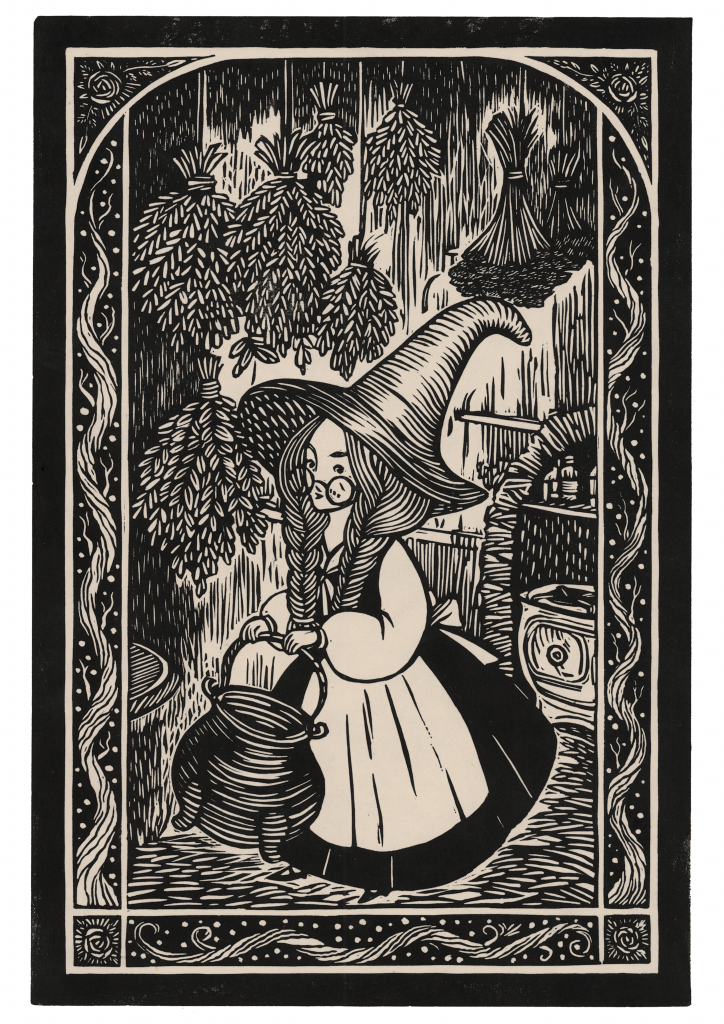
One of those stories centres on Hazel and Batcat, a grumpy witch and a mischievous, hell-raising cat inspired by Elisabeth’s own companion of 20 years, Kitsune. Her real-life presence often made the work unpredictable. During Covid, when paper shortages already made printing difficult, she once stepped across fresh prints, leaving paw marks behind.
Elisabeth thought no one would want them.
Instead, one customer bought a marked print and loved it more because of the paw print. The mistake had become part of the story. Something unplanned, inconvenient and very real had entered the work.
That kind of detail is difficult to reproduce digitally. It is not simply texture. It is evidence of a life around the object: a cat in the studio, a shortage of paper, an artist adapting, a customer understanding that the trace made the piece more human.
Reading Aloud and Spooking People Out
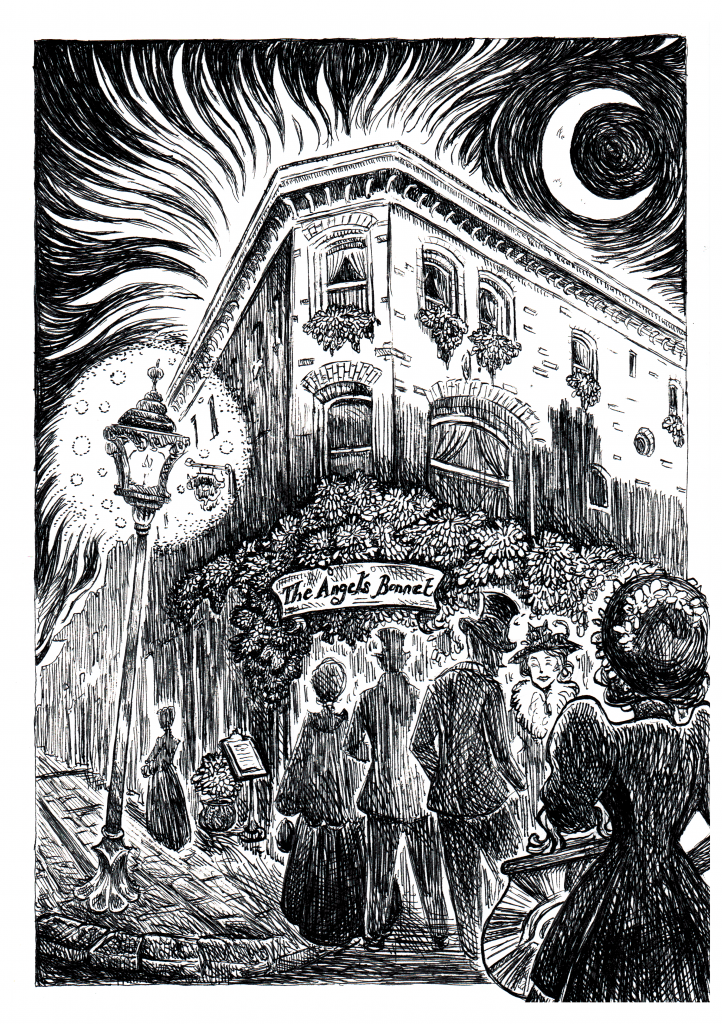
Alongside her visual work, Elisabeth has begun doing live readings. Through Illustrators Ireland and the Alliance Française, with the support of Debbie Jenkinson and Karen Harte, she was invited to take part after Debbie was unable to do the reading herself. The opportunity came through the kind of real-world connection that events often make possible.
Elisabeth would like to do more of it.
She describes herself as socially awkward when standing with a microphone, and says she shakes “like a leaf” before reading. But once she begins, something else takes over.
“It transports people into another world,” she says.
She especially enjoys watching people react, particularly when the work unsettles them.
“I love spooking people out during my live readings,” she says.
After one event, there was a small book sale where people asked questions about the reading, the story and what might come next. Some had missed the first part and wanted to know more. Others asked what she planned to do after it. That response has encouraged her to think about taking readings further, even dreaming of travelling with them one day.
For an artist whose images already feel close to folklore, horror, old storybooks and strange creatures, the readings make sense. They give voice to the same worlds the linocuts suggest.
Keeping Old Techniques Alive
Elisabeth has a deep respect for digital art, but she has always been drawn to traditional process.
In her twenties, while in fine art, she left partly because of the pressure to use digital methods. She did not reject digital art entirely, but she wanted to be stubborn. She wanted to keep older techniques alive.
There is warmth, she says, in traditional work. At events, people touch the prints and react when they realise what they are holding.
“It’s a real print,” they say. “It’s a real linocut.”
Elisabeth does sell reproductions on high-quality paper, but most of the time people choose the original prints, even when they cost more. That tells her something about the appetite for physical work. People still want the thing made by hand. They still respond to the pressure of the ink, the grain of the paper, the fact that no print is quite identical to another.
For Elisabeth, the mistakes are part of that value.
With digital tools, she says, you can copy, paste and erase. With ink, a mistake may mean starting again. With lino, some errors can be repaired with Sugru, but not always. She remembers one plate where a correction failed after around 40 hours of work. She had to redo the entire piece.
It was frustrating, but it was also part of the process.
“I think it makes you grow as an artist to learn from your mistakes,” she says.
The Image Before the Print
Elisabeth is self-taught, and she is honest about the difficulty that brings. She did not receive the formal training she wishes she had in anatomy or perspective, so she has had to work harder to build those skills herself. Sometimes she takes reference photos. Sometimes she poses in awkward positions to understand how a body should sit inside an image.
But her process begins before all of that.
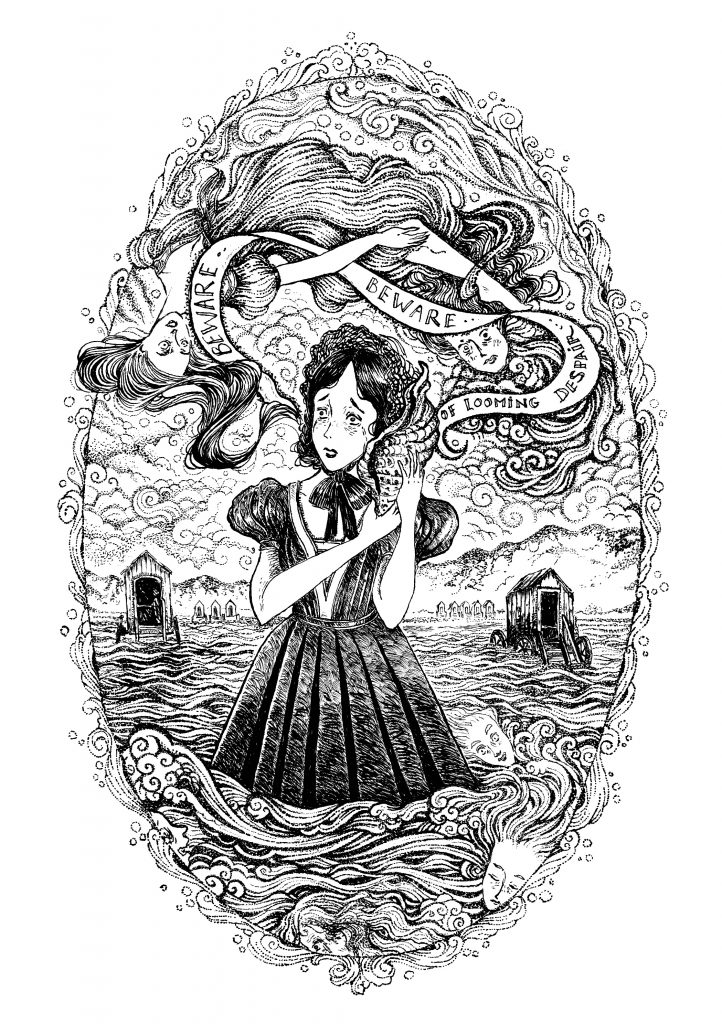
When an image arrives in her mind, it does not come flat. It comes with atmosphere. She can almost smell it, taste it, feel what surrounds it. Then comes the difficult work of translating that inner image onto paper.
“You never quite get what you had in your head,” she says.
That gap can be frustrating, but it is also where the work happens. The first sketches may be rough. She describes some of them as dreadful. Then, through each version, the composition sharpens. The movement begins to settle. The image gets closer to the thing she first sensed.
Her practice is also shaped by film and animation. She watches movies while she works and thinks of images cinematically, often as black-and-white films with occasional inclusions of colour. Her pictures do not feel still to her. She sees them in movement.
“You have to be a bit of an actor,” she says, thinking about expressions, gestures, interaction and the world around the figure.
That sense of movement is visible in her work. Even when a linocut is fixed on paper, it can feel like a scene caught mid-motion.
Fairy Tales, Tolkien and Worlds Still Unseen
Elisabeth’s imagination is full of worlds she would still like to explore.
Tolkien is important to her, though difficult, because she grew up with illustrations that already shaped the way she sees those stories. Brian Froud, one of her favourite illustrators, made such a deep impression that it can be hard to escape those images when approaching fantasy.
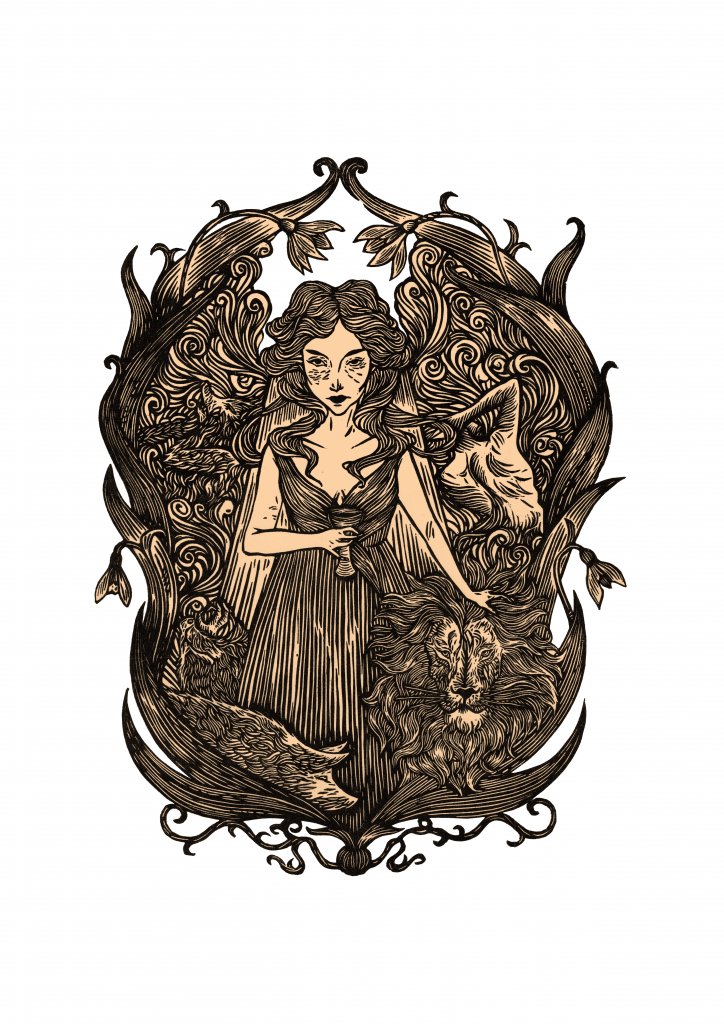
She is especially drawn to books and legends that have not already been over-illustrated, because they allow her to form her own inner image. She would love to make work around Arthurian legends. Greek mythology also calls to her, and she has already made a Circe print inspired by Madeline Miller’s novel. She loves that piece, even if it is not one of her bestsellers.
There are many other possibilities: Grimm fairy tales, Dracula, ghost stories, personal worlds of her own. Yet because printmaking takes so much time, she is careful about what she chooses.
“I prefer working on personal stories,” she says.
That preference matters. Elisabeth does not want to simply reproduce someone else’s world. She admires artists who can make fan art while keeping their own style, but she finds that difficult. She would love, for example, to be asked to make work connected to Nintendo’s Breath of the Wild, but she knows there would be challenges “I love the art direction so much I struggle to unsee it”.
For her, every artist should try to build their own identity.
“Don’t try to imitate other artists no matter how much you love their work,” she says, “try to nurture your own perspective and the way you see the world, try to interpret what emotionally resonates with you”
The Artists Who Answered Back
That belief in individual artistic voice goes back to childhood.
Around the age of 11 or 12, she wrote to Brian Froud and Alan Lee because she wanted to become an illustrator like them. At that age, she did not fully understand how significant they were. Fairy tale imagery was often dismissed around her as childish, something “for babies,” but their work gave her a sense of possibility.
She first contacted the publisher, who offered to pass on a letter. The letter travelled all the way to New York and eventually reached them. She remembers receiving the reply with the British stamp.
Over the years, she has met both Brian and Alan Lee, and describes them as sweet, generous people. Their work still helps her when she feels low.
“Whenever I fall down, I look at their work and I’m like, oh, I need to keep going.”
That story is part of why AI imitation makes her so angry. Artists like the Frouds gave something to her when she was a child. Their work inspired her. To see artists’ images scraped, imitated or repackaged by people who did not go through the process feels, to her, like a violation of that generosity.
It is not only about style. It is about the lives behind the style.
The Anger of Seeing Work Stolen
Elisabeth discovered that some of her own work had been used to train AI. The drawing in question came from a period when she was returning to drawing after a ten-year break. She describes it as not her strongest work, but that almost made the experience feel stranger. The piece was part of her return, a marker of effort and vulnerability. Even a photograph of herself had been used.
“It felt very violating,” she says.
For her, AI theft is not a clean technical issue. It is the ripping of work from artists who have already moved through doubt, financial pressure, illness, side jobs and long periods where drawing might not be possible. She speaks about a benign tumour on her finger which required surgery and left her unable to draw with her right hand for months, about the struggle of rebuilding skill after setbacks, and about how many artists survive by taking jobs that drain them.
When AI systems take from that work without consent, the result feels dehumanising and exploitative.
“Drawing is not about the final result,” she says. “It’s a journey through the process. Without a process, it’s not a drawing.”
That line sits at the centre of Elisabeth’s response. The image is not the whole artwork. The artwork is also the hours, the mistakes, the learning, the failed plates, the re-carving, the paper, the ink, the body that made it, and the person who had to keep going.
AI can imitate a surface. It cannot have gone through the journey.
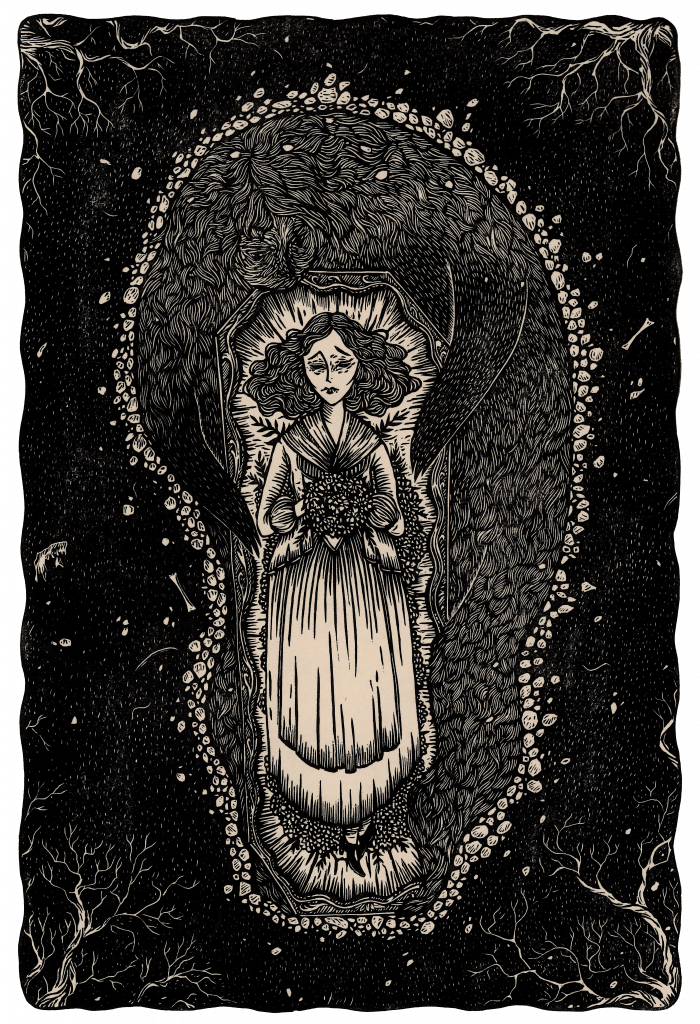
Inviting the Imitator to Dublin
When someone used AI to imitate artwork and sell it, she confronted him.
“At some point standing up for yourself is really important,” she says. “And standing up for other people.”
The exchange became complicated. Elisabeth says the man had given up on his own art career for personal reasons. She tried to speak to him with some empathy, to recognise that his struggles were real, while also making clear that artists have their own grief, financial hardship and setbacks.
She asked him why he had liked drawing in the first place. What had it made him feel as a child? What had been lost?
There is a generosity in that question, even inside her anger. Rather than only condemning him, she tried to bring him back to the original feeling of making. The spontaneous joy of drawing on a desk at school. The need to steal every spare second to sketch. The part of creativity that can be crushed, but not necessarily lost forever.
She also invited him to Dublin to try the process himself.
That invitation matters. It was not only a challenge. It was a statement of belief. If someone wants the appearance of linocut, let them feel what the process actually demands. Let them carve. Let them print. Let them make mistakes. Let them understand the weight of the labour before trying to profit from its imitation.
Elisabeth’s anger is not abstract. It comes from knowing how much traditional work takes, and how easily digital theft can strip away the evidence of that work.
AI, Power and the Lowest Point of the Internet
Elisabeth’s concerns around AI extend beyond her own artwork.
She speaks with particular anger about AI being used for deepfake abuse images of adults and children. For her, these technologies are not harmless. They are already being used in ways that violate people, especially women and girls. She rejects the argument that “it is just an image” because the harm can still feel like a violation.
That is part of why AI feels, to her, so connected to bullying.
She is careful to distinguish between people who may be desperate, grieving or creatively crushed, and those who are already in positions of power and use AI to remain relevant by taking from smaller artists. The latter she finds much harder to forgive.
“You shouldn’t try to do something that hurts other people just to remain in your place of power,” she says.
Her critique is emotional, but it is also ethical. The problem is not simply that machines can make images quickly. It is that they can be built on unpaid creative labour, used to imitate living artists, and then applied to forms of abuse that laws and platforms still struggle to address.
For an artist devoted to touch, paper and process, this digital culture feels not only cold, but dangerous.

Thomastown, Comic-Con and the Life Around the Work
Despite the seriousness of these concerns, Elisabeth’s practice remains rooted in physical events, conversation and community.
Her upcoming schedule includes the Libertine Market, Dublin Comic-Con, Thomastown Creative Arts Festival, Northern Ireland Comic-Con, and The Dublin Comic Arts Festival. Dublin Comic-Con is one of her favourite events of the year, fast-paced and constant.
Thomastown offers something different: a full festival across a village, with exhibitions, ceramics, printmaking, painting and people travelling from far away to see and buy work.
She will also be exhibiting at Men’s Shed, a place she describes as very special, where everyone feels at home.
“Culture is really important,” she says. “It is bringing a tiny town into full bloom.”
After that, she hopes to arrange more readings, especially around Halloween, when her ghost stories might find the right atmosphere.
That balance between intensity and intimacy seems important to her. Comic-Con brings speed, energy and crowds. Thomastown gives her time to sit down with people, talk properly, visit exhibitions and feel part of a wider cultural place.
Again, it comes back to contact. Work meeting people. People meeting work.
Start Tiny, Keep Going
Toward the end of the conversation, Elisabeth brings out older drawings.
One is from when she was 12. Another is one of her first linocuts. She is blunt about them, laughing at how rough they are, but she shows them for a reason.
She wants people to understand that artists do not arrive fully formed.
“I don’t believe in talent,” she says. “I think it’s hard work.”
That belief is not about denying skill. It is about refusing the myth that artists simply appear gifted, as if the years of practice, mistakes, setbacks, illness, jobs, exhaustion and persistence do not count. For Elisabeth, the process is everything because it is where the artist is made.
“You start tiny,” she says. “You practice, and you make mistakes and you learn.”
She also wants people to know there is no shame in having another job. Many artists, at some point, have side jobs. Survival is part of the story too.
Her encouragement is simple but important: draw more, even if it is only for enjoyment. Keep making. Keep being yourself. Do not try to become someone else’s style. Do not measure the work only by the final result.
For Elisabeth Neveux, the print is never only the print. It is the plate, the hand, the pressure, the mistake, the market table, the childhood letter, the artist who answered back, the person who kept going after ten years away.
It is also the refusal to let that journey be flattened into a generated imitation.
The real print remains real because someone lived their way through it.
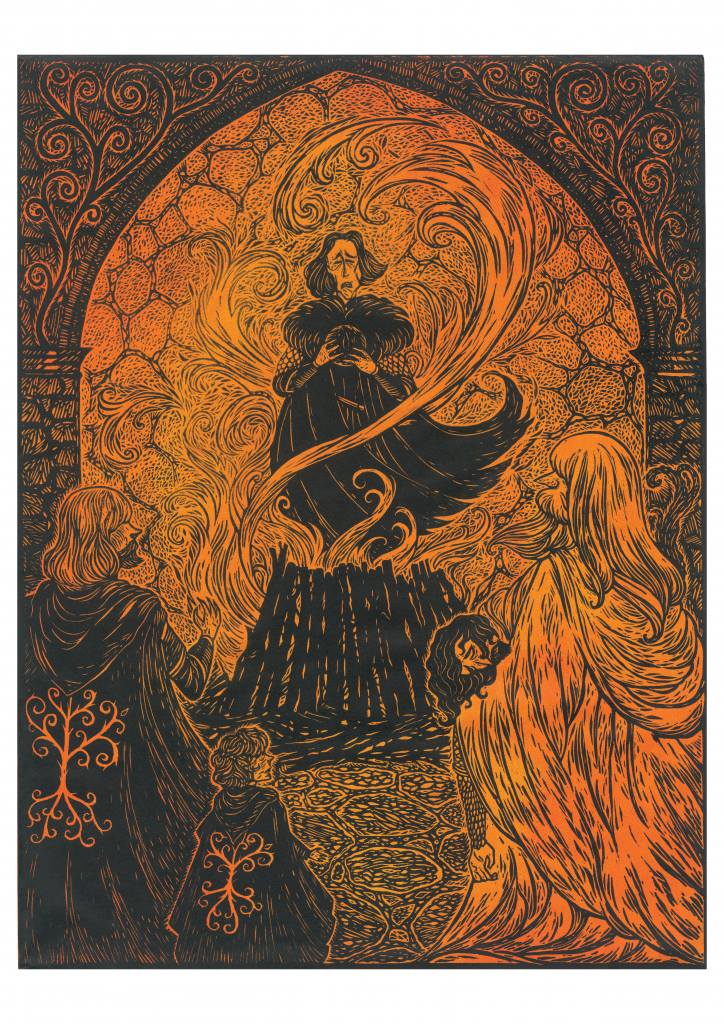
To support Elisabeth Neveux’s work directly, including her current fundraising towards a new A2 press, visit her Ko-fi page: @elisabethneveuxillustration
And keep up with her via social media: @elisabeth_neveux_illustration
Support Go Leor. Get the Print. Join the Story.
Go Leor is an independent Irish arts magazine built by hand, heart, and community. Your support keeps meaningful storytelling alive – in print, in culture, and in conversation.
Through Patreon, you can support the magazine in two simple ways:
- Supporter Listing
Have your name printed inside every issue as part of the community helping Go Leor grow. - Print Copy – UK & Ireland
Receive the latest print issue delivered each month across the UK and Ireland, with your name included inside the magazine.
The Latest Articles
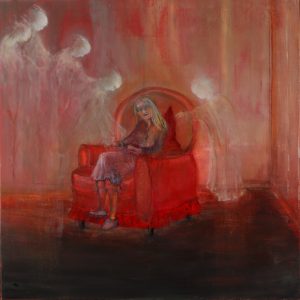

Maria Noonan-McDermott: Where Memory Becomes Art
Transforming intimate family memories into paintings and poetry, her work invites others to recognise stories of their own.
Rosina Law-Braney: Reclaiming the Seven Deadly Sins
Through zines, illustration and humour, Rosina Law-Braney creates vibrant feminist stories that make room for identity, desire, grief and collective creative freedom.
Alexander Edward: Weaving from the Land
Growing his own willow beside Strangford Lough, Alexander Edward brings coppicing, landwork and an ancient craft into bold contemporary forms.
John Britton: Finding Calm Through Ink
After three decades of visceral performance and constant travel, John Britton has found a quieter connection through ink, mentorship and calm.
Yvonne Moore: Following Curiosity into Colour
Refusing to settle into a single style, Yvonne Moore follows curiosity across colour, poetry and community, creating art that brings her – and those around her – fully to life.
Lucy Fleming: Carrying the North Coast Light
Through fluorescent colour, oil pastel and an instinct for collaboration, Lucy Fleming turns the light of the North Coast into images that connect art, music and community.