Aodh O’Cuana

Cloch, Croí, Crann

Through cairn-building, oak saplings and communal remembrance, Aodh O’Cuana asks how we might honour those we love beyond the formal space of a funeral.

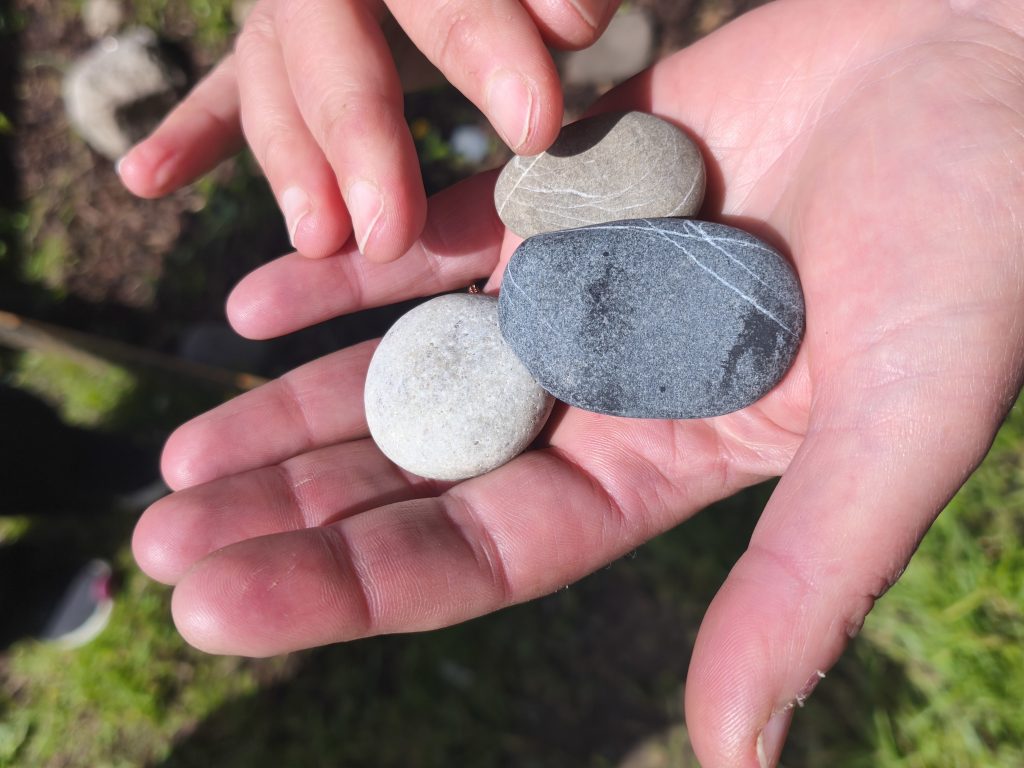
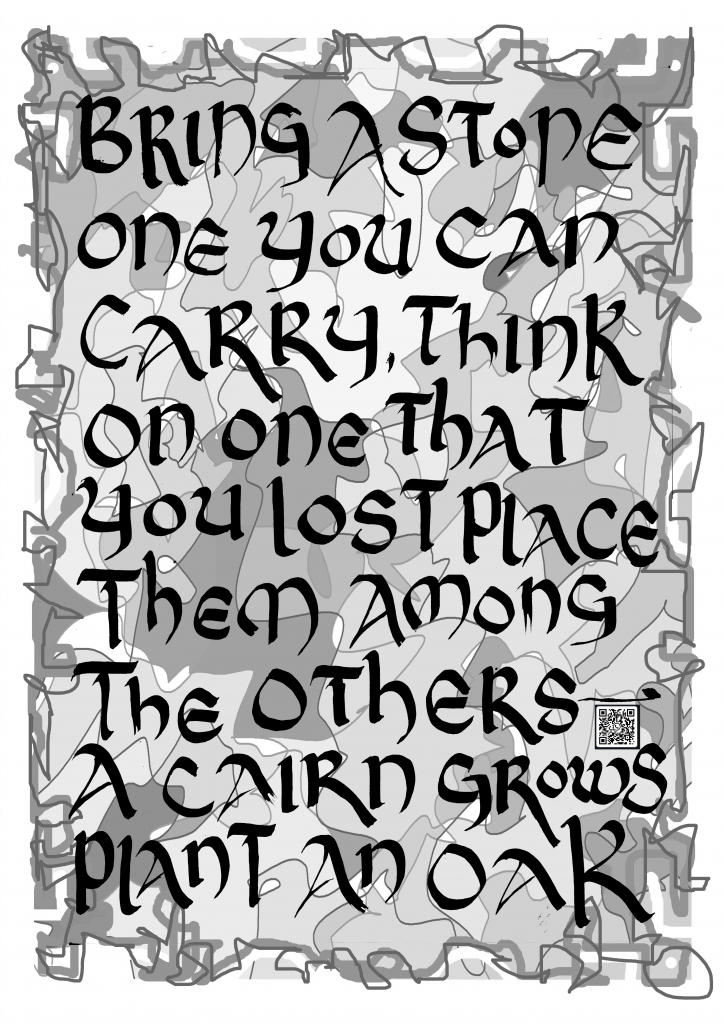
Aodh O’Cuana’s recent MFA project begins with a simple invitation: bring a stone for someone you love.

That stone might come from a beach, a field, a walk, a garden, or a place connected to the person being remembered. It might be carried in silence or arrive with a story already attached. Once brought to the site, it becomes part of a communal cairn. In return, each participant receives an oak sapling to take into their care.

The project, Cloch, Croí, Crann – Stone, Heart, Tree – creates a structure for remembrance that is neither a funeral nor a monument in the traditional sense. It is a shared act, built by those who take part. Aodh describes the project as an attempt to create “a way to memorialise people outside of a funeral,” and also “outside of a catastrophe.”

It is a work about grief, but not only grief. It is about love that still needs somewhere to go. Participants can honour someone who has passed away, but they can also remember, celebrate or hold close someone who is still living. What matters is the act of choosing someone and carrying that care into the project.

“I wanted to create a space for that,” Aodh says, reflecting on the gap the project responds to. “A day-to-day chance for someone to say something about somebody who they love or respect.”

Outside the funeral

The impulse behind Cloch, Croí, Crann was sharpened by Covid, and by the disruption that period brought to funerals, gatherings and communal mourning. The formal structures around death were suddenly limited, delayed, reduced or made impossible. Many people lost the chance to stand together, to speak together, or to take part in the rituals that help grief become shared.

Aodh’s project does not try to replace those rituals. Instead, it creates another route into remembrance. It asks what can happen outside the usual structures, when people are given a simple framework and allowed to bring their own meaning to it.

The work is deliberately participatory. “The project was basically trying to get people to have their own experience,” Aodh explains. He wanted “to make something that was truly participatory,” where those who arrived were not just viewing a finished artwork, but helping to make it.

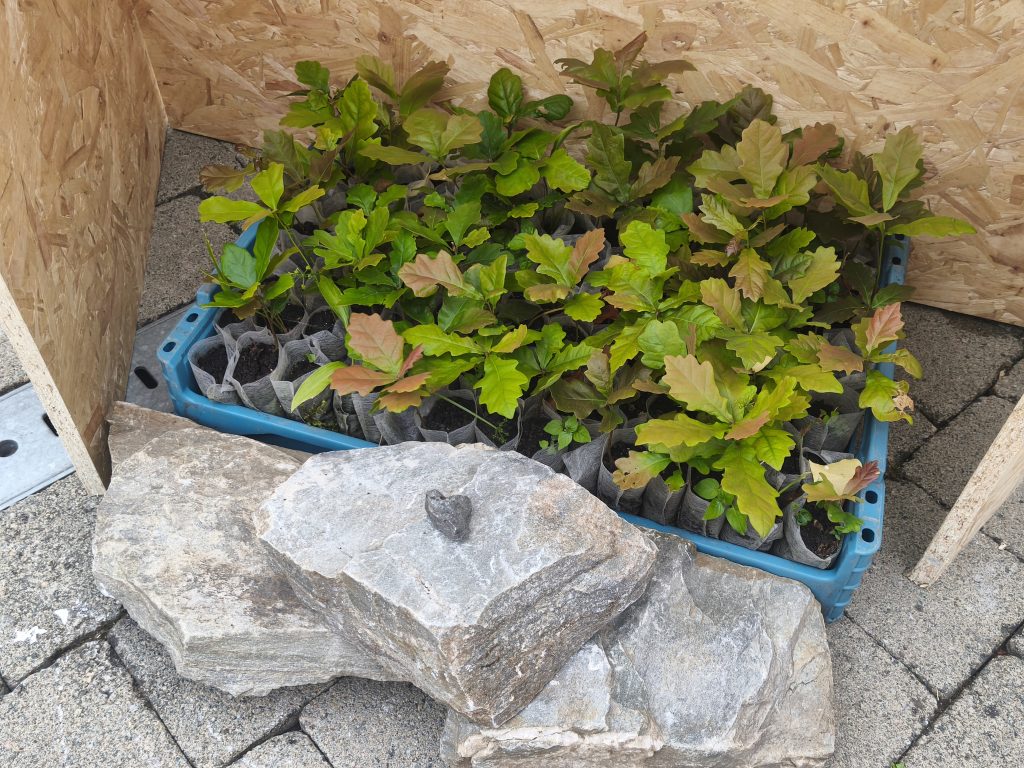
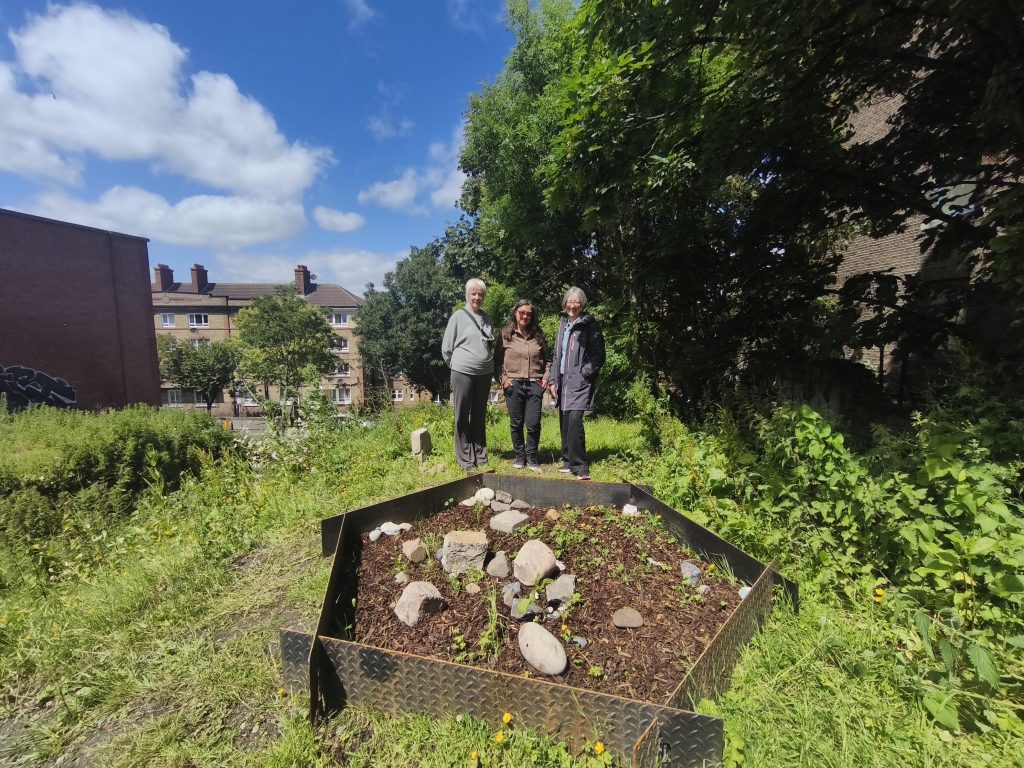
The cairn became the centre of that participation. People brought stones and placed them together, gradually building a shared form out of individual acts. The project turned the familiar image of a pile of stones into something named, felt and remembered.

For Aodh, that question began partly through looking at the Irish landscape and the cairns that already exist across it. He remembers walking up Croagh Patrick and seeing stones gathered at the top. 

“On the one hand, a pile of stones is a pile of stones,” he says. “But I was wondering what it would be like if you could know each one of those stones, who it was for.”

That thought becomes one of the most moving parts of the project. A cairn can be ancient, anonymous and communal, but Aodh’s work asks what happens when each stone has a story attached to it. Who carried it? Who did they carry it for? What memory sits inside the act of placing it down?

A cairn made from personal journeys

Each participant’s stone entered the work through a small personal journey. Some people chose stones from meaningful places. Others found them through instinct or accident. The route to the stone became part of the story.

Aodh noticed that this produced “a folkloric aspect” within the project. People did not simply arrive with material for a sculpture. They arrived with accounts of where the stone came from, how they chose it, and why it mattered.

“Even just the stories from each person, where they got their stone, they were quite folkloric,” Aodh says. “Everybody had their own story about how they had decided or picked.”

This is where the work becomes more than a memorial gesture. It also becomes a gathering of narratives. The cairn holds the physical stones, but the project also holds the stories that brought them there. It recognises that remembrance does not happen only in the final act of placing something down. It begins earlier, in the walk, the search, the choice, the private thought before joining the group.

The project’s power lies in the fact that those stories are partly shared and partly withheld. Participants were invited to speak, but they did not have to. Some chose to tell the group who their stone was for. Others could remain quiet. That choice matters. The project does not force disclosure. It allows space for public remembrance without demanding public confession.

Aodh describes the experience of bringing people into that space as deeply affecting. “Some people were crying and genuinely mourning.”

At that point, the work required another kind of care from him. It was no longer simply an art project with a participatory structure. It was a space where people were speaking about those they loved.

“I realised how there was another element to how I was facilitating that,” Aodh says. He had to be “impartial” and “respectful,” aware of the weight people were bringing into the work.

The transference of care

If the stone anchors the project in memory, the oak tree sends it forward.

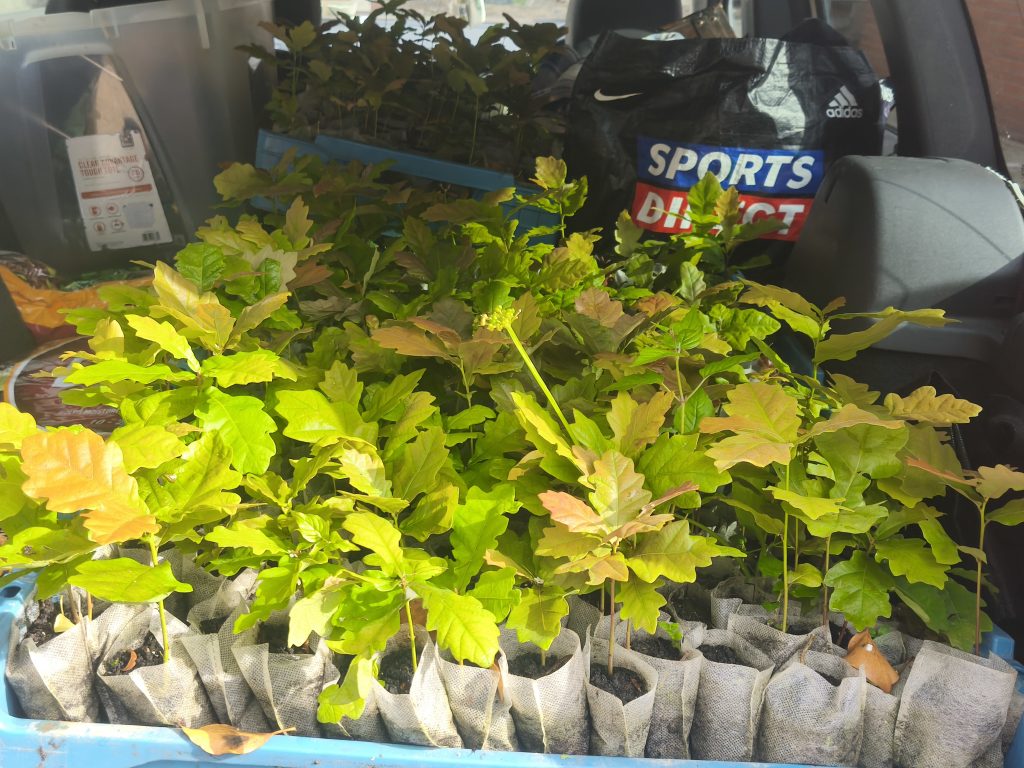
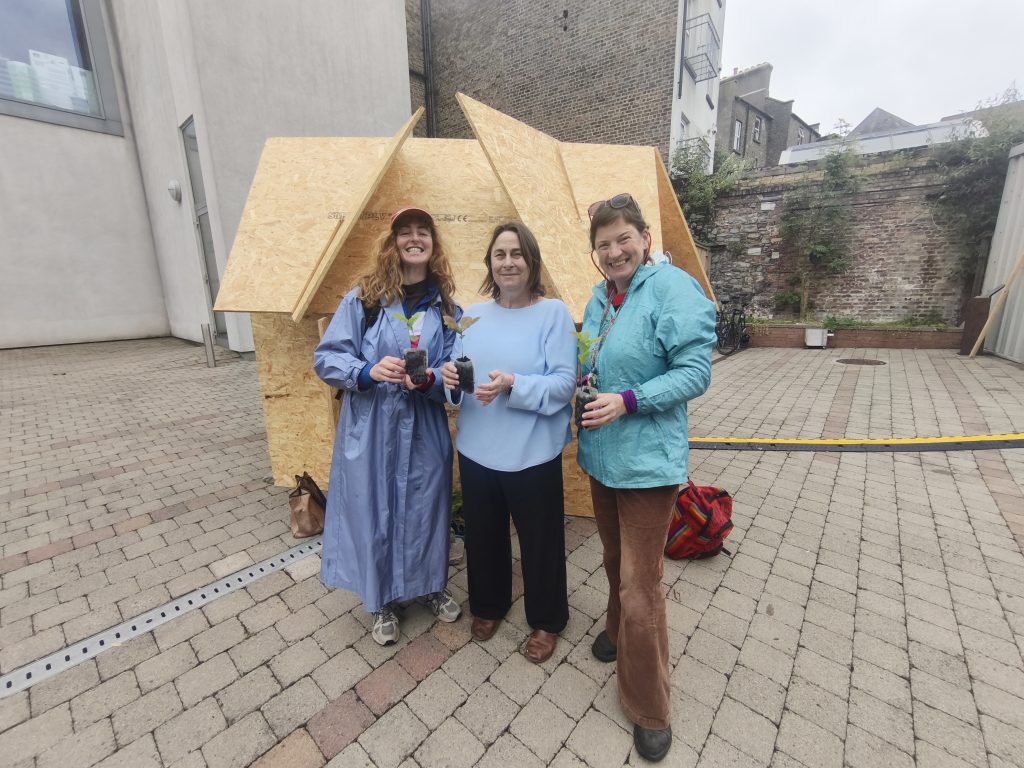
Each participant who added a stone to the cairn was given an oak sapling to take away and look after. Aodh describes this as “a transference of care.” Someone arrives holding a memory of a person they love, and leaves with a living tree now placed in their responsibility.

“I thought it would tie in very nicely,” he explains, “to ask somebody to think about someone who they really loved and then to present them with a life to care for.”

The exchange gives the project a powerful movement between past and future. The stone is placed into a cairn, joining a collective memorial. The oak leaves the site, travelling outward into someone’s garden, land, home or care. The memorial is not fixed only in one place. It branches out.

The oak also changes the timescale of the work. A human life may be remembered in a moment, but an oak demands a much longer imagination. Aodh speaks about the tree’s lifespan with a kind of awe. 

“If it survives,” he says, “it’s going to be growing for 200 years, maturing for 200 years, living in maturity for 200 years, and then kind of on its way out for 200 years.”

That long life turns the sapling into more than a symbolic object. It is fragile at first, then enduring if cared for. It may outlive the participant who plants it. It may become part of a landscape long after the original act of remembrance has passed.

The oak trees came into the project through a collaboration with Mike Fay and Lara De Rivero Fernandes, whose own work at Cregg Castle in Claregalway has involved gestating more than 10,000 acorns and bringing them through the long, careful process of becoming saplings.

While living in Claregalway, Aodh stayed in Cregg Castle, where he connected with Mike, known locally as “Magic Mike”, who works with a forest school. Together, Mike and Lara had collected thousands of acorns and begun the slow work of selecting, storing and nurturing them.

“He collected 10,000 acorns and went through the arduous process of selecting them,” Aodh says, describing how they were placed into crates with layers of paper and soil, needing darkness and cold through the winter before they could gestate. Around 8,000 sprouted.

When Mike and Lara heard about Aodh’s project, they kindly donated 500 oak saplings. “He was just happy for them to be finding a place,” Aodh says.

Around 70 of those saplings were sent out during the first phase of Cloch, Croí, Crann, leaving hundreds more with the potential to extend the work through future events or new cairn sites.

A house for gathering

The first phase of Cloch, Croí, Crann was not only about the cairn. It also involved a meeting point, a temporary structure and a journey from one place to another.

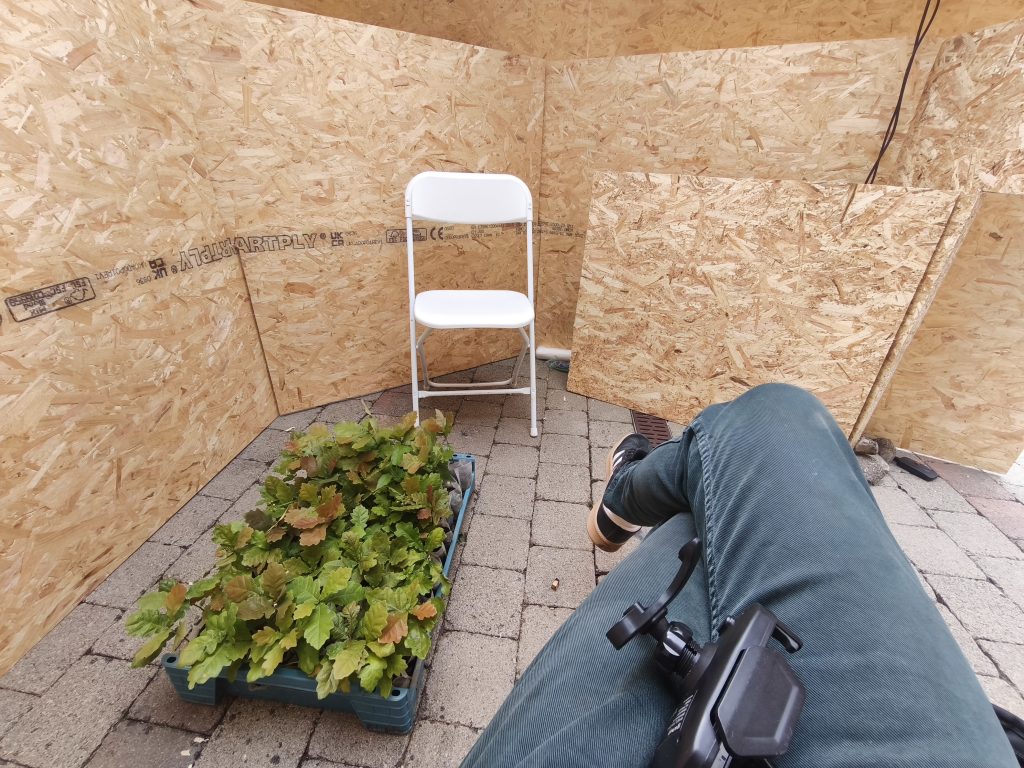
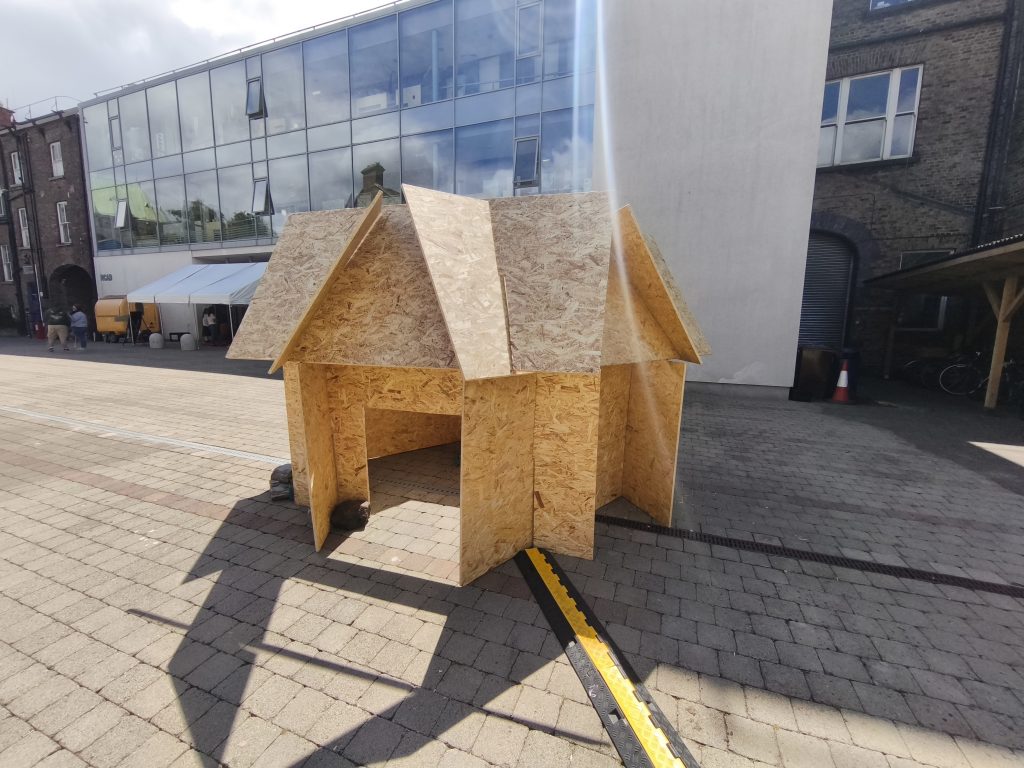
Aodh created a flat-pack structure from OSB boards, designed to be reusable if the project moved elsewhere. It was a practical object, but it also became part of the project’s symbolic language. Participants met there before walking to the cairn site.

“I had a kind of pop-up flat-pack structure,” Aodh says. “If there was another cairn site, I wanted that to be flat-pack.”

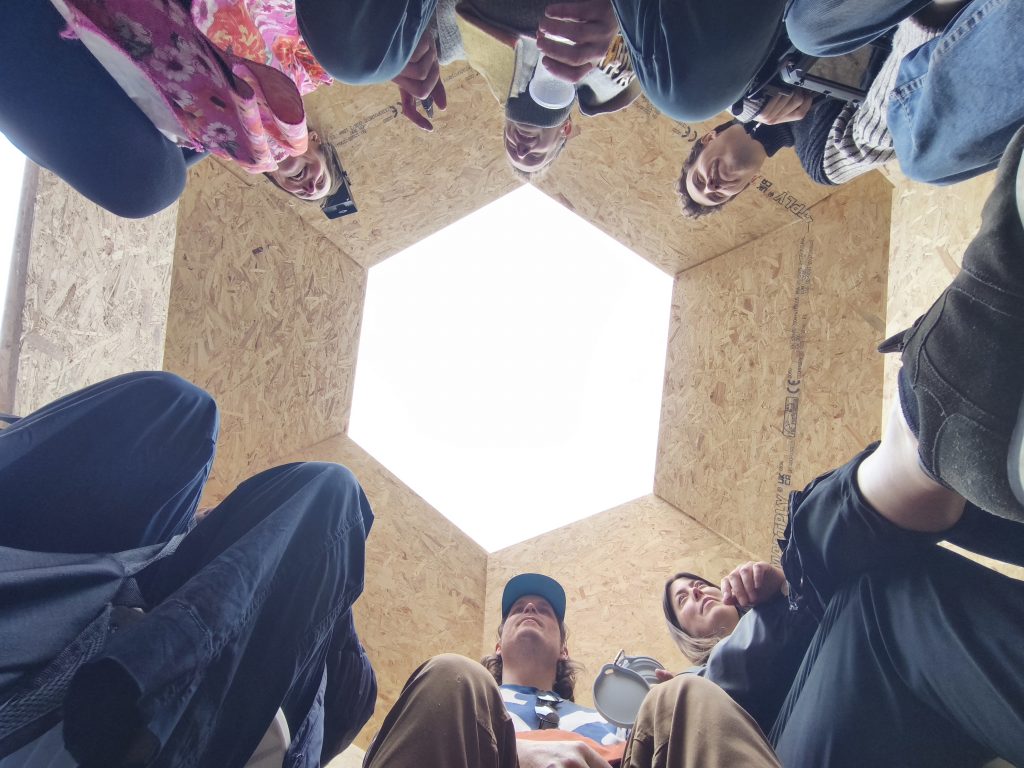
The structure gave people somewhere to arrive. It slowed the process down. Rather than turning up, placing a stone and leaving, participants enocuntered a shared space first. They gathered, waited, became acquainted, and then moved together.

Its hexagonal shape also began to connect with older forms of gathering. Aodh describes some of these links as “happy accidents,” but they became important to the atmosphere of the work. He was thinking about roundhouses, fire, conversation and the older social structures of people sitting together.

“I was trying to think about pre-Roman conquest, and what was the living situation for a lot of that time,” he says. “It was the roundhouse. I just thought about the nature of that, with people sitting around with the fire in the centre.”

This interest in gathering shaped the experience of the participants. At the site, they could tell the story of their stone if they wished.

“They didn’t have to say anything if they didn’t want to,” Aodh says.

That optional quality is essential. The project creates a ritual, but not a rigid one. It gives people a sequence of actions, but allows them to decide how much of themselves to place into it.

Turning away from the digital

Although Aodh studied Fine Art Media, the project became a deliberate move away from heavy digital layers. Technology was used where it was useful, but not allowed to dominate the work.

“I’ve just been going away from the digital,” he says. “I wanted to use all parts of modern life, so I used WhatsApp as a kind of catalyst to organise it, but I didn’t want it to be majorly tech heavy.”

At one point, Aodh had considered augmented reality elements. In the end, he chose not to include them. The work did not need that layer. “It felt like a hat on a hat,” he says.

That decision is one of the reasons the project feels so direct. The materials are plain and readable: stone, wood, paper, saplings, soil, handwriting. The work does not need a technological explanation to make it meaningful. It asks people to do something ancient and immediate with their hands.

This restraint also allows the emotional charge of the work to remain with the participants. A digital layer might have drawn attention towards the cleverness or modernity of the artwork. Instead, the project stays focused on the act of remembrance.

The Book of the Loved

Alongside the cairn and the trees, Aodh has been developing another element: The Book of the Loved.

This book gathers the short texts written by participants for the people they chose to honour. Aodh asked each person to write a small testimonial of around 20 words. It could take any form. It might be plain, poetic, drawn from a song, or shaped as a direct message.

“I wanted to know about each stone, who it was attached to,” Aodh says. Participants were asked to write a short testimonial using “any words that they wanted.”

The book connects to Aodh’s interest in calligraphy, ancient Irish manuscripts and the act of writing. He mentions looking at the Book of Kells and older Irish visual traditions, thinking about how writing itself can become an object of care.

The language around these texts is important. “Epitaph” does not quite fit, because not everyone being honoured had died. Some participants wrote for people still living. “Testimonial” is closer. The book is not a record of death. It is a record of love.

Aodh has created a housing for the book and has been working on motifs and possible decorative elements. He is still deciding whether to handwrite the testimonials and whether to include illustrations. The book is still forming, which seems appropriate for a project that is itself still open.

There is also a careful administrative side to the work. Aodh speaks about the project almost feeling like “setting up a company,” because it needed systems, records, a visual identity and a way for people to understand how to take part. But this structure does not make the work cold. It protects it. When many people’s loved ones are being carried within the same artwork, care has to include organisation.

The artist as operator

One of the most interesting aspects of Cloch, Croí, Crann is that Aodh does not seem interested in making himself the permanent centre of the work.

He created the project, shaped its ritual, built its structures, organised its participants and facilitated its first gatherings. But he also speaks about wanting the work to be clear enough that it could continue elsewhere without him always needing to be present.

“It’s almost like a package or a road map,” he says. “The elements of it could be clearly defined.”

Someone else could potentially meet participants and guide them to a cairn site. The project could be replicated, not as a copy of an object, but as a shared method: bring a stone, honour someone loved, add to the cairn, record a testimonial, take a tree into care.

Aodh describes himself as needing to be “just an operator” within the system he has created. That phrase says a great deal about the ethics of the work. The artist sets up the conditions, but the meaning belongs to those who participate. The grief, love, humour, tenderness and memory are not his to own.

“I wasn’t necessarily 100% necessary for it to operate,” he says, reflecting on the possibility of the project moving beyond him.

That does not reduce the artistic authorship of the work. If anything, it clarifies it. Aodh’s role is in designing a structure that can hold other people’s emotional truths without overwhelming them. The artwork is not only the cairn, the tree, the book or the meeting. It is the full system of care that connects them.

A living memorial

By the end of its first phase, around 70 stones had been placed and around 70 trees had been sent out into people’s care. The cairn still has space to grow. Hundreds of oak saplings remain available. Aodh hopes to continue the work through further events, and the possibility of new sites remains open.

What makes Cloch, Croí, Crann so moving is that it does not offer grief a neat conclusion. It does not pretend that remembrance can be finished. Instead, it gives remembrance a form of work to do.

A stone is placed. A tree is planted. A sentence is written. A name is held. A person leaves with something living to care for.

The project is quiet, but it is not small. It asks how love might be carried beyond the structures we usually rely on. It asks what happens when mourning is made communal without becoming institutional. It asks whether a memorial can be built slowly, by many hands, and still remain intimate.

Aodh’s answer is not theoretical. It is practical. Gather people. Ask them to bring a stone. Let them speak if they want to. Record the words. Build the cairn. Give them a tree.

Through Cloch, Croí, Crann, remembrance becomes something physical, ecological and ongoing. It is not sealed into the past. It is held in stone, written into a book, planted into soil and carried forward through care.

Follow Cloch, Croí, Crann on social media to learn more about the ongoing project, including future opportunities to take part in the communal cairn-building and oak tree planting: @clochcroicrann

Support Go Leor. Get the Print. Join the Story.

Go Leor is an independent Irish arts magazine built by hand, heart, and community. Your support keeps meaningful storytelling alive – in print, in culture, and in conversation.

Through Patreon, you can support the magazine in two simple ways:

  • Supporter Listing
    Have your name printed inside every issue as part of the community helping Go Leor grow.
  • Print Copy – UK & Ireland
    Receive the latest print issue delivered each month across the UK and Ireland, with your name included inside the magazine.

The Latest Articles