
Laura McKenzie Atkins
Fine Artist
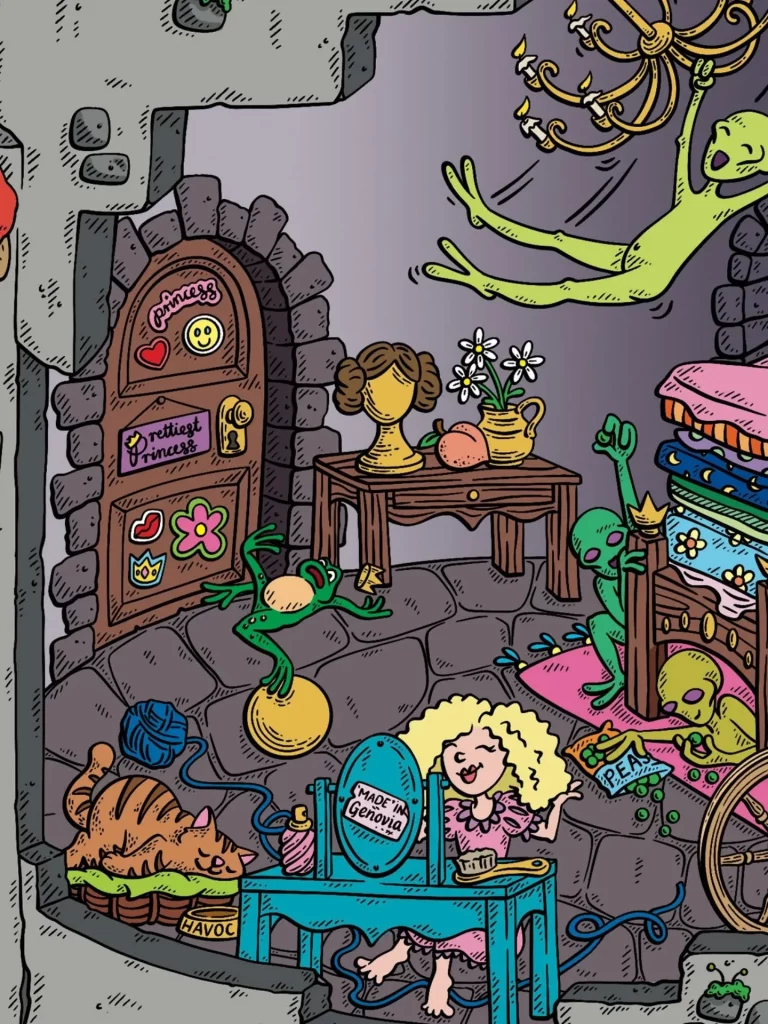
Intricate ink, hidden stories and strange little worlds come together in Laura McKenzie Atkins’ wimmelbild drawings.
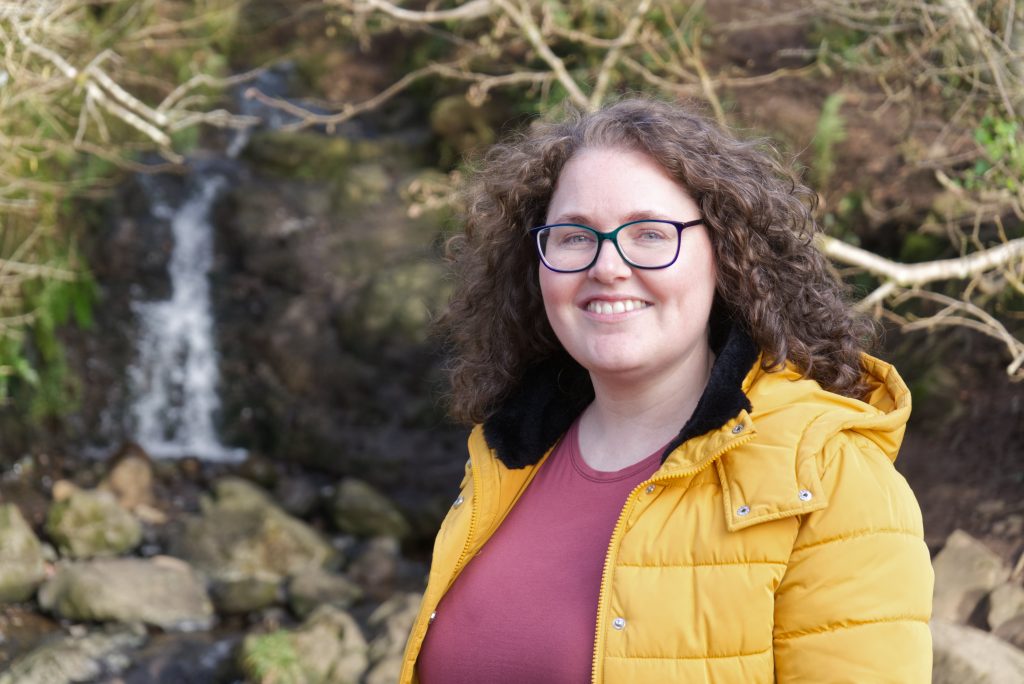
There is a point in Laura McKenzie Atkins’ work where looking becomes searching.
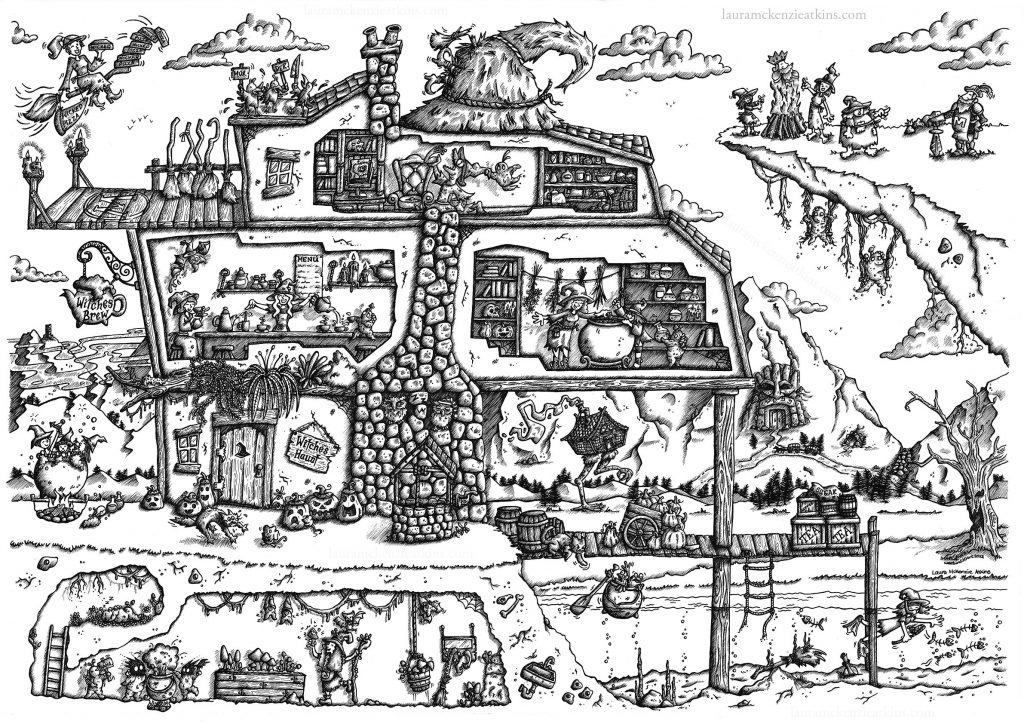
At first, the image may read as a castle, a teapot, a street, a tower, a crowded fantastical structure or some impossible building from a story that has already been told somewhere just out of reach. Then the eye starts to move. A small figure appears. Then another. A joke, a ghost, a historical reference, a creature tucked into a corner, a tiny architectural detail, a character doing something strange on the edge of the scene. The drawing opens out not through scale, but through attention.
Her work belongs to the tradition of the wimmelbild, a type of densely populated image filled with stories, characters and small incidents. It is a form many people might associate with Where’s Wally, but Laura’s route into it came from somewhere much older and stranger: castles, ink illustrations, dark fairy tales, medieval binding, fantasy games, family stories and the childhood thrill of climbing around Carrickfergus Castle with chips from the local chippy.
Laura did not grow up with the word wimmelbild. She had not heard it until 2022. The discovery came almost accidentally, through a Facebook art group challenge called Inky April, where artists were encouraged to make an ink drawing each day for the month.
Most people made a separate image each day. Laura began with a doorway. Then came the guards. Then the surrounding structure.
Day by day, the image grew outward.
“I had no plan when I started,” she says. “I just drew a thing and thought, okay, next day I’ll just add on to that.”
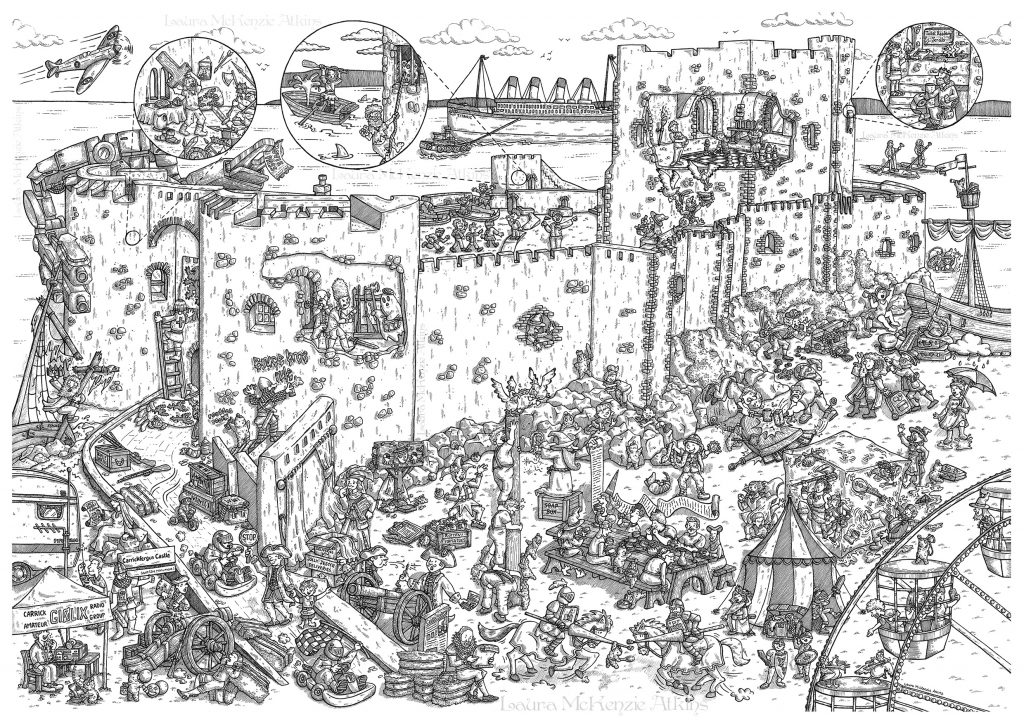
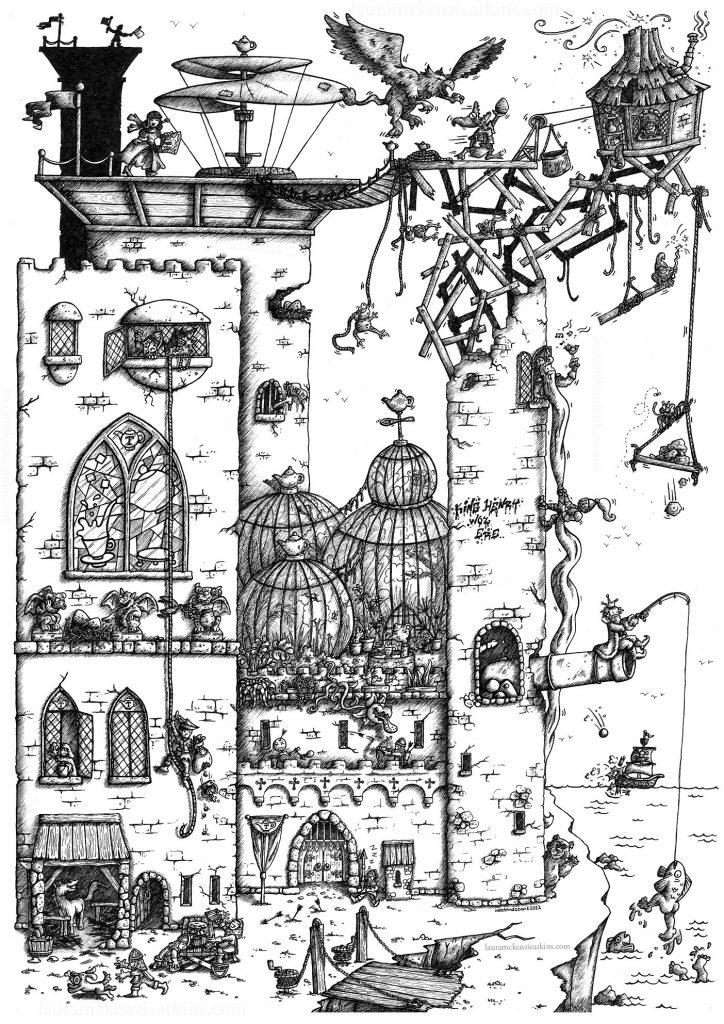
By the end of the month, the drawing had become Castle Teapot, her first wimmelbild. When she shared it, people recognised the form before she had the language for it.
“They went, that’s a wimmelbild,” Laura says. “I had never heard of it. I didn’t know what that was.”
When she looked it up, something clicked. The term gave a name to what she had already begun doing instinctively: building an image as a world, filling it with movement, characters and small stories that refuse to be taken in all at once.
Bad Doodles and Better Plans
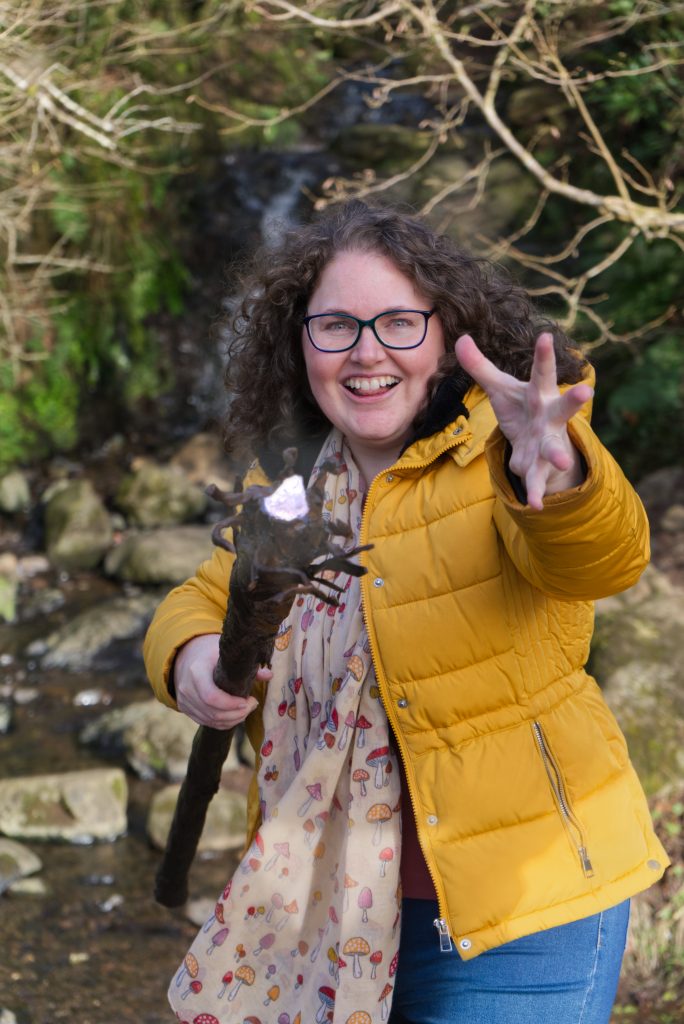
Although Laura is the artist whose name sits on the work, her process is not entirely solitary. Her husband Scott plays a quiet but important role behind the scenes, especially in the early planning stages.
Scott is creative in his own right. He paints tiny models, plays tabletop games and has a strong eye for colour, structure and imaginative problem-solving. Laura describes him as someone who helps her think through the early shape of a piece before the drawing becomes too fixed.
“At the start, when I’m planning out a build, Scott will be very much part of it,” she says. “He’s really good at doing what I call bad doodles.”
Those “bad doodles” are often quick stick-figure sketches on Post-it notes, rough indications of how a scene could work or how a problem might be solved. They are not the finished image. They are a way of testing the architecture of an idea before Laura commits to the long labour of drawing it.
That collaboration developed over time. Early on, Laura was more protective of the work, reluctant to show it before it reached a stage where she felt it could be seen. Scott would sometimes look at a finished or nearly finished piece and point out ways it could be improved. Over time, Laura realised that asking earlier could save her from having to redraw whole sections later.
Now, the rhythm is more fluid. Laura brings the idea. Scott helps break open possible approaches. They bounce plans back and forth, testing what can work and what might cause trouble later.
For a practice built on dense detail, that early stage matters. A wimmelbild may feel playful, even chaotic, but the final image depends on hundreds of decisions about layout, scale, perspective, spacing and narrative movement. Without that underlying structure, the abundance can collapse into noise.
Laura describes herself as more of a “wing it” person. Scott plans.
Together, they make those instincts meet.
Fantasy, Games and Shared Worlds
Laura and Scott’s interests overlap without being identical. Both are drawn to fantasy and science fiction, though from slightly different directions. Laura leans towards Lord of the Rings, darker fantasy, old stories and fairy-tale worlds. Scott is more drawn to Star Wars, space opera and tabletop role-playing.
Their history with Dungeons & Dragons goes back more than twenty years. They began playing with friends in their teens, working from a rulebook they barely understood at first, and are still playing with some of the same people now.
“We have a Friday night group and we still play together,” Laura says.
Sometimes games use miniatures, sometimes they do not. Scott paints models, and friends’ characters have been printed and painted over the years. That kind of world-building runs parallel to Laura’s own drawings. A campaign, like a wimmelbild, depends on small invented details that make a setting feel alive. A character has to exist somewhere. A place needs rules, atmosphere, history and surprise.
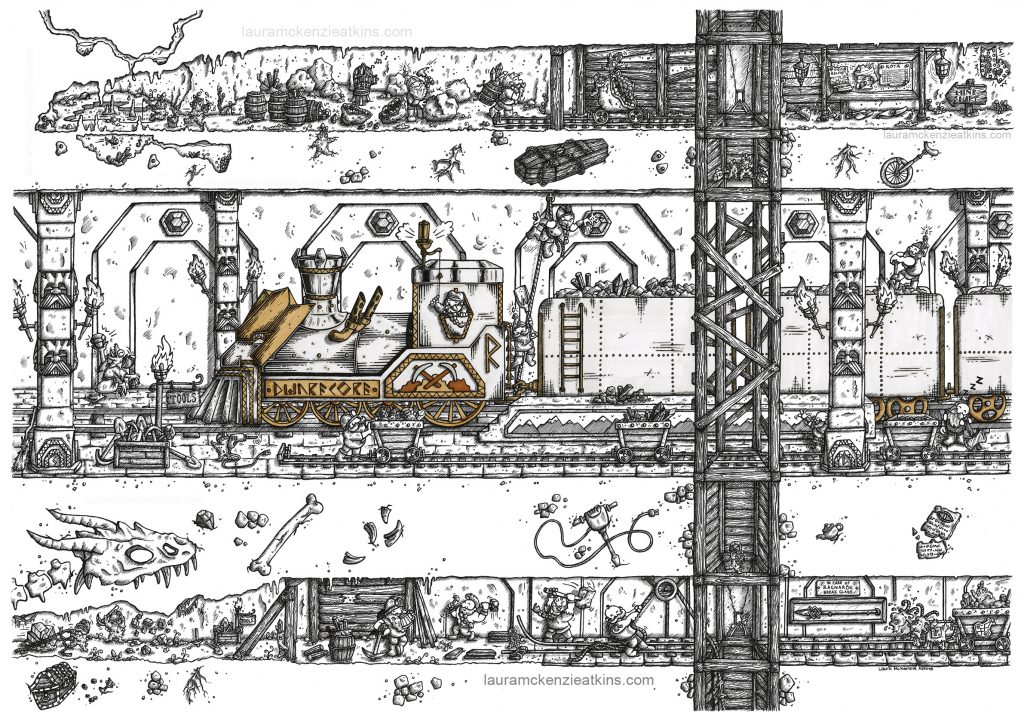
Scott’s influence is especially clear in the way some of Laura’s future ideas twist familiar genres and settings into something stranger, busier and more playful. A dwarven mine shaft becomes a train station. Pirates become space pirates. A Victorian city becomes a steampunk machine full of brass, cogs, trains, airships and strange inventions. These are the kinds of ideas that suit Laura’s work because they give her worlds to fill, systems to complicate and small visual jokes to hide in plain sight.
There is a shared pleasure in asking: what happens if two worlds that should not belong together are made to work?
Castles, Chips and Childhood Dragons
Laura’s attraction to castles is not abstract. It comes from growing up in Carrickfergus, where the castle was part of childhood geography.
“Because I grew up in Carrickfergus, the castle was where we would go,” she says. “My parents would take us down into the town, and then we would climb around the castle while eating chips from the local chippy.”
It was familiar, free and full of imaginative possibility. Laura remembers the marina, the boats and the freedom of being able to climb around parts of the castle that are no longer open in the same way. As a child, it was not simply a heritage site. It was a place to inhabit.
Her family invented their own stories around it. Carrickfergus Castle has its own history and legends, including the story of a princess connected to the castle, but Laura and her siblings added dragons, rescues and their own imagined dramas.
“We always pretended there was a princess in the castle and we were rescuing her from the dragon,” she says.
That combination is central to her work: real architecture, local memory, historical research and invented fantasy all layered together. Her drawings do not treat history as something sealed off. They let it become active again, crowded with the stories people attach to places as they grow up around them.
Her father also encouraged that fascination with old places. He would take Laura and her siblings to ruins, forests and historic sites, feeding a curiosity about what had been there before. Even now, Laura is drawn to the question of who occupied a place before her, what they might have done there, and what stories a building or ruin might still hold.
Books, Ink and Older Illustrations
Before wimmelbild became the label for her work, Laura was already drawn to older forms of illustration. She loved ink sketches in books, especially spot illustrations that interrupted a novel with a glimpse of what a place, creature or character might look like.
She was less interested in bright search-and-find books as a child and more interested in older stories, darker fairy tales and images that looked like they came from a character’s own diary or sketchbook. Scott describes it as the kind of image that appears as if it has been drawn inside the world of the story itself, not outside it as decoration.
That matters because Laura’s work often feels less like an illustration of a finished tale and more like an artefact from one. The drawings have the density of something found: a map, a manuscript page, an old book plate, a visual record made by someone who lived inside the story.
She is particularly drawn to etched images from old books, where metal plates allowed artists to create precise, highly detailed scenes. The appeal lies in the amount of information they could hold.
“I always loved those because they could get so much fine detail,” she says. “It was always big landscapes with characters in them, and it was always telling a story.”
She has not moved into etching herself. Printmaking, especially in a school art department context, feels too messy for the way she likes to work. Ink pen gives her the clean line, directness and control she wants.
“I like the clean nature of being able to use a pen, and being able to put the cap on when I’m done,” she says.
Handmade Books and Thinking Through a Project
Laura also makes leather-bound journals, a skill that emerged partly through her work as a technician in a grammar school. The school had access to a resource centre where materials could be collected, and one of those materials was leather. Laura began wondering what she could do with it, then taught herself to make small books.
The result fitted perfectly with her wider interests. Leather binding, long stitch, medieval methods, handmade pages: all of it sat naturally beside the worlds she was already drawing.
“I learned the long stitch method, which is medieval binding,” she says. “It turned out so good that I started selling them to the teachers in school.”
At first, she made them for herself. She liked the idea of creating the object that would then hold her own sketches.
“I’ve made a thing and now I’m going to put my own drawings in it,” she says. “This is all by me. I like that.”
The journals have become part of her project process. During Covid, she filled one with sketches from favourite movie scenes while she and Scott watched old films they loved. Now, every major build has its own journal. Into it go research notes, newspaper clippings, photographs, sketches, timelines, important names, dates and visual ideas gathered during visits to a site.
Scott points out that these journals often become a place to design figures who may later appear in the finished wimmelbild: historical characters, local figures, ghosts, legends or people connected to the building’s story.
In that sense, the journal is not separate from the artwork. It is where the world begins to gather itself.
The Discipline of Tiny Lines
Laura’s finished drawings are often so detailed that a magnifying glass becomes part of the viewing experience. She uses extremely fine pens, including a 0.03mm nib, and Scott bought her a magnifying lamp so she could work even closer.
That intensity creates a strange contradiction. The drawings are full of lively figures, jokes and movement, but they are produced through a process of extraordinary patience. Every mark has to be considered. The image is drawn first in pencil, then inked, often in multiple passes. A first pass establishes the lines. Later passes alter weight, strengthen certain forms and build depth.
Scott notices those stages clearly.
“She’s not happy to just do the same line thickness across everything,” he says. “It doesn’t look right, so she’ll go over it all again with a second ink pass.”
Laura likes pencil, but ink gives her something pencil cannot: crispness at a tiny scale.
“I find that I just can’t get the tiny marks that I want in pencil,” she says.
The clean line is important because the drawings are already full. If the marks became too soft, the work could lose clarity. Ink lets her pack the image with detail while keeping each part readable.
Perspective has been one of the challenges. Laura describes herself as not naturally strong at it, though she is improving. Castle Teapot, her first wimmelbild, has a flatter quality that reminded her of the Bayeux Tapestry: figures and buildings arranged in a way that carries the story without requiring strict depth.
Later works have demanded more structure. Scott remembers telling her that a mineshaft image with multiple layers could not simply be drawn section by section. It needed measuring, planning and straight lines.
Laura wanted to wing it.
The finished result worked because planning made the complexity possible.
Print, Paper and Keeping Detail Alive
Laura keeps her originals and sells prints. That brings its own technical problems. A drawing full of tiny marks can easily lose its force if the scanning, paper or printing process fails.
Her first major piece, Castle Teapot, was drawn on watercolour paper. She liked the slight texture and warmth of the surface, but it did not scan cleanly. The paper’s bumps and shadows appeared in the file, creating hours of editing work for Scott.
After that, he encouraged her to separate drawing surface from final print surface. Now Laura draws on Bristol board, which gives her the smoothness needed for fine ink detail, then prints on the kind of textured paper she wishes she could have drawn on in the first place.
That solution keeps both parts: the clean scan and the tactile final print.
She also works with watercolour over ink in some pieces, though the sharpness of the lines can make the colour look digital at first glance. She does make digital work too, but she prefers pen on paper.
Digital drawing is faster, but it changes how she works.
“When I do digital, I zoom in too much and I put in too much detail,” she says. “Whenever you get your print, so much of that is lost because I’ve been so close to it.”
Hand drawing keeps the image grounded in a physical scale. The paper resists. The pen has limits. The work takes longer, but Laura has stopped treating that as a problem.
“It takes as long as it takes,” she says.
Asking People to Look Longer
That refusal to hurry is not only practical. It is part of what the work asks from the viewer.
Laura is aware of how quickly art is consumed online. An image appears, is liked or ignored, and disappears with a swipe. Her drawings do not work properly at that speed. They need time. They reward the person who leans in.
“You can’t do that with my art,” she says. “You have to stop and take a look and you have to look really closely.”
She wants people to recognise references, to find hidden figures, to discover that a castle is not only a castle but a container for myths, jokes, films, ghost stories and real history. In her later castle works, research has become central. She looks for local stories, legends and factual histories, then folds them into the image.
She also creates a secrets list to accompany the work, showing where particular characters, ghosts or references can be found.
Scott sees that list as a way to make local history more playful.
“People don’t know about the local ghost stories of Belfast Castle,” he says. “They may not know who the architects were, or the argument over who actually designed the building.”
The secrets list turns the print into a game, but it also opens up the history behind the image. A viewer might begin by looking for hidden cats or ghosts, then end up learning something about the building itself.
That mixture of play and research is one of Laura’s strongest qualities. Her work does not lecture. It hides information in plain sight and invites people to go looking for it.
Riddles, Aliens and Castle Roswell
Laura is currently working on a jigsaw wimmelbild for a Canadian company. The piece, called Castle Roswell, brings together a medieval castle and aliens.
“They came to me and said, we want to have aliens, and I know that you like castles,” she says. “Would you put an alien in a medieval castle? I’m like, yes, of course. That’s my dream.”
The project fits naturally into her interests. Although she had not drawn aliens before, she grew up loving alien stories, films and The X-Files. Scott helped develop the title, Castle Roswell, which instantly tied the medieval setting to UFO mythology.
It also gave Laura room to include her own recurring creatures: small characters she calls Rootles, little mandrake-like beings with mushrooms on their heads. They began as clay figures made for an art class in school, then started appearing in drawings. Mischievous and small enough to hide, they now populate her builds like a private species from her own visual folklore.
“They’re just mischievous and get into things,” she says.
Castle Roswell is planned as part of a later Kickstarter. Another artist, based in Vietnam, is working on a related alien-and-pirate theme. Next year, the artists are expected to swap prompts, with Laura taking on pirates and aliens in her own way.
Scott already knows how he wants to twist it.
His version would not simply be aliens on a pirate ship. It would be space pirates: an old-style galleon floating in space, crewed by figures in comic bubble helmets.
“Why is there a wooden ship in space?” he says. “Because it’s funny.”
That answer could almost stand as a manifesto for part of Laura’s work. The images are highly skilled and deeply researched, but they are not solemn. They are full of play, strangeness and the pleasure of making unlikely things belong together.
Steampunk, Time and Future Worlds
Beyond the commissions, Laura and Scott have their own ideas waiting. One is a steampunk time-themed world: Victorian London, brass and bronze machinery, cogs, gears, airships, trains, pocket watches and impossible inventions.
It is easy to see why the idea appeals. Steampunk offers the kind of visual excess Laura’s work thrives on: mechanisms, costumes, windows, streets, pipes, signs, engines and tiny moving parts. Scott is especially drawn to pocket watches, with their intricate internal logic and visible machinery.
For Laura, those future worlds are not a departure from castles and folklore. They are another way of doing what her work already does: building an image that can hold many stories at once.
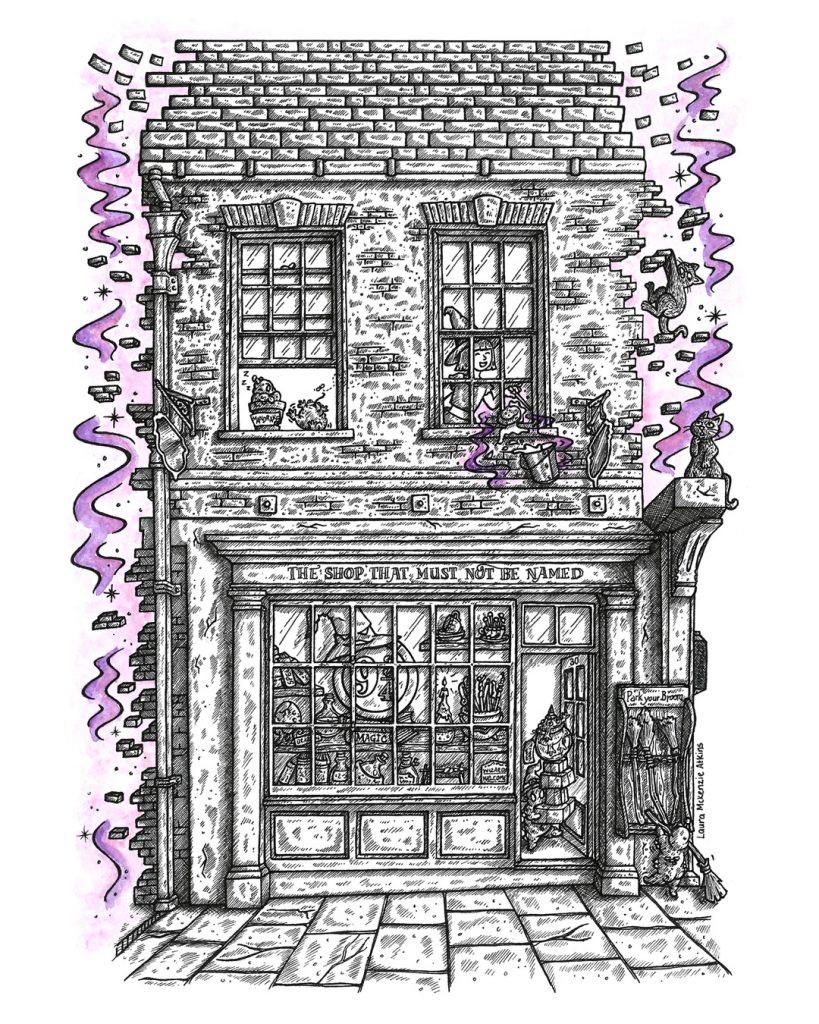
She is also open to commissions, though Scott is clear that they take time because of the detail involved. Laura has already created wimmelbilds of houses and meaningful places for people: homes, meeting places and sites with personal memory attached. Not every piece has to be huge. A small build can still hold a world if the subject matters enough.
Beginning Later
One of the most striking things Laura says comes near the end of the conversation. She explains that she was 41 when she began making this particular kind of art seriously. Before that, she painted and doodled, but the wimmelbild work arrived later.
She does not present that as a regret. Instead, it becomes a kind of encouragement.
“You’re never too late,” she says.
That feels important in relation to her work.
These drawings are not rushed declarations from someone trying to keep pace with every trend. They are the result of years of accumulated interests finally finding the right form: childhood castles, family stories, school materials, tabletop games, ink drawings, dark fairy tales, old books, handmade journals, films watched during lockdown, and the practical partnership of someone willing to say when a mineshaft needs a ruler.
Laura McKenzie Atkins’ work asks for something unfashionable: time. Time to make, time to plan, time to research, time to draw, time to scan, time to print, and time for the viewer to look properly.
In a visual culture built for speed, her drawings resist the glance. They are full of doors, windows, ladders, towers, creatures, ghosts and jokes. They pull the viewer into the page and make them work for the reward.
The result is art that feels alive with attention. Not because it shouts, but because it waits for the viewer to come closer.
Explore Laura McKenzie Atkins’ website to find her latest work, online shop, commissions and upcoming events: lauramckenzieatkins.com
And keep up with her via social media: @lauramckenzieatkins
Support Go Leor. Get the Print. Join the Story.
Go Leor is an independent Irish arts magazine built by hand, heart, and community. Your support keeps meaningful storytelling alive – in print, in culture, and in conversation.
Through Patreon, you can support the magazine in two simple ways:
- Supporter Listing
Have your name printed inside every issue as part of the community helping Go Leor grow. - Print Copy – UK & Ireland
Receive the latest print issue delivered each month across the UK and Ireland, with your name included inside the magazine.
The Latest Articles

Maria Noonan-McDermott: Where Memory Becomes Art
Transforming intimate family memories into paintings and poetry, her work invites others to recognise stories of their own.
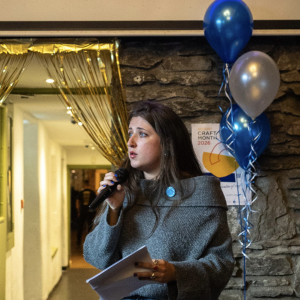
Rosina Law-Braney: Reclaiming the Seven Deadly Sins
Through zines, illustration and humour, Rosina Law-Braney creates vibrant feminist stories that make room for identity, desire, grief and collective creative freedom.
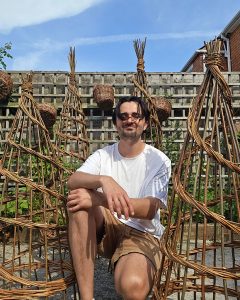
Alexander Edward: Weaving from the Land
Growing his own willow beside Strangford Lough, Alexander Edward brings coppicing, landwork and an ancient craft into bold contemporary forms.
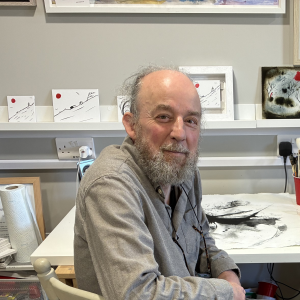
John Britton: Finding Calm Through Ink
After three decades of visceral performance and constant travel, John Britton has found a quieter connection through ink, mentorship and calm.
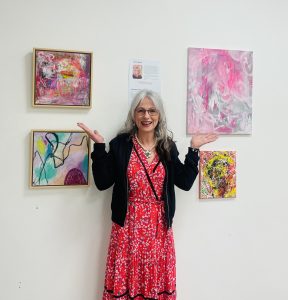
Yvonne Moore: Following Curiosity into Colour
Refusing to settle into a single style, Yvonne Moore follows curiosity across colour, poetry and community, creating art that brings her – and those around her – fully to life.
Lucy Fleming: Carrying the North Coast Light
Through fluorescent colour, oil pastel and an instinct for collaboration, Lucy Fleming turns the light of the North Coast into images that connect art, music and community.