Critter
Illustrator & Street Artist
Through goblins, cartoon villains and a growing world of strange creatures, Belfast artist Critter is finding the freedom to make what he wants and enjoy making it.
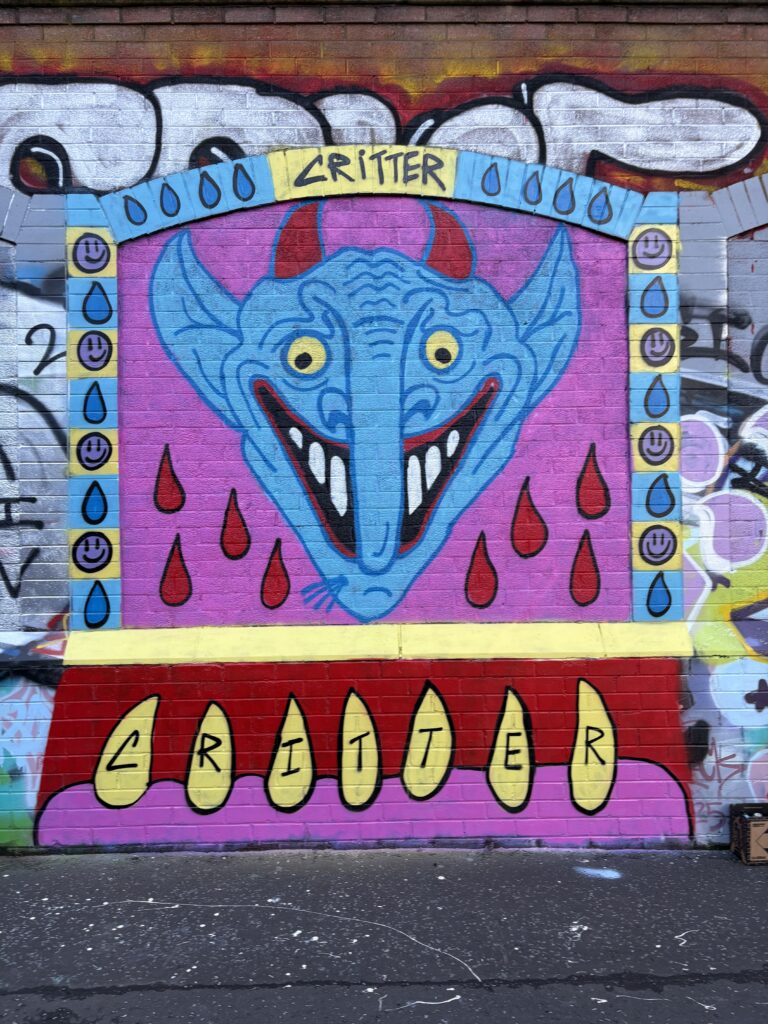
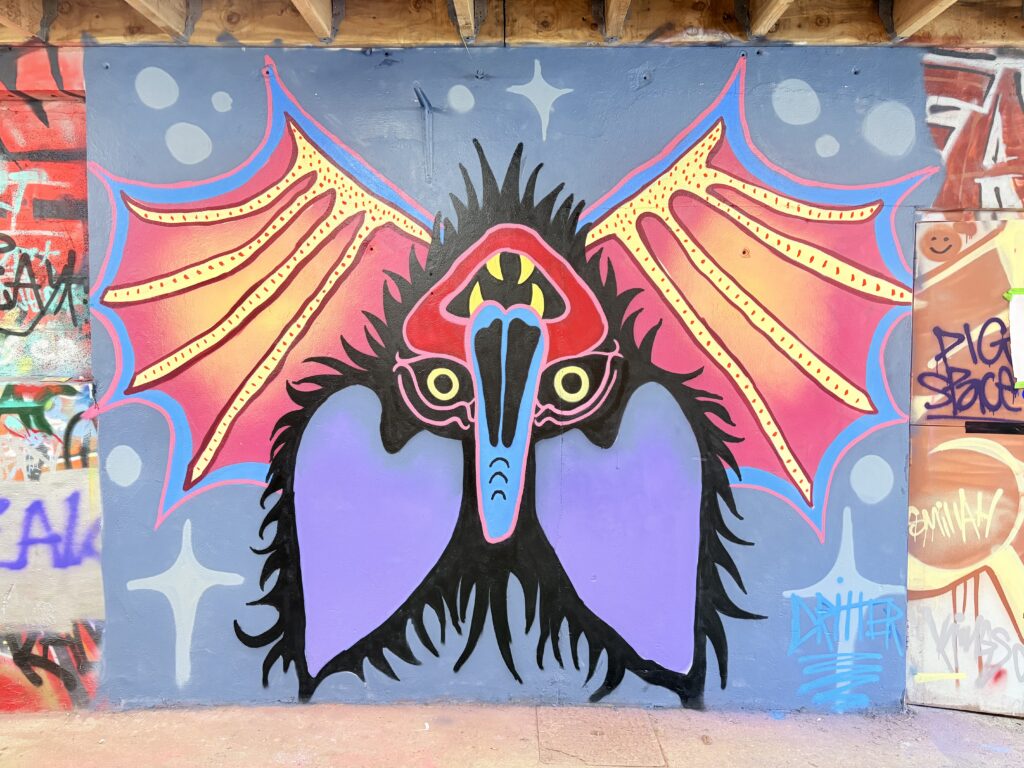
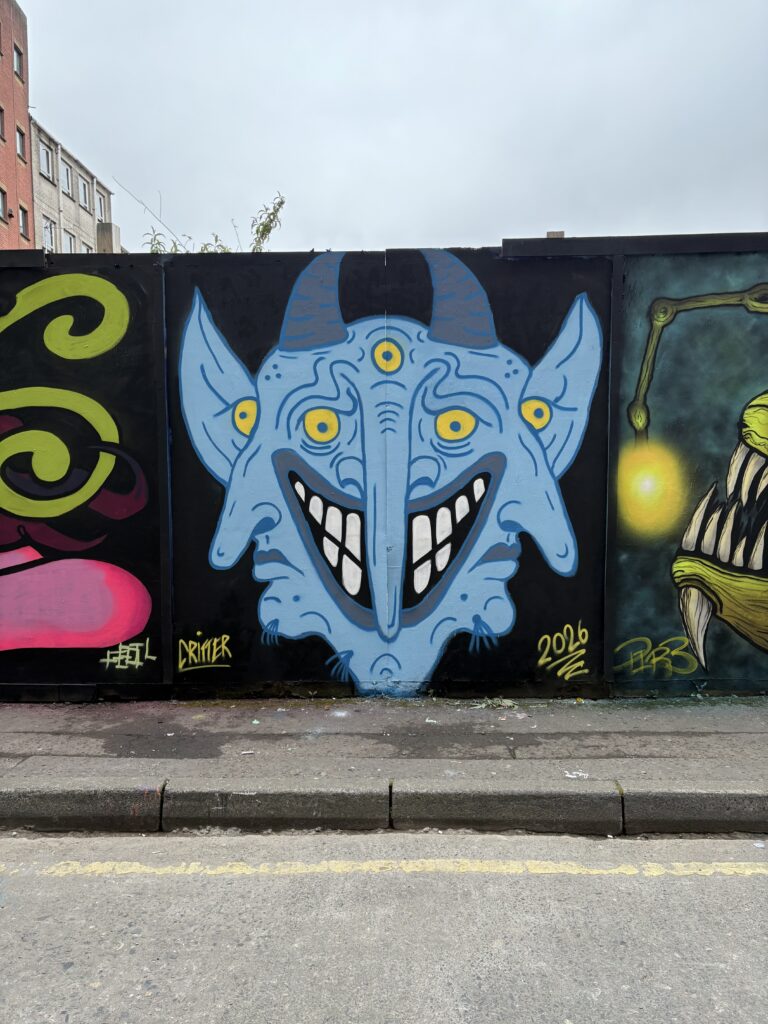
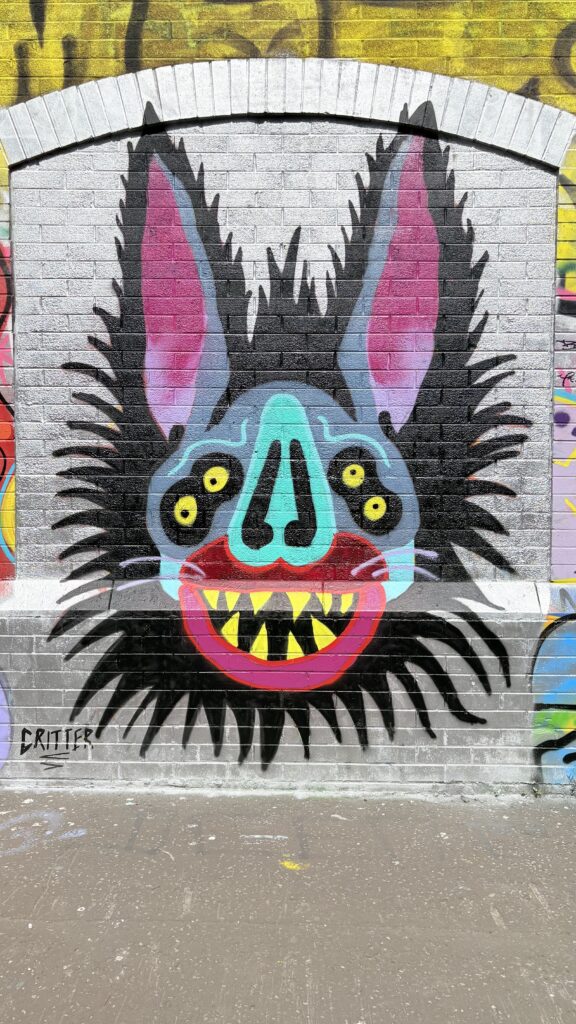
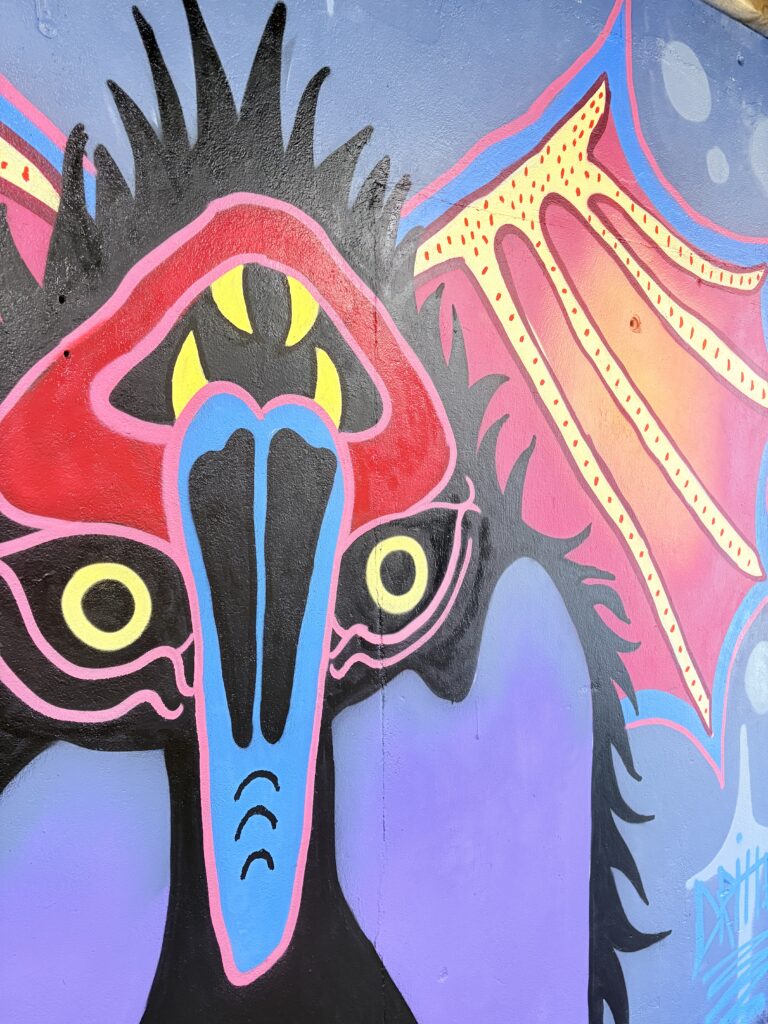
An imagined world is taking shape, populated by goblins, bat-like creatures and a growing cast of non-human characters. He describes it as an “underbelly society”, an ecosystem whose inhabitants emerge as he draws and paints. He has yet to discover what the whole world looks like, and that uncertainty is part of what makes building it exciting.
For Belfast artist Critter, that freedom has taken some finding. Before the murals, the spray cans and the cast of creatures now appearing in his work, there were digital illustrations and event posters. There were commissions he was pleased to receive, followed by hours spent worrying about whether the results were good enough. Even a happy client could do little to quieten his own criticism.
Now, making something deliberately awkward offers a way through that feeling.
“There’s something really freeing about making something that’s purposefully ugly,” he says. “It almost feels like a protest to the perfectionism.”
It is a useful introduction to Critter’s world: colourful, strange and still taking shape, with room for its creator to discover things as he goes.
The Pressure To Get It Right
During the working week, his nine-to-five job in Belfast keeps him occupied, with art taking shape around those commitments. His creative work remains separate from his day job, developing in the hours he can find for it.
He has no formal art training. His route into illustration involved an iPad, Procreate and YouTube tutorials, teaching himself how to use the tools and gradually picking up commissions. Some of those early jobs were posters for parties and events in Belfast’s dance scene.
Getting that work was exciting. He was being asked to draw, and people were happy to pay for what he could make. The difficulty arrived once the commission was underway.
“I was excited to get the commission, but then when I was working on the commission, I was super stressed,” he explains. “I didn’t like the process.”
There were several audiences to think about: the person commissioning the poster, the people it was meant to attract, and Critter himself. He worried about how the finished image would be received, scrutinising decisions and imagining reactions before anyone else had seen it.
“I was still finding myself being really hypercritical,” he says. “The perfectionism was rotting my brain.”
At the same time, the things he most wanted to draw did not always belong comfortably in an advertisement. The uglier, stranger ideas could feel difficult to use when the image also had to sell an event. Making something more palatable meant setting those ideas aside, and gradually the enjoyment went with them.
He eventually stopped taking that direction. Trying it had taught him something valuable about the kind of work he wanted to make, even if it had taken an uncomfortable experience to find out.
“I wouldn’t have known that had I not tried it.”
Picking Up A Spray Can
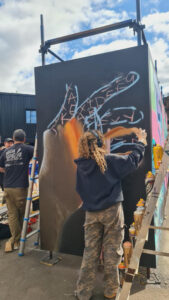
His first encounter with spray painting came in June 2025, at a workshop run by FGB behind Vault Art Studios Shankill Mission. It was a small group, and something Critter had wanted to try for a while. Having an opportunity to pick up a can, with someone encouraging him through those first attempts, made a difference.
He remembers enjoying how it felt. Afterwards, the immediate thought was that he wanted to do it again.
A few weeks later, Belfast Legal Walls on Little Patrick Street offered somewhere to continue. The workshop was still fresh in his mind, and he decided to give it a go.
“I just loved it straight away,” he says. “It felt miles away from the other stuff that I had just done.”
At first, he would arrive with spray cans and no prepared design. He treated the wall much as he would a sheet of paper, allowing an image to develop as he worked. There was no complete plan waiting to be transferred onto the surface.
A World Of His Own
That approach gave him somewhere to put the creatures that had been following him around since childhood.
The origins of those creatures are straightforward: he has always liked monsters. As a child, he was always drawing them; in his early twenties, his imagination continued to return to characters that were something other than human.
“That’s just sort of where my brain likes to go.”
The medium was new, but the interest was already there. Goblins and, more recently, bat-like creatures have become inhabitants of a world he is gradually discovering through making it. He describes the beginnings of an “underbelly society”, an ecosystem of non-human characters whose surroundings and relationships have yet to be fully worked out.
“I don’t really know what the whole world looks like yet,” he says. “But I think that’s kind of exciting as well.”
There is no complete catalogue of characters waiting to emerge. An idea arrives, he follows it, and something else becomes possible. The uncertainty gives him a reason to keep going.
“It feels a bit limitless. And I’ve only just begun.”
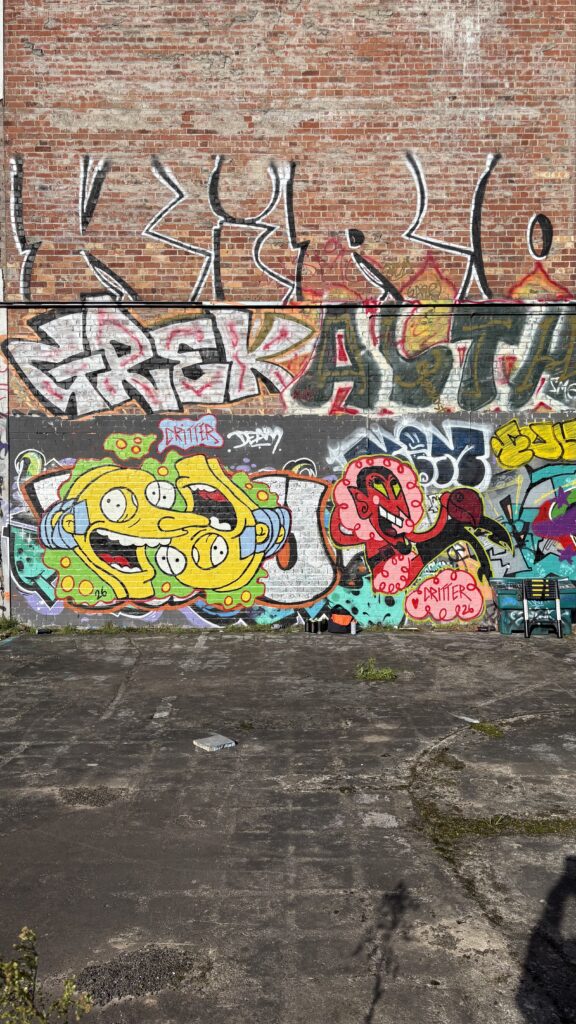
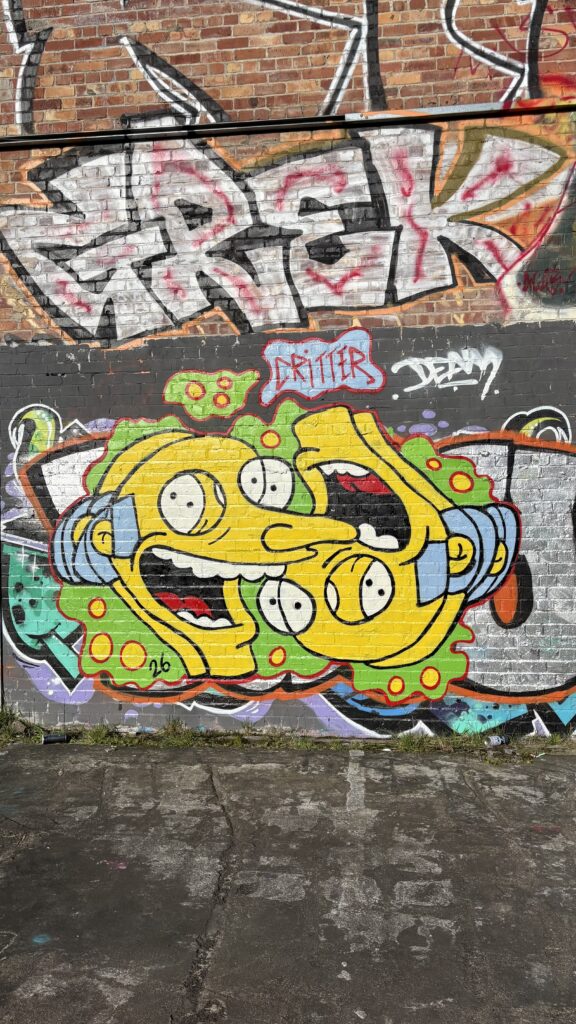
Some familiar faces have found their way into that world too. HIM from The Powerpuff Girls and Mr Burns from The Simpsons reflect a longstanding affection for villains. As a child watching wrestling, Critter was drawn to the bad guys; cartoons and films brought a similar fascination with their appearances and stories.
“I just always thought that the bad guys were cooler.”
When he paints a recognisable character, he wants to find his own way into it. His version of Mr Burns began with a drawing on the iPad, which he duplicated, shifted and layered, playing with the head until the familiar face became something more disorientating.
He describes the result as “Mr Burns on an acid trip.”
Learning On The Wall
The iPad still has a role in how he develops ideas. As he has met other painters and watched how they work, he has learned more about planning and transferring a design onto a wall. His paintings have become more detailed, and his process has changed with that growing knowledge.
But working physically brings a resistance he finds useful. A digital drawing offers enormous control: another layer, another adjustment, an undo button whenever a mark goes wrong. For someone inclined to keep questioning whether an image could be better, those possibilities can become exhausting.
Spray paint asks different things of him. A mark can be corrected, but the correction takes work. The surface, scale and handling of the can introduce challenges that cannot be resolved with a tap on a screen.
“It’s really humbling,” he says.
That feeling has stayed with him as he has learned. He still finds the physical work challenging, and that challenge is part of why he enjoys it. There is satisfaction in figuring something out through doing it, even when the result differs from what he first imagined.
A Welcome From The Community
Other artists have helped him find his way. Alongside FGB’s encouragement at that first workshop, he singles out Wee Nuls as both an inspiration and a source of support. More broadly, he speaks warmly about the welcome he has received from people across the street art scene.
In other parts of the art world, he has encountered what felt like gatekeeping or snobbery. His experience here has been of people celebrating newcomers and giving them opportunities to develop.
Seedhead Arts and Daisy Chain were among those offering opportunities early on. Being asked to take part, and finding himself included in events such as Hit the North, has meant a great deal at a stage when he still feels he is beginning.
“For a newcomer, I was just sort of extremely humbled,” he says, “but also really grateful that I even got asked in the first place.”
Connections have also grown online, through conversations with artists in other parts of the world. His page does not have to be enormous for it to introduce him to people who understand the excitement of making something and want to encourage someone else doing the same.
Room To Enjoy It
That support matters when time is limited. Working full time means there are ideas he cannot immediately pursue and experiments that have to wait. He would like more hours to give to the work, including the possibility of making something physical that people could hold. What form that might take remains open.
For now, he is comfortable describing the art as a hobby and a passion project. He leaves room for things to change, but turning it into full-time employment is not a requirement he is placing on himself.
Keeping it alongside his job takes some pressure off. After his experience with illustration commissions, that is something he values. He wants to be able to enjoy making the work without immediately asking it to support him.
Letting It Exist
The temporary nature of street art helps too. A painting might be covered, tagged or removed. A paste-up could be torn down tomorrow. Even the building beneath a mural may eventually disappear.
For Critter, knowing that a piece might have a short life makes it easier to let it be finished. He has made it; it exists for a while; then something else may happen to it. The possibility of change loosens the demand that every decision must be right forever.
As for why the awkward ideas are worth pursuing in the first place, Critter had spent a couple of days considering his answer. He worried that putting it simply might sound arrogant, but his reason was clear.
“It’s worth pursuing because it’s what I want to make and what I want to do.”
He is careful about attaching anything larger to it. He does not want to pretend there is a grand statement behind every character. There is pleasure in making something strange, in following a preference that has been there since childhood, and in letting an image exist without needing it to advertise or promote anything.
That seems reason enough. His creatures have given him something he was losing while trying to anticipate everyone else’s response: the desire to make the next thing.
Critter’s world is still developing. He does not know all its inhabitants, what might eventually be held in someone’s hands, or where the next idea will lead him. For the moment, he is enjoying finding out.
“It’s just there,” he says, “and it’s ugly and it’s there.”
Keep up with Critter via social media: @critter.wtf_
Support Go Leor. Get the Print. Join the Story.
Go Leor is an independent Irish arts magazine built by hand, heart, and community. Your support keeps meaningful storytelling alive – in print, in culture, and in conversation.
Through Patreon, you can support the magazine in two simple ways:
- Supporter Listing
Have your name printed inside every issue as part of the community helping Go Leor grow. - Print Copy – UK & Ireland
Receive the latest print issue delivered each month across the UK and Ireland, with your name included inside the magazine.
The Latest Articles

Grace McMurray: Stitching Memory and Identity
Through knitting, embroidery, drawing and costume, Grace McMurray makes work that carries personal histories, shared enthusiasms and the value of time spent creating.

Caroline Murphy: Colour, Pattern and Possibility
Working under the name Pansy Soup, Belfast artist Caroline Murphy brings together colour, found materials and a willingness to see where an idea leads.

Annemarie Mullan: Creating Together with Cré
From articulated clay figures to ambitious group exhibitions, Annemarie brings stories into physical form while helping eight distinct creative voices become stronger together.

Curly Bap: Making Art for Others and Herself
From animal portraits to experiments with paper, textiles and clay, Curly Bap is finding her next direction through the people, places and creative possibilities around her.

Noodle: Familiar Faces and an Eye for Light
Portraiture, playful references and a fascination with light shape Noodle’s paintings, as the Scottish artist explores new subjects and larger surfaces from her studio in Bangor.

Maria Noonan-McDermott: Where Memory Becomes Art
Transforming intimate family memories into paintings and poetry, her work invites others to recognise stories of their own.