
Maria Noonan-McDermott
Visual Artist & Poet
Transforming intimate family memories into paintings and poetry, her work invites others to recognise stories of their own.
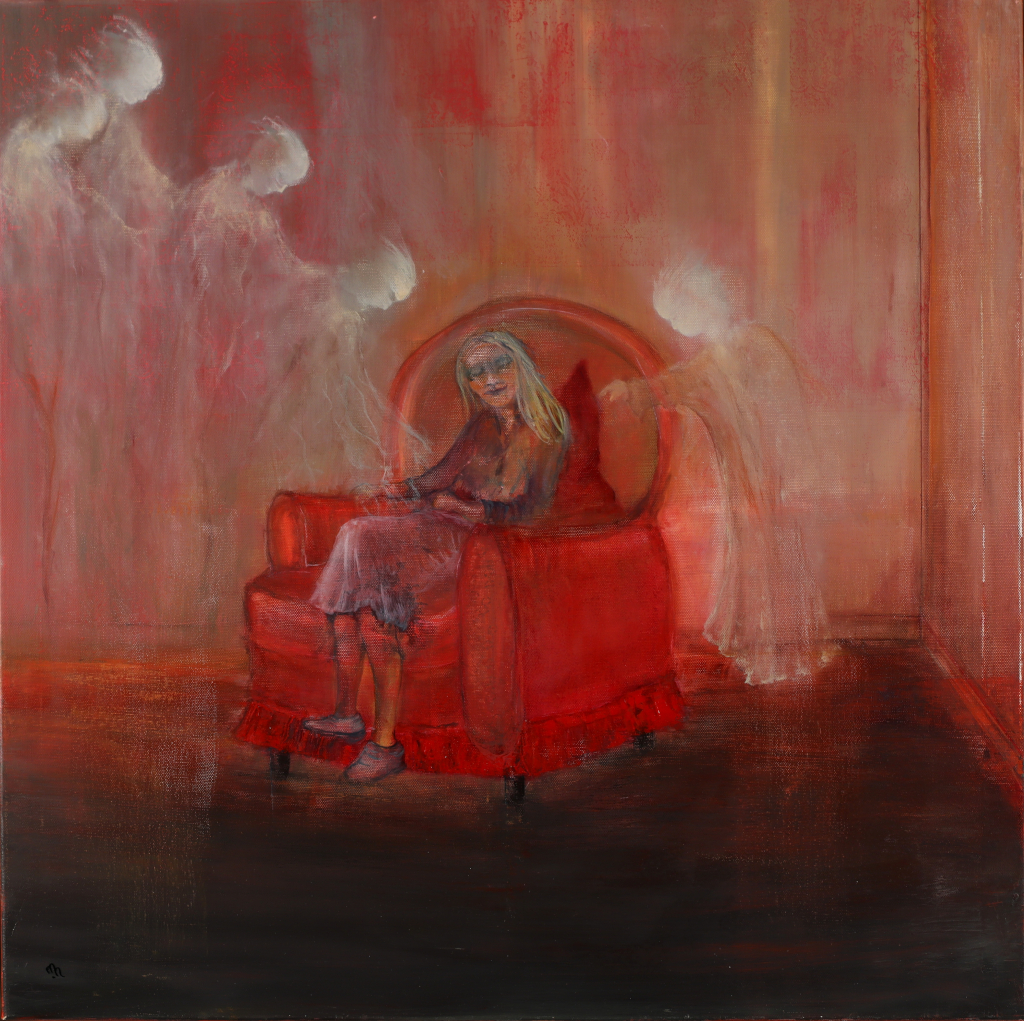
For once, Maria Noonan-McDermott’s studio is tidy. Paintings have been gathered, checked and packed in preparation for Time-Lapse at the Strule Arts Centre in Omagh, an exhibition that will mark almost four decades since her first solo show. The order is necessary, but it is not necessarily the part she loves.
“I enjoy mainly the painting part,” she says. The lists, marketing and administration have become familiar after so many years of exhibiting, yet it is still the encounter with an image – the moment when colour, memory and emotion begin to find a form – that brings her back to the studio.
There are many lives gathered inside the paintings waiting to leave it. Some hold Maria’s memories of her mother, Maisie, whom she helped care for through Alzheimer’s. Others return to a Donegal childhood shared between seven children, a mother running a business and a father who came home from sea carrying books and stories from around the world. As Time-Lapse has travelled, these personal memories have been joined by those of its audiences. Visitors recognise their parents, siblings, childhood homes and experiences of care within Maria’s work. They begin to tell her their own stories, and the exhibition changes again.
What began as a deeply personal tribute has become something shared. Maria’s work contains the particulars of one family, but never closes around them. Its figures, landscapes, chairs and inherited objects retain enough mystery for another person to enter.
“It’s not a piece of work in isolation anymore,” she says. “It’s for everyone. Everybody has a story to tell.”
A Place of Her Own
Maria grew up as one of seven children. She remembers herself as quiet and shy, often listening while the stronger voices of family, neighbours and visiting relatives filled the room. In a household that busy, it could be difficult to get a word in. Art offered her both a language and a place that was recognisably hers.
Her earliest creative connection was with her mother. Maisie had trained and worked as a dressmaker and designer in London before returning home to care for her own grandmother. Maria believes she would have loved to remain there. Instead, Maisie opened a shop and found another way to put her ability and independence to use. She painted too, and recognised the same instinct in her daughter.
“I seemed to be the only one who enjoyed and participated in the art side of things,” Maria says. “The fact that my mother gave me attention because I liked art was a big thing for me.”
When Maria was thirteen, Maisie asked if she would like to attend summer painting classes with her. Hosted by the artist Dawn Buchanan, for three successive summers, mother and daughter went together. In the grand surroundings of a large house with a working farm in Raphoe, Maria sat at an easel in a bay window beside adult painters and was treated as though she belonged among them. The work she produced still felt rudimentary beside her mother’s, but technical accomplishment was only part of what those days gave her.
“It was my mum and me together, the two of us, which was kind of unheard of in such a large family,” she says. “I felt special.”
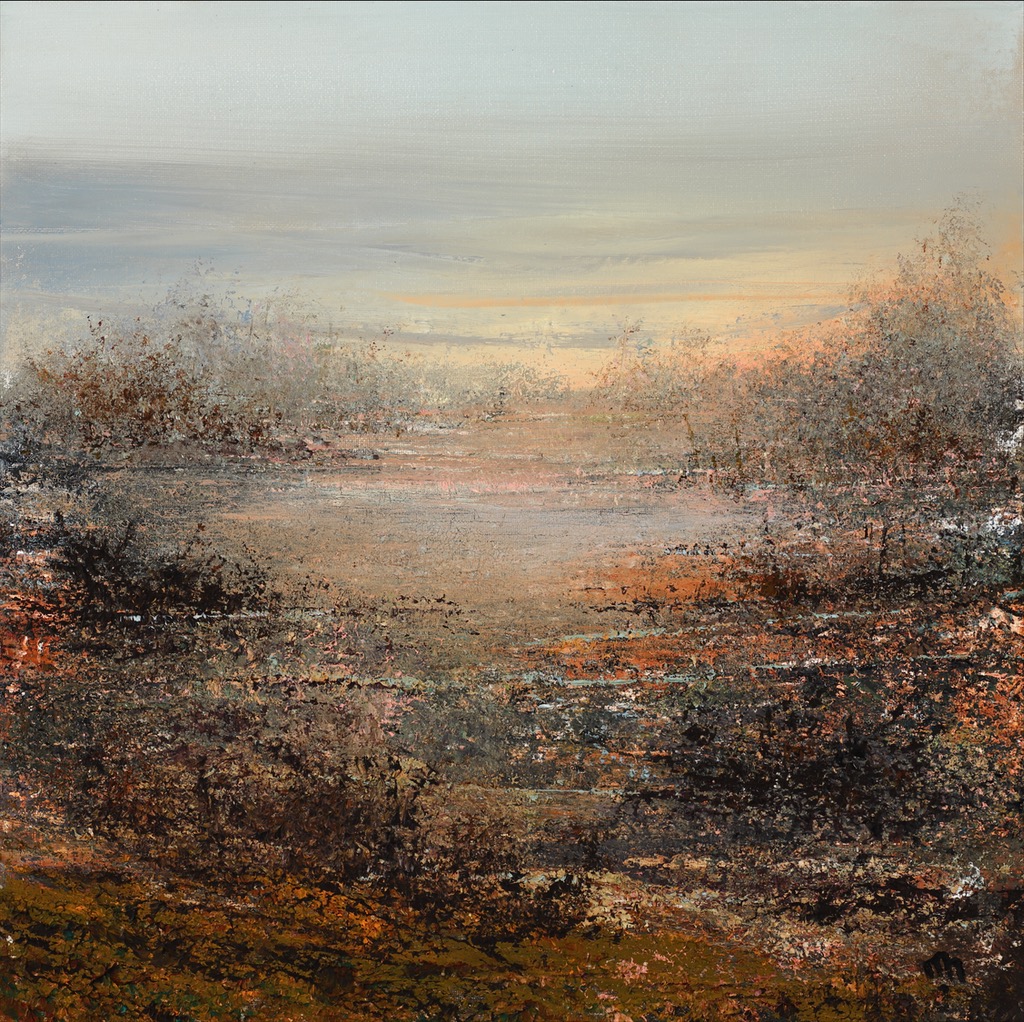
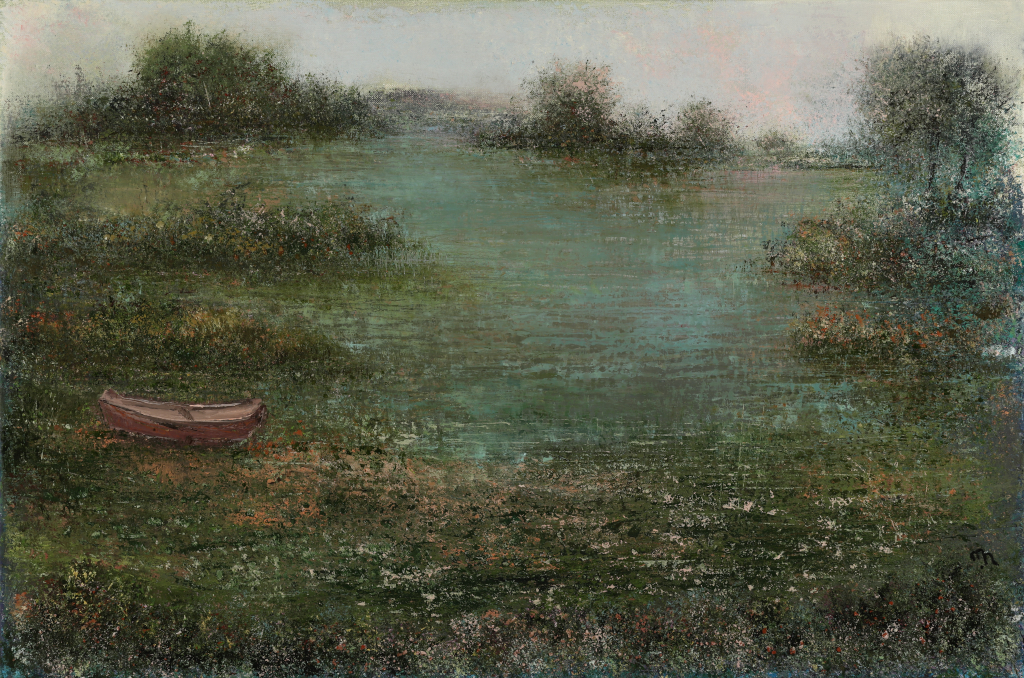
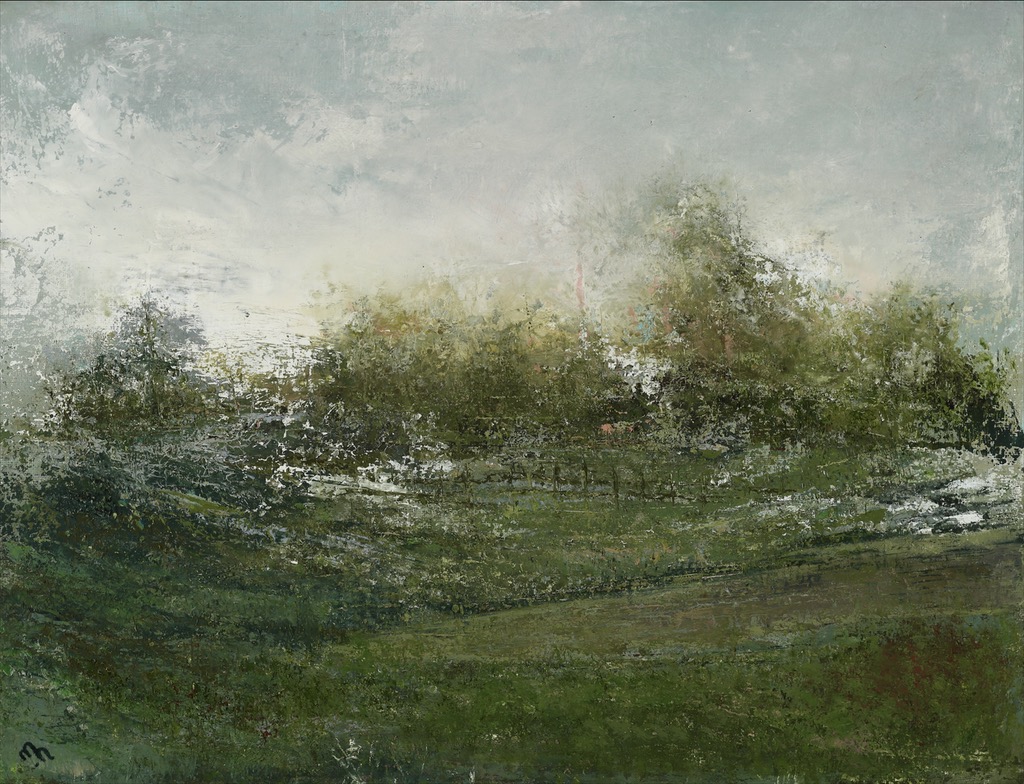
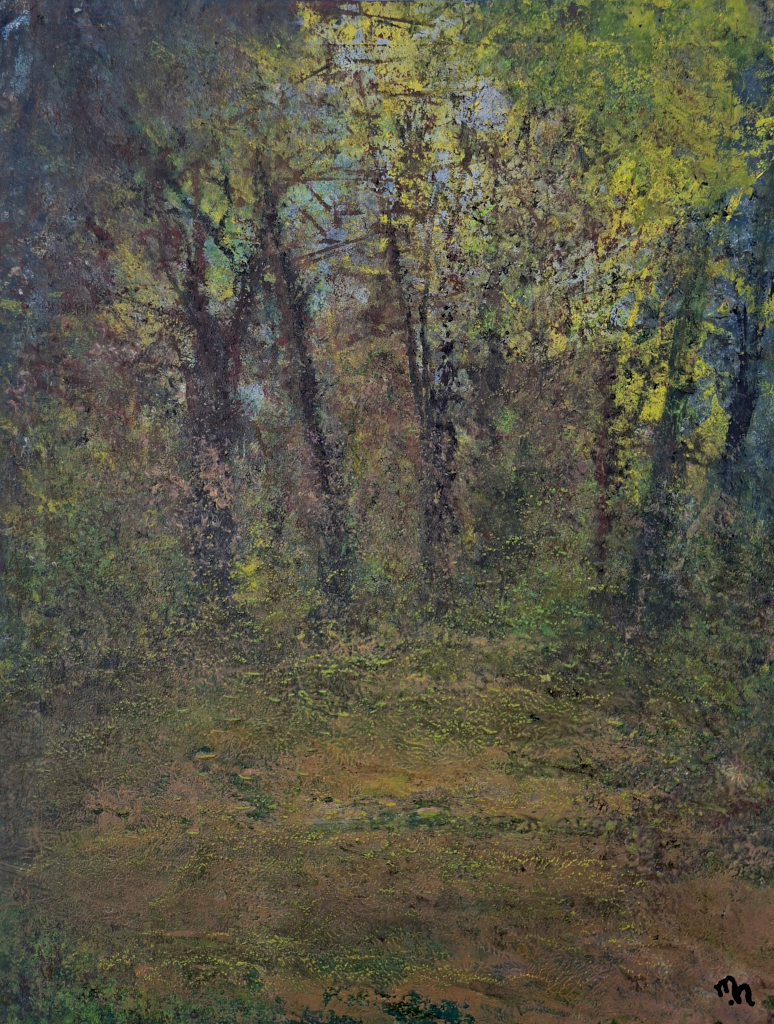
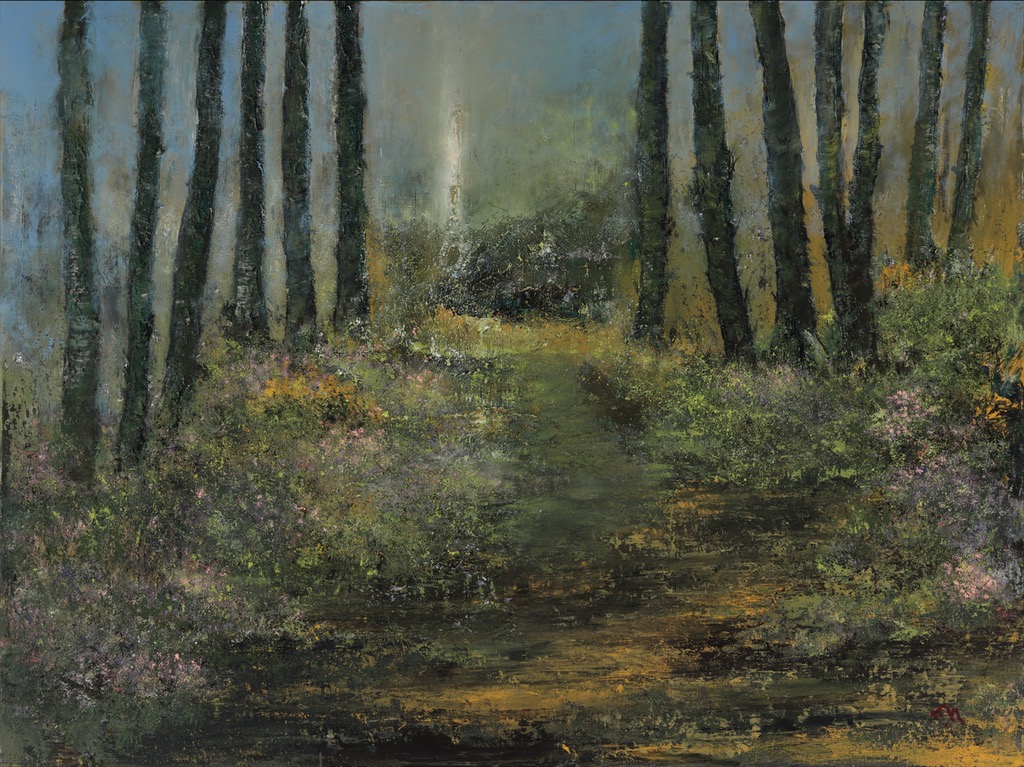
Landscape did not immediately feel like her subject. At thirteen she was inhibited by it, but love arrived gradually, strengthened by the memory of those summers. Decades later, the Irish landscape remains one of the central presences in her work. Its light and shifting weather allow her to approach a place as both something seen and something remembered.
Art initially distinguished Maria within the family, but storytelling bound the family together. Her father was a radio officer who could be home for as little as two months of the year. When he returned, he arrived as a charismatic presence, ready to play music, read aloud and give his children the time that their mother, sustaining a home, shop and seven young lives, rarely possessed.
The family was not wealthy, yet their house contained what Maria remembers as an actual library. Her parents collected books, while her father brought more home from his travels. Birthdays were marked with classics: Little Women, Around the World in Eighty Days, Tom Sawyer, Dickens and many others. He also wrote short stories and beautiful letters. Reading was never treated as an ornament to life. It was part of the family’s everyday vocabulary.
As a child, Maria absorbed the stories circulating around her. She was particularly drawn to those that might have appeared unimportant to anybody outside the community: small incidents, eccentric characters, repeated anecdotes and fragments carried from one generation to the next. She admires writers such as Jennifer Johnston for making ordinary lives extraordinary, and recognises the same impulse within herself.
“I think I’m more of a storyteller,” she says. “I like to hear somebody tell a little story, something that may not be important to anyone else, and find the narrative there.”
The quiet child at the edge of the conversation was not absent from it. She was becoming its witness.
Finding the Right Instrument
Maria began her professional life in Dublin, studying Fashion and Design. Entering the industry exposed a commercial and sometimes abrasive world for which college had not prepared her. She returned home unsure of the precise direction she would take, but certain that she could not abandon creativity altogether.
Jewellery briefly provided another possibility. She enjoyed making it and sold successfully at festivals, but the cost of establishing a properly equipped business was prohibitive. A conversation with a friend eventually led Maria towards a year of visual education. It became one of the most exciting periods of her life: long days of experimentation, sculpture, lectures and the discovery of forms she had never previously been able to access.
During an evening painting class, a lecturer watched Maria attempting a large still life of peppers with tiny brushes. She disappeared and returned with two palette knives, telling Maria that these were what she should be using. The change was immediate.
“That was me then. I was totally hooked,” Maria says. “I still have that palette knife 35 years later, and I’m still painting with the palette knife.”
The knife gave her paint a physical presence and a directness suited to the feeling she wanted an image to carry. Oil remained her principal medium for around 25 years, although new practical demands have continued to alter the work. Touring group exhibitions often requested paintings measuring 30 by 30 centimetres. Maria initially found the restriction difficult; a small work could require as much time and concentration as a large canvas, while leaving less physical room in which to move.
Yet the constraint opened another stage of experimentation. She began combining acrylic and ink and working on paper, widening a vocabulary that might otherwise have remained centred on oil. She now moves between sizes and materials, accepting that a long career does not remove the necessity of learning.
“You’re always experimenting,” she says. “You’re never going to be a professional in any area – you’re always going to be learning.”
That willingness to change has carried Maria through landscapes, portraits, figurative painting and ten years working in theatre. Studying actors and stage characters drew her towards bodies shaped by light, movement and narrative. Early portraits were realistic; later figures became more abstract and often lost their individual features. She now imagines returning to portraiture again, completing the circle through expressive, partially abstracted faces, perhaps accompanied by sculpted heads in clay.
The subject changes, but the underlying need remains: finding the instrument capable of carrying a feeling that ordinary conversation cannot always contain.
The Language That Remained
Maria’s relationship with Maisie changed profoundly during the years of her mother’s illness. Maisie lived with Alzheimer’s for approximately a decade, with Maria involved in continual care during the final five years. The familiar ways they once connected gradually became more difficult. During her last three years, unfamiliar noises could confuse or upset her. Music, which she had loved, was eventually silenced. The television remained off. The world around her had to become quieter and gentler.
Communication did not disappear, but its form changed. Maria would sit beside her mother, hold and gently stroke her hand, or massage cream into her skin so that touch could continue when words could not. They explored textured fabrics together. Maria and her family made small arrangements of material for Maisie to feel, responding to her fascination with different surfaces. They drew, even when Maria eventually did more of the drawing, because the activity still held something familiar.
“Touch was a very, very important thing,” Maria says. “It was just to have something that she was still familiar with.”
Maria also read aloud while her mother rested. In the long intervals of quiet, she began writing down fragments of what they were experiencing. Sometimes she recorded a detail from the day; sometimes only a word arrived. Painting and poetry became ways of approaching experiences she could feel more clearly than she could explain.
There is no easy sentimentality in this movement from speech towards touch. It acknowledges the losses imposed by Alzheimer’s, but also the determination to keep seeking a point of connection. A hand could still be held. A texture could still awaken interest. A familiar creative act could remain between them. Love adapted itself to the language that was available.
It was important to Maria and her family that Maisie remained in her own home, surrounded by places and objects that she knew, until her death. Afterwards, those belongings acquired another gravity. They were no longer simply objects from a family home; they formed an archive of a woman whose creative life, responsibilities and unrealised possibilities had shaped all seven of her children.
Time, Memory and a White Dress
Time-Lapse was first conceived as a tribute to Maisie a year after her death. Supported in its initial development by an Irish Hospice Foundation Seed Grant in association with Creative Ireland, it brought together paintings, poetry, installations and inherited objects. Maria expected it might exist as a single exhibition. Instead, it began travelling in 2022 and has continued to evolve with every place it has entered.
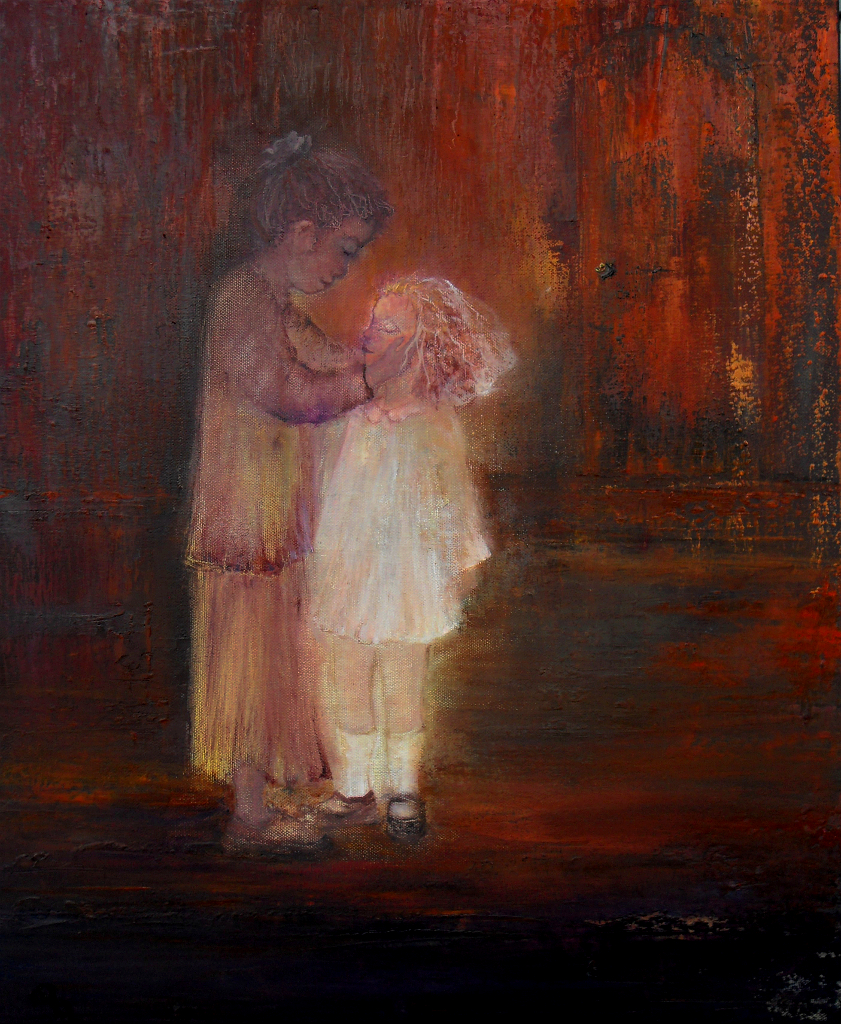
The work had been forming long before Maria gave it a title. Notes written while sitting with her mother, family belongings, older paintings and episodes that only revealed their meaning later all became part of it. One such moment arrived during Covid, when Maria watched her niece’s small wedding through a screen.
A little girl passed the camera wearing a white dress. Maria suddenly recognised it as the First Communion dress from her own childhood, unseen for fifty years. The sight reached across time. During a period when the pressures of care had created strain within a large family, Maria saw herself and her four sisters as children again: sharing secrets, laughing and wearing their Communion dresses. Adult frustrations briefly fell away, revealing the first intimacy beneath them.
“Everything was put into perspective at that moment,” she says. “Everything else wasn’t important.”
Maria responded first through poetry, writing Alma Gemela, and then through a painting of the child in white. This movement between forms is characteristic of her work. An image, line from a book, remembered conversation or single word can generate a poem; the poem can then release a painting. Neither simply illustrates the other. Each brings forward something that its companion cannot completely say.
The family stories within Time-Lapse are often intensely specific. Jolly Holidays recalls all seven children travelling with their parents in a green Morris Minor. The Hermit’s Hut draws upon the two precious months each year when Maria’s father returned home. In Cherished Memories, Maisie appears with her childhood dog, whom she spoke about repeatedly as Alzheimer’s drew her further into early recollection. At times she mistook ornaments for the dog and tried to feed them, a tender confusion through which the strength of that childhood attachment remained visible.
These are Maria’s people, objects and memories, yet the emotional structures beneath them are widely understood. A family car becomes every impossibly crowded journey remembered with affection. A white dress holds the sudden return of childhood. An animal loved decades earlier embodies the peculiar endurance of memory. Maisie’s life is never reduced to her condition; she emerges as a designer, businesswoman, mother, artist and child with treasured stories of her own.
What Other People Bring
At the first presentation of Time-Lapse, the atmosphere was understandably solemn. Maria was surrounded by relatives and friends, and the work remained close to the grief from which it had emerged. She could not have anticipated that she would still be developing the exhibition in 2026, or planning to bring it to Belfast in 2027.
Its continuation has been shaped by the generosity of audiences. Visitors tell Maria about relatives who lived with dementia, the people for whom they cared and the characters who formed their own communities. A painting becomes the beginning of a conversation rather than its conclusion. Their stories lead Maria back towards others from her own life, allowing another poem, portrait or installation to emerge.
The response has affirmed something Maria understood intuitively as a child: the story that appears smallest or most private can carry enormous meaning. One visitor looked at a figure and declared, “That’s me.” It was not a portrait of her, but Maria was delighted by the recognition. The viewer had not misunderstood the painting. She had completed its movement outwards.
“That would make me happy, to think somebody thought that was them,” Maria says. “She felt that painting was her.”
Maria wants Time-Lapse to make the experiences of carers visible and to loosen some of the stigma surrounding Alzheimer’s and dementia. It does so through emotional recognition rather than distance. The exhibition gives viewers room to remember the exhausting, loving and sometimes contradictory realities of care, while encountering a person beyond a diagnosis.
In that sense, the project is not a monument fixed in one form. It behaves more like memory itself: gathering, fading, returning and changing according to the present moment. Each audience leaves something with it.
The Essence of Something
Maria describes her work as highly emotive. Even a landscape must contain an element of mystery and connection before she is compelled to paint it. She is not searching only for a recognisable view, but for the atmosphere that allows a place to feel inhabited by memory.
“With painting, it’s an essence of something,” she says. “Even in my landscapes, there always has to be an element of mystery. It has to draw me in for some reason.”
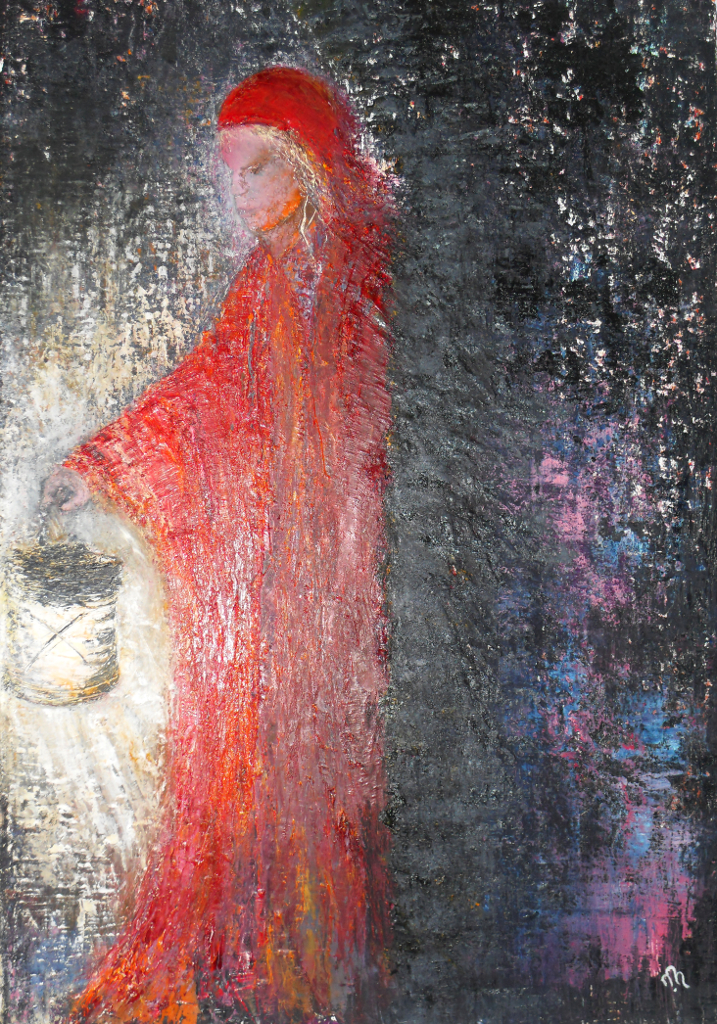
Poetry allows her to reveal more. A painting can carry what she cannot yet articulate, while a poem can move closer to the detail of a thought, voice or recollection. Together they create the ethereal quality that runs across her work. Figures remain particular enough to feel loved, but open enough to become a stranger’s mother, sister or younger self. Landscapes are rooted in Ireland while appearing to contain many different times at once. Empty chairs and small domestic objects seem to wait for the stories another viewer will place upon them.
Her poetry has also developed an independent life beyond the exhibitions. Maria has published three books bringing writing and visual art together, while Winter Tapestry, The Red Chair and The Empty Chair have been selected for successive volumes of Washing Windows: Irish Women Write Poetry. In 2025, Aunties received the Eilish MacBride Award at the Frances Browne Literary Festival. These poems return to the same apparently ordinary details that have always drawn her attention, revealing how much history and feeling can be held within a chair, a remembered voice or a familiar family role.
This openness is not vagueness. It comes from Maria’s close attention to individual lives. She has spent decades listening to the details others might disregard, then locating the emotional current that connects them to something larger. Her art does not ask an audience to adopt her memories as their own. It gives them permission to bring their own memories forward.
For a child who once struggled to get a word in among seven siblings, Maria has built a life from listening and responding. Art gave her a distinct identity within her family and a precious private connection with Maisie. Later, it helped her accompany her mother through a world that was becoming unfamiliar. Now it enables experiences once held within a single home to meet people across Ireland and beyond.
As Time-Lapse arrives at the Strule Arts Centre, it will become Maria’s 30th solo exhibition, 37 years after her first. The milestone belongs to a remarkable career, but the work resists being presented as a completed journey. Maria is still experimenting, still considering portraits and sculpture, still listening for the stray word or recollection that might open another path.
Most importantly, Maisie’s story continues to meet other lives. The quiet hours spent holding her hand have become paintings, poems and installations through which carers recognise their own tenderness. The dresses, books, textures and family journeys are not sealed away as relics. They remain active, gathering meaning as new people encounter them.
“By exhibiting and not working in isolation, the journey continues for other people,” Maria says. “The work lives on, basically.”
In Maria’s hands, that continuation is not an escape from loss. It is one of the forms love can take after a life has ended: a story retold, a memory offered freely, and an image spacious enough for somebody else to enter.
Time-Lapse opens at the Strule Arts Centre, Omagh, on Thursday 3 September 2026 and features a Gallery Tour with Maria on Friday 18 September – Admission is free:
struleartscentre.co.uk
Discover Maria’s paintings, poetry and exhibition history:
marianoonan-mcdermott.com
And keep up with her via social media:
@marianoonanmcdermott.
Support Go Leor. Get the Print. Join the Story.
Go Leor is an independent Irish arts magazine built by hand, heart, and community. Your support keeps meaningful storytelling alive – in print, in culture, and in conversation.
Through Patreon, you can support the magazine in two simple ways:
- Supporter Listing
Have your name printed inside every issue as part of the community helping Go Leor grow. - Print Copy – UK & Ireland
Receive the latest print issue delivered each month across the UK and Ireland, with your name included inside the magazine.
The Latest Articles

Rosina Law-Braney: Reclaiming the Seven Deadly Sins
Through zines, illustration and humour, Rosina Law-Braney creates vibrant feminist stories that make room for identity, desire, grief and collective creative freedom.
Alexander Edward: Weaving from the Land
Growing his own willow beside Strangford Lough, Alexander Edward brings coppicing, landwork and an ancient craft into bold contemporary forms.
John Britton: Finding Calm Through Ink
After three decades of visceral performance and constant travel, John Britton has found a quieter connection through ink, mentorship and calm.
Yvonne Moore: Following Curiosity into Colour
Refusing to settle into a single style, Yvonne Moore follows curiosity across colour, poetry and community, creating art that brings her – and those around her – fully to life.
Lucy Fleming: Carrying the North Coast Light
Through fluorescent colour, oil pastel and an instinct for collaboration, Lucy Fleming turns the light of the North Coast into images that connect art, music and community.
Paul Burch: Shaping Old Mountains in Clay
After decades spent teaching others, Paul Burch has returned to clay, building warm, characterful sculptures from memory, landscape and the freedom to experiment.