Anne Harper
Musician & Storyteller
From ancient hills in County Down to evolving musical practice, uncovering the quiet connections that link mythology, place, and lived experience
The shift doesn’t arrive dramatically. It doesn’t announce itself.
It begins, instead, with a hill.
For most of her life, Anne Harper’s world was defined by structure – by the discipline of classical music, by the clarity of notation, by the quiet expectation that you would play what was written and nothing more.
For over twenty-five years, she worked as a classical clarinettist, moving through orchestras where precision mattered more than authorship, and where stepping outside the line was rarely encouraged.
It was a life built on mastery, but not necessarily on voice.
“I always felt like part of my musicianship wasn’t being fulfilled,” she says. “Like I had a very developed right arm and a very underdeveloped left.”
That imbalance stayed with her. Not as dissatisfaction exactly – but as something unresolved.
The resolution came not through music, but through place.
The Hill That Demanded a Voice
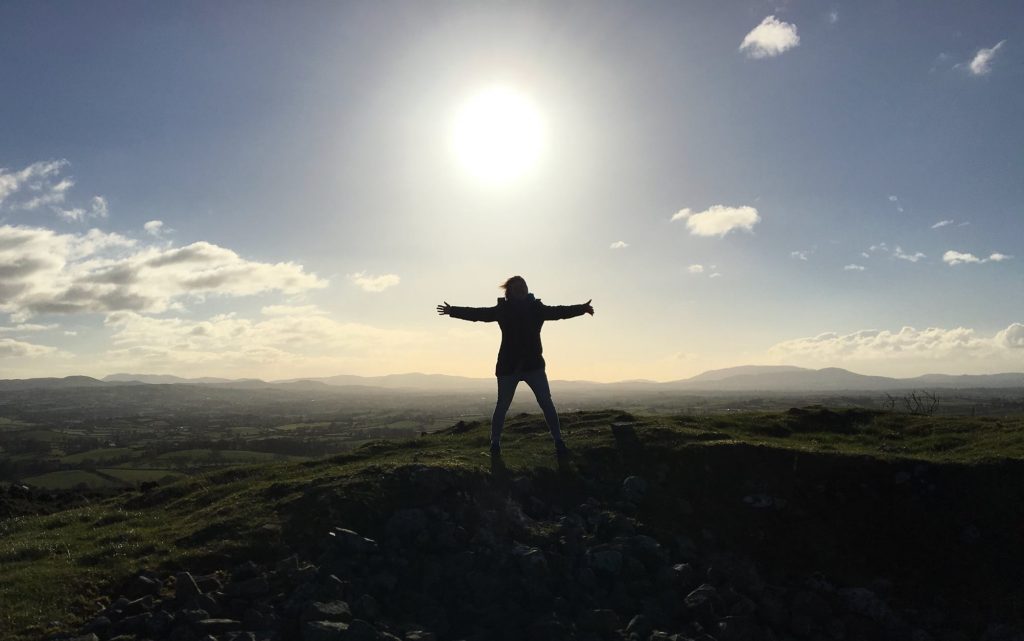
The place is Knock Iveagh – a hill in County Down layered with centuries, even millennia, of history. A Neolithic burial cairn. A Bronze Age reuse. A site of inauguration for ancient chieftains. A landscape that has been lived with, returned to, and remembered across generations.
For Harper, it is also personal.
Her family has known the hill for centuries. It is not an abstract site. It is part of the fabric of where she is from.
When permission was granted for development – a wind turbine placed on the hill – something shifted. “I couldn’t sit by,” she says. “So my job became to tell the story of the hill.”
What followed was not simply protest. It was research. It was immersion. It was a reorientation of how she understood her role – not just as a musician, but as someone responsible for carrying and communicating meaning.
Through her involvement with Save Knock Iveagh, Harper’s work moved into public space. Not as performance, but as articulation. Not as opposition for its own sake, but as an act of care.
“That hill changed the course of my life,” she says.
From Interpretation to Authorship
The change did not happen in isolation.
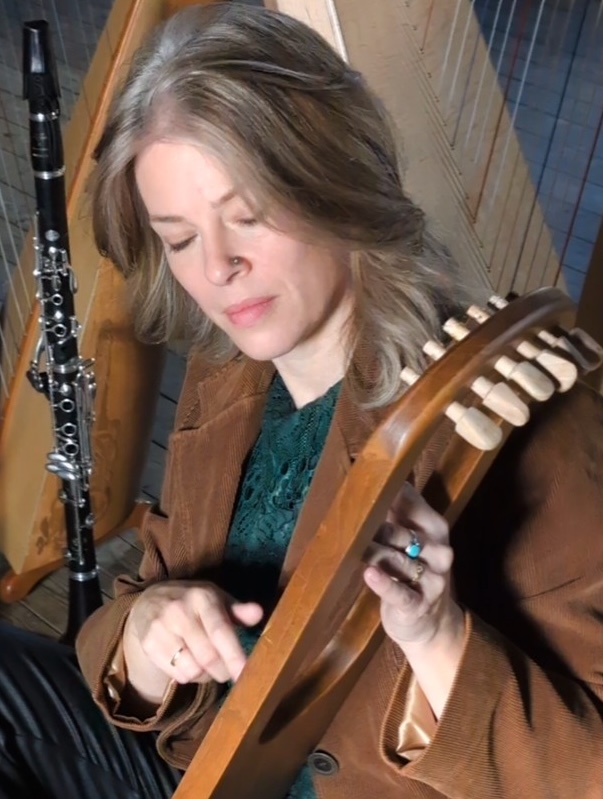
Alongside this growing engagement with place, Harper’s relationship with music was also shifting. The clarinet – once central – began to recede, not in importance, but in function. In its place, the harp emerged.
Where classical music offered infinite complexity, the harp offered limits.
And in those limits, clarity.
“With fewer notes, fewer possibilities – it focuses your mind,” she explains. “It actually allows you to write.”
Composition followed. Not as a formal decision, but as a natural extension of a new way of thinking. Music became less about interpretation and more about expression – a means of carrying ideas rather than simply executing them.
It is a quieter kind of authorship. But it is unmistakably hers.
Where Music First Met Story
Long before this shift, however, there was an early encounter that now feels quietly foundational.
When asked about her first experience of music and storytelling coming together, Harper doesn’t point to a live performance or a traditional session. Instead, she returns to a recording – Sergei Prokofiev’s Peter and the Wolf.
“I remember having the record,” she says. “Hearing the voice and the music blended together.”
It is a simple memory, but a significant one. In that piece, narrative and music are inseparable – each shaping the other, each giving meaning to the other. Characters are carried through sound. Story is structured through composition.
Looking back, it offers a clear line into her current work.
“I wish I could say I had a storyteller come into school,” she reflects, “but that was the first time I really heard the two together.”
What Prokofiev offered was not just a composition, but a model – one that quietly suggested that music could carry narrative, and narrative could live within music.
Now, decades later, that same principle sits at the centre of her practice.
Stories That Still Live in the Land
At the centre of Harper’s work is a question: what remains of the stories we’ve inherited?
Not as text. Not as fixed narrative. But as fragments – embedded in landscape, echoed in place names, resurfacing in patterns that repeat year after year.
She speaks about “wonder tales,” a term used by Dáithí Ó hÓgáin in his book The Sacred Isle, to describe stories that have survived in partial form. Stories that may not be complete, but are still meaningful.
“I think we still have them,” she says. “Even if they’ve come down broken.”
Her interest lies in what those stories align with – how they intersect with archaeology, with seasonal change, with the physical world around us.
“You can piece things back together,” she says. “You can find them happening every year.”
This approach resists the idea of mythology as something distant or symbolic. Instead, it treats story as something active – something that continues to exist alongside us, if we know how to look.
Across Water, Not Apart
One of the most striking aspects of Harper’s thinking is how she reframes geography.
“We’re very used to seeing maps north to south,” she says. “But if you turn the map, you start to see bridges instead of barriers.”
In her work, the Irish Sea is not a divide. It is a route.
Rivers become highways. Bays become entry points. Travel by water – historically – was often easier than by land. And with that movement comes exchange: of people, of language, of music, of story.
It is this perspective that underpins her recent exploration into the connections between early Irish music and traditions further afield – including the influence of Middle Eastern instruments.
She does not claim certainty. Instead, she asks questions.
“It just struck me that the worlds aren’t as far apart as you think.”
Collaboration and Continuity
Despite stepping away from orchestral life, Harper has not stepped away from collaboration.
Her work with storyteller Liz Weir on Cloak of Wisdom reflects this – a project grounded in folklore, memory, and the transmission of knowledge across generations.
“It’s lovely to have that company,” she says. “That camaraderie is really important.”
Where classical music offered collaboration within strict boundaries, her current practice allows for something more fluid. Ideas move between people. Stories are shared, reshaped, extended.
There is no single authority. Only contribution.
The Intimacy of Storytelling
Harper came to storytelling later than music. She formally trained during the pandemic – initially without a clear plan for what it would become.
What she found was something different entirely.
“The essence of storytelling is human to human,” she says. “Sharing the same emotional journey.”
Unlike music performed on a stage, storytelling places the teller and the listener in direct relationship. There is no distance. No separation.
“You see it on people’s faces,” she says. “The nod, the laugh, the silence.”
It is this immediacy that defines the practice for her – and what she feels cannot be replicated digitally. While she uses social media to share her work, the core of storytelling remains physical, present, and shared.
“We’re all becoming tired of digital connection,” she suggests. “At some point, we need more.”
Reclaiming the Role of the Artist
In speaking about the past, Harper returns often to the role of the artist within society.
There was a time, she notes, when poets and storytellers held power – not in a political sense, but as custodians of memory and reputation. They could praise. They could criticise. They could shape how a leader was remembered.
Today, that role feels less defined.
But not, she believes, less necessary.
“I think it’s still a powerful tool,” she says.
Her own work reflects that belief. Not through confrontation, but through attention. Through the act of noticing, of connecting, of giving form to things that might otherwise go unspoken.
Becoming Visible
For Harper, stepping into public view was not a natural progression.
Coming from a classical background, self-presentation felt unfamiliar. Even uncomfortable. But the need to speak for Knock Iveagh made it unavoidable.
“It wasn’t about me,” she says. “It was about representing that place.”
That necessity became a catalyst.
What began as advocacy became a broader practice – one that now includes music, storytelling, research, and digital sharing. A practice that is still evolving, still asking questions, still finding its shape.
“I had to step up,” she says. “And just do it.”
An Ongoing Conversation
There is no fixed endpoint in Anne Harper’s work.
It moves between disciplines. Between places. Between past and present. Between the personal and the collective.
It is as much about listening as it is about speaking.
At its core is a simple idea – that stories matter. That places hold meaning. That connections exist, even when they are not immediately visible.
And that sometimes, all it takes is one piece of music – heard at the right time – to stay with you long enough to shape everything that follows.
Anne will be speaking at the Group for the Study of Historic Irish Settlements conference in Strangford from 8th–10th May, sharing her work on stories embedded in the landscape: facebook.com/GSIHS
She will be presenting at Ulidia 8 – The Eighth International Conference on the Ulster Cycle of Tales at Rathcroghan Visitor Centre from 23rd–25th June, exploring the relationship between story, music, and archaeology across Ulster and western Scotland: rathcroghan.ie
Along with hosting a conversation with Lord Iveagh at the Rathfriland Literary Festival from 4th–7th June, discussing the heritage of Iveagh and the history of the Guinness family alongside live music: facebook.com/Rath-Literary-Festival
Find out more about Knock Iveagh through a copy of Knock Iveagh: Memory and Materiality in a Community Landscape: trivent-publishing.eu
And keep up with Anne via social media: @thatharperwoman
Support Go Leor. Get the Print. Join the Story.
Go Leor is an independent Irish arts magazine built by hand, heart, and community. Your support keeps meaningful storytelling alive – in print, in culture, and in conversation. Through Patreon, you can join as a monthly supporter and receive exclusive benefits across our tiered memberships:
Fir Bolg: Your name printed inside every issue.
Muintir Neimhidh: Your name + monthly issue delivered (UK & Ireland) and PDF issues.
Muintir Partholóin: All previous benefits + monthly editor’s dispatch.
Bradán Feasa: All benefits + help shape future articles and themes.
Your backing helps us print, publish, and grow a space for creative voices across Ireland and beyond.
The Latest Articles

Joshua Burnside – Inside It’s Not Going to Be Okay
From the layered textures of Teeth of Time to a more exposed and intimate sound in It’s Not Going to be Okay, Burnside enters a new phase of his work

Clann Miotlantach / Mythlantics, Alice Rekab and the Future It Opens
Tracing identity through objects, inheritance, and the quiet movement of the Atlantic Ocean as a space of connection and shared histories

Kerrie Hanna – Carrying the Land Through Authentic Material and Light
Ancient pigment and endangered craft meet feminist reclamation and community authorship in a practice rooted in land and light

Why Online Movements Have Such a Powerful Grip on People
Mark Malone explores how people are drawn into online spaces – and how understanding, not judgement, might be the way out

Frances Magee – Preserving Ireland’s Natural World in Cyanotype Magic
In her North Belfast garden, Frances Magee transforms carefully tended plants into luminous cyanotypes – where texture, imperfection and light combine in work that feels timeless.

Mark Bonello – Capturing the Spirit of Ireland’s North Coast
From London galleries to the North Coast studio, Mark Bonello paints light, labour, and lived experience with unwavering focus