Sam Allen
Artist
A practice shaped by return – where coastlines, family memory, and material come together to explore what it means to carry home with you
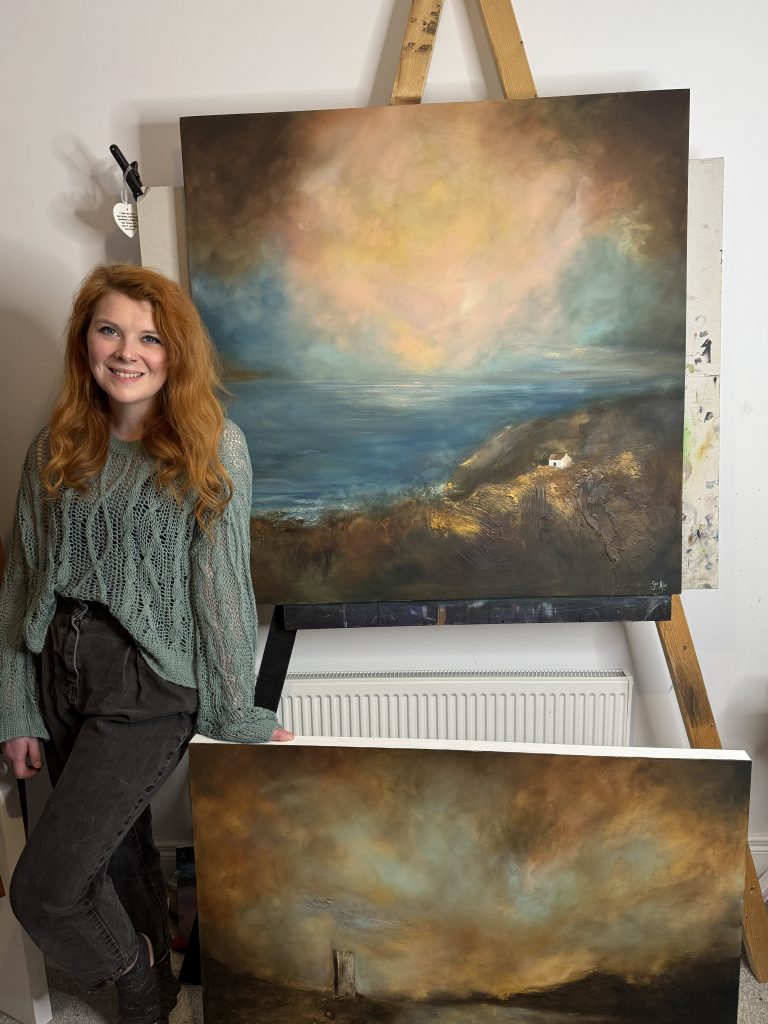
There’s a quiet consistency running through Sam Allen’s work – a sense that no matter how far it travels, it is always orienting itself back toward something familiar. Not just landscape, but the idea of home as something lived, shared, and returned to.
Her recent work, Made from the Sea, sits at the centre of that instinct. It’s a body of work shaped by movement – across coastlines, across memory, across time – but grounded in the belief that there is always somewhere to come back to.
“No matter how far you go, no matter how much time passes, you’ll always have somewhere to return to… there’s always a light on at the table.”
The Centre of Things
That idea of return begins close to home. For Allen, it’s rooted in family – houses that weren’t just places to live, but places people gathered.
“My mum and dad’s house was nearly like the centre of even our extended family… when big events were happening, everyone came back there.”
Even as life took her further afield – studying in Scotland, living in England – the pull of Northern Ireland remained constant.
“We’d always wanted to come back… my family and all of that connection is here.”
That sense of openness has followed her. In every place she’s lived, her home has become a point of return for others too – friends arriving with bags, staying over, settling into something that feels shared.
“There was a space and a bed and a seat at the table… it was really nice.”
It’s a feeling that moves quietly through her work: the idea of an eternal welcome.
Mapping a Place
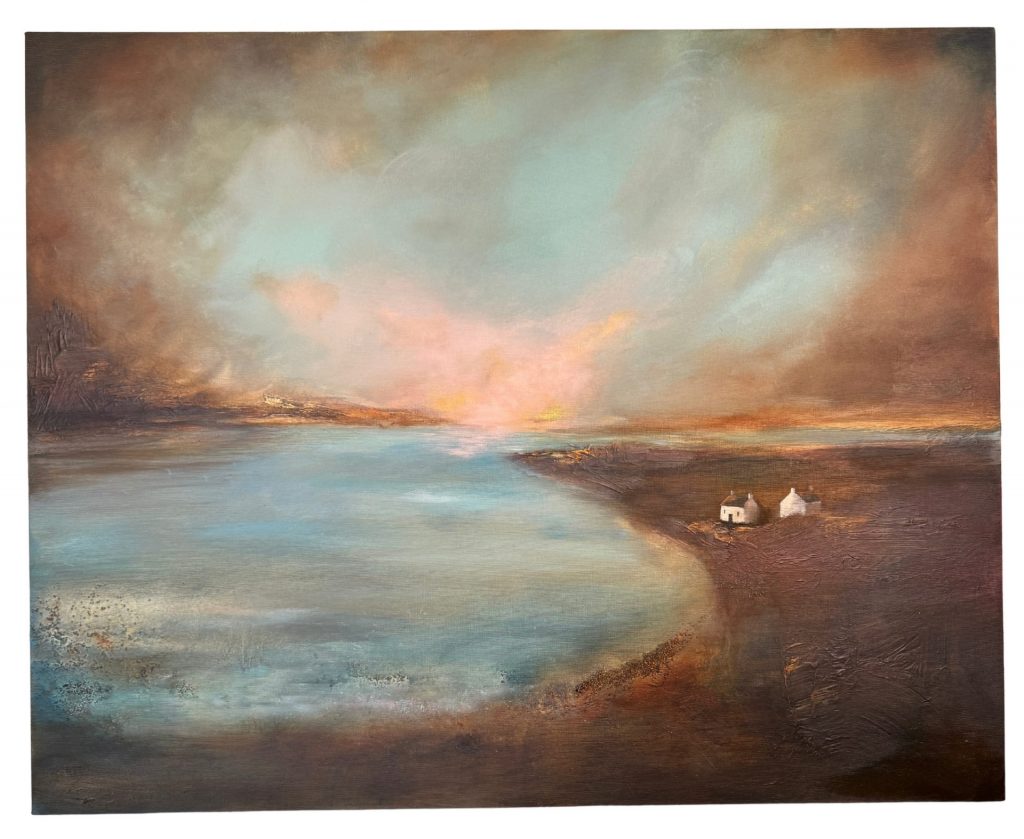
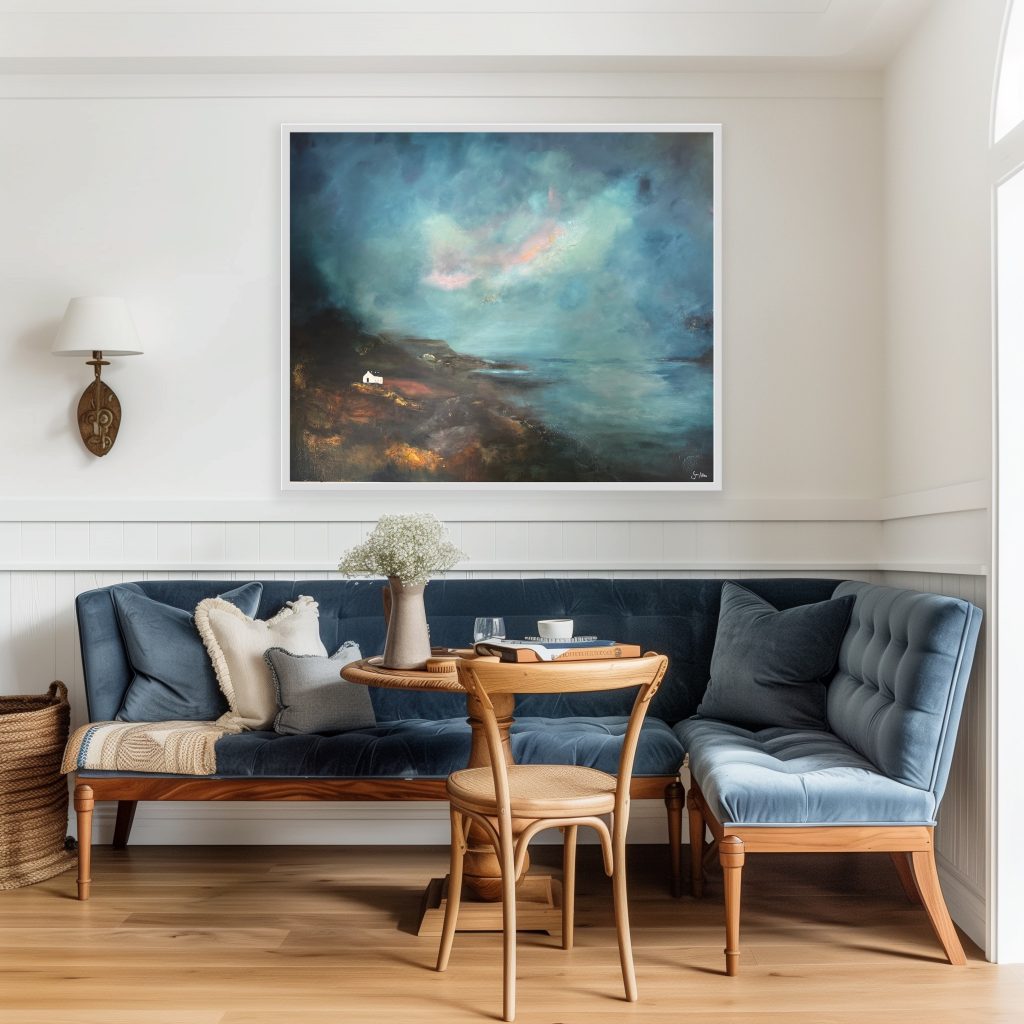
While cottages appear in her paintings, they’re only part of a wider map. Allen is careful not to let the work settle into a single motif.
“I don’t want everything to just be little cottages… today I’m working on a bridge in Tollymore Forest.”
Across the work, locations begin to accumulate – Donegal, the Ards Peninsula, Bangor, Murlough Bay, Cave Hill, the Mournes – each one carrying its own atmosphere, its own pull.
Lighthouses appear too – Fanad Lighthouse, South Rock Lighthouse – markers not just of place, but of direction.
“That was the other idea… the light that guides you home.”
These aren’t fixed destinations. They are points of connection – places that hold memory, or offer the possibility of return.
Inheritance and Observation
Allen’s relationship with place is not just built through her own experience. It carries through generations.
While working from locations around Donegal, she discovered that many of the places she had painted already existed in photographs taken by her grandmother.
“It was incredible to see a painting that I had already finished, and then I found her photos… I recognised them straight away and saw the link.”
The connection felt less like coincidence and more like continuity – a thread running quietly beneath the work.
That sense of inherited place becomes even more explicit in works like her painting of the Widows Row Cottages in Dundrum. Built after a devastating storm claimed the lives of local fishermen, the cottages became a collective act of care – communities coming together to ensure families were not left without support.
It’s a story that sits naturally within Allen’s practice: place as shelter, as memory, as something sustained through people as much as landscape.
Made from the Sea
If Returning to Place maps the landscape, Made from the Sea brings it into the work itself.
For Allen, the sea has long been a place of instinctive return.
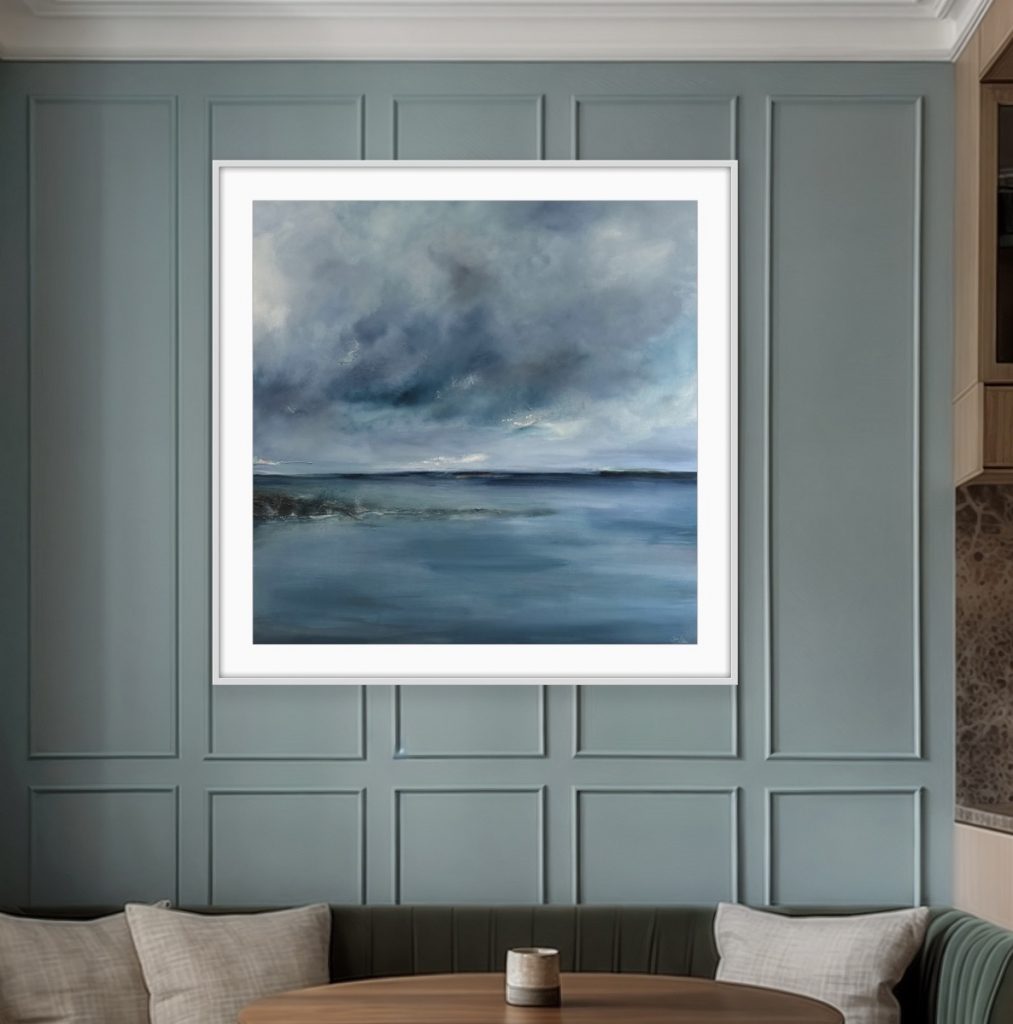
“Nearly every point in my life where things have been really, really difficult, I have ended up by the water.”
It’s not just the view, but the sensory experience – the sound of waves, the smell of salt air – that resets something internally.
“It just takes it all down and helps you come back to centre.”
The shift came while painting on the beach.
“I just want to bring this feeling home… what if I actually tried to put the sea and the sand into the paintings?”
From there, the process expanded. Sand and seawater are gathered from specific locations – Donegal, the Ards Peninsula, Murlough Bay – each labelled, each carried back to the studio.
“I have them all labelled on little jars… I look a bit strange with my bags of sand.”
The result is a work that doesn’t just depict place, but contains it.
“It’s not just a seascape… this is a part of Ireland that’s come home with you.”
Material as Meaning
That instinct – to embed experience – extends beyond the coastline.
Tea, for instance, becomes part of the work. Not just visually, but symbolically.
“Quite a lot of my paintings have sand and seawater, but I’ve also used tea and tea leaves… it’s creating that moment around the kitchen table.”
In one piece, this becomes a reflection on decision-making and shared knowledge.
“You sit around the table, you get your cup of tea… you’re looking to the heads for making decisions.”
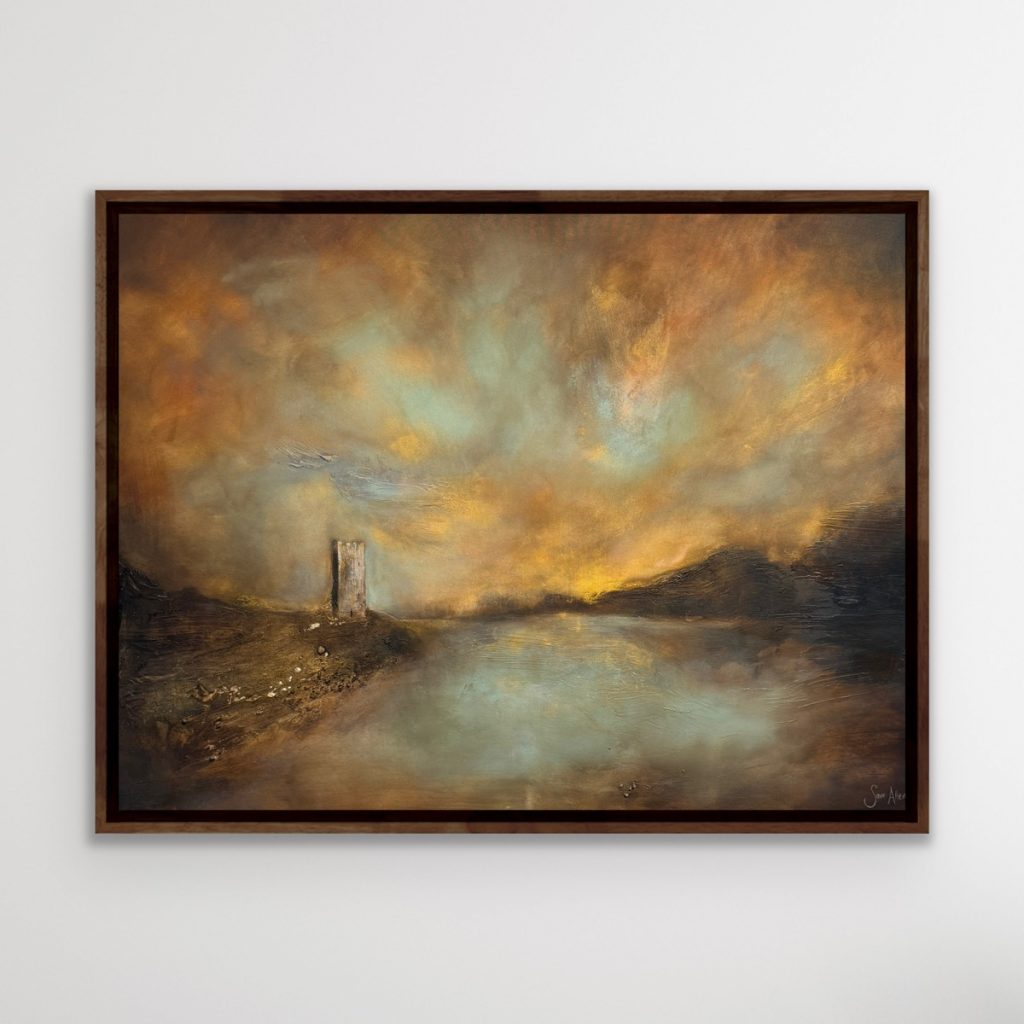
Elsewhere, history and mythology enter the work – but not as distant reference points. On Achill Island, the remains of Grace O’Malley’s castle become something far more immediate within Allen’s practice.
The connection is not simply to O’Malley as a historical figure, but to her as a mother.
“The story goes that her child had been kidnapped and taken over to Britain… and she went and insisted on the release of her son.”
Allen speaks about this from a place that is deeply personal. As a new mother herself, the story shifts from history into something felt.
“The depths that you would go to to try and bring them home safely… I really connected with that.”
What might otherwise read as a story of power or legend instead becomes something more intimate – about protection, instinct, and return. The castle on Achill, weathered and enduring, sits alongside her cottages not as contrast, but as continuation.
It reframes the emotional core of the work. From storm to stillness, from sea to shelter, from castle to cottage, the thread remains the same: the pull to return, and the force that brings people home.
Colour, Process, and Trust
Despite the clarity of these themes, Allen’s process remains largely intuitive.
“I’ll sketch out roughly the proportions… and then I put it away and everything else is very intuitive.”
Colour – often described by others as bold – is not something she consciously sets out to define.
“I just wanted to create something that was uplifting… and that was just what came out.”
Instead, it emerges through layering – base tones, sand, paint, texture – built up slowly until the surface holds together.
“If you have a base colour… that can pull all of the other colours together.”
The process itself is not always immediate.
“The painting can look really terrible for a long time… but I know that it will reach a better stage.”
It’s a practice built on trust – allowing the work to find its way.
Routine and Reality
That trust extends into how she approaches the act of working.
“I’m not going to wake up every morning and think, I’m going to paint today.”
Instead, she builds a routine – tea, candles, music – creating a sensory environment that allows her to step into the work.
“Because so much of my work is sensory… it’s creating that sensory environment that will promote it.”
Even on days where motivation is low, starting becomes the most important part.
“I’ve never regretted a session of painting… even if what I’ve created isn’t there yet.”
Between Life and Work
Like many artists, Allen is working within the realities of daily life – motherhood, time, and the demands of visibility.
“I’m really struggle with social media… I’m not good at remembering to post or knowing what to say.”
There’s a tension between the uninterrupted flow of her process and the stop-start nature of documenting it.
“You’re stopping and moving the camera… you’re nearly losing some of that time.”
And yet, she recognises what people connect with.
“People really like seeing the artist behind the art.”
Her presence online has continued to grow, drawn by the clarity of what she’s making.
“I love creating art that holds a story and brings a real sense of atmosphere into whatever home they belong in.”
That message has resonated with others who feel that same connection to place, to Ireland, and to the sea.
An Open Door
What emerges from Allen’s work is not just a visual language, but a way of thinking about place – one rooted in return, connection, and continuity.
Across cottages in Donegal, coastlines in the Ards Peninsula, lighthouses along the shore, and castles on Achill Island,
the message remains consistent.
“There’s always somewhere to return to… there’s always that safe space.”
In her work, home is not fixed. It is carried – through memory, through material, through the quiet persistence of place.
Sam’s upcoming exhibition The Places You’ll Go launches at The Hallows Gallery on 13th June 2026: thehallowsgallery.co.uk
Explore Sam’s latest work and find available pieces on her website: samallenart.com
And keep up with her via social media: @sam_allen_art
Support Go Leor. Get the Print. Join the Story.
Go Leor is an independent Irish arts magazine built by hand, heart, and community. Your support keeps meaningful storytelling alive – in print, in culture, and in conversation.
Through Patreon, you can support the magazine in two simple ways:
- Supporter Listing
Have your name printed inside every issue as part of the community helping Go Leor grow. - Print Copy – UK & Ireland
Receive the latest print issue delivered each month across the UK and Ireland, with your name included inside the magazine.
The Latest Articles

Shirani Bolle: Monsters, Survival & the Power of Colour
Colour, craft, and confrontation converge in a feminist practice that reclaims the body, the home, and the right to be seen

Stuart Quigley: The Wonderful Spirit Behind This Beyond
A practice shaped by return – where coastlines, family memory, and material come together to explore what it means to carry home with you

Seanna O’Boyle: The Authentic Depth of Light, Layers and Ancient Wood
Drawing from the Old Masters and Irish prehistory, a practice that builds meaning through material, memory, and the discipline of making

Alison Pascoe: The Powerful Art of Knots, Craft & Connection
A practice rooted in heritage craft, where knotting, material and teaching become a language of connection across place and people

Bernadette Doolan: The Revealing Force Behind Her Figures
A practice shaped by resilience, where the figures she paints hold a quiet strength that continues to rise through each work, carried across a practice that moves between mediums

Becca Calmont: The Magic Art of Wax, Silver and Instinct
From reclaimed materials to instinct-led making, a jewellery practice built on process, variation, and the refusal to repeat