Seanna O’Boyle
Painter & Sculptor
Drawing from the Old Masters and Irish prehistory, a practice that builds meaning through material, memory, and the discipline of making
There is a particular density to Seanna O’Boyle’s work that resists easy description, something rooted not only in subject or composition but in the materials themselves.
Whether working in paint or carving from ancient bog wood, her practice is guided by a sensitivity to history, culture and the work’s physical presence, where making becomes less about forcing and more about responding to what is already there. What emerges across both strands of her work is a consistent way of thinking ‑ one that treats material, light, and history as active participants rather than passive elements.
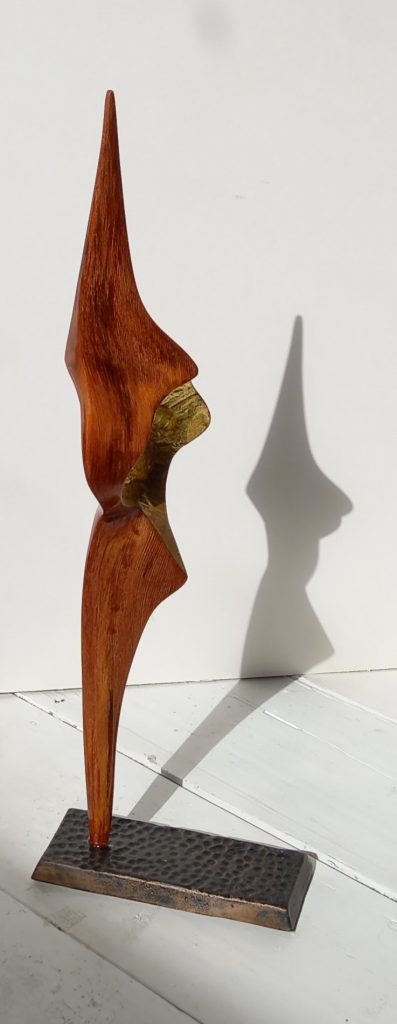
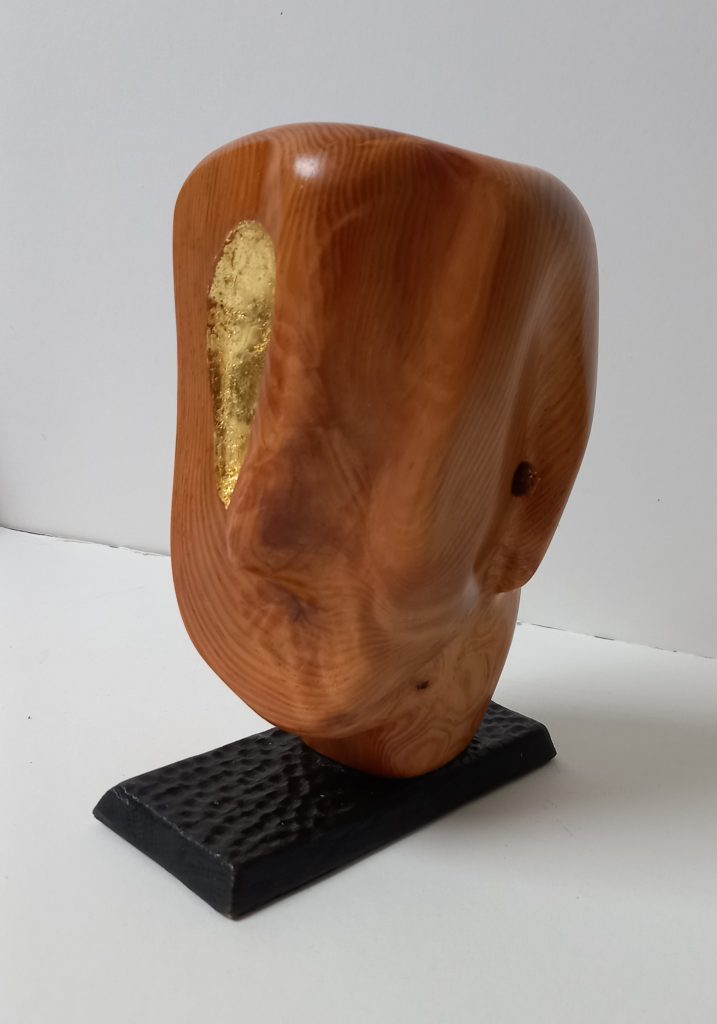
Her sculptural work begins, quite literally, in the ground. The bog wood she uses is not simply found material but something approached with a sense of care and recognition. This bogwood, sourced on the west coast of Ireland, was dated to around 5,000 years old – something she recalls as a defining moment for her sculpture.
“So I found a piece of wood about 5 or 6 years ago in a bog… and I just knew there was something special about it… I took it to Queens University and they dated it to about 5,000 years old and it was potentially the original pine that grew in Ireland… so it’s precious to me.”
That sense of time translates to the finished work alongside her knowledge of archaeology directing how she approaches the material, shaping both her decisions and her restraint. There is an awareness not just of the wood as an object, but of its life before it became the material ‑ its place within a landscape and timeframe that no longer exists in the same form.
“When this was alive… millennia ago… farming was a new idea… this wood just fills me with awe and wonder.”
This attitude carries through into the act of carving itself, where control can be transitory. Seanna describes how “the wood tells you where it wants to go”, a recognition that the material can redirect intention at any stage. Cracks or shakes and faults then become part of the process, forcing adjustment rather than resistance, and creating a practice grounded in responsiveness rather than certainty.
Light as Structure
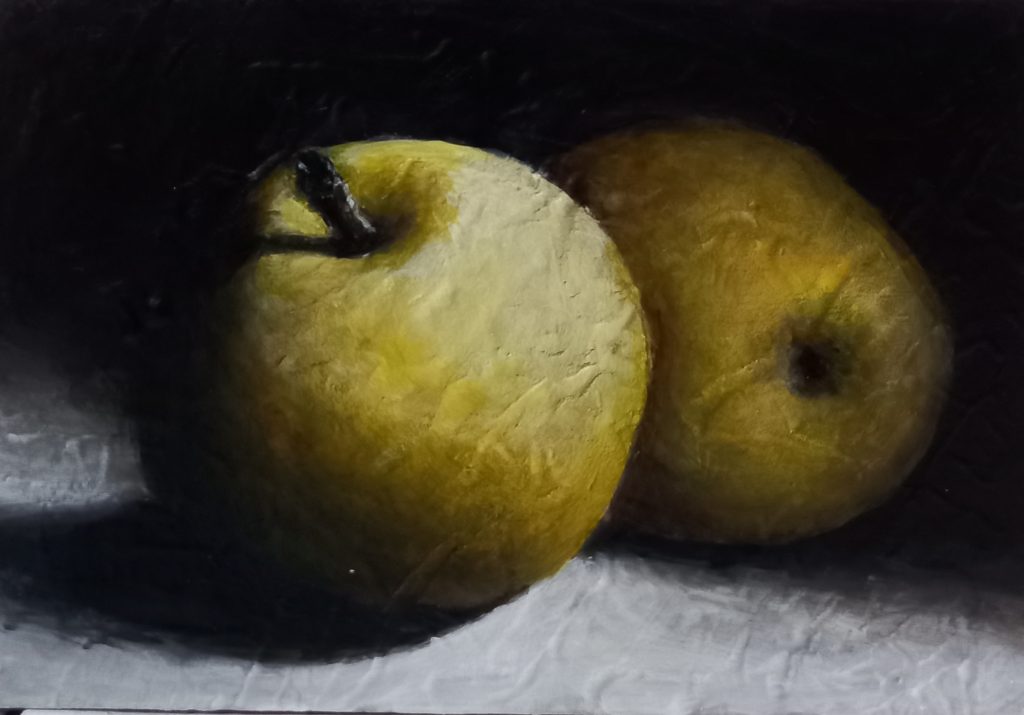
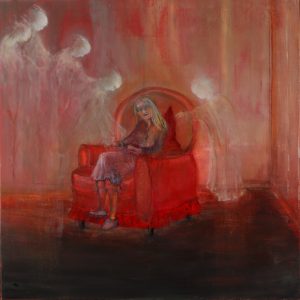
If sculpture is a negotiation with material, painting becomes a negotiation with light. Seanna’s work draws a clear line back to the Old Masters ‑ unconsciously through instinct not imitation. Her paintings are built through contrast, where shadow and light are used to construct form.
“The Old Masters such as Caravaggio and Rembrandt created strong dramatic contrasts… producing a theatrical atmosphere between the light and the shadow… I use these too, in fact only very recently being self taught I realised these techniques had a name. Chiaroscuro and Tenebrism, both using light dark to create the dramatic contrasts I am always after”
Her attraction to shadow is rooted in a preference for depth, atmosphere, and a sense of something emerging from darkness.
“I just love the depth of shadows but without the light it is meaningless, light is important to all artists… by filling the surface with the composition it adds to the drama creating a volume nearly sculptural in appearance.”
That preference shapes everything that follows. Light is not used to reveal but to isolate, often focusing attention in a way that feels almost theatrical. Objects are not arranged casually but deliberately staged, emerging from surrounding shadow in a way that focuses attention.
Building the Surface
Seanna’s paintings are built through layering. Layers of paint sit over textured gesso, creating a surface that holds the history of its making even when those earlier stages are no longer visible.
“Painting multiple layers is something I have always used because even though the viewer may not be aware of this it does create a felt depth…”
This idea of “felt depth” becomes central. Her paintings are not concerned with surface realism but with building intensity, layer by layer, until the image has impact. The viewer may not consciously register the number of layers or the complexity of the surface, but the effect is cumulative.
“If you create more and more layers… the person looking at it won’t know, but they’ll feel the depth adding more interest to it… it’s something they sense rather than see. It’s all about the layers”.
That phrase – “it’s all about the layers” – becomes a quiet key to her practice. It applies equally to paint, to material, and to meaning, where it sits alongside broader cultural reference.
That depth of feeling is rein-forced by her approach to colour. Rather than relying on pure black or stark contrast, she builds shadow mixing colours from the painting’s limited earthy palette, allowing colours to harmonise across the painting.
“If you mix colours together, the painting will naturally harmonise… the viewer won’t necessarily know what’s been done, but they will feel it.”
The Shadow Box
Central to this process is composition, shaped by a clear grounding in what each painting is trying to achieve. Seanna constructs her own compositions within what she refers to as her ‘shadow box’. This allows her to direct light with precision rather than relying on observation alone, a method influenced by her ongoing return to a Giacometti quote she holds onto: “the object of art is not to produce reality but to create a reality of the same intensity.”
“This quote inspired me to create compositions in a homemade lightbox or as I call it my ‘shadow box’. There I can control the intensity of light and the shadows… if I didn’t create my own composition and lighting I think the work would suffer.”
This method places her somewhere between observation and invention. The objects may be real, but the conditions in which they exist are constructed. Light becomes an active tool, shaping the painting rather than simply illuminating it.
Layers of Influence
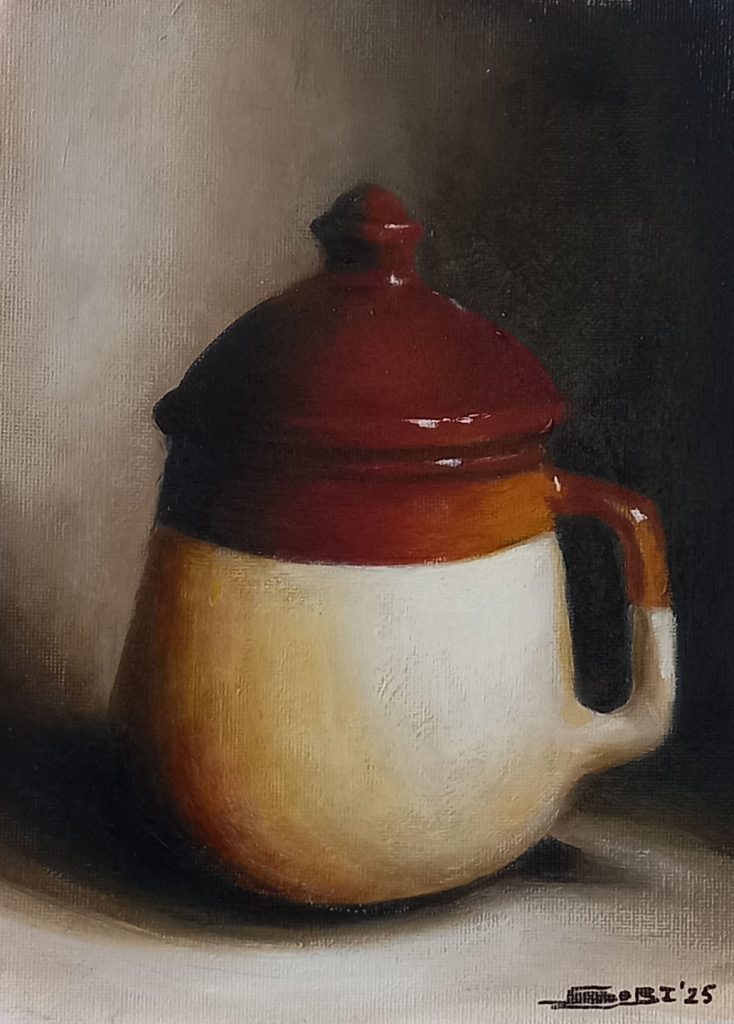
The idea of layering extends beyond material into influence. Seanna’s father, a hobby potter, introduced her early to making, though not in a direct way.
“My father could turn his hand to anything… finding an early pot by my father inspired two paintings, just adding my own personal layer to the works…in fact both were bought by a potter closing the circle”
A more defining influence came through her apprenticeship with bodhrán maker Eamon Maguire, where she encountered Irish culture in a deeper way.
“He was so enmeshed in Irish culture… the music, dance, myths and legends, celtic art for example the Book of Kells… that really influenced me the most because I’d never really been exposed to that before.”
This period introduced her to Irish culture and its legacy. Eamon Maguire was rooted in music, storytelling, craft, and community. His approach, grounded in traditional bodhrán making and a lived engagement with Irish culture, exposed Seanna to a way of working where materials, heritage, and daily practice were inseparable.
Material as Meaning
This sense of historical continuity becomes most visible in her sculptural work, where the materials themselves carry meaning. The use of bog pine, bronze, and gold is not decorative but deliberate, each element chosen for both its physical and cultural weight.
“The value I place on this wood I find hard to put into words so I let the materials reflect this – bronze… and real gold… both high value materials found in the earth and used in ancient times.”
The decision is not purely aesthetic but ethical – an attempt to match the value of the material with the value of its presentation. “I didn’t want to combine it with cheap materials… it deserved the quality.”
Between Knowing and Not Knowing
Seanna’s interest in Irish prehistory extends into her painting, though in a less direct way. Her interest in rock art – symbols carved into stone before the existence of written language – initially led her toward abstraction, but over time this approach felt disconnected.
“Rock art basically was potentially a symbolic language of our ancestors before the written language… and we still don’t know to this day what it means completely… and I find that so powerful.”
Stepping back from this to improve her technical skills she returned to drawing and still life, rebuilding her practice through repetition and observation.
“I just thought I need to stop… went back to still life… started just drawing… over and over again.”
This return to fundamentals was not a regression but a recalibration “this gave me the time to reconnect with art, creating work that meant something to me .”
A Practice Still Moving
There is no sense of completion in Seanna’s work, particularly in painting, which she sees as still evolving. Her approach remains critical and iterative, defined by revision as much as creation.
“I paint over so many things… but if I’m not happy with it, what’s the point in putting it out there?… I want to stand over it.”
That critical eye is balanced by a clear sense of direction. She speaks about wanting to loosen her work, to move toward more fluid brushwork while retaining the intensity created through light and shadow.
“I would like to loosen up… not be so tight… but still using the same techniques with dark and light… I’m always searching for that intensity.”
More than a pursuit of intensity alone, Seanna’s practice is defined by a deep respect for history, Irish legacy and the discipline of making. Whether working in paint or wood, she builds work that carries meaning – drawing on the cumulative importance of tradition and practice she recognises in the people, materials, and landscapes around her. Through material, through light, and through the patient accumulation of layers, her work holds not just form, but a continuity of knowledge and care.
To explore Seanna’s work further and view pieces currently available, visit her website: seannaoboyle.com
And keep up with Seanna via social media: @seannaoboyleartist
Support Go Leor. Get the Print. Join the Story.
Go Leor is an independent Irish arts magazine built by hand, heart, and community. Your support keeps meaningful storytelling alive – in print, in culture, and in conversation.
Through Patreon, you can support the magazine in two simple ways:
- Supporter Listing
Have your name printed inside every issue as part of the community helping Go Leor grow. - Print Copy – UK & Ireland
Receive the latest print issue delivered each month across the UK and Ireland, with your name included inside the magazine.
The Latest Articles

Shirani Bolle: Monsters, Survival & the Power of Colour
Colour, craft, and confrontation converge in a feminist practice that reclaims the body, the home, and the right to be seen

Stuart Quigley: The Wonderful Spirit Behind This Beyond
A practice shaped by return – where coastlines, family memory, and material come together to explore what it means to carry home with you

Alison Pascoe: The Powerful Art of Knots, Craft & Connection
A practice rooted in heritage craft, where knotting, material and teaching become a language of connection across place and people

Bernadette Doolan: The Revealing Force Behind Her Figures
A practice shaped by resilience, where the figures she paints hold a quiet strength that continues to rise through each work, carried across a practice that moves between mediums

Sam Allen: The Special Pull of Home, Sea and Memory
A practice shaped by return – where coastlines, family memory, and material come together to explore what it means to carry home with you

Becca Calmont: The Magic Art of Wax, Silver and Instinct
From reclaimed materials to instinct-led making, a jewellery practice built on process, variation, and the refusal to repeat