
Paul Burch
Ceramic Artist
After decades spent teaching others, Paul Burch has returned to clay, building warm, characterful sculptures from memory, landscape and the freedom to experiment.
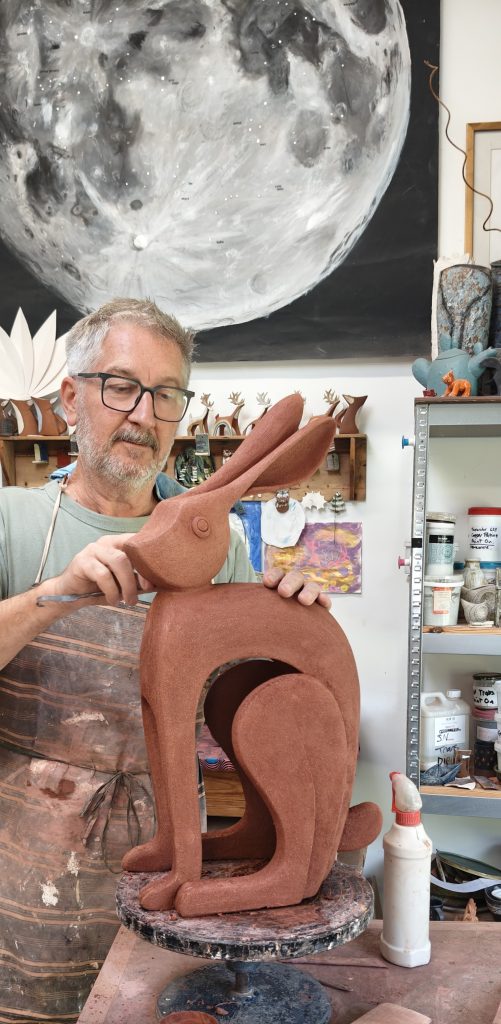
Across the walls of Paul Burch’s Jordanstown studio, images gather faster than they can be filed away. He takes hundreds of photographs and keeps anything capable of stimulating another possibility. Behind him hangs an enormous moon made with chalk, charcoal and paint by his daughter before she left for Edinburgh. At nearly two metres square, it has nowhere else to go. Here, it belongs among the references, unfinished objects and material prompts from which new work might begin.
The crowded walls are a continuation of Paul’s years as an Art and Design teacher. A good art room, he believes, should surround its students with ideas. Now retired, he has recreated that atmosphere for himself, filling a home studio with enough visual material to keep curiosity moving.
“I just collect images and take hundreds and hundreds of photographs,” he says. “Anything that stimulates – ideas, possibilities. I kind of like that.”
The space is private, but Paul’s imagination is anything but narrow. Hares, foxes, seals, elephants, musicians and fragments of landscape emerge from slabs of terracotta and stoneware. Some are shaped by the coast or the Mournes; others by museum collections, unfamiliar musical instruments or the challenge of making clay behave as though it were another material entirely. Each object begins as a construction problem and becomes a way of testing how much character a few carefully placed planes and gestures can hold.
Returning to His Own Work
Paul studied ceramics at Belfast Art College before moving to London, where he maintained pottery workshops during the early years of his career. When he married and began raising a family, the practical demands of life changed his direction. The workshops were given up, and Paul trained as a teacher at Goldsmiths before returning to Northern Ireland.
Teaching required him to become conversant in far more than clay. Drawing, painting, textiles and printmaking all belonged to the curriculum, and Paul remembers working within a strong team of teachers who made the school an enjoyable place to be. He would still like to paint more and retains a particular affection for printmaking.
What connects print and ceramics for him is process. A print is constructed through stages: an image is developed, transferred, worked and revealed. Paul approaches clay similarly. Rather than beginning with a rotating wheel and pulling a vessel upwards, he rolls flat slabs and builds from them, allowing an object to develop piece by piece.
“I like to construct,” he says. “You start with flat slabs of clay and build the ideas, in a way.”
For years, most of Paul’s creative energy went into helping other people develop their ideas. Retirement offered the chance to return to the work that had first interested him, but with the breadth of knowledge accumulated through teaching. The move was not a rejection of the classroom. His studio carries its best qualities forward: technical curiosity, openness to different forms and a willingness to try something without needing to know immediately whether it will succeed.
That freedom matters. Younger ceramicists building a livelihood must consider whether a new object will sell and how quickly its labour can be recovered. Paul recognises that his pension gives him room to work differently. If an experiment fails or an audience does not respond, it does not threaten his income.
“I feel privileged, in a way, that I have the space to be able to just explore these things,” he says. “If they go right, they go right. If they don’t, you work on it or move on to the next thing.”
Old Mountains
Paul calls terracotta “flower pot clay,” but the phrase is affectionate rather than dismissive. Ceramics contains its own hierarchy. At one end sits porcelain: pale, strong and capable of translucency, commonly treated as the finest expression of the material. At the other is red earth, abundant enough to be associated with ordinary plant pots and basic domestic use.
Paul is drawn to the lower end of that hierarchy. Terracotta possesses a toasted warmth before any additional colour is introduced. Its iron-rich body makes its origins visible. During a visit to Vietnam, he watched women digging sticky red clay beside a river to supply a local pottery. The directness of that relationship stayed with him: earth lifted from the ground and transformed through work and heat.
“I quite like that it’s the most common, basic material you can have,” he says.
Clay has been described to Paul as old mountains worn down across millennia. Rock becomes sediment, travels through rivers and settles in mudflats. In the hand, it is sticky and temporary. Inside a kiln, heat changes it into ceramic capable of surviving for thousands of years more.
As a teacher, Paul used that endurance to excite his students. Leave a ceramic figure in the garden, he told them, and someone might excavate it in two thousand years and wonder whether it represented one of the gods worshipped inside a twenty-first-century home. Much of what is understood about earlier civilisations has been drawn from the pottery they left behind. Clay can begin as one of the most ordinary materials on earth and end as evidence that a person lived, ate, played and imagined.
That passage between impermanence and survival helps explain Paul’s interest in archaeology, erosion and decay. His pieces do not seek the immaculate surface promised by porcelain. Their construction remains legible. Edges, planes and joins contribute to objects that feel made rather than manufactured, carrying the warmth of the material and the decisions of the hand.
Paul sources clay suited to the demands of each object, often through Scarva Pottery Supplies. Ordinary terracotta works for many indoor pieces, while larger garden sculptures require a higher-fired terracotta crank capable of resisting moisture and frost. It retains the red, iron-rich colour he values but survives outdoors like a tougher flower pot.
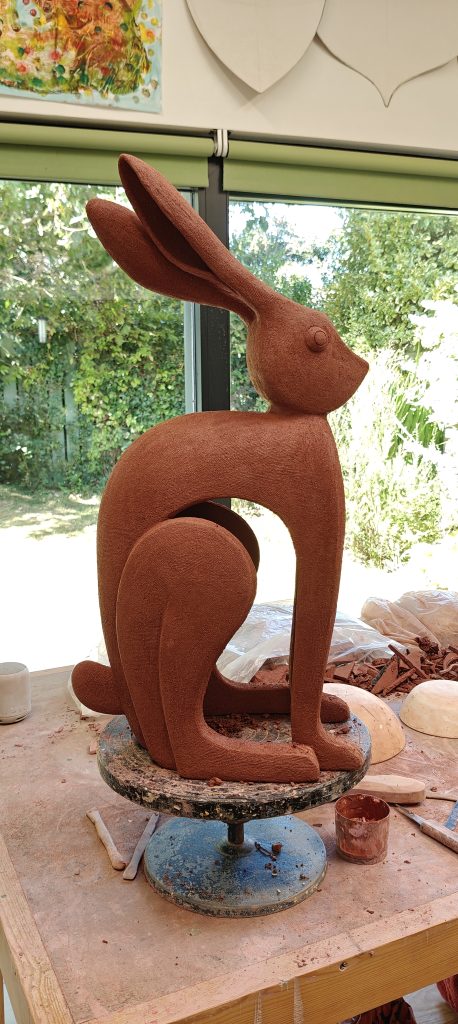
Scale still requires negotiation. His kiln sits in the garage and imposes an absolute boundary on what can be fired. A two-metre garden piece must be constructed in sections and assembled afterwards. The ears of a large hare have to fit beneath the lid. Earlier versions pointed straight upwards because Paul feared that lowering them might cause cracks; as his confidence grew, the ears became larger, more expressive and better adapted to the available space.
The kiln does not merely restrict the work. It encourages invention.
Capturing the Creature
The animals inhabiting Paul’s work are recognisable without being anatomically exact. A hare is unmistakably a hare, but it remains visibly built from clay. Planes meet where fur might otherwise soften the body. The forms have a geometric directness, as though each creature has been reduced to the movements and proportions needed to hold its personality.
“They’re not accurate hares, and they’re not soft like a hare,” Paul says. “They’re obviously built, and you can see the structure and the way it’s made.”
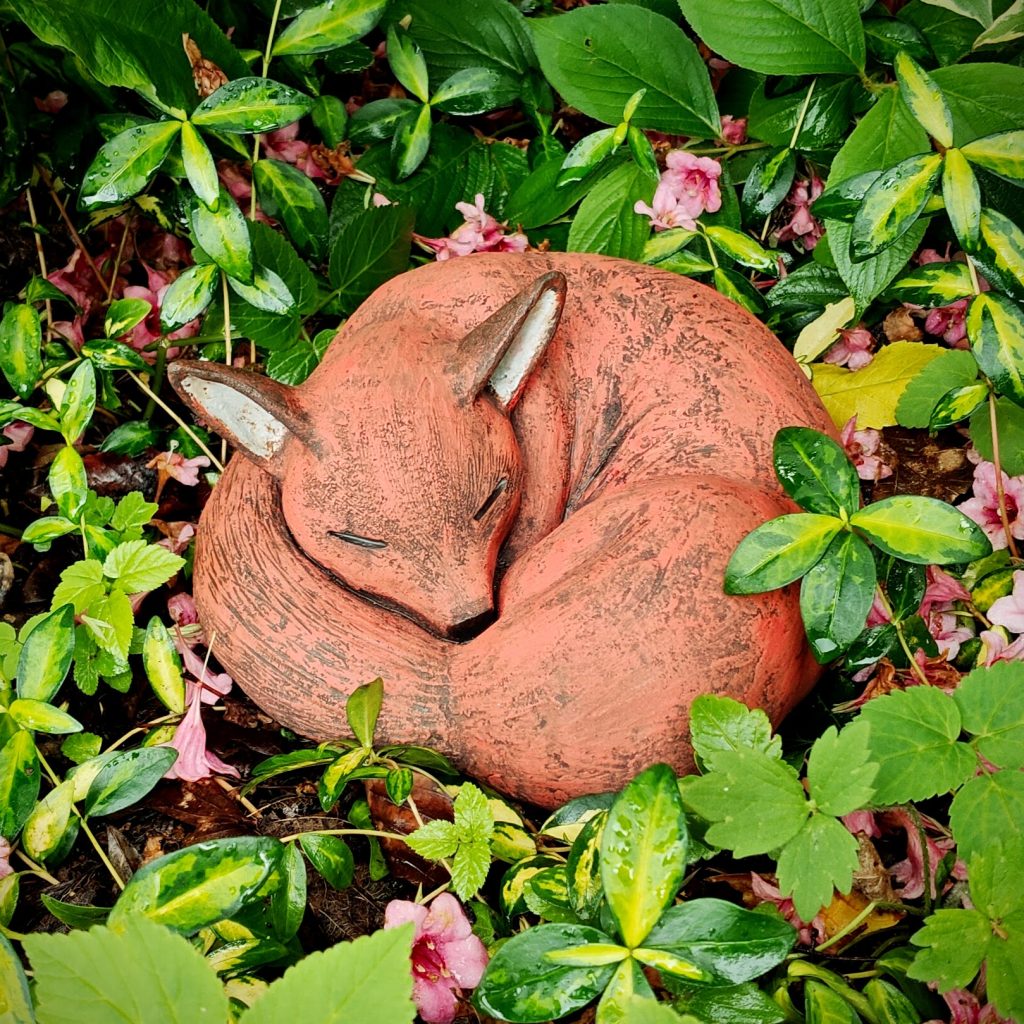
The subjects arrive through lived encounters as much as formal research. On Rathlin Island, Paul has eaten lunch surrounded by seals – wild animals watching from a cautious distance, curious but not yet driven away by human presence. Foxes fascinate him for the opposite reason: their ability to adapt to cities and continue using spaces reshaped around them. Hedgehogs visit his garden. Birds gather outside the studio. Each offers a point of contact with a natural world that survives beside people, despite the pressure placed upon it.
Hares carry deeper cultural associations. Paul is conscious of their place within Irish folklore as creatures capable of moving between this world and another, although he has not set out to illustrate those stories directly. The connection sits beneath the sculpture rather than dictating it. As the hares continue to evolve, he is interested in letting their surfaces carry more of that history.
Other pieces emerge from memories of childhood and place. Paul grew up in Rathcoole when open land, a farm and a stream still lay close to the large housing estate. He remembers corncrakes in summer, along with newts and tadpoles found in flooded ground. Family holidays were spent near the foot of the Mournes, where a day might move between swimming in the sea and walking in the hills. At night, hares passed through the garden.
When Paul constructs an animal moving, he is not reproducing one exact view. He offers enough to let another person enter with memories of their own.
“It allows somebody to come into that story,” he says. “It takes them somewhere they will recognise – not an actual, literal place, but an experience.”
That invitation may help explain the affection people feel towards his animals. They are specific enough to have individual character yet open enough to hold somebody else’s fox, seal or remembered hillside.
The Third Attempt
Paul has a theory that he needs to make something three times before he gets it right. The first version establishes whether the idea can stand. The second corrects what became obvious only after firing. By the third, construction, surface and intention begin to agree.
One running hare demonstrated the difficulty of giving movement to a heavy material. Paul mounted it above a live-edge wooden base with a steel support, trying to suspend the angular body in motion. The sculpture remained unsold at a garden show. A friend supplied an unsentimental explanation: “it has a great big steel spike stuck in its stomach.”
Paul laughs at the failure, but it contained a genuine technical problem. Clay readily suggests weight and stillness; making it appear airborne is considerably harder. He continues to consider how the head, body and support could be separated or reconfigured, although each solution introduces another anxious moment of assembly.
His musical sculptures are developing through the same cycle. Paul is fascinated by instruments encountered during travel and in museum collections: their elongated bodies, openings and unfamiliar proportions make them compelling pieces of sculpture before a note is played. At a recent performance in Bangor, a Chilean musician played a charango, a small Andean stringed instrument traditionally associated with an armadillo-shell body. Its construction carried geography and cultural history within its shape.
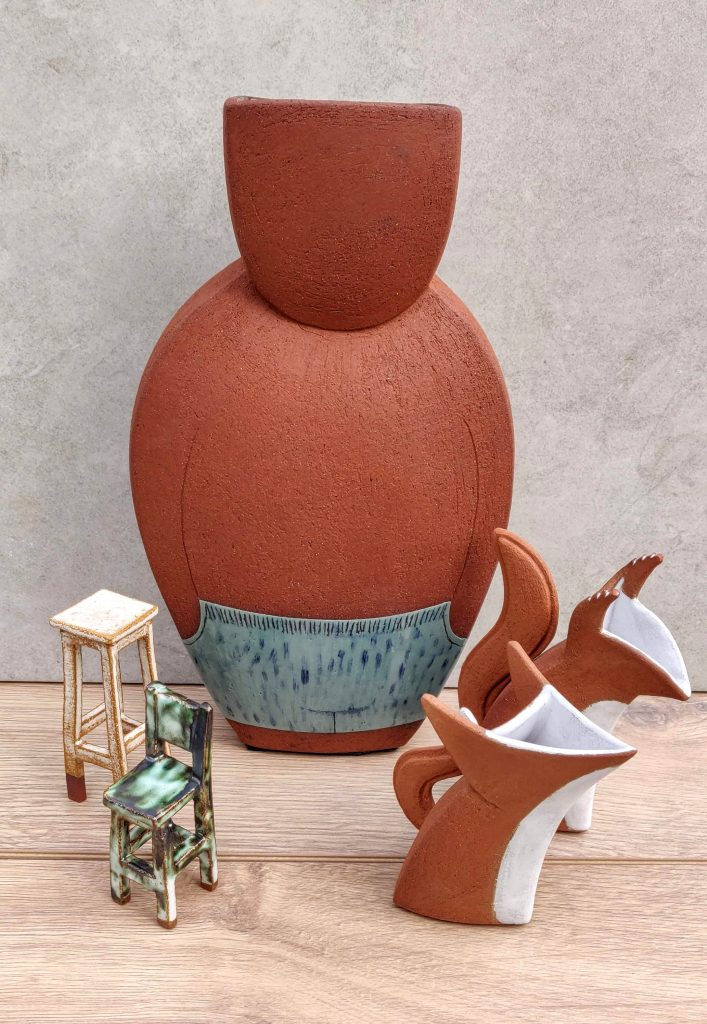
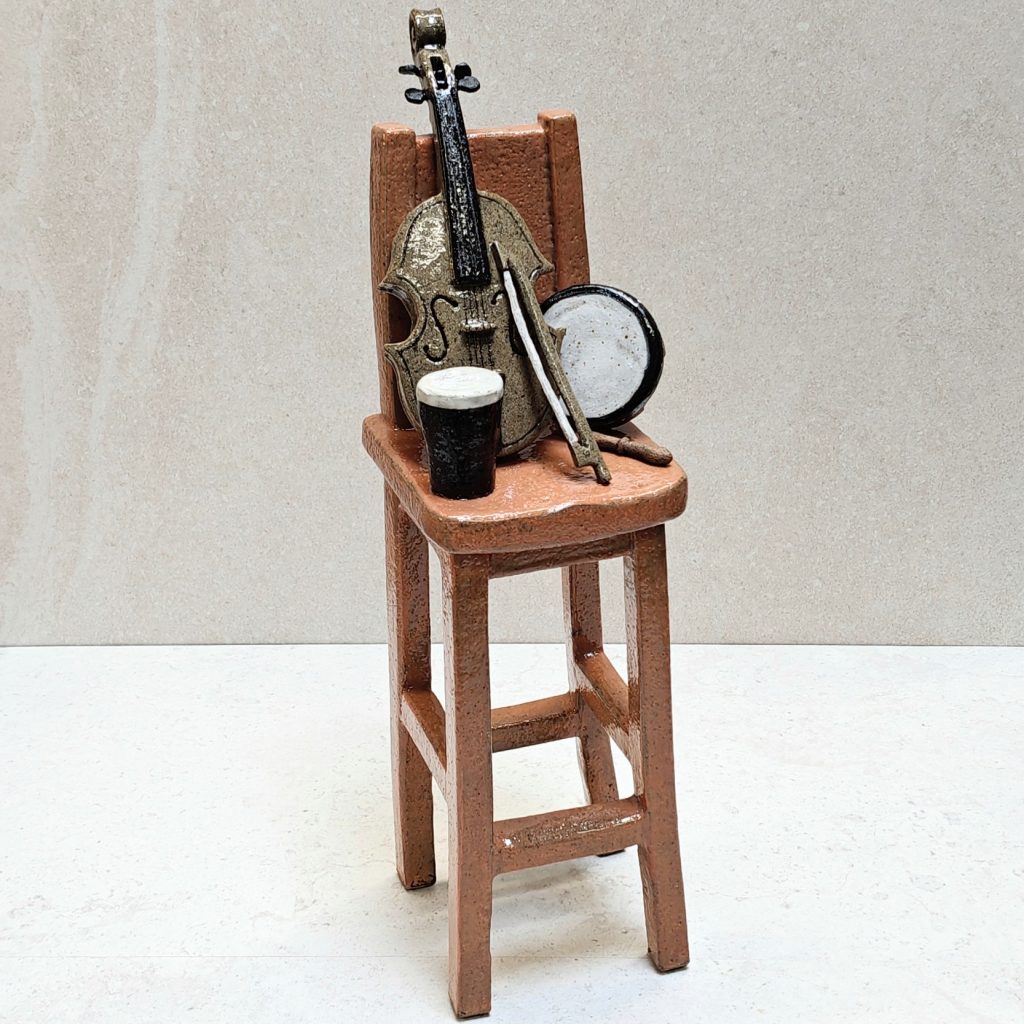
Paul’s own ceramic instruments bring those interests closer to home. Small stools, a bodhrán and a shining pint of Guinness made during the Belfast Fleadh suggest the social world of an Irish session. An early version taught him that a surface could become too green or too heavily glazed. The next would leave more clay exposed, allowing the instrument and furniture to retain the warmth of terracotta while using glaze only where sheen contributes meaning.
The mistakes are not interruptions to the work. They are the method by which it becomes clearer.
Made by a Real Person
When Paul first worked in London, he attempted to become what he calls a “proper potter,” producing domestic cups, plates and bowls. It was difficult to compete with retailers capable of manufacturing inexpensive objects that imitated the marks of the hand. A mould could reproduce a fingerprint or irregular surface while removing the time and variation that gave those features meaning.
The cultural appetite has shifted. After years of increasingly digital life, Paul believes people have become more conscious of touch and more willing to value evidence that an object was made by a person. A handmade mug can now command a price that once seemed impossible – not simply because it functions better, but because its differences connect the owner to its maker.
Paul discovered the commercial appeal of his own work through smaller seasonal pieces. Stags, deer and other Christmas objects helped pay for clay, glaze and firing. Vicki Foster at 2020 Art in Whitehead offered valuable support and repeatedly asked for more as customers responded.
Success created another problem. Paul had retired to make personal work, not to exchange the demands of teaching for a production line governed by Christmas. Repeating the same objects began to feel like a chore.
“I started to feel like a slave to Christmas,” he says. “I wanted to start making my own work again.”
One-off sculptures offer the balance he wants. He does not mind returning to hares because each one changes. Commissions may begin with a customer pointing to an earlier piece, but the new animal will acquire its own posture, surface and character. Paul can respond to what people love without pretending that handmade work should be identical.
A Studio Made Wider
Paul is comfortable working alone. His studio opens onto the garden, and he is content to make, travel and exchange ideas with friends. Joining County Antrim Open Studios – CAOS – nevertheless expanded the possibilities around that solitary routine.
The members are spread across the county and work in different disciplines. Through the group, Paul has visited workshops filled with unfamiliar skills and machinery and begun to imagine collaborations between clay, furniture and other materials. The collective presence also creates opportunities that are difficult for an individual maker to secure alone.
The CAOS exhibition at the Oriel Gallery at Clotworthy House in Antrim proved transformative. It brought the members together physically, introduced Paul’s work to a much wider audience and generated commissions. For the first time, he could look ahead at an order book and tell someone that a piece might not be ready until October.
Community also allows experience to circulate. Paul speaks warmly about Denise McAuley of Moneyvart Ceramics, whose energy and command of glaze he admires. Denise, in turn, has credited Paul’s work and encouragement as an influence. Decades spent teaching have not disappeared inside retirement; they re-emerge more informally through advice, reassurance and an ability to recognise what another maker is doing well.
Paul has since become involved with Cré Collective in Belfast, introduced through connections made within CAOS. Each group offers a different focus, new exhibition possibilities and the simple momentum created when artists share ideas. Sitting alone in a workshop, Paul could not have manufactured those encounters for himself.
There are still many directions to follow. He wants to work at a larger scale, develop his animals and explore the sculptural language of musical instruments. Recent elephants began with the realisation that a wooden form he had seen elsewhere could be reconstructed easily from flat clay slabs. Each receives a small accompanying bird, turning a single figure into a relationship. Another object may begin with leftover clay and become a tiny stool – part pub furniture, part memory of the art-room stools that surrounded him throughout his teaching career.
The strands do not always fit neatly together, and Paul no longer requires them to. The studio gives him room to follow an idea until it succeeds, changes direction or makes space for something else. The walls remain full. The kiln remains finite. Between those two conditions, the possibilities continue to multiply.
Paul expresses surprise that his work might merit an article. “I just feel like I make stuff and like making stuff,” he says.
That plain statement contains the character of his ceramics. They do not disguise their construction or strain towards a false perfection. They are made from common earth by someone who understands its history, enjoys its problems and finally has the freedom to follow where it leads. In Paul’s hands, old mountains become hares, musicians and remembered landscapes – objects built for the present, but capable of surviving long enough to puzzle somebody in the distant future.
Keep up with Paul via social media:
@paulburchceramics
Support Go Leor. Get the Print. Join the Story.
Go Leor is an independent Irish arts magazine built by hand, heart, and community. Your support keeps meaningful storytelling alive – in print, in culture, and in conversation.
Through Patreon, you can support the magazine in two simple ways:
- Supporter Listing
Have your name printed inside every issue as part of the community helping Go Leor grow. - Print Copy – UK & Ireland
Receive the latest print issue delivered each month across the UK and Ireland, with your name included inside the magazine.
The Latest Articles

Maria Noonan-McDermott: Where Memory Becomes Art
Transforming intimate family memories into paintings and poetry, her work invites others to recognise stories of their own.
Rosina Law-Braney: Reclaiming the Seven Deadly Sins
Through zines, illustration and humour, Rosina Law-Braney creates vibrant feminist stories that make room for identity, desire, grief and collective creative freedom.
Alexander Edward: Weaving from the Land
Growing his own willow beside Strangford Lough, Alexander Edward brings coppicing, landwork and an ancient craft into bold contemporary forms.
John Britton: Finding Calm Through Ink
After three decades of visceral performance and constant travel, John Britton has found a quieter connection through ink, mentorship and calm.
Yvonne Moore: Following Curiosity into Colour
Refusing to settle into a single style, Yvonne Moore follows curiosity across colour, poetry and community, creating art that brings her – and those around her – fully to life.
Lucy Fleming: Carrying the North Coast Light
Through fluorescent colour, oil pastel and an instinct for collaboration, Lucy Fleming turns the light of the North Coast into images that connect art, music and community.