
Lucy Fleming
Artist & Designer
Through fluorescent colour, oil pastel and an instinct for collaboration, Lucy Fleming turns the light of the North Coast into images that connect art, music and community.
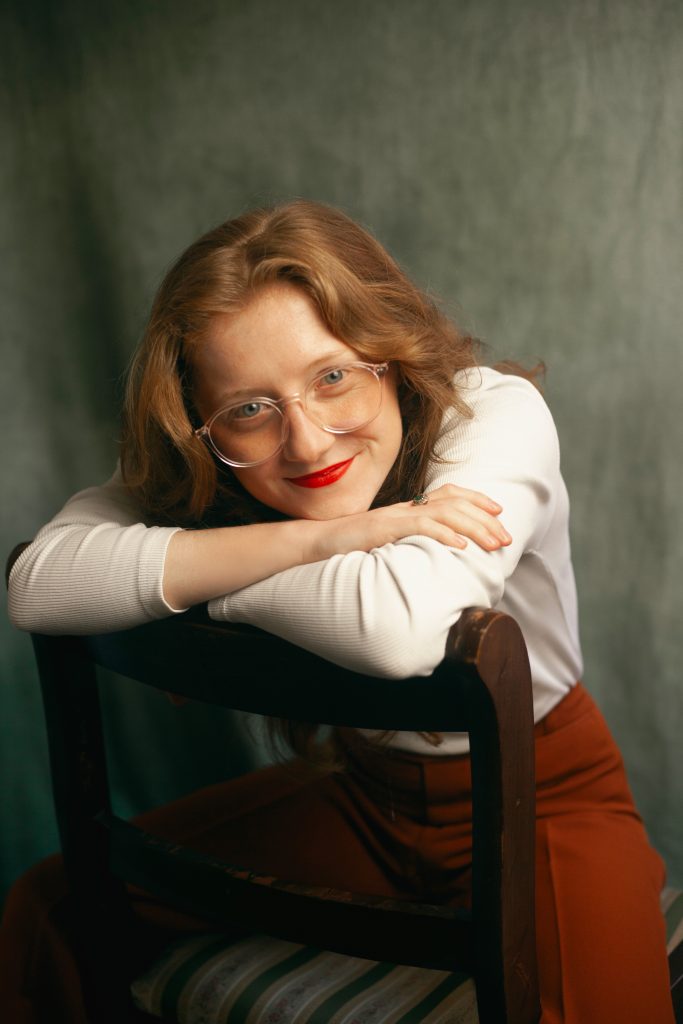
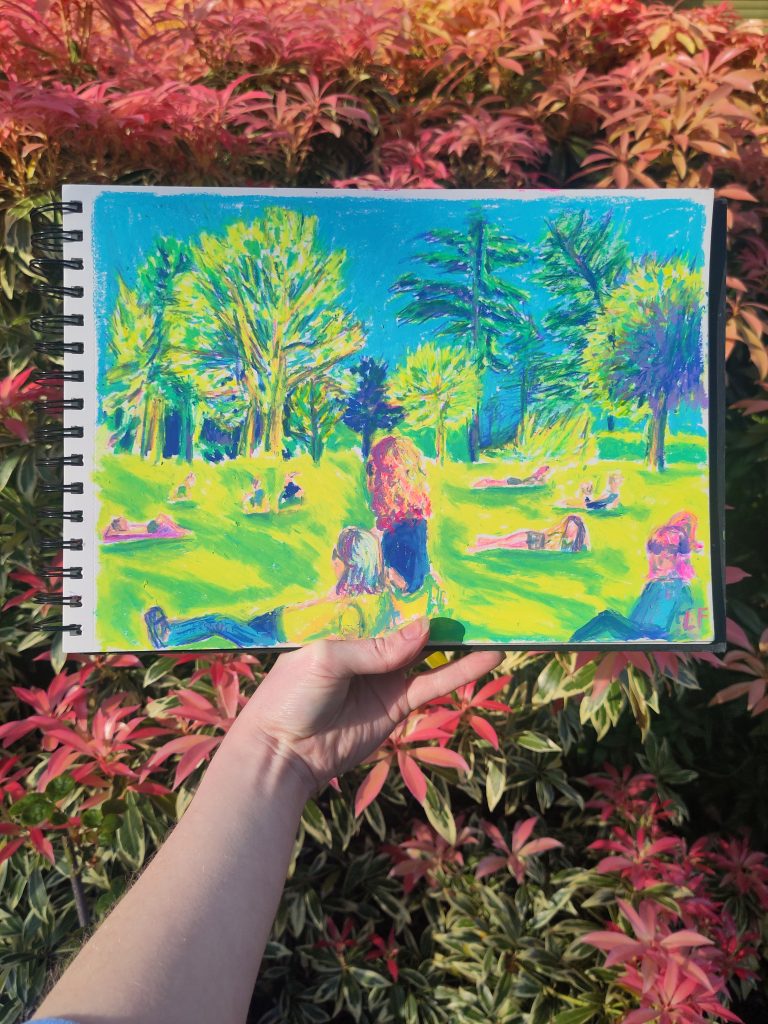
There is a particular moment Lucy Fleming watches for: sunlight passing through the leaves of a tree, changing ordinary greens into something briefly luminous. Some leaves deepen into shadow while others seem to glow yellow, almost fluorescent, as though the light has entered them rather than simply landed on their surface.
Lucy does not want to reproduce the scene with botanical precision. She is interested in the colours that appear between what is physically present and what the moment feels like. A breeze, the warmth in the air or an unexpected memory can become as important as the shape of the tree itself.
“I’m trying to describe how it looks, but also how it feels at the same time,” she says. “When I have colours in my hands, somehow I seem to be able to do that.”
That desire gives Lucy’s work its recognisable brightness. Fluorescent pinks, electric blues, sharp greens and warm oranges are not used to escape reality. They allow her to describe more of it. The colours carry atmosphere, movement and memory, giving a translucent quality to leaves, windows, reflected skies and figures passing through public spaces.
Her work now moves between oil-pastel drawings, graphic and motion design, music-related commissions and ideas for animation. Around those forms is an expanding community of artists, musicians, organisers and charitable groups. Lucy may begin with colour, but the work rarely ends with her alone.
Returning to the Page
Lucy grew up in Portrush and studied Interactive Media at Ulster University’s Coleraine campus. The course brought together graphic design, web development, motion graphics and the wider Adobe suite, providing the practical route into creative employment that she had been searching for.
It also changed the way she worked. Lucy had drawn throughout school, using acrylic paint and pencil, but during university she concentrated increasingly on digital media. Drawing gradually fell away as she focused on building the skills required for a professional design career.
“I went into it thinking, ‘I kind of know what I want to learn,’” she recalls. “I basically wanted someone to tell me how to use the full Adobe thing.”
The course gave her much more than software knowledge. With a small class and three lecturers overseeing the programme, Lucy describes it as a place where confidence mattered as much as technical ability. One short university animation, combining an excerpt from a speech by Greta Thunberg with motion graphics, was selected by an environmental film festival. The invitation offered an early indication that an idea made quietly at a computer could travel further than she expected.
After a placement brought her to Belfast during the restrictions of the pandemic, Lucy initially returned to the North Coast. She found work she loved but spent hours travelling between home and Belfast. Eventually the journey made the decision for her. She moved to the city and discovered that the change strengthened, rather than weakened, her sense of where she came from.
“I was never more proud to be from the North Coast,” she says. “People would ask, ‘Where are you from?’ I’m from Portrush, I’ll have you know.”
By then, her creative life was taking place almost entirely through screens. Professional design work could be followed by personal digital projects in the evening, turning what should have been a different kind of activity into an extension of the working day. Lucy needed something physical: paper, colour and a process that could not be endlessly adjusted through another menu or keyboard command.
In April 2025, she found a box of oil pastels that had somehow followed her from school to Belfast. She picked up the materials with no clear plan beyond discovering whether she could still draw. Using whatever paper was available, she began with the objects in front of her.
Oil pastel offered an immediate contrast to the controlled possibilities of digital design. The colour had weight. It caught against the paper, left evidence of pressure and made each decision difficult to erase. The uncertainty was part of its appeal.
Lucy decided that she would post the result regardless of how she felt about it.
“The exact words I said to myself were, ‘Even if this is shite, I’m going to put it on Instagram,’” she says. “It was just to get over that absolute perfectionism.”
Nothing disastrous followed. People responded warmly, Lucy drew again and the account became a form of accountability. She tried making something each day and, crucially, began leaving the desk to do it.
The North Coast in Fluorescent Colour
Belfast gave Lucy new streets, parks and people to draw, but trips home immediately returned her attention to the coast. She sketched the Strand at Portrush, the promenade in Portstewart and the familiar line where land, water and sky meet. These were not formal expeditions intended to produce finished landscapes. Drawing gave her a reason to sit, look and translate a place she already knew into colour.
The North Coast appears in Lucy’s work as both subject and visual foundation. Its light can change quickly, breaking across water, wet windows and broad skies. Because she knows these places intimately, she also recognises the rare moment when the light strikes them differently. A familiar view can become briefly strange and demand to be recorded.
One drawing began with an early train journey from the coast to Belfast. Lucy noticed the sunrise reflected across the window and photographed it before the moment disappeared. When she returned to the image in oil pastel, she worked more realistically than she usually does, using black paper to draw additional depth from the light.
The dark ground alters the behaviour of every colour placed upon it. Highlights seem to emerge from inside the image, while fluorescent marks take on the radiance of coloured glass. Lucy has continued exploring that effect in a drawing of morning light passing through the window of her own living room.
“I got up in the morning and thought, ‘I have to take a photo of this to draw,’” she says. “I find light fun.”
Her apparent simplicity contains close observation. Rather than begin with the assumption that a leaf must take a particular shape or shade of green, Lucy looks for the pieces of colour surrounding it. One area may be yellow, another blue, another almost white. The image is constructed through their relationship.
“I’m looking at what shape is there, what shape is about it and where the light is,” she explains. “There’s a bit of colour here and a bit of colour here, and you’re piecing it together.”
The resulting drawings are impressionistic without being vague. Figures in a park remain distinct enough that Lucy can jokingly ask whether she happened to draw somebody who was there that day. Movement is preserved through swift marks and compressed forms, while colour communicates the temperature and rhythm of the scene.
She is capable of highly realistic drawing, but accuracy alone does not contain everything she wants to retain. The fluorescent palette allows a landscape to hold the memory attached to it: a particular September, the smell after the beach, the atmosphere before rain or an unexpected sense of hopefulness.
A Visual Language for Music
Lucy’s creative community in Belfast developed partly through music. Her brother is a guitarist in Sweet Neptune, and his willingness to give her room to experiment created a bridge between her personal artwork and professional design skills.
The band’s music is energetic, playful and difficult to contain within a restrained visual identity. Lucy responded with colour, illustration, portraiture, logos and branding that communicate not only how the band looks, but how listening to it feels. The work invites an audience into the music before the first note is heard.
“Their music is so fun,” she says. “There’s a certain community surrounding that band where everyone is lovely and non-judgemental. I can be as colourful or as quiet as I want to be.”
That trust made risk possible. An unusual proposal could be tested rather than immediately made sensible. Through Sweet Neptune, Lucy met other bands and began making work for them, finding that Belfast’s art and music communities were not separate worlds at all. The same people moved between gigs, illustration, photography, performance and design.
What initially felt like a large city became a network in which one introduction could lead to a new commission, friendship or collaboration. Lucy’s Instagram account helped her locate people who were also making work because the idea itself delighted them. Over time, the network became a community that continues to grow through messages, shared projects and nights of live music.
Animation remains one of the forms she would most like to pursue further. When Lucy listens to music, she often imagines scenes moving alongside it: dramatic sequences, hand-drawn worlds or a sudden visual shift suggested by a change in sound. She is particularly interested in traditional cel animation and the demanding process of creating life through incremental movement.
Ideas for Sweet Neptune are already waiting. They require time, but the ambition reveals something consistent across Lucy’s work. Whether she is drawing a tree, designing a band identity or imagining an animated sequence, she is translating atmosphere from one form into another.
Giving the Work Somewhere to Go
Community is not an addition to Lucy’s art. It shapes what she believes her creative skills are for.
She has been vegetarian since she was thirteen and grew up in a home with rescue dogs. As her understanding of environmental and social issues developed, those early attachments became a wider commitment to kindness towards people, animals and the natural world.
“I just want to try and be as kind as I can,” she says. “There’s a lot of awful stuff, and I want to try and make anything – plant, animal or human – feel slightly less awful.”
That instinct makes work with a purpose especially meaningful. Lucy has supported Causeway Coast Dog Rescue for years and used the Belfast Marathon Relay to raise money for the organisation. Her workplace team regularly chooses charities connected to its members; when plans were less organised one year, Lucy decided to run for the rescue herself.
The connection brings her Belfast life back towards home. The race takes place in the city where her creative community has expanded, but its benefit travels to a small rescue serving the Causeway Coast. Lucy is already considering how the fundraising could become more ambitious, including the possibility of tackling a longer distance in costume.
Her ideas are not limited to direct donations. With experience in design, social media, video and styling, Lucy can see how those practical skills might help a small organisation become more visible. A charity shop could be photographed and promoted with the imagination of an independent fashion label. Outfits could be styled, stories could be told and more people could be encouraged through the door. Lucy’s mind moves quickly from recognising a need to imagining the creative infrastructure that might support it.
“I’m going to create stuff anyway,” she says. “It’s just nice if there’s a platform for it, if there’s a space for that.”
Her relationship with ROSA began through work she had originally intended to keep private. After seeing an open call for artists, Lucy felt that the piece belonged within the organisation’s publication and submitted it. ROSA selected the work – a darker, more ethereal image than much of her public output, with hands reaching through deep shades – and then placed it on the cover of its zine.
Lucy discovered the decision while scrolling online.
“A couple of weeks later, there’s the magazine and it’s on the front cover,” she remembers. “I thought, ‘What’s happening!?’”
Seeing the image distributed around Belfast altered its meaning. Something drawn in solitude had become part of a collective feminist publication, placed in the hands of readers and carried into conversations Lucy could not have predicted. ROSA later invited her to contribute to further work, continuing a relationship that allows design and illustration to participate directly in organising.
The cover also demonstrates the flexibility of Lucy’s visual language. Fluorescent brightness is central to her work, but it is not a compulsory surface treatment. Colour responds to purpose. When a subject requires darkness, the glowing quality remains through contrast: hands, edges and gestures become visible because of what surrounds them.
Lucy does not speak about community work as a way of building her own reputation. She is more interested in whether the image, campaign or idea can be useful. Design becomes a tool that can help an organisation communicate, raise money, reach an audience or give an important experience a visible form.
Seeing an Environment Organically
Lucy’s recent inspiration includes the work of Violetta Borigard, a Ukrainian artist whose route into painting has passed through illustration, photography and design. Borigard works primarily with acrylic and mixed media, creating environments through layered colour, shifting shapes and deliberately organic perspective.
Lucy was initially drawn to an image discovered online. In one painting, warm light strikes a tiled surface without turning it into a perfectly measured exercise in perspective. The tiles shift slightly out of alignment, becoming reflective pieces within the atmosphere of the scene. Looking at it evokes more than a location.
“It feels like a really warm summer’s day where the air is humid,” Lucy says, “like you’ve just come back from the beach and you’re chilling, and the sun is there. It just feels lovely.”
Other Borigard works bring acrylic together with marks that resemble oil pastel or crayon. Leaves appear almost collaged, their forms changing as colour passes across them. Lucy recognises an approach to the environment that feels close to her own: instinctive rather than mechanically accurate, but highly attentive to the way light changes a place.
The influence does not ask Lucy to imitate a finished style. It gives her another example of how an artist can keep perspective flexible, allow materials to remain visible and prioritise the sensation carried by a scene. Borigard’s work affirms that an environment can be recognisable without being fixed and that colour can describe humidity, heat and reflection as convincingly as it describes an object.
Lucy’s own work is still expanding quickly. She only returned to physical drawing in 2025, yet the oil pastels have already connected previously separate parts of her life: the colour instincts of a designer, the environmental attention present in her early animation, the light of the North Coast, the energy of Belfast’s music community and the belief that creative ability becomes more valuable when it can be shared.
She does not need every drawing to become a product or every experiment to settle into a single professional identity. The freedom lies in following what remains interesting. When one material stops being fun, she can move to another; when an unfinished idea finds a new purpose, she can return to it.
The constant is attention. Lucy notices the moment a train window catches the sunrise, the possibilities inside a charity shop, the visual world surrounding a band or the way a small organisation might reach more people with the right image. She sees colour as something capable of travelling between them all.
Light spills through leaves for only a moment. Lucy’s work begins by catching it, but its real strength comes from what she does next: carrying that brightness into the communities around her and giving it somewhere else to glow.
Keep up with Lucy via social media:
@lucyfleming.design
Support Go Leor. Get the Print. Join the Story.
Go Leor is an independent Irish arts magazine built by hand, heart, and community. Your support keeps meaningful storytelling alive – in print, in culture, and in conversation.
Through Patreon, you can support the magazine in two simple ways:
- Supporter Listing
Have your name printed inside every issue as part of the community helping Go Leor grow. - Print Copy – UK & Ireland
Receive the latest print issue delivered each month across the UK and Ireland, with your name included inside the magazine.
The Latest Articles
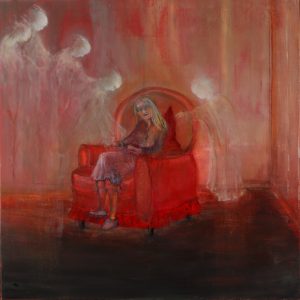

Maria Noonan-McDermott: Where Memory Becomes Art
Transforming intimate family memories into paintings and poetry, her work invites others to recognise stories of their own.
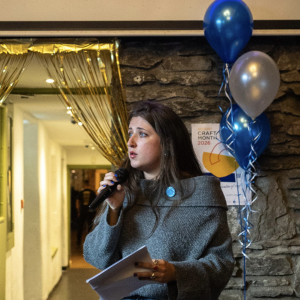
Rosina Law-Braney: Reclaiming the Seven Deadly Sins
Through zines, illustration and humour, Rosina Law-Braney creates vibrant feminist stories that make room for identity, desire, grief and collective creative freedom.
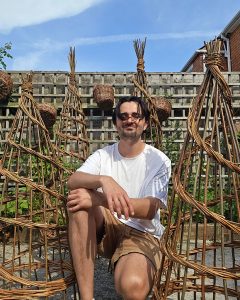
Alexander Edward: Weaving from the Land
Growing his own willow beside Strangford Lough, Alexander Edward brings coppicing, landwork and an ancient craft into bold contemporary forms.
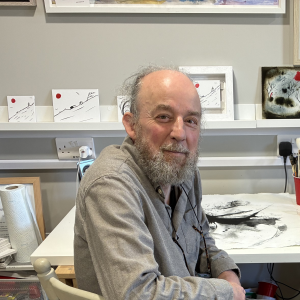
John Britton: Finding Calm Through Ink
After three decades of visceral performance and constant travel, John Britton has found a quieter connection through ink, mentorship and calm.
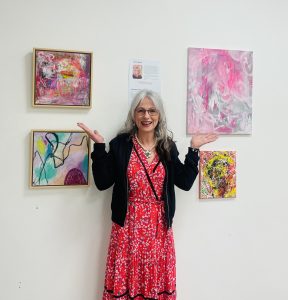
Yvonne Moore: Following Curiosity into Colour
Refusing to settle into a single style, Yvonne Moore follows curiosity across colour, poetry and community, creating art that brings her – and those around her – fully to life.
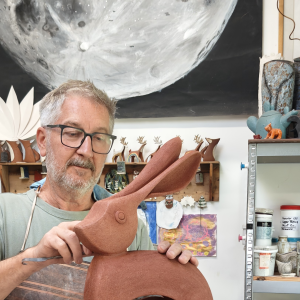
Paul Burch: Shaping Old Mountains in Clay
After decades spent teaching others, Paul Burch has returned to clay, building warm, characterful sculptures from memory, landscape and the freedom to experiment.