
Alexander Edward
Basketcase Belfast
Growing his own willow beside Strangford Lough, Alexander Edward brings coppicing, landwork and an ancient craft into bold contemporary forms.
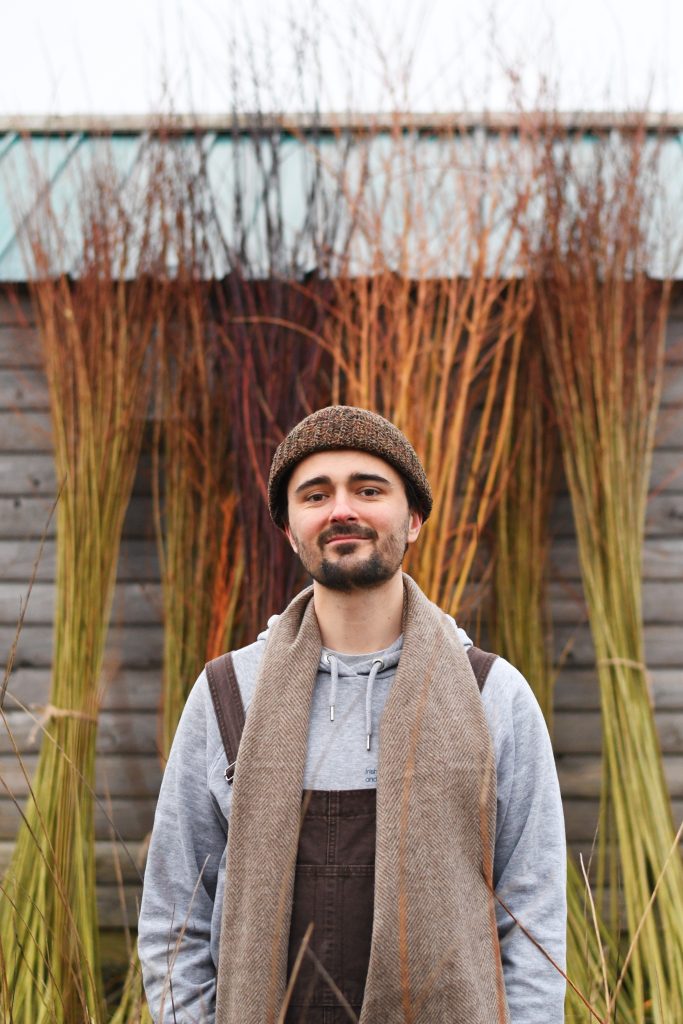
Across Alexander Edward’s workshop, lengths of willow splay into the air before they settle into form. At this stage, a basket can resemble something alive: a many-limbed creature turning in the hands, its rods held together by pressure, movement and the growing certainty of the weave. Alexander has compared it to a Demogorgon. It can also fight back. A loose rod might spring towards his face; a change in tension can become a snap; a form that wants to collapse has to be persuaded, held and worked into strength.
Basketry is physical work. A basket can take hours or days, with Alexander using his own strength to manoeuvre rods through gaps while repeatedly wetting the willow to keep it flexible. If it dries, it breaks, and part of the work may have to begin again. Structure arrives through what he calls “managed tension”: each rod pushing or pulling against another until something that ought to spring apart becomes immeasurably strong.
Under the name Basketcase Belfast, Alexander grows, harvests and weaves much of his own willow. It is an unusual combination. Most weavers buy prepared rods, but for Alexander the making begins in the ground, with the colour, thickness and character of each variety growing on a plot beside Strangford Lough. He is a weaver, but also a landworker, following the material across a complete cycle from living stool to finished object.
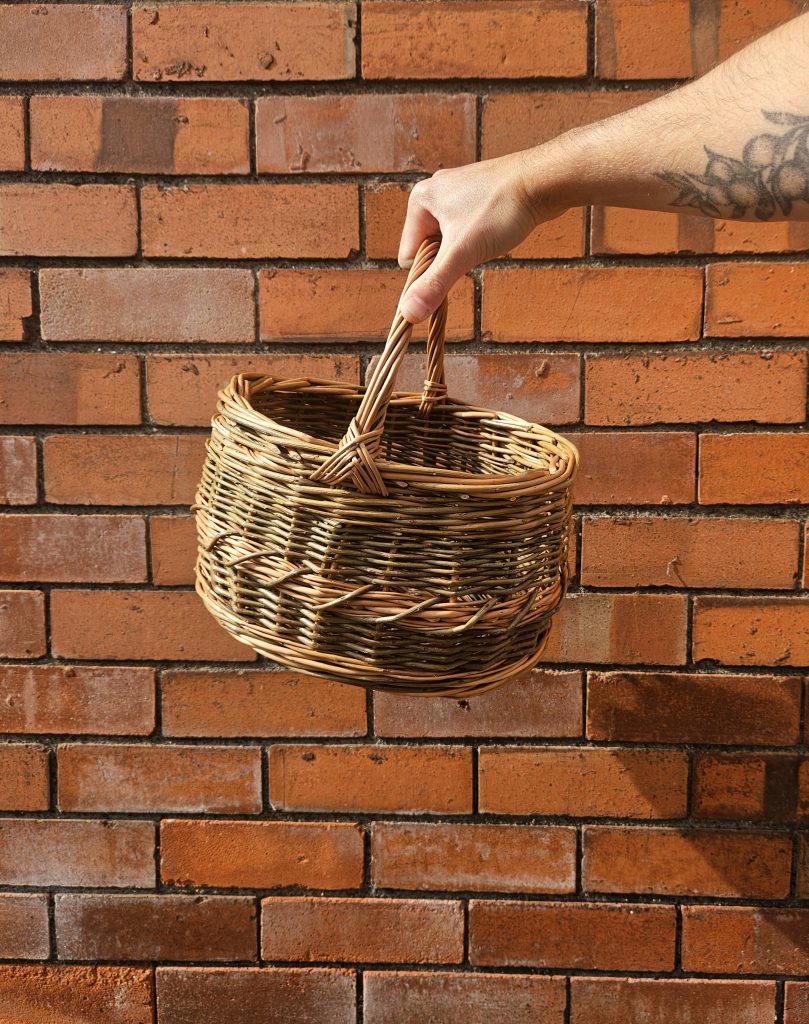
That closeness to the material has encouraged him to test what an old craft can be allowed to say. Traditional baskets sit alongside garden structures, sculptural experiments and angular bottle carriers; willow is joined by hazel, sycamore and, in one deliberately unsettling work, discarded tyre rubber. He values the knowledge carried through basketry, but does not believe its future has to look like its past.
“It’s a little bit like punk basketry or something,” he says, before admitting that these days he listens to rather more Radio 3 and Radio 4 than punk.
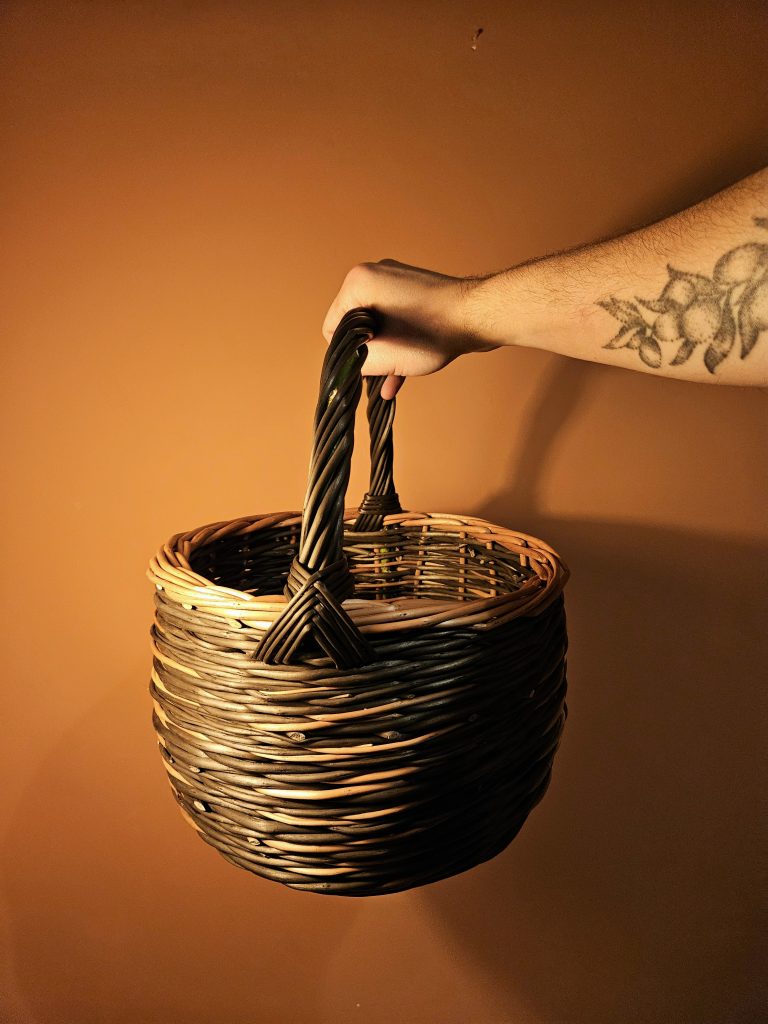
A Basket from the Skip
Alexander’s route into basketry began around fifteen years ago, long before he considered claiming the craft as his own. He was working within a community supporting children and adults with complex needs. The site included a school, a college and a farm, as well as a resident basketmaker, Sabine Wolniczak.
Alexander sometimes accompanied young people to Sabine’s weaving sessions. Some were non-verbal or experienced considerable challenges with communication, concentration and motor skills. Basketry could become technically demanding, but its basic movements were methodical and repeatable. He watched the young people find their way into that rhythm and was struck by what the process could offer.
“I had more interest in that than the art or the craft of it,” he says. “I was like, this is obviously very therapeutic. I really respect it for that.”
At that point, willow belonged in Alexander’s mind beside activities such as candle dipping: pleasant, gentle and worthwhile, but not something he imagined becoming central to his own life. One of Sabine’s baskets began to change that relationship quietly. Alexander found it sitting in a skip, apparently destined for disposal, and could not leave it there. He brought it home, where it remained for years and served as a bed for three adopted cats.
The basket was useful, but it also retained the atmosphere of those earlier sessions. About a decade later, Alexander contacted Sabine and asked to attend a class. He took two introductory sessions over the following months and rediscovered the mechanical rhythm he had first noticed while watching others weave.
Sabine recognised his enthusiasm. She was preparing to retire and had several plots on which she grew willow; someone would need to take responsibility for them. At the end of Alexander’s second class, she offered him the chance to assume the rent and care of one plot. It could produce around 14,000 rods in a year, enough for hundreds of baskets. For someone with only a few classes behind him, the scale was daunting. Alexander accepted it anyway.
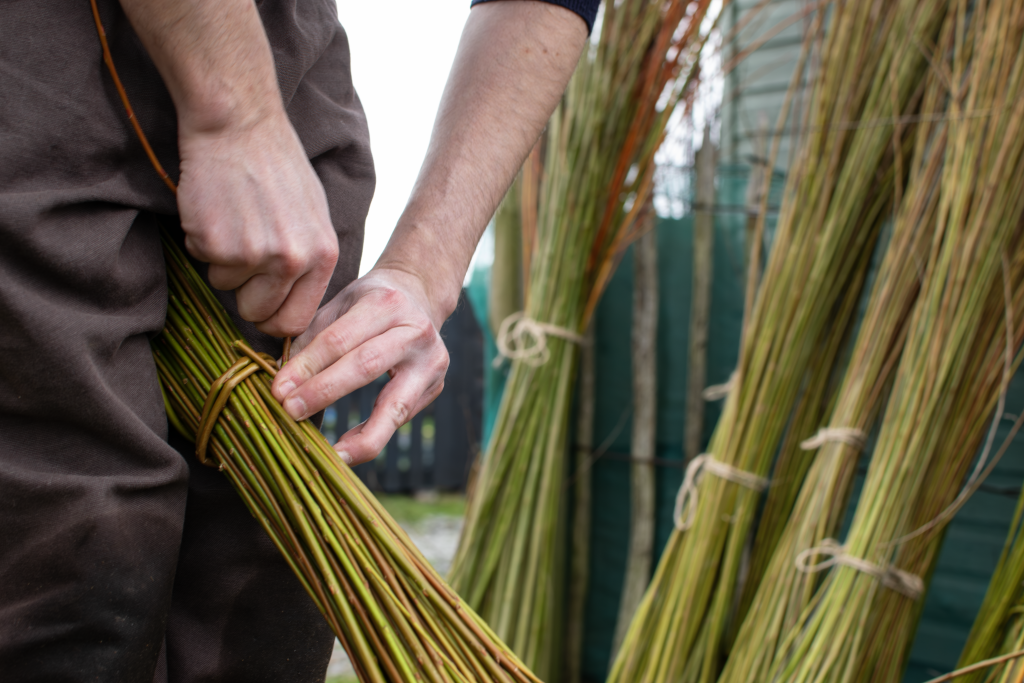
Growing with the Lough
The work Alexander does on the plot is coppicing: cutting willow down low during its winter dormancy so that it regenerates from the stool. Shoots rise throughout the following year, some reaching four metres, before he returns to cut them again. Far from exhausting the plant, the cycle encourages it. A stool that produced five rods might send up six after cutting, then seven or eight in later seasons.
“Every time you hack it, it just doesn’t give up,” he says. “It likes it and it kind of wants you to do that – to grow yet more of it.”
Every culture in the world has developed ways of weaving containers from the materials available to it. Willow became fundamental here because it grows readily in the local climate. Its basic logic may be familiar to anyone who wove rushes as a child, but willow is woodier and thicker, able to take and retain far greater tension.
The heavy, moisture-retentive clay beside Strangford Lough suits it particularly well. The plot lies within a landscape Alexander had already come to regard as an adopted home.
His mother settled near Downpatrick, towards the lower end of the lough, while Alexander is based closer to its upper reaches. The water travels in and out with the tide; light-bellied brent geese return in their thousands; egrets and whooper swans move between the shoreline and the rolling drumlins of County Down.
The willow contributes another rhythm. Once harvested, each year’s growth must be sorted according to the rods’ size, thickness and variety, then dried and stored. Alexander can often recognise a variety from its tip and from subtle changes in colour. None of the colour in his work comes from dye. It is the result of centuries of cultivation promoting particular natural tones, followed by the choices he makes about which varieties to keep and grow on his own plot.
The relationship is practical as well as beautiful. Coppicing strengthens the plants, while the plot creates shelter for insects and birds and holds carbon within land that might otherwise be absorbed into more intensive agriculture. Alexander feels a kinship with Belfast’s community gardens: both use overlooked or vulnerable ground to create something local, shared and regenerative.
At first, responsibility for so much willow felt overwhelming. Around the same period, what appeared to be an ordinary cold resulted in sudden sensorineural hearing loss, leaving Alexander with severe hearing loss on one side. He describes the NHS treatment he received as miraculous and remains profoundly grateful for the sound he retained.
The experience changed how he listens and works, but it did not become the definition of his work. As his health stabilised, the plot offered a way back into physical, purposeful activity. What had initially seemed like an intimidating inheritance became a beautiful piece of land filled with material he could learn from.
“I started to settle with doing the weaving and go to where I grow it,” he says. “I was like, my God, this is a very resilient, regenerative space. This isn’t a drag. It’s work – I have to harvest it – but what a beautiful place to be.”
The tide completes its cycle roughly every six hours. The willow completes its own over a year. Alexander works somewhere between the two.
A Physical Language
Weavers describe willow almost anatomically. Every rod has a back, a belly, a butt and a tip, and each part responds differently when placed under tension. Learning to weave means learning how those differences can be directed. A rod is not simply threaded into position; it is read through the hands, bent at the point where it will hold and balanced against the forces already contained within the basket.
The vocabulary of the craft carries that physicality. Pegging means securing willow with a carved wooden insert, almost like driving in a nail. Slyping is a sharp cut made with a knife to accentuate an angle in the fibre. Pricking down requires the willow to be bent against a blunt point. Bodkins, knives, awls and a rapping iron all have their place in Alexander’s workshop, but the work ultimately relies upon his hands: maintaining pressure, judging moisture and keeping the structure in place as it grows.
There is rhythm within that labour. The hands repeat a sequence; rods pass around one another; the basket turns. Knitting may require a maker to keep track of dozens of stitches, while a willow pattern, at its simplest, might ask Alexander to count only to four. Four rods move on one side and four on the other: one, two, three, four, repeated until the movements become fluent.
“It’s like rock and roll in comparison,” he says. “I’m counting just the same as I would have done when I played the drums.”
Music was once a large part of Alexander’s life, particularly drumming, and his hearing loss altered his relationship with it. Rhythm remains the most dependable element, something that can be felt and followed even when melody no longer arrives with the same fullness or precision. Weaving holds some of that same combination of timing, repetition and variation.
The comparison extends beyond metre. A folk musician may use familiar chords, inherited structures and a vocabulary carried by generations, yet produce something unmistakably personal. Basketry works similarly. No single movement needs to be impossibly complicated; confidence accumulates through repetition until simple gestures can be combined fluently.
Alexander still describes himself as a beginner. Apart from three classes, much of his learning has been self-directed.
That humility acknowledges the extraordinary technical and sculptural work of more experienced basketmakers, but it also reflects what attracts him to the craft. Willow does not need to be elevated beyond ordinary life to be valuable. Its accessibility is part of its beauty.
“This is just popular and normal stuff that could be made pleasant and decent,” he says. “It’s just bringing something that’s been done for years forward, keeping it alive and keeping it going – and doing it confidently and creatively.”
Beyond the Basket
Alexander is proud of basketry’s heritage but impatient with the narrow image that often surrounds it. Willow can be presented as picturesque and reassuring: a cottage craft placed safely within an imagined past. He readily admits that he enjoys “cottagecore stuff”, but wants to explore what else the material can do. For him, bringing the craft forward means using its knowledge boldly rather than simply preserving a familiar appearance.
That question has led him into gardens, where weaving becomes architecture. Working with landscaper and garden designer Michael Reid, Alexander recently helped create a woven structure for a kitchen garden enclosed by a high clay-brick wall. The wider garden drew upon formal French and Italian influences, while its planting brought edible and ornamental species together in a looser cottage-garden arrangement. The willow needed to connect those worlds without becoming either conventional fencing or freestanding sculpture.
Alexander looked towards Renaissance gardens for context, searching paintings and drawings for woven forms that might belong within a formal space. The completed structure bends through the garden rather than imposing a rigid boundary upon it. It performs a practical role, but its usefulness is allowed to be strange.
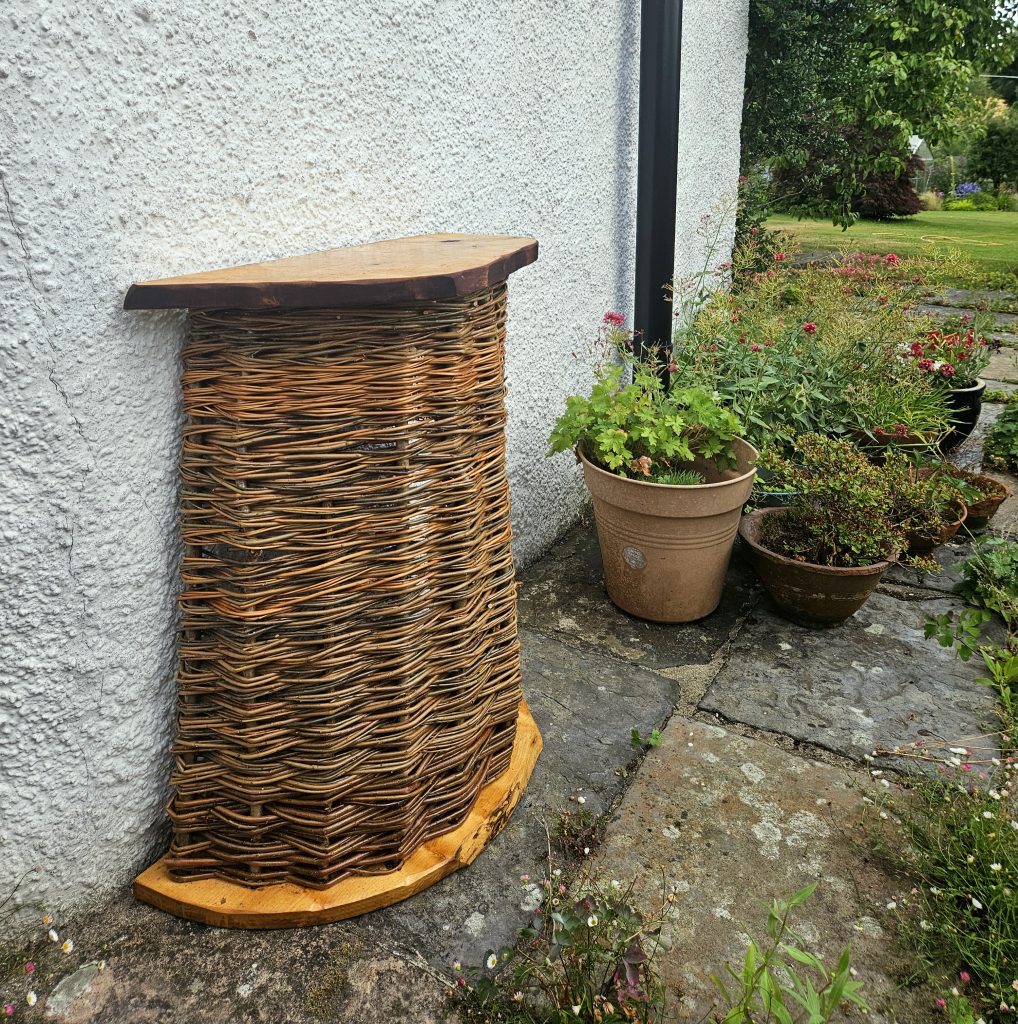
The same collaboration produced an unusual piece of outdoor furniture resembling a barrel cut vertically and set against a wall. Reid’s initial inspiration came from woven artillery gabions: large baskets historically filled with earth or stone to form military defences. There was no ready-made guide for translating the idea into furniture, so Alexander worked out how to hold and weave the upright stakes with help from his partner. Irish sycamore, hazel and willow from his own plot eventually formed an object that carried a distant historical reference into a contemporary garden.
Completing it gave Alexander a welcome measure of progress. He may still call himself a beginner, but the project required him to solve a problem for which he could not simply follow an established pattern.
“It makes me feel like a very competent and confident beginner,” he says. “That’s a nice feeling to have.”
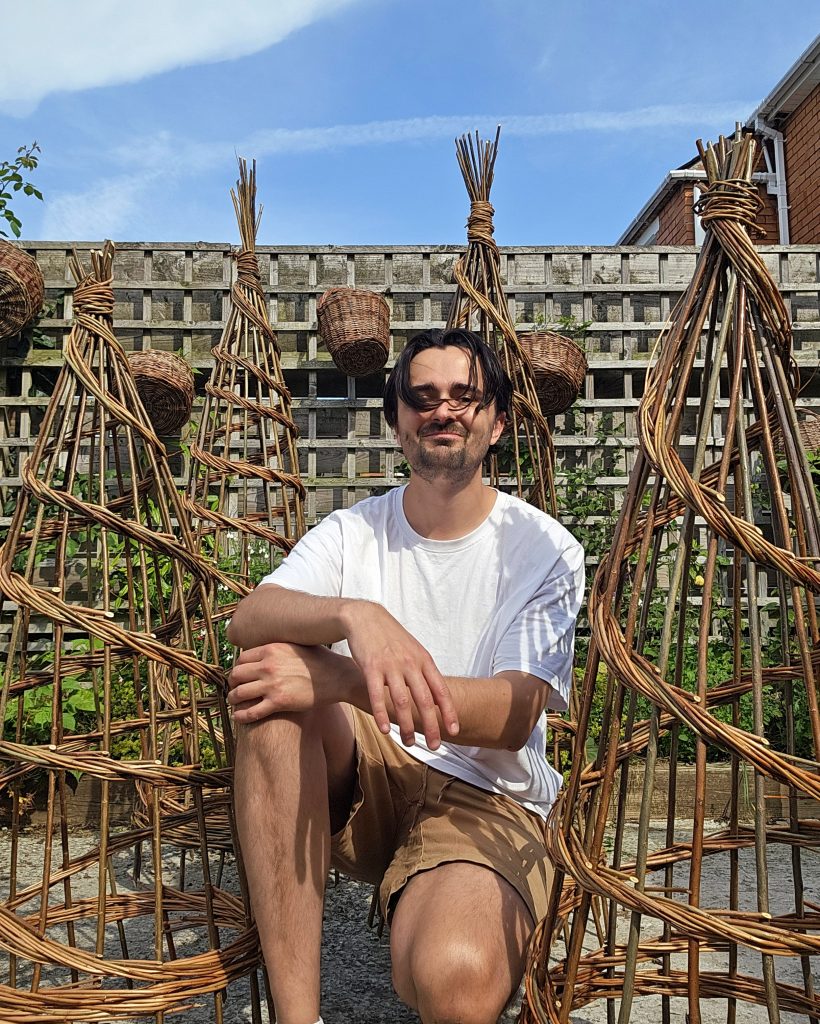
His woven obelisks make a similar crossing between tradition and something less easily placed. Their purpose is familiar: they provide structure for sweet peas and other climbing plants. Yet as the willow twists upwards, Alexander sees something almost science-fictional in the result. An object that might once have been commonplace now appears distinctive beside mass-produced spirals of metal or plastic.
The reversal interests him. Handmade natural structures can be treated as old-fashioned, yet the conditions that once made them ordinary have largely disappeared. To grow the material, understand each part of it and construct an object from the ground up now feels unusual – perhaps even radical.
Baskets of the Apocalypse
Alexander pushes that contradiction further in an evolving series he calls Baskets of the Apocalypse. The works begin with a concern that much of willow culture remains too comfortable within its own imagery. Beautifully made baskets can still feel detached from the environmental conditions on which their material depends.
Willow is famously resilient. It pioneers damaged ground, tolerates wet conditions and grows back after severe cutting. That resilience can create an illusion of permanence. Alexander’s plot lies on a floodplain near a sewage treatment facility. Too much water could rot submerged stools; contamination could make harvesting unsafe. Elsewhere, drought and wildfire create different threats. A heritage craft rooted in the natural world is not protected from ecological crisis simply because its public image is green and peaceful.
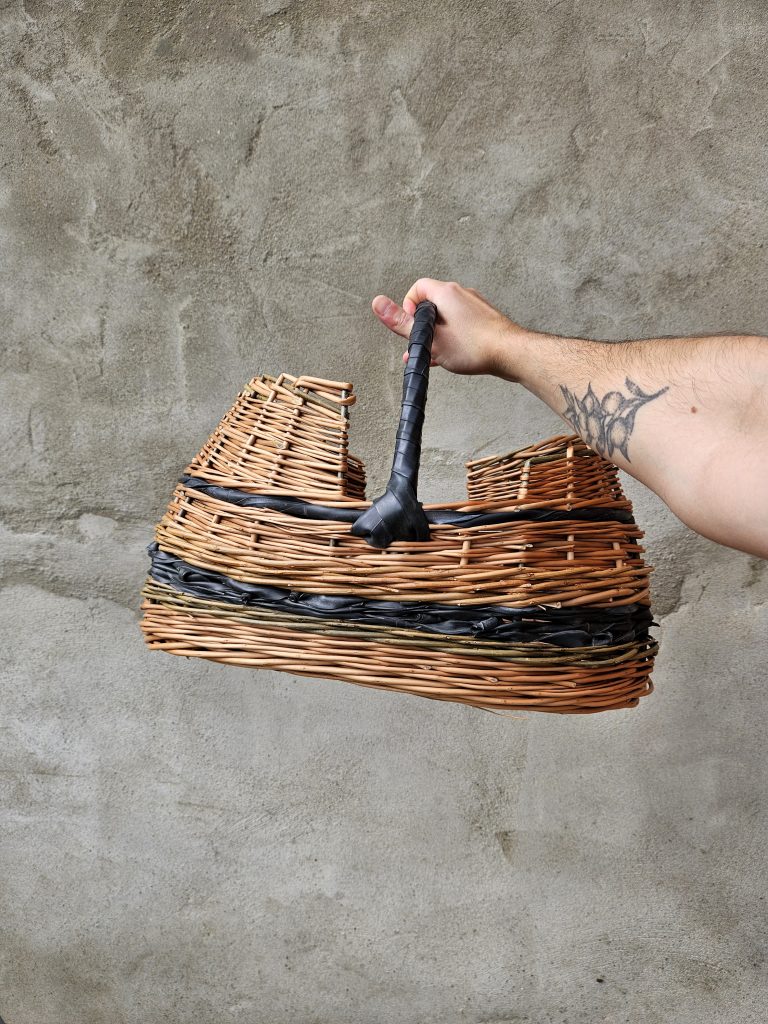
A single basket can require several hundred rods. Alexander began wondering what a weaver might use if those rods were no longer available. The answer led him towards what he calls “forever materials”: substances that endure not because they regenerate, but because they refuse to break down.
For one work, he replaced willow with strips of discarded tyre rubber. The form recalls a Moses basket, perhaps one of basketry’s most tender and traditional objects. Rubber proved remarkably effective to weave – flexible, strong and functional – but it also smelled, resisted beauty and carried the history of thousands of journeys across tarmac. A material produced from ancient organic matter became a container for something precious in an imagined future where fresh willow was scarce.
“It’s very ugly and disturbing,” Alexander says. “There are consequences, I suppose, to the damage that comes to heritage crafts.”
The basket could function, and that is what makes it unsettling. It does not present environmental collapse as an abstract idea; it offers a plausible replacement that nobody would want to need. Through it, Alexander moves beyond representing a threatened landscape and asks what people might physically carry when familiar materials disappear.
The series also gives him a way to make his own music within basketry. He compares traditional forms to songs that can be covered faithfully. The Baskets of the Apocalypse retain the underlying structure but change the material, context and emotional register. They use an inherited vocabulary to tell a story belonging unmistakably to the present.
Heritage in Use
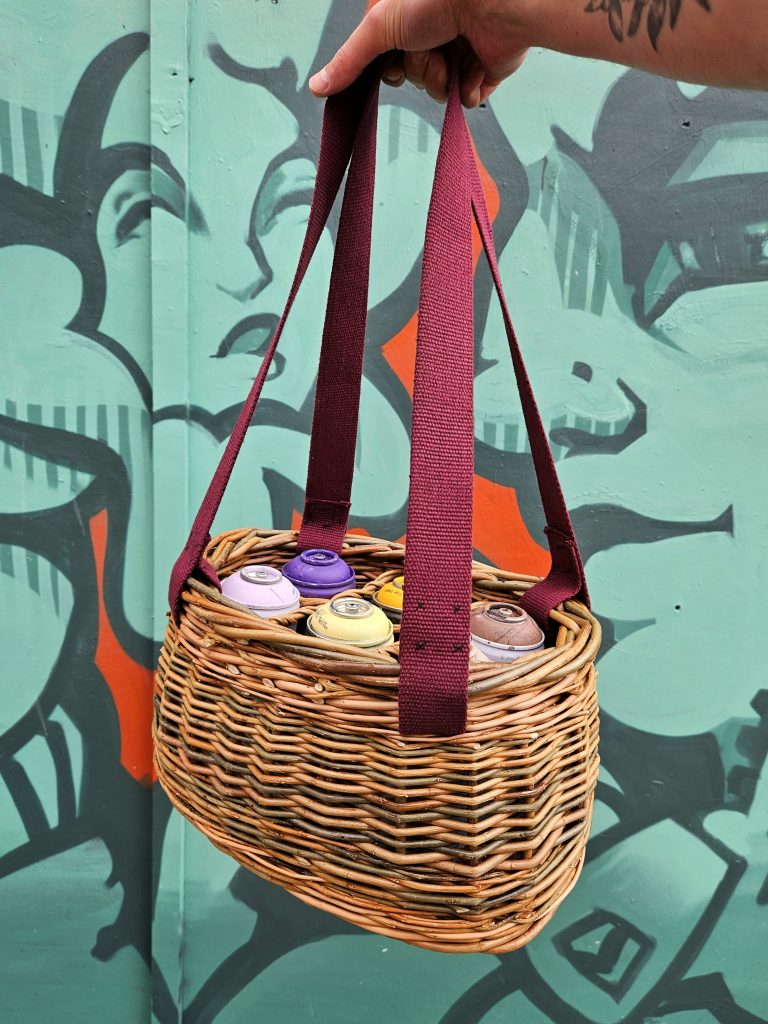
Even Alexander’s more playful ideas return to function. At The American Bar in Belfast, he plans to teach people to make small Buckfast baskets: angular, body-hugging bottle holders carried by a canvas strap. The joke is immediate, but so is the intention. A conventional shopping basket may have little relevance to a younger person walking through Belfast or attending a festival. A woven bottle carrier might actually accompany them.
“How can I make something that’s traditional and part of our heritage relevant to someone today?” he asks. “If you don’t use it, then what’s the point?”
That does not mean every object must solve an urgent problem. It means the life of the willow should continue after the weaving ends. A basket might travel to an allotment or community garden. An obelisk might disappear beneath sweet peas. A fence might follow the uneven movement of a garden rather than forcing the land into a straight line. Use allows an object to gather the marks and associations that eventually make it irreplaceable.
Alexander understands that through Sabine’s rescued basket. After years of use, he could now reproduce its measurements and weave another version, but technical accuracy would not replace it. The original carries the memory of the skip, the young people he watched weaving, the teacher who encouraged him and the cats that slept inside it.
“I’d be devastated if I lost it,” he says. “It’s funny to say that as a weaver who could very easily replicate it, but I could never make it.”
This is the strength at the centre of Basketcase Belfast. Alexander wants to disrupt the prettified image of weaving, confront the pressures facing its materials and invent bold forms that speak to people now. Yet he also respects the ordinary promise of a basket: that it can enter someone’s life, be carried and repaired, and become more valuable through use.
The work begins beside Strangford Lough, where willow moves with the wind, water and return of birds. Alexander cuts it back to the stool, sorts it by variety, learns the character of every rod and carries it into his Belfast workshop. There, back, belly, butt and tip meet through the pressure of his hands. Tension becomes structure; material becomes form; something grown within a year may remain in a family for fifty.
For Alexander, the future of basketry lies in that complete relationship: landwork and craft, heritage and experiment, usefulness and imagination. By growing the material as well as weaving it, he is not simply preserving an old way of making. He is finding out what it can become next.
To discover more about Alexander’s work and find details of upcoming events, demonstrations and markets, visit:
basketcasebelfast.com
And keep up with them via social media:
@basketcasebelfast

Support Go Leor. Get the Print. Join the Story.
Go Leor is an independent Irish arts magazine built by hand, heart, and community. Your support keeps meaningful storytelling alive – in print, in culture, and in conversation.
Through Patreon, you can support the magazine in two simple ways:
- Supporter Listing
Have your name printed inside every issue as part of the community helping Go Leor grow. - Print Copy – UK & Ireland
Receive the latest print issue delivered each month across the UK and Ireland, with your name included inside the magazine.
The Latest Articles

Maria Noonan-McDermott: Where Memory Becomes Art
Transforming intimate family memories into paintings and poetry, her work invites others to recognise stories of their own.
Rosina Law-Braney: Reclaiming the Seven Deadly Sins
Through zines, illustration and humour, Rosina Law-Braney creates vibrant feminist stories that make room for identity, desire, grief and collective creative freedom.
John Britton: Finding Calm Through Ink
After three decades of visceral performance and constant travel, John Britton has found a quieter connection through ink, mentorship and calm.
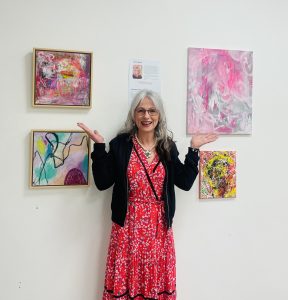
Yvonne Moore: Following Curiosity into Colour
Refusing to settle into a single style, Yvonne Moore follows curiosity across colour, poetry and community, creating art that brings her – and those around her – fully to life.
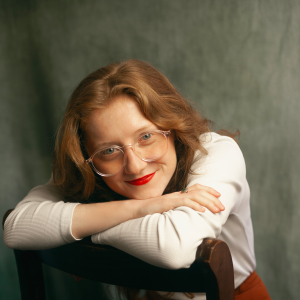
Lucy Fleming: Carrying the North Coast Light
Through fluorescent colour, oil pastel and an instinct for collaboration, Lucy Fleming turns the light of the North Coast into images that connect art, music and community.
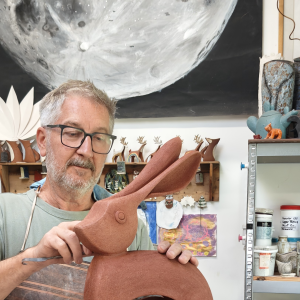
Paul Burch: Shaping Old Mountains in Clay
After decades spent teaching others, Paul Burch has returned to clay, building warm, characterful sculptures from memory, landscape and the freedom to experiment.