
Vicki McCorkell
Fallen Embers Pyrography
Ballymena artist Vicki McCorkell transforms locally sourced wood into dark, intricate works shaped by mythology, dreams and human emotion.
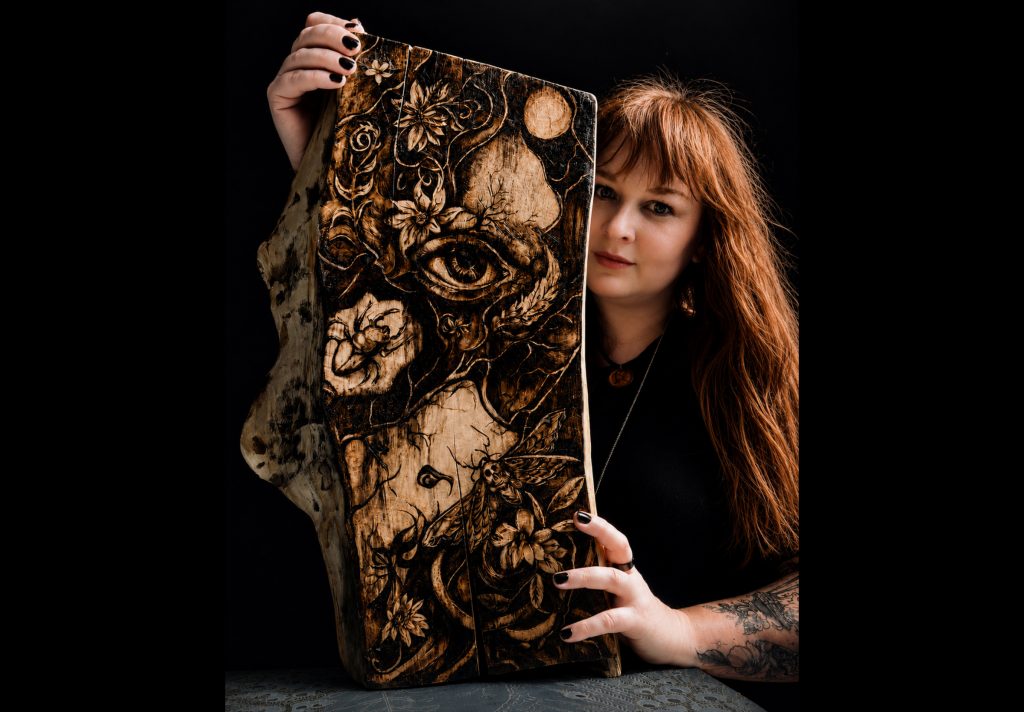
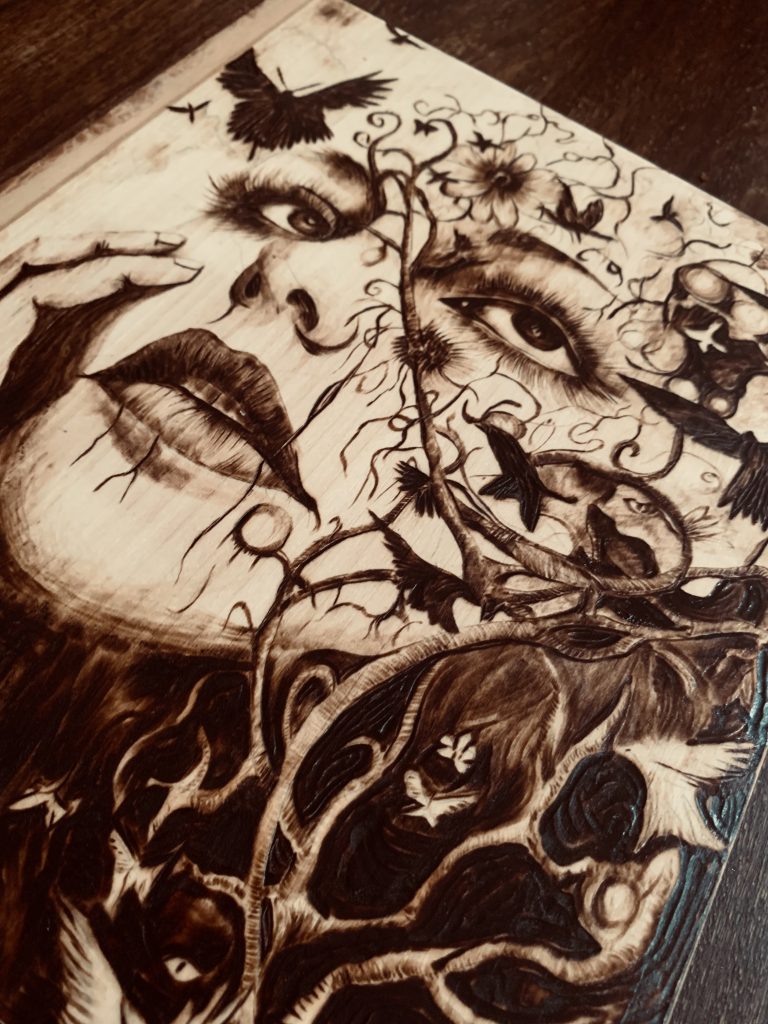
A knot in a piece of wood became an eye. It was not part of Vicki McCorkell’s original plan. Faced with the choice of burning over it or allowing it to remain, she began to see something staring back at her from within the grain. She shaped the image around it and, in doing so, found the detail that would become a quiet signature of Fallen Embers Pyrography.
There is now at least one hidden eye in every piece Vicki creates. Some are easy to find; others disappear within dense shadows and strange figures. At markets, once visitors discover the recurring motif, they begin searching for it across the entire collection. The work stops being something they simply look at and becomes something they explore.
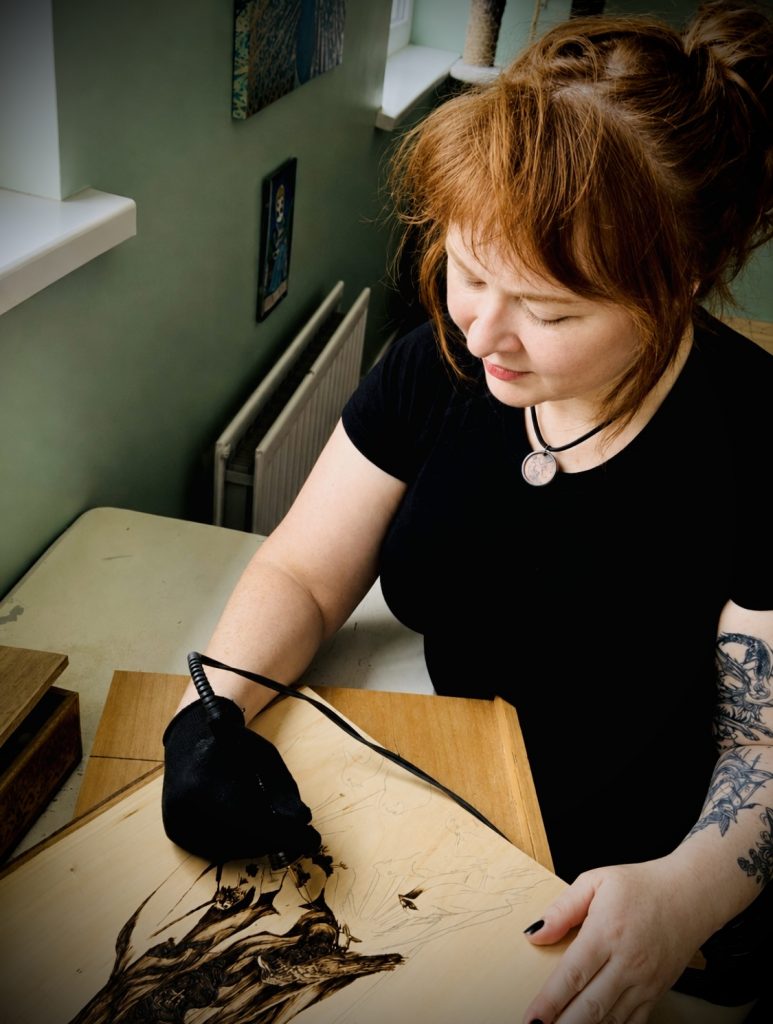
It is an appropriate emblem for an artist whose work depends upon sustained attention. Vicki burns imagery into wood by hand, building darkness slowly while remaining alert to every knot, split and irregular line. She arrives with a drawing, but the wood is never a passive surface. It has already lived a life of its own—and it can change the direction of a piece at any moment.
“You might come up with this idea and think, ‘Right, I’m going to burn this image today,’” she explains. “Then you get the piece of wood, and the wood has its own idea. It’s got its own life, and you have to respect that.”
Burning a Little Darker
Vicki established Fallen Embers in 2024, but creativity had long been part of her life. She had painted, sketched and drawn for years without finding a medium that held her in quite the same way. Pyrography began almost on a whim, with an inexpensive burner bought simply to try something new. The response was immediate.
“The minute I picked up that burner, I was like, ‘Wow, this is good.’ It’s so unlike any other medium.”
Drawing remains central to her process. An image may be carefully planned in a sketchbook before being redrawn on the wood, or it may begin directly on the surface. What distinguished pyrography from the other art forms Vicki had explored was the way it allowed her to turn shading into a physical act.
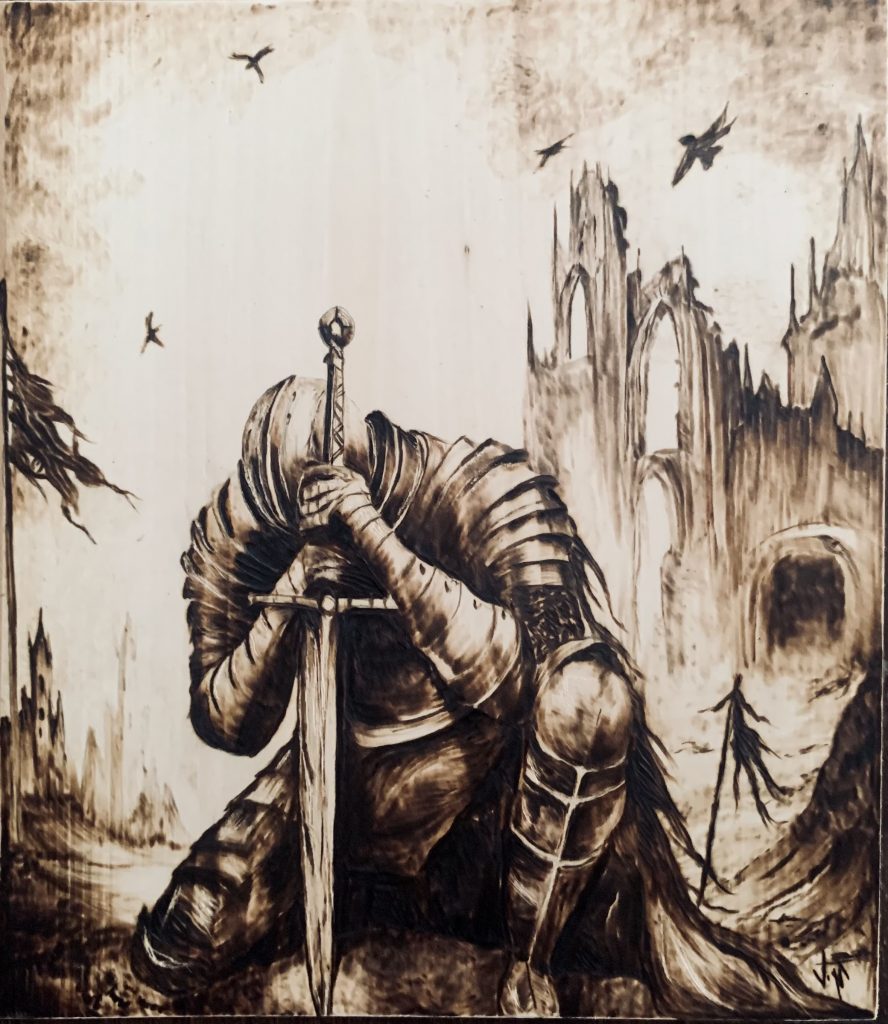
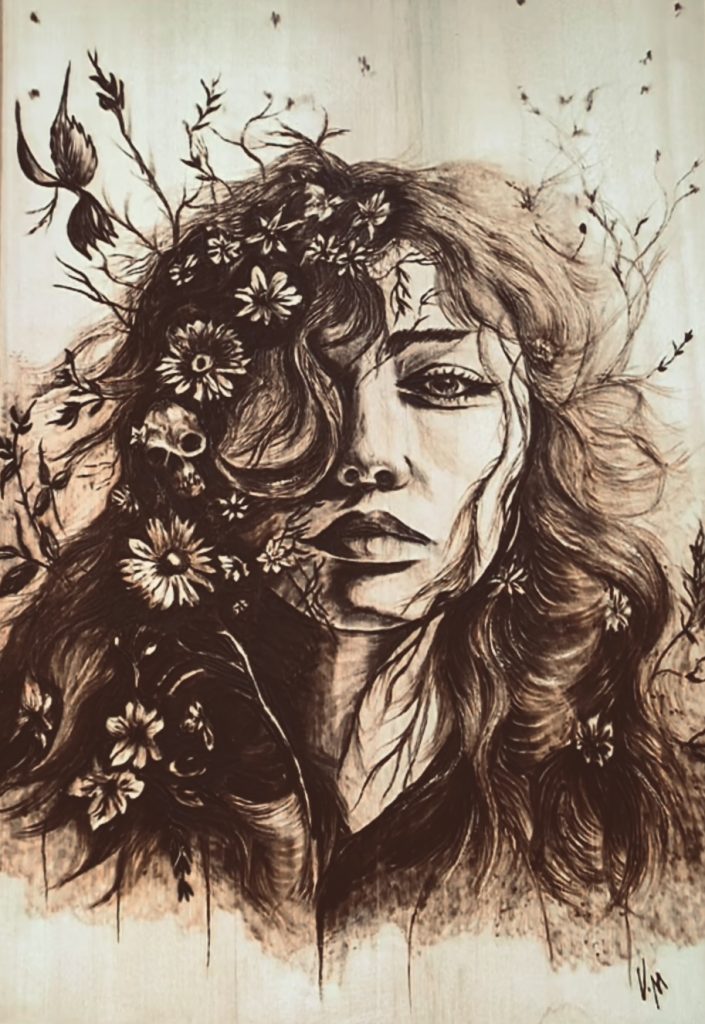
“I’ve always loved blackwork. I love artists who explore that relationship between light and dark,” she says. “This is basically shadow work. You’re using the dark burn and the negative space of the wood to create an image. It’s shading, but you’re burning.”
Many pyrographers favour a lighter touch, creating marks that can resemble antique illustration. Vicki instead pushes the material towards deep blacks and striking tonal contrasts. This is where the Fallen Embers motto – Burn a Little Darker – begins to feel less like a slogan and more like an artistic declaration. Darkness is both her subject and one of the materials from which the image is built.
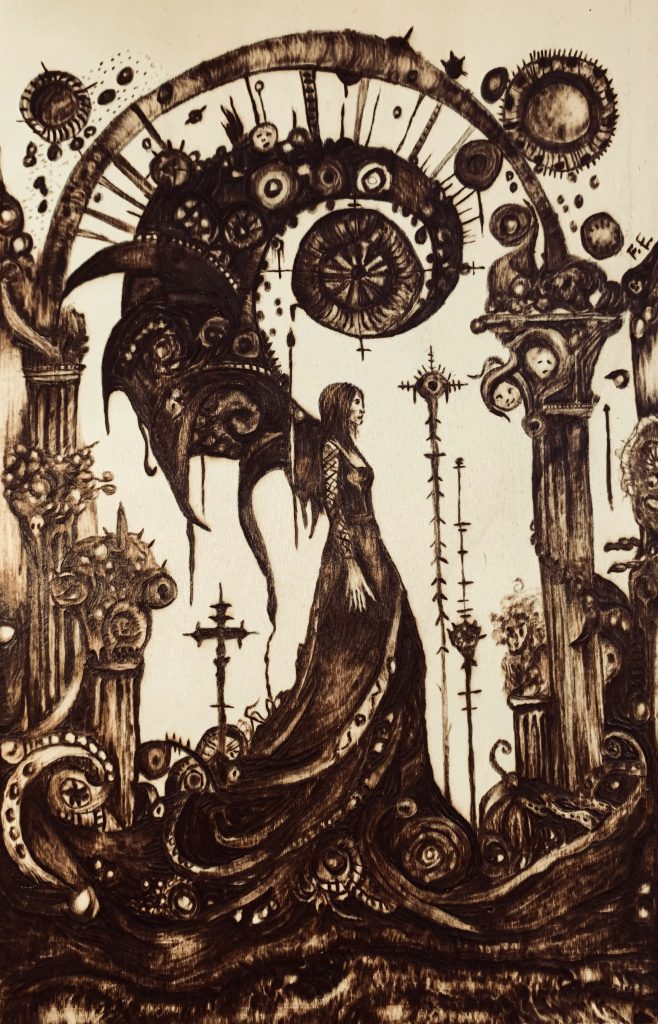
The light in her work matters just as much. Edward Hopper, particularly his use of illumination in Nighthawks, is a significant influence. Vicki admires the way light enters Hopper’s rooms and makes solitude visible. The precision of M.C. Escher and the surreal worlds of Salvador Dalí have also fed into her developing visual language, alongside the densely populated, fantastical paintings of Hieronymus Bosch.
The Life Already Inside the Wood
Vicki’s earliest experiments were made on plywood bought from a craft shop. It was readily available, but she quickly found that it neither burned well nor reflected the kind of work she wanted to make. That discovery led her towards local carpenters, mills and woodworkers, who began supplying offcuts that might otherwise have been discarded.
The circle has continued to widen. People now contact her with stacks of unused wood, eager to see the material transformed rather than wasted. Their generosity has become another layer in the history of the finished piece.
“People are so keen to pass wood on and become part of the story of whatever you’re creating,” Vicki says. “The people become part of the story as well. It’s not just the wood.”
Through experience, she has learned which species best accommodate her fine lines and heavy shadows. Sycamore, beech and limewood provide pale, responsive surfaces that take a burn cleanly and are abundant locally. Oak and pine can be more resistant, their prominent grain making controlled lines difficult.
Even with a suitable piece, however, certainty is impossible. Heat can reveal a weakness or cause the wood to split while she is working. A knot can obstruct a figure – or provide it with an eye.
This constant negotiation is fundamental to Fallen Embers. Vicki is creating upon the wood, but she is also responding to it. The surface resists complete control, forcing her to leave space for accident and redirection. It is this quality that allows a material which has been cut down or cast aside to take on another life.
“You’re taking something that’s very natural and giving it a new lease of life,” she explains. “A piece of wood that has been chopped down and is now dead, and that most people would throw away – you’re giving it a new life.”
Dreams, Myths and Human Traps
Within that revived material, Vicki creates worlds shaped by dreams, folklore and mythology. Growing up, she was drawn to stories from Irish folklore as well as Norse and Greek mythology. Their figures and symbols continue to emerge throughout her work, sometimes directly and sometimes filtered through her own subconscious.
Her Dreamscapes series draws heavily upon dreams and the strange narrative logic they can contain. Realistic faces and bodies meet impossible spaces, shadowed figures and images that seem caught between awakening and sleep. Vicki describes her current interests as moving between realism and surrealism: recognisable forms provide an entrance, before the familiar begins to fracture.
She is particularly interested in developing more compact and densely detailed compositions influenced by Bosch – images crowded with objects, symbolism and fantastical creatures that refuse to make immediate sense. Such complexity would also give her more room to test the dramatic contrast at the centre of her work.
Yet the darkness in Fallen Embers is not only fantastical. It also gives shape to feelings that can be difficult to admit or articulate. The title of The Human Trap series originated in a song that lodged itself in Vicki’s mind. As the phrase repeated, she began thinking about the human condition and the emotional prisons people can construct around themselves.
“It explores the darker side of human emotions – the ones that we don’t really talk about that much, particularly here in Northern Ireland,” she says. “We’re not good at opening up and expressing emotion, or the negative side of emotions.”
Across works such as Paranoia, Sinking Feeling and Not Alone, those internal states become something viewers can encounter outside themselves. Another collection, Silent Architects, considers loss, decay, growth and the rebuilding of the self, while her Norse-inspired work explores destiny, guidance and the strength of women within ancient sagas.
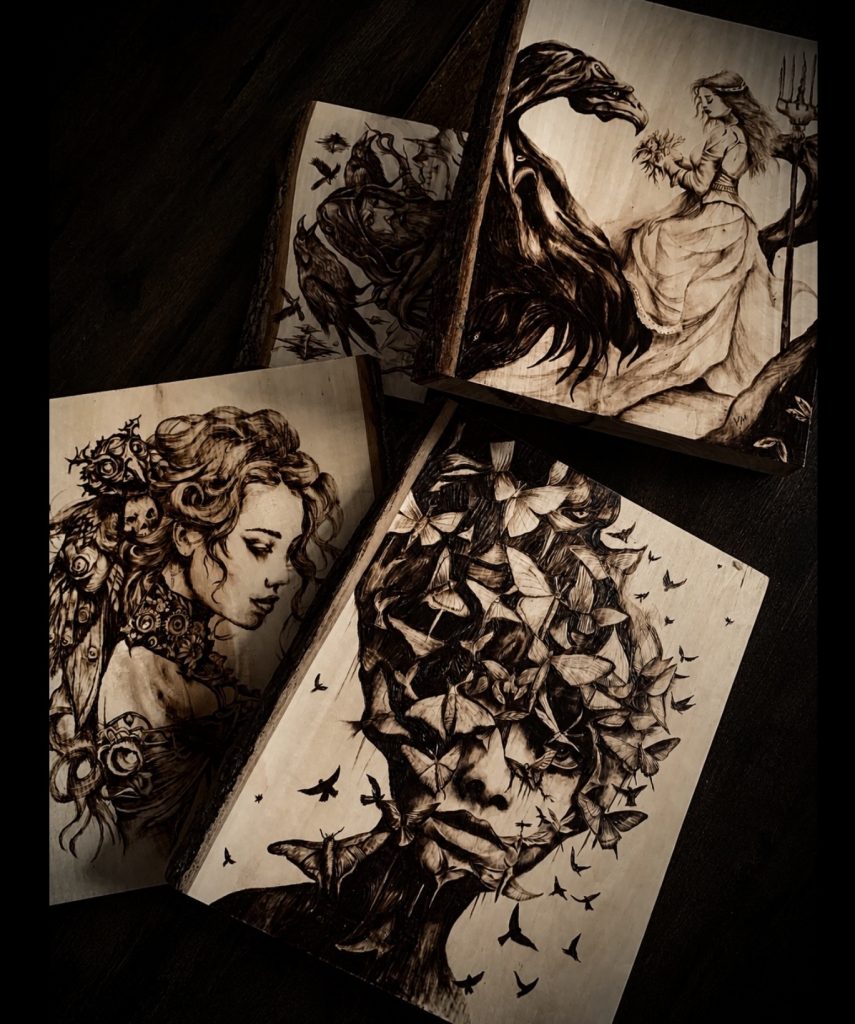
Vicki often works in groups of three because the structure naturally suggests a beginning, middle and end. Although each series begins with her own idea, she does not want to close the work around a single prescribed meaning. Instead, the images offer fragments from which viewers can assemble stories of their own.
An Experience Beyond the Image
That desire for connection extends into the physical experience of Fallen Embers. Wood carries a texture, weight and scent that cannot be reproduced fully on a screen. Vicki wants people encountering the work in person to touch the surface, follow the grain and consider the feelings it brings forward.
Markets are exhausting and logistically difficult – particularly when a small car must carry large slabs of wood – but they offer something social media cannot. Vicki can watch people react, learn which pieces attract them and see the moment someone discovers a detail embedded within a burn. Although she plans to be more selective about events, that direct encounter remains valuable.
She tries to carry the same sensory quality into online orders. Packages are assembled as experiences in themselves and can include a small extra, such as the necklace placed into one recent order, before being finished with a cedarwood scent. Before the artwork is even visible, the recipient is met by the smell of wood.
“The minute you open that package, it’s a sensory overload,” she says. “I want all of it to be an experience.”
Her own home bears the atmosphere of the process, usually smelling somewhere between burned oak and toast. It is a small reminder that these images are not printed or applied: they are made through heat, smoke and time.
Collaboration, Not Commission
Vicki takes the same personal approach to commissioned work, although she does not particularly like to call it that.
“I always think of it as not a commission, but a collaboration,” she explains.
Those who approach her have generally followed Fallen Embers for some time and understand the darkness and detail that define her style. Rather than reproducing a supplied photograph exactly, Vicki wants to learn about the person or story behind it. If the work is a portrait, she asks about the subject’s character, employment, interests and life. These details can then be translated into the final design, allowing the client’s idea to retain the distinct visual identity of Fallen Embers.
This exchange keeps the work from becoming mechanical. A collaboration must belong to the person who requested it, but it must also contain something recognisably Vicki’s. As with the wood itself, the final image emerges from a conversation between two sources rather than one imposing itself upon the other.
Stories on a Larger Scale
Although Fallen Embers began only two years ago, Vicki is already testing the physical limits of her art. She has completed pieces on five-foot planks and transformed live-edge boards into burned tabletops before legs were attached, allowing the image to become part artwork and part furniture. In the future, she would like to explore resin and develop more work on this functional scale.
Her greater ambition, however, is narrative. Vicki imagines a large wall panel capable of carrying an entire myth from one end to the other: perhaps the story of The Odyssey, burned into a long piece of wood like a tapestry or ancient frieze. It would be a labour measured in years rather than months, but it would bring together the ideas already running throughout Fallen Embers – myth, natural material, patient detail and storytelling through sequential images.
“I think that’s what I always want my art to be: telling some sort of story,” she says. “When people look at my work, I want them to build their own little story about it as well.”
For now, one recent piece remains particularly difficult to release: a face from which moths emerge. Vicki sees it as a turning point, the moment when a newly learned skill became visible and the work seemed to step into another stage of its development. She may eventually allow it to leave, but for the moment it stays with her.
The piece captures what is so compelling about Fallen Embers. Transformation happens everywhere: discarded wood receives a new purpose; a mistake becomes part of the composition; an emotion becomes a figure; a knot becomes an eye. Vicki’s work is dark, but never empty. Something is always growing, watching or waiting to emerge from within the grain.
Explore Vicki McCorkell’s original work and commission information through the Fallen Embers Pyrography website:
fallenembers.co.uk
Follow Fallen Embers Pyrography on Facebook:
Fallen-Embers-Pyrography
And keep up with Vicki via Instagram:
@fallenemberspyrography
Support Go Leor. Get the Print. Join the Story.
Go Leor is an independent Irish arts magazine built by hand, heart, and community. Your support keeps meaningful storytelling alive – in print, in culture, and in conversation.
Through Patreon, you can support the magazine in two simple ways:
- Supporter Listing
Have your name printed inside every issue as part of the community helping Go Leor grow. - Print Copy – UK & Ireland
Receive the latest print issue delivered each month across the UK and Ireland, with your name included inside the magazine.
The Latest Articles

Dee Magee: Captivating Jewellery Exploring Identity, Storytelling and Sustainability
From raven-sized lockets and reclaimed silver to animation and community, Dee Magee uses Quirky but Fierce to make room for the ideas that refuse to stay in one lane.

FÉOIL: Powerful Street Art Confronting Trauma, Identity and the Body
From distorted bodies and three-headed wolves, FÉOIL turns experiences that resist easy conversation into images too large, strange and alive to be ignored.

Helen Hancock: Powerful Glass Art Preserving Motherhood, Memory and Loss
Derry artist Helen Hancock transforms breast milk, ashes and other intimate materials into luminous glassworks that preserve stories of motherhood, loss and family.

Greta Baltic: A Powerful Exploration of Lithuanian Identity Through Photography
Lithuanian-born visual artist Greta Baltic uses photography, folklore and collaboration to explore life between cultures – while creating spaces in which other artists can be seen.

Martina O’Connor: Transforming Everyday Memories into Vibrant Art
Martina uses vibrant colour and expressive palette-knife work to preserve treasured memories, familiar objects and the everyday places that have shaped her life.

Seba Brhom: Art, Memory and the Beauty of Being Seen
A Syrian artist and teacher now living in Northern Ireland, Seba Brhom uses drawing, fabric, Arabic lettering and community workshops to share beauty, memory and gratitude.