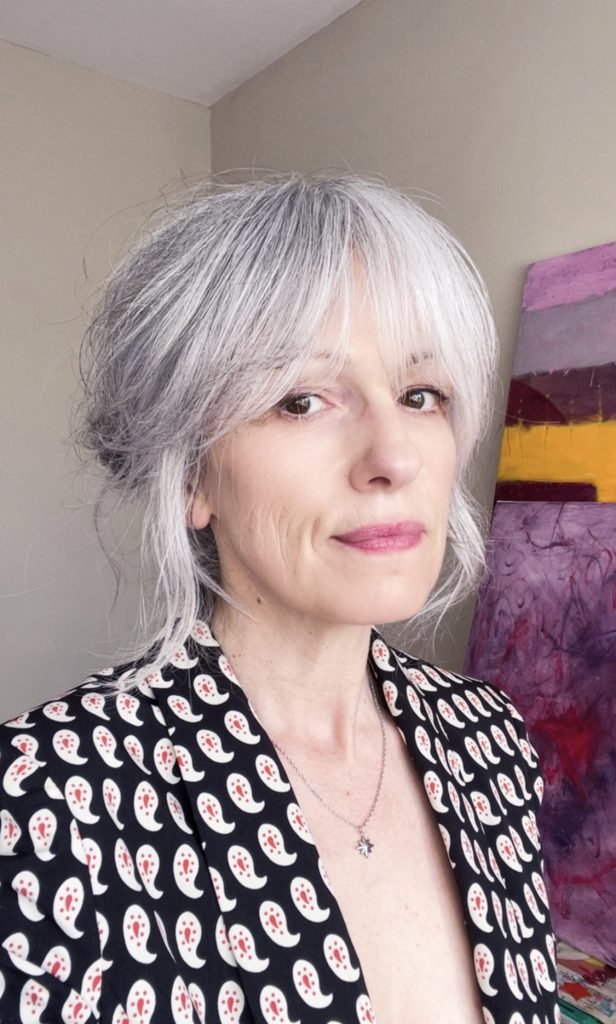
Yvonne Moore

Abstract Artist

Refusing to settle into a single style, Yvonne Moore follows curiosity across colour, poetry and community, creating art that brings her – and those around her – fully to life.

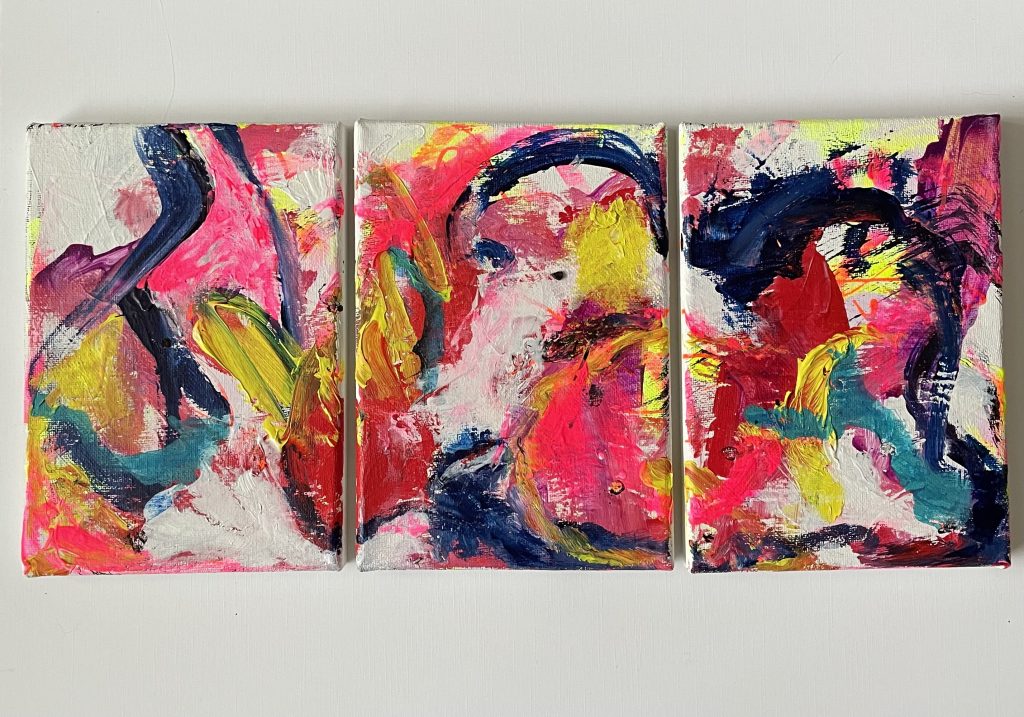
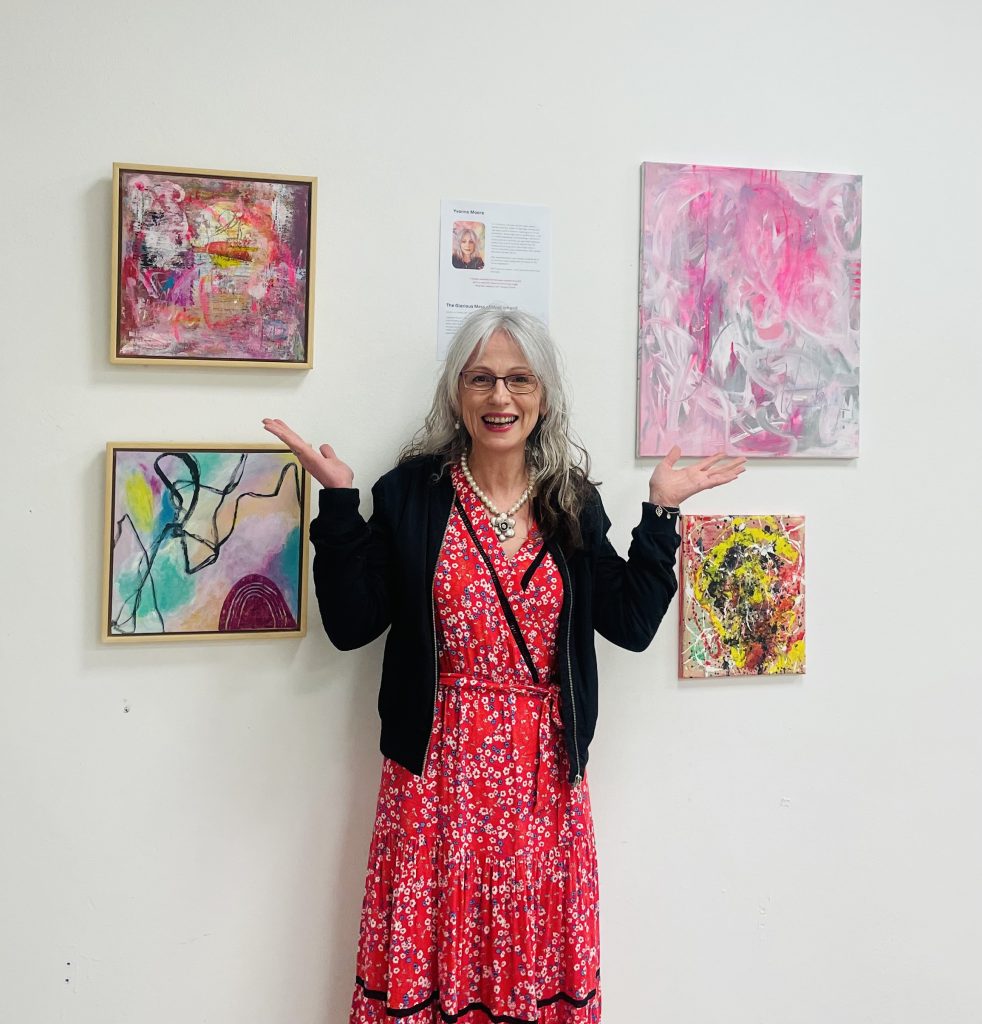
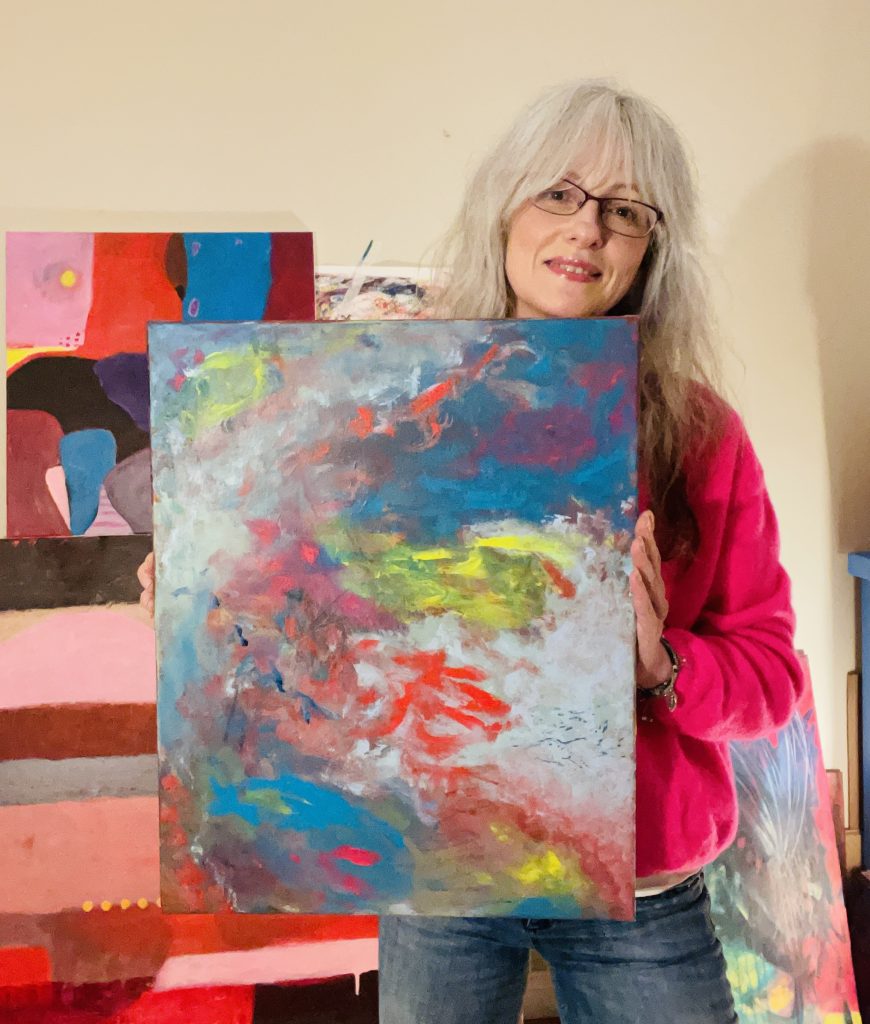
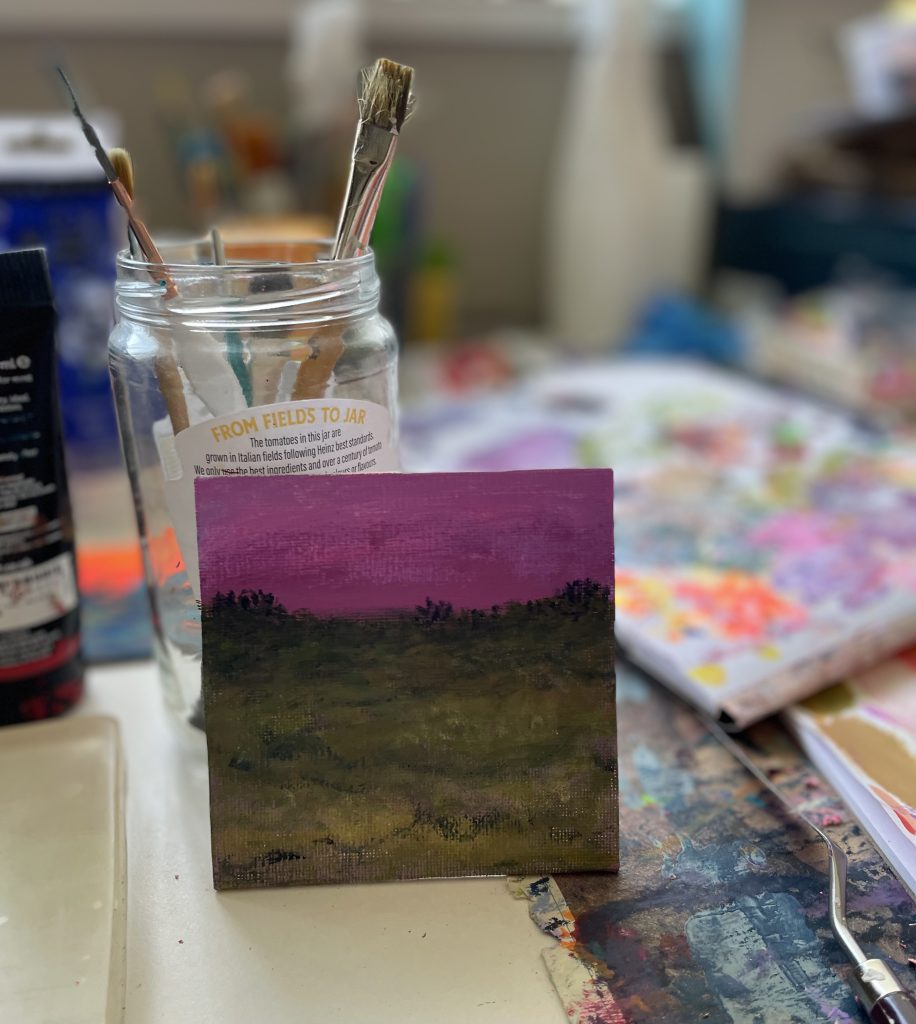
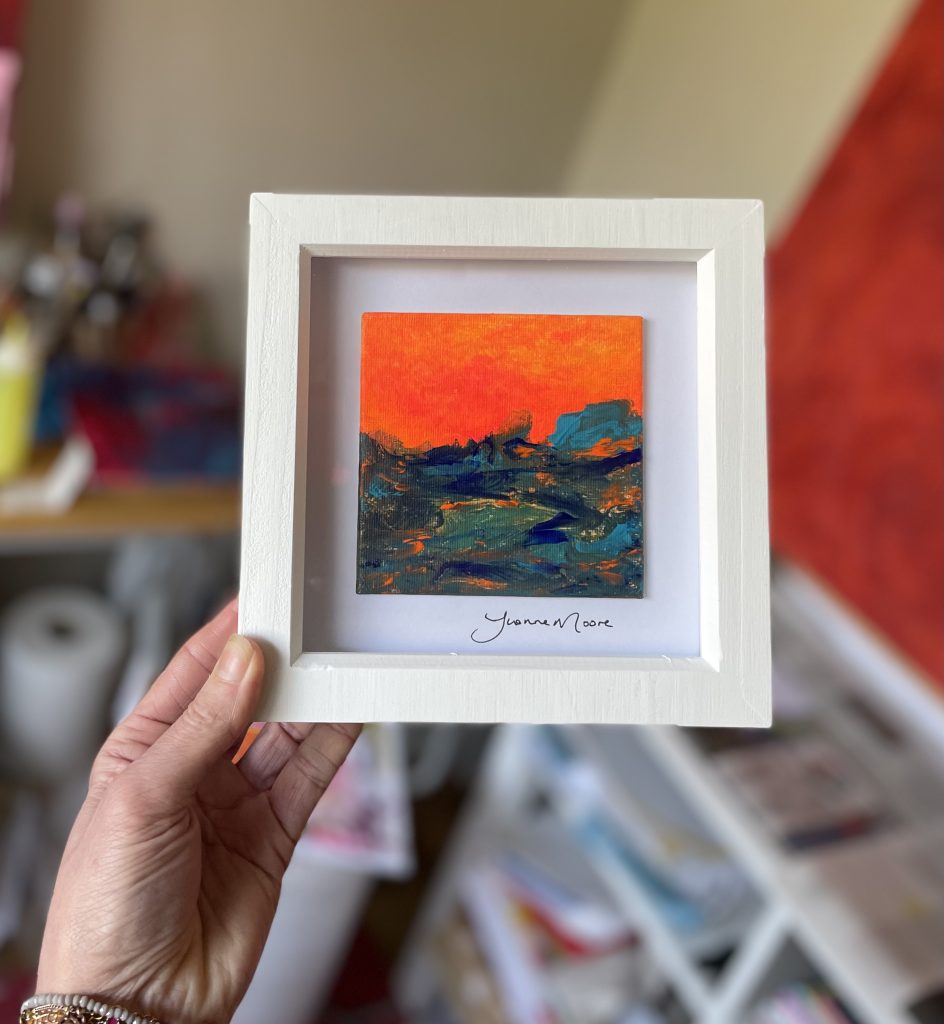
The paintings pictured lining the stairs to Yvonne Moore’s studio do not immediately announce themselves as the work of one artist. Abstract landscapes sit alongside energetic fields of colour, botanical shapes, experiments in texture and pieces made using stencils cut by Yvonne herself. Each seems to contain the remains of a different question.

For an artist, this could be treated as a problem to solve: identify the recognisable elements, refine them and continue until every new work carries a dependable signature. Yvonne has little interest in doing that.

“I am not somebody who you would say has a cohesive body of work,” she says. “And I’m quite happy with that.”

She describes herself plainly as an experimental painter. Self-taught and only a few years into her development, she approaches a canvas with curiosity rather than certainty. One decision prompts another. A colour may suggest a shape; a mark may need to be hidden, repeated or pulled into an entirely different composition.

“My whole modus operandi is experimentation,” she says. “It’s a kind of ‘what if?’ What if I did that mark? What if I used that colour? What if I used that tool? What would happen next if I did this? What if I covered this up?”

Beginning at the Cooker

Yvonne first painted in 2022, four years after her divorce. During those intervening years, much of her attention had been placed upon supporting the emotional wellbeing of her children while rebuilding a different identity for herself.

As her children grew older and needed her less, an unfamiliar space began to open in the evenings. Homework was completed, dinner was finished and they disappeared to see friends or play games. Yvonne was left with a restlessness she could not easily settle.

“I wasn’t in a great place, if I’m honest,” she says. “I was very restless, bored and lonely.”

A video appeared unexpectedly in her Instagram feed showing someone experimenting with acrylic paint pouring. Yvonne was mesmerised by the movement of the paint, the meeting of colours and the blooms that appeared as the surface was manipulated.

Until then, she had never considered herself artistic. She had not spent her childhood drawing or painting and had built her adult life around intellect, learning and professional responsibility. What attracted her to acrylic pouring was the suggestion that it might be a process she could understand.

“It looked like a technique,” she explains. “I thought maybe even somebody who’s not artistic – meaning me – could do that, because it looked like something you could learn. And I’m great at learning things.”

She bought inexpensive acrylic paints and several small canvases. Without a studio or permanent workspace, she cleared the dishes after dinner, spread newspapers across the cooker and began to pour.

It quickly became apparent that the process was not as simple as it appeared online. Colours became muddy when combined incorrectly and many early attempts were washed from the canvas and poured down the sink. The outcomes mattered less than what was happening within Yvonne while she made them.

“I immediately found that I felt alive doing this,” she says. “I was coming from a place where I wasn’t feeling very alive. The restlessness seemed to disappear whenever I was in that space.”

The constant thoughts she describes as “50 tabs open in her brain” became quiet. Painting did not demand that she arrive with the right language or a fully formed idea. It asked only that she begin.

Following What Feels Alive

Acrylic pouring became a gateway rather than a destination. From there, Yvonne began moving between materials, methods and scales, following what she now calls “the breadcrumbs of my delight.”

“If this feels good, I’ll do this,” she says. “Then it’s: what will delight me next?”

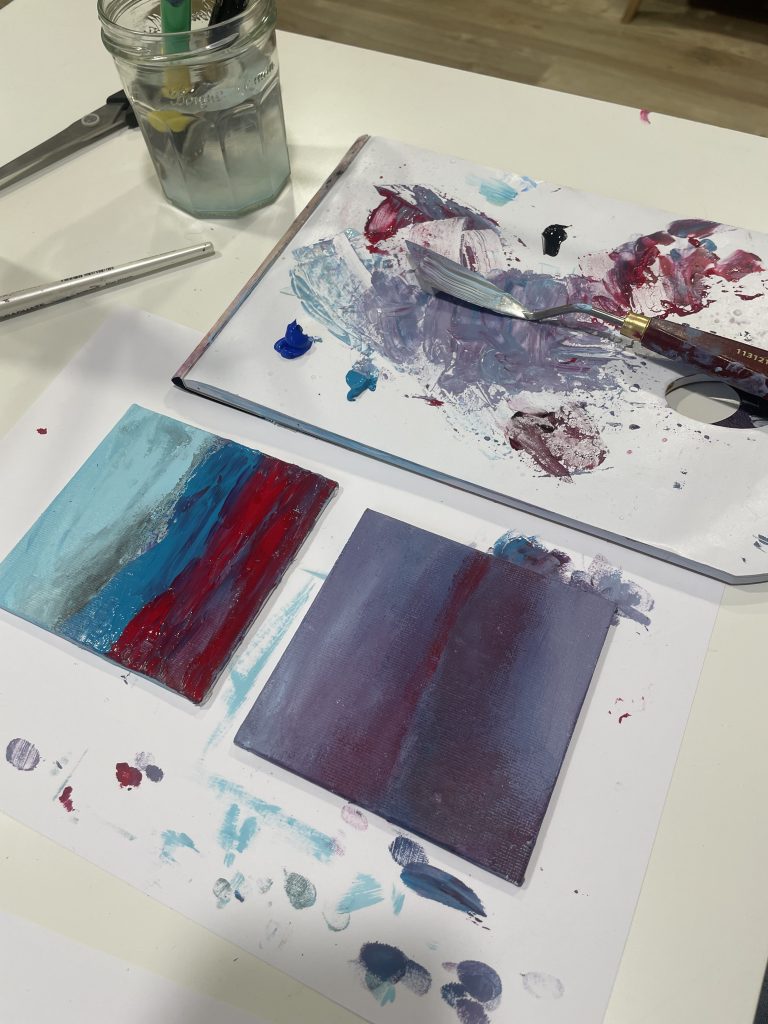
Sometimes that means watercolour, oil pastel or a gel plate. At other times, she creates tiny pieces or works at the largest scale her studio can accommodate. Balloons, string, egg cartons, corks, Nerf pellets, leaves and the netting from a bag of oranges have all become tools. Every object is reconsidered through the mark it might leave.

A recent botanical idea developed into several related paintings after the first brought her the feeling she was seeking. One sold within hours of being shared on LinkedIn, bought by a collector in London who already owned one of her works. Yvonne made two more paintings exploring similar shapes and colours, but even their success does not oblige her to continue indefinitely.

“I’m not sure I’ll do more of those,” she admits. “I might do.”

That freedom contradicts much of the conventional advice given to artists. Yvonne has repeatedly encountered the expectation that she should establish a coherent visual language – something recognisable enough that a viewer could identify one of her paintings without seeing her name.

She understands the commercial reasoning behind it, but the repetition required would leave her bored. Some collectors return precisely because they cannot predict what she will make next, building a relationship with one artist while choosing distinctly different paintings for their homes.

The connection between the works is not a repeated palette or technique. It is the permission Yvonne gives herself to remain curious.

From Intellect to Intuition

Before painting, Yvonne’s appetite for discovery carried her through several industries, including five years as managing director of Galgorm Resort and Spa.

After leaving Galgorm in 2013, she became a business coach and mentor, delivering training around leadership and customer experience. She later moved into parent coaching, studying conscious and mindful approaches to parenting before sharing that knowledge with others.

Whatever the subject, Yvonne immersed herself completely through books, specialists and thousands of hours of podcasts. “Learning is another thing that makes me feel alive,” she says.

When painting began to feel like a possible career, that instinct intensified. Although self-taught, Yvonne’s education has included demonstrations, online classes and time within an art academy. She studied underpainting, layering, texture, composition and tonal values, discovering how much a hidden history can change the surface of a finished work.

Yet as she accumulated knowledge, she noticed herself approaching the canvas through her head rather than her heart.

“I was moving further away from my intuition,” she says. “I was coming to a painting with thoughts of composition and colour values at the beginning, instead of just coming with my curiosity.”

She stepped away from the courses. The knowledge remained, but its role changed. Yvonne now begins intuitively and allows technique to enter when it is needed. If a painting reaches a difficult point, her understanding of composition or value can help her recognise what is not working. Knowledge supports instinct without being permitted to replace it.

The First Painting to Leave

Selling work was not part of Yvonne’s original intention. Painting had begun privately as a way through restlessness, but she was also sharing her development with a substantial network built over many years on LinkedIn.

In August 2025, she posted a painting and asked her connections what it should be called. One person suggested ‘Sold’ before privately asking to buy it.

The excitement was followed by panic. Yvonne had never priced a painting and had no framework for deciding what it might be worth. Once that sale was negotiated, however, another quickly followed. This time, a viewer told Yvonne that one of her paintings had rendered him speechless because it seemed to capture the soul of his late mother.

Although Yvonne begins without a predetermined message, the work can still meet somebody else’s memories with startling precision. It also demonstrated that people were willing to buy her paintings without demanding the consistency she had been told an artist required. The art found its audience before she had written the correct statement or refined herself into a recognisable brand.

Beyond the Artist Statement

Yvonne is naturally suspicious of rules that appear without convincing explanations. She calls herself “the adult who never grew out of asking why,” and her arrival in the art world has given her plenty to question.

The artist statement is one example. In ordinary conversation, she hears artists explain their motivation directly: they paint because they love it, because they cannot stop, because it grounds them or because it is where they feel happiest. Yvonne’s own explanation is similarly clear.

“I paint because it makes me feel alive and because it cures my restlessness.”

Yet artists are frequently expected to translate those instincts into elaborate statements. For Yvonne, there is a contradiction in asking people who paint what they cannot express in words to justify those paintings through words.

“I’m good with words, so I can do that thing,” she says. “But I’ve spoken to artists who say, ‘I’m not good with words. This is why I paint.’”

Her frustration is with the distance created when art is made needlessly exclusive. The same resistance shapes her feelings about formal exhibition openings, where viewer, artist and artwork can become separated by obligation and ceremony. She wants approaching art to feel less intimidating.

An Invitation to Play

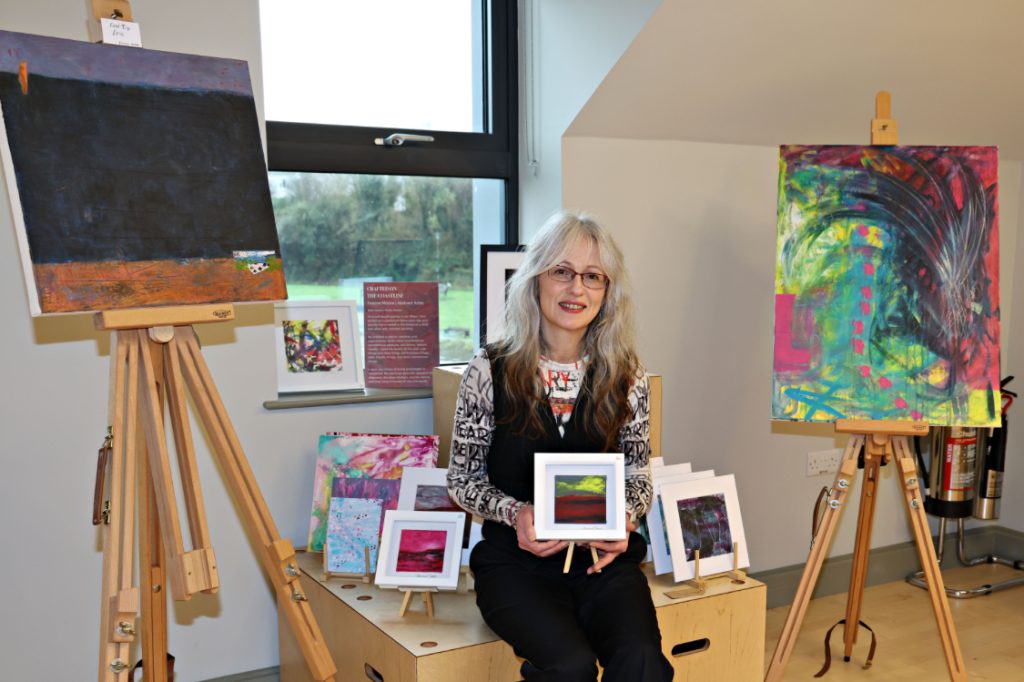
That belief was tested during Yvonne’s recent pop-up residency at The Lab on Belfast’s Lisburn Road. She committed to the exhibition only a few weeks before it opened, preferring to enter the experience quickly and learn through doing rather than spend months anticipating every problem.

“I’m a jump-in-and-learn-while-you’re-doing kind of person,” she says. “I could have taken three months or six months to plan it and put every step in place, but that’s not how I am.”

Across four days, she exhibited paintings, prints, bags, cards, sketches and colour studies, sold work and spoke with visitors. Some elements succeeded; others showed her how advance local promotion and bookable activities might help shape a future event.

The most meaningful element was a decision made almost at the last minute. Yvonne created a “Play Station”: a table where visitors could pick up an oil pastel and add a drawing, doodle or name to a large sheet of paper that she intends to transform into a collage.

The oil pastels proved an ideal choice. For someone experienced in art, they offered rich colour that could be layered and blended. For a visitor with no confidence in drawing, they were simply crayons – familiar objects carried forward from childhood and therefore less frightening to touch.

As people sat with their hands occupied, conversation changed. They were no longer required to stand before a painting and produce an immediate opinion, nor did they need to maintain direct eye contact with the artist. They could make an absent-minded mark and allow their attention to move between the page and the person beside them.

“The way they opened up to me in conversation was very beautiful,” Yvonne says. “This lovely, organic kind of conversation arose out of it.”

Some stayed far longer than they might have if they had simply looked at the paintings and left. One remained for close to an hour.

The experience suggested new possibilities for exhibiting. Yvonne hopes to return to The Lab and develop workshops helping people create their own abstract work, perhaps alongside another residency. The aim would not be only to place finished paintings before an audience, but to let visitors experience some of the curiosity that produced them.

Poetry from Another Place

Words remain an important part of Yvonne’s creative life, although they arrive differently from paintings.

She can enter the studio in an emotionally neutral state, choose a colour and begin working from curiosity. Poetry generally comes during moments of heightened emotion, whether joyful or painful. Rather than being assembled slowly, a poem often arrives almost complete, leaving her hand struggling to keep pace.

Sometimes a finished painting provokes a poem. When the artwork is sold, Yvonne may write the words out by hand and send them to its new owner. She has considered bringing the forms together more formally, perhaps through a book combining reproductions of her paintings with poems and pieces taken from her online reflections.

The process does not work in reverse. Yvonne does not begin with an existing poem and attempt to illustrate it. Painting depends upon not knowing what is waiting to emerge; translating a completed piece of writing into an image would define the destination too early.

Many poems remain unshared, among the open tabs in Yvonne’s mind waiting for the breadcrumb that might lead towards them.

The Art of Connection

Although Instagram introduced Yvonne to acrylic pouring and remains a source of visual inspiration, LinkedIn has become the more important home for her work. It is where she has sold many paintings, developed relationships with collectors and built friendships that have moved beyond the platform.

She values the word “connection.” A response on LinkedIn is more likely to become a comment, a conversation, a Zoom call or an eventual meeting. When someone within her network has an exhibition or project to share, that support is often returned.

“A lot of the people I’m connected with are very creative, and we support each other really beautifully,” she says.

Whether she is arranging an event, inviting someone to draw at an exhibition or sharing an unfinished painting, Yvonne’s instinct is to turn an audience into participants.

The Next Breadcrumb

Opportunities have begun to arrive without Yvonne pursuing them through a conventional strategy. She has been interviewed by The Irish News and invited to take part in an exhibition in Liechtenstein at the end of October. Her participation in an interiors photoshoot fell through due to logistics, but still introduced her to an architect, stylist and photographer working within major interiors publications.

Yvonne learned a great deal from the process, which brought potential future opportunities onto her radar that she might not otherwise have considered.

She believes this is partly a consequence of appearing online as herself rather than following every trend or manufacturing an image to attract opportunities. People respond to the energy, humour and unconstrained curiosity she shares.

“If you show up as yourself, the right people tend to come and find you,” she says. “That is what I have been finding, at least so far.”

Yvonne may never produce the cohesive body of work she has been told to pursue. The paintings might continue changing in colour, scale, surface and method. Poetry may become a book, a Play Station may become a workshop and an exhibition may feel more like an invitation.

Beneath that movement, something consistent is already visible. Every strand begins with the same question – what if? – and continues for as long as it makes Yvonne feel alive.

For someone who began painting on top of the cooker during evenings filled with restlessness, that aliveness is not incidental to the work. It is the reason the work exists.

Explore Yvonne’s original paintings, prints and hand painted tote bags:
yvonnemoore.bigcartel.com
Keep up with her via social media:
@thisisyvonnemoore
And connect with her on LinkedIn:
Yvonne Moore

Support Go Leor. Get the Print. Join the Story.

Go Leor is an independent Irish arts magazine built by hand, heart, and community. Your support keeps meaningful storytelling alive – in print, in culture, and in conversation.

Through Patreon, you can support the magazine in two simple ways:

  • Supporter Listing
    Have your name printed inside every issue as part of the community helping Go Leor grow.
  • Print Copy – UK & Ireland
    Receive the latest print issue delivered each month across the UK and Ireland, with your name included inside the magazine.

The Latest Articles