
Annemarie Mullan
Cré Collective
From articulated clay figures to ambitious group exhibitions, Annemarie brings stories into physical form while helping eight distinct creative voices become stronger together.
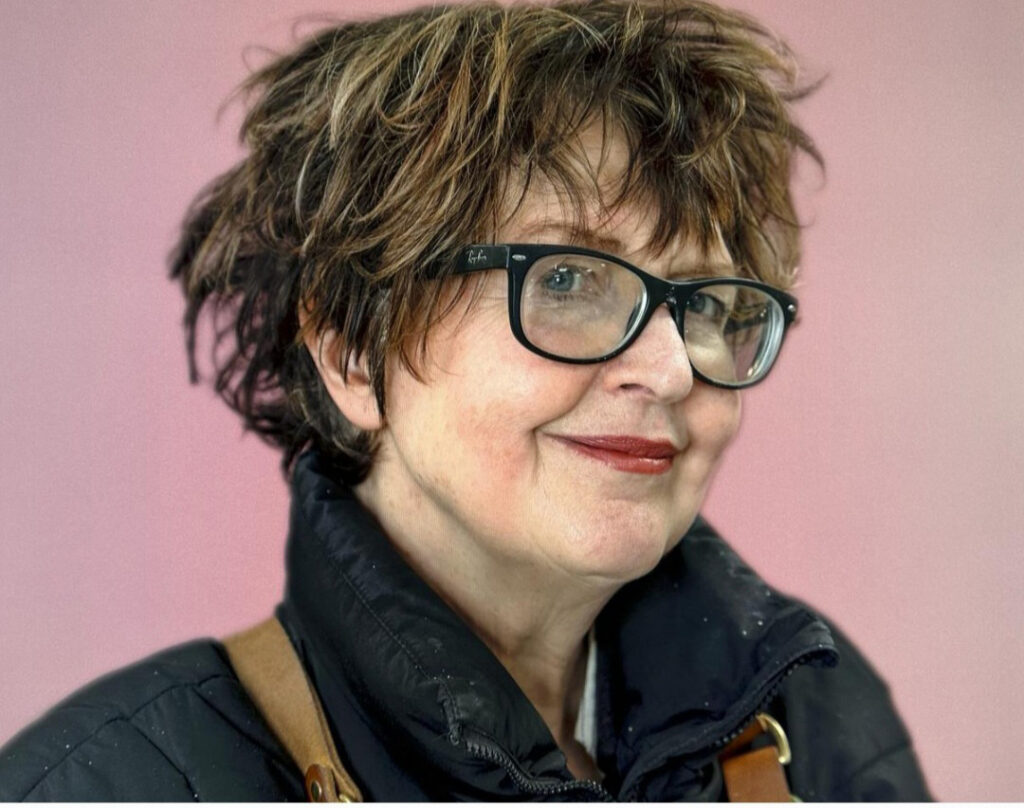
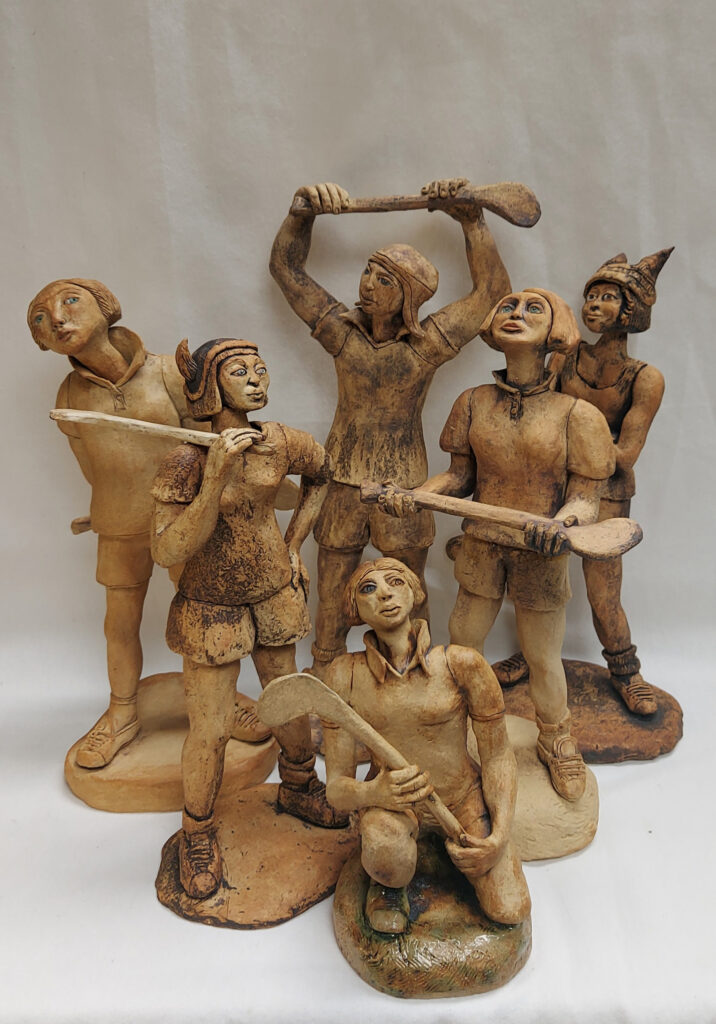
On the table in front of Annemarie Mullan, a camogie player exists in pieces. The legs and base have been built together; the torso will settle above them; the head and neck wait to complete the figure. Wet clay could not support the full weight of the body while drying, but building in sections also gives Annemarie something more interesting than a practical solution. Before the pieces are permanently joined, the figure can tilt, pivot and find her stance.
It is a method carried from Annemarie’s earlier work in puppet animation, where characters were constructed as articulated bodies and expression depended upon the smallest adjustment. In clay, the separation allows her to push a shoulder forward, shift the balance of a torso or give a head an attitude of its own.
“It allows me to do more extreme gestures,” she says.
The camogie players are muscular and physical: women built to take up space rather than becoming delicate ceramic figurines. Annemarie hopes eventually to create an entire team as the Camogie Association, GAA and Ladies Gaelic Football Association move towards integration. The work carries her hope that women’s field sports will receive the profile they deserve, but it also presents her with the pleasure of a sculptural challenge.
“They’re quite Amazonian,” she says. “I kind of like trying to make that kind of woman.”
Movement runs throughout Annemarie’s practice, but it also offers a way of understanding the wider creative structure she has helped to build. Cré Collective brings eight artists together without asking them to surrender the character of their individual work. Each member retains their own voice, materials and interests, but the group can pivot, divide responsibility and take on projects that would be difficult for one artist to carry alone.
Like Annemarie’s figures, the parts remain visible. Their strength comes from how they are joined.
A Figure in Motion
Annemarie works under the name Hand2Maden, creating predominantly female figures whose stories move between mythology, theatre, folklore and ordinary life. Women appear with animal features, masks and elaborate costumes. A Red Riding Hood figure wears the wolf rather than fleeing from it. Another raises her hands until her fingers become a grove of trees. A Valkyrie-like character carries a bird mask, with wire moving around her like a furious herald of a storm.
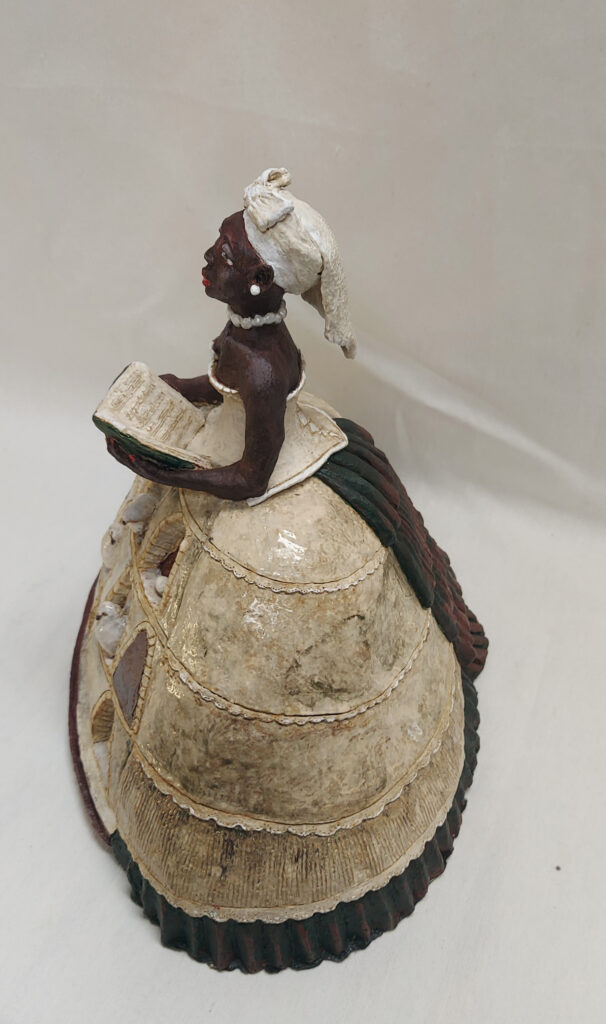
Her large-skirted figures, which she calls Divas, bring Annemarie’s theatre training directly into the body. A dress can become a surface for decoration, but it can also open into a miniature stage: a proscenium containing another character, scene or story. Costume is never simply something placed upon the figure. It becomes part of the architecture through which the figure speaks.
Annemarie initially studied Film and Theatre Design in New York before transferring into a two-year master’s programme in animation at New York University. Before leaving for America, she had worked as an art director in London and built a portfolio through student productions connected with the National Film School and International Film School. At NYU, she built puppets and sets and made two short films that were later shown on PBS.
She studied with animator and animation historian John Canemaker, whose classes emphasised intention, facial expression, gesture and the physical anatomy of humans and animals. The question was not simply how a character looked, but what they intended to do and how the whole body could reveal it.
That education continues each time Annemarie assembles a ceramic figure. Her separately built characters can be posed before they are glued together, while some retain their articulation as a deliberate part of the finished work. She calls these mobile figures her Bobbitys. They make visible the point where ceramic sculpture meets the logic of the puppet: a body is not fixed until its character has been found.
“Sometimes I make a feature of the movement,” she says.
Her fascination with masks carries a similar theatrical inheritance. She is drawn to the prescribed villains, heroines and comic types of commedia, where a mask can announce a personality before a character has spoken. Horns, wolf skins and animal faces allow her human figures to cross into something older and less easily categorised.
Yet Annemarie is equally interested in women recovered from real history. One exhibition piece was inspired by Rachael Baptist, the celebrated Black singer who performed in Dublin’s pleasure gardens during the eighteenth century and built a career across Ireland and Britain.
Annemarie was struck by a Black woman moving through that level of society in the 1750s and by descriptions of the elaborate dresses in which she performed. The story found a natural home in the expansive silhouette of a Diva.
“I loved there being a story behind the women that I tried to capture,” Annemarie says.
Clay as Narrative
After returning to Ireland, Annemarie taught animation through Northern Visions and in schools. As animation became increasingly digital, that line of work grew less viable, but her movement into ceramics was not an attempt to replace something she had lost. Clay had been present throughout her creative life.
Her undergraduate degree was in jewellery and silversmithing, but even then she moved towards sculptural objects and boxes, combining porcelain with cast aluminium, silver, wood and textiles. Some of the tools she made during that degree now serve a new purpose in her ceramic work. Jewellery remains another part of her repertoire, including black-and-white porcelain earrings and hanging ceramic angels joined with wire.
When her children began school, a daytime ceramics class with potter Rory Shearer in Castlereagh gave Annemarie the space to deepen her knowledge of clay, glazes and firing. She later installed her own kiln with support from the Arts Council, studied ceramics at Belfast Metropolitan College and worked with bronze at Millfield Foundry. She would still jump at the chance to work in cast iron or stone.
“I am drawn to tools and materials,” she says. “I love the idea of merging disciplines and mixing media. I don’t really see limits when it comes to the realm of sculpture.”
She speaks with particular affection about clay’s elemental nature. Earth and water allow the object to be formed; air removes its moisture; fire makes that form permanent. Within those apparently simple materials lies an enormous technical world: earthenware, terracotta, porcelain and Parian, paper clay and clay strengthened with different grades of grog or flax fibre.
Experience makes the results more predictable, but never entirely certain. Annemarie refers jokingly to “Schrödinger’s kiln”: until the door opens, a piece seems to exist somewhere between success and disaster. There may be another firing for underglaze or glaze, followed by lustres or decals. Some makers will fire a piece repeatedly in pursuit of the colour they want.
Because Annemarie makes sculpture rather than tableware, she feels no obligation to remain within food-safe ceramic surfaces. Acrylic and oil paint can sit beside glaze, just as wire, wood or textile can enter the finished piece. Clay is not a closed discipline but one material among many.
“I love storytelling,” she says. Annemarie also holds a master’s degree in Creative Writing from Queen’s University’s Seamus Heaney Centre and works as a facilitator with Poetry in Motion, bringing poetry into schools. Her poem Northpaw was recently named runner-up for the 2026 Seamus Heaney Award for New Writing.
For her, writing and sculpture are not separate careers competing for attention. “Clay is just another way for me to continue the narrative.”
Stronger Together
Cré Collective began in a classroom, but the relationships behind it were present from the first day. Annemarie and several other established or developing artists enrolled in a two-year HND in product design at Belfast Metropolitan College, drawn partly by the opportunity to expand their skills and gain access to clay, kilns and equipment.
The group clicked quickly. A WhatsApp chat began almost immediately, carrying questions, images and encouragement beyond the hours of the course. When their tutor asked them to imagine forming a collective and organising an exhibition as a final project, the exercise gave structure to a possibility they had already begun discussing.
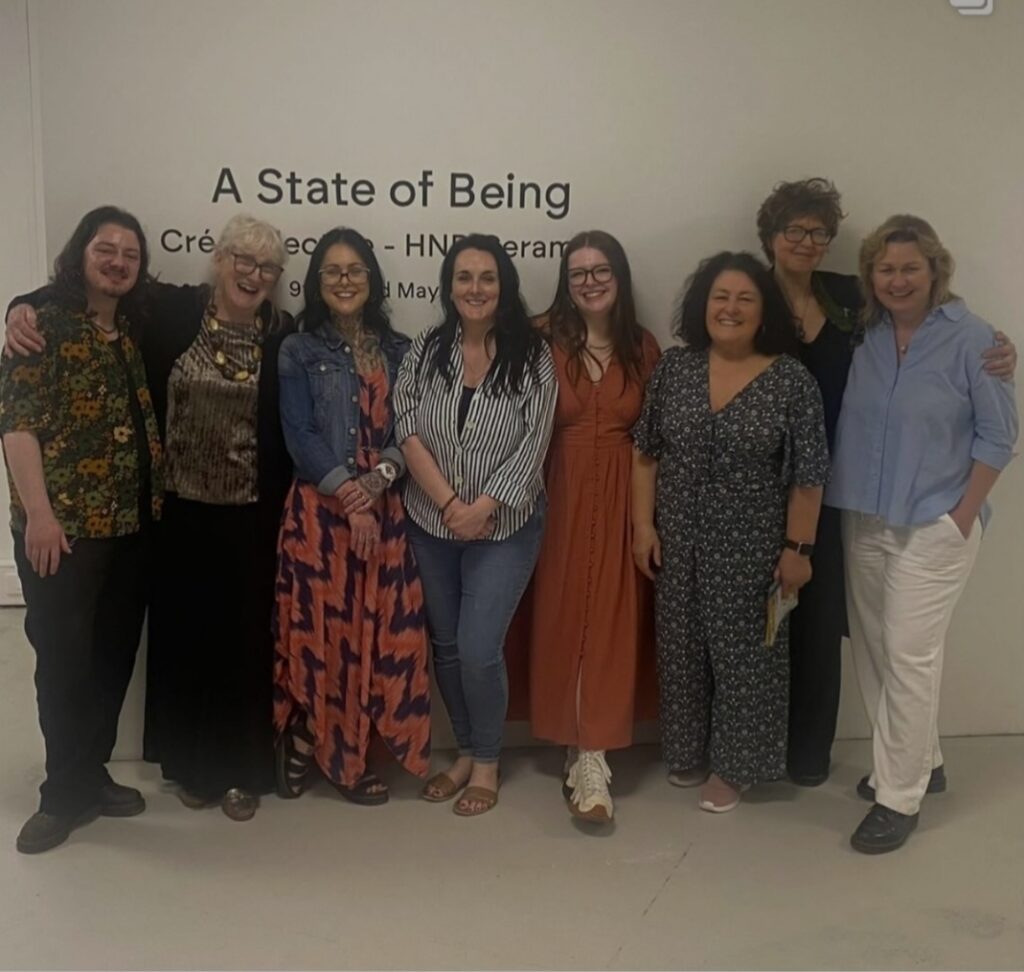
They did not allow the idea to dissolve at graduation. Annemarie, Danielle Morgan, Denise McAuley, Joanna Mules, Margaret Woods, Alec Chambers, Riley Kennedy and Sandra Kerr Gordon became the eight members of Cré. They wrote a constitution, established formal roles and learned the administrative procedures needed to operate as a functioning group, hold an AGM, manage a bank account and apply for funding.
The organisation might sound far removed from the freedom of the studio, but it gives that freedom somewhere to go. Minutes become actions. Skills become roles. Experience accumulated through teaching, committees, marketing, writing or making can be shared rather than repeatedly learned by each person alone.
“Everybody picked it up very quickly,” Annemarie says. “Everyone picked up on procedure and process and stopped arguing, because they realised: here’s the process; here’s what we’re going through to make this happen.”
For artists accustomed to working alone, the collective provides both momentum and accountability. Members share work in progress, respond to one another’s ideas and approach a common exhibition theme through distinct personal narratives. If one person begins producing work at pace, the energy travels through the group.
“We kind of spur each other on instead of that working-in-isolation thing that so often artists have to do,” Annemarie says. “There is a sort of collegiality that’s very comforting.”
The differences between the members are essential. Cré remains clay-heavy, but its artists move through porcelain, metal, print, sculptural installation and other media. A collective exhibition can therefore fill walls as well as plinths and show several ways of thinking through one theme. No individual approach is presented as the group’s house style.
Annemarie compares the structure alternately to Star Trek’s Borg and to a beehive. The first image captures the pleasure of several minds briefly moving towards one aim; the second allows more room for individuality. Each bee has its own task, but the hive can accomplish something none could build alone.
The comparison is playful, yet the effect is concrete. One member can maintain the database, another keep minutes, another develop graphics, while responsibility for sponsorship, press releases, social media, posters and gallery relationships is distributed according to experience. Members proofread one another’s writing and cast what Annemarie calls “a cold eye” over material before it reaches the public.
The benefit is not only efficiency. It is the relief of having someone in your corner who understands the labour involved.
Seisiún
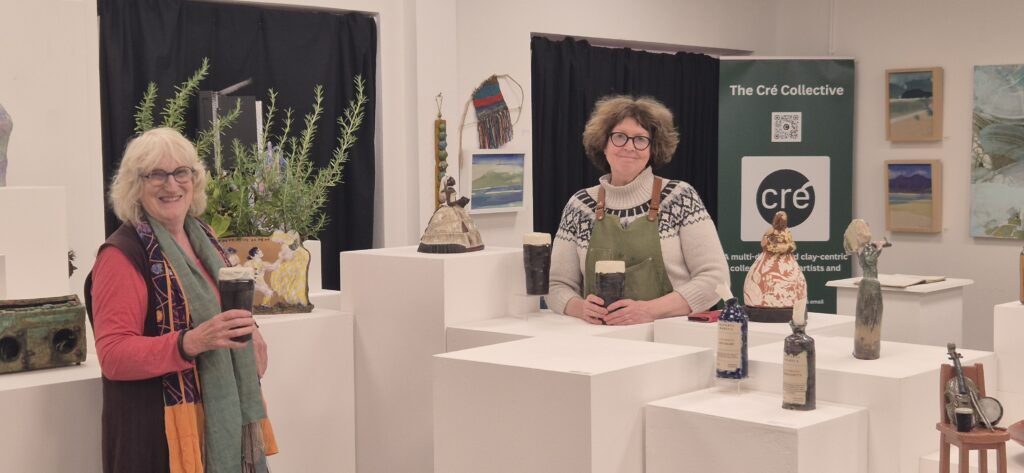
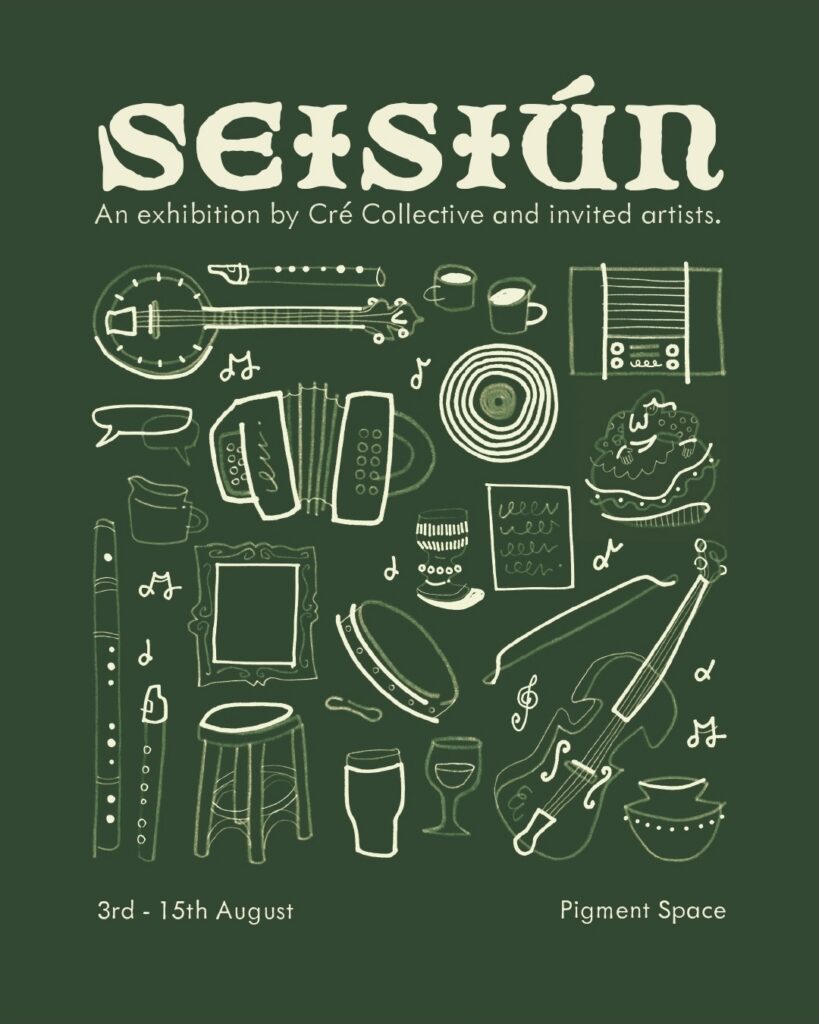
The collective’s ability to move quickly became clear with Seisiún, its sixth exhibition and its first to invite artists from outside the core group. Organised in approximately six weeks, the exhibition took the idea of an Irish session as its starting point, allowing ceramics, sculpture, print and painting to meet music, drawing and poetry.
The group already knew how to assign roles. A suitable venue at Pigment Space was secured close to Annemarie’s home on Belfast’s Ormeau Road. Plinths were sourced and delivered. Artists prepared statements, prices and images instead of leaving galleries to chase the essential information at the last moment. Promotion, installation, sales and staffing became shared tasks.
That foundation allowed the project to grow beyond a conventional group show. Visiting artists were invited to exhibit alongside Cré. Barbara Allen led a live figure-drawing session with tuba player Jonathan Brennan, who also contributed work. Lunchtime poetry readings brought another audience into the gallery, with books displayed on a plinth so that the writers became part of the exhibition rather than entertainment added around its edges.
Annemarie drew upon the relationships formed through her creative-writing studies and Poetry in Motion work to invite poets into the space. The encounter opened further possibilities, including a proposed collaboration with Femina Culpa, a poetry collective whose work examines injustices experienced by women within the nineteenth-century judicial system.
“Ceramics was poetry you could touch,” Annemarie recalls hearing someone say. The phrase stayed with her because it captured the ease with which the two forms met inside the gallery. Sculpture created a setting for language, while poetry encouraged visitors to read the objects differently.
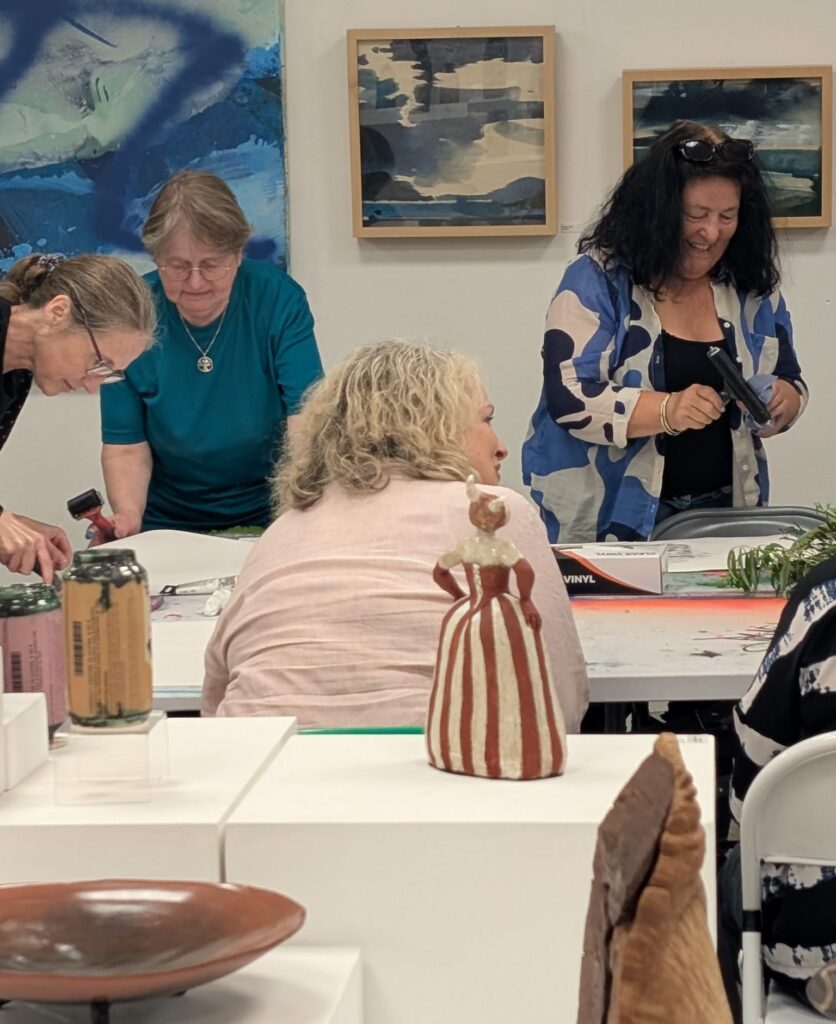
Maintaining that programme required more than making and installing artwork. Cré members took gallery shifts, delivered tours and workshops, organised readings, handled sales, gave interviews, provided refreshments and wrote publicity. For a solo artist, the accumulation could turn an exhibition into a burden. Across eight people, it became manageable.
“That’s a lot of work for one person,” Annemarie says. “But when you’ve got eight people and you can divide out the workload, it becomes more joyful. It’s not as onerous.”
Seisiún launched to a packed gallery. Its success was not accidental and did not depend upon one member quietly carrying the rest. It grew from the procedures, trust and shared vocabulary established over several years. The collective now has a protocol it can refine for future exhibitions and collaborations.
More Than a Group Show
Cré’s value extends beyond the practical matter of getting work onto walls and plinths. Each exhibition adds to the members’ individual profiles while also building a collective record that can support funding applications and conversations with galleries. An institution is not being asked to take a chance on one isolated proposal, but offered a curated body of work, a functioning organisational structure and a group capable of delivering the administrative side of a show.
“We can come in with artists’ statements and prices,” Annemarie says. “We’re not helpless.”
That confidence also changes who the group can approach. A collaboration is backed by eight sets of skills, achievements and connections. Other artists can be invited into individual exhibitions as associates, allowing the circle to expand without destabilising a core group that has taken time to learn how to work together.
Cré has received many requests from people interested in joining, but Annemarie is protective of its balance. Groups must form, test themselves and establish trust. One new member can improve the dynamic, but can also change it completely. Inviting associate artists into particular projects offers a gentler route: relationships can develop through actual shared work before the central structure changes.
The collective is now considering future exhibitions, further collaborations and an eventual online shop connected to its social-media presence, through which the members could sell individual work. Annemarie also hopes to develop another Seisiún, building upon the mixture of visual art, workshops, music and poetry established by the first.
Around the Ormeau Road, potential partners and spaces form a small cultural geography. The Commons community hub, Pigment Space and the Errigle sit within walking distance of one another. Rather than asking audiences to choose between isolated events, Annemarie imagines several reasons for people to move through the area: an exhibition, a reading, a workshop or a performance reinforcing the others.
This outward-looking energy does not erase the quieter reality of making. Annemarie still spends hours alone forming bodies in sections, testing how a mask changes a face or wondering what will emerge from the kiln. Each member of Cré must still return to their own materials and make the work only they can make.
What changes is what happens around that solitude. An image can be sent to the group. A theme can gather eight responses. An artist statement can be proofread by someone who understands why it matters. A project that would exhaust one person can be divided until it becomes joyful.
On Annemarie’s table, the camogie player’s separate parts wait to become a body. The final gesture will depend upon the relationship between them: where the torso leans, how the head turns and whether the whole figure seems ready to move. Cré works through a similar balance. Its members do not disappear into the collective. They lend one another weight, movement and possibility.
Together, they are able to stand differently.
Keep up with Annemarie via social media: @hand2maden
And to explore the work of all eight members and find details of upcoming Cré Collective exhibitions and projects, follow: @crecollectiveni


Support Go Leor. Get the Print. Join the Story.
Go Leor is an independent Irish arts magazine built by hand, heart, and community. Your support keeps meaningful storytelling alive – in print, in culture, and in conversation.
Through Patreon, you can support the magazine in two simple ways:
- Supporter Listing
Have your name printed inside every issue as part of the community helping Go Leor grow. - Print Copy – UK & Ireland
Receive the latest print issue delivered each month across the UK and Ireland, with your name included inside the magazine.
The Latest Articles

Grace McMurray: Stitching Memory and Identity
Through knitting, embroidery, drawing and costume, Grace McMurray makes work that carries personal histories, shared enthusiasms and the value of time spent creating.
Caroline Murphy: Colour, Pattern and Possibility
Working under the name Pansy Soup, Belfast artist Caroline Murphy brings together colour, found materials and a willingness to see where an idea leads.
Critter: Strange Creatures and Creative Freedom
Through goblins, cartoon villains and a growing world of strange creatures, Belfast artist Critter is finding the freedom to make what he wants and enjoy making it.
Curly Bap: Making Art for Others and Herself
From animal portraits to experiments with paper, textiles and clay, Curly Bap is finding her next direction through the people, places and creative possibilities around her.
Noodle: Familiar Faces and an Eye for Light
Portraiture, playful references and a fascination with light shape Noodle’s paintings, as the Scottish artist explores new subjects and larger surfaces from her studio in Bangor.
Maria Noonan-McDermott: Where Memory Becomes Art
Transforming intimate family memories into paintings and poetry, her work invites others to recognise stories of their own.